×
Request Free Sample ×

Kindly complete the form below to receive a free sample of this Report

* Please use a valid business email

Leading companies partner with us for data-driven Insights

clients tt-cursor
Hero Background

Japan Smart Commute Market

ID: MRFR/ICT/60264-HCR
200 Pages
Aarti Dhapte
February 2026

Japan Smart Commute Market Research Report By Mode of Transportation (Bicycles, Electric Scooters, Carpooling Services, Public Transportation, Walking), By Technology (Mobile Applications, Smart Traffic Management Systems, IoT Devices, Navigation Systems), By User Type (Individual Commuters, Corporate Employees, Students, Tourists) and By Service Type (Ride-Hailing, Bike-Sharing, Car-Sharing, Public Transport Enhancement)- Forecast to 2035

Share:
Download PDF ×

We do not share your information with anyone. However, we may send you emails based on your report interest from time to time. You may contact us at any time to opt-out.

Japan Smart Commute Market Infographic
Purchase Options

Japan Smart Commute Market Summary

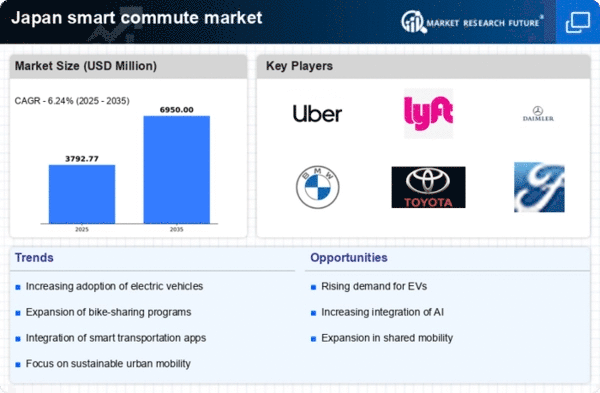
As per Market Research Future analysis, the Japan Smart Commute Market size was estimated at 3570.0 USD Million in 2024. The Smart Commute market is projected to grow from 3792.77 USD Million in 2025 to 6950.0 USD Million by 2035, exhibiting a compound annual growth rate (CAGR) of 6.2% during the forecast period 2025 - 2035

Key Market Trends & Highlights

The Japan smart commute market is experiencing a transformative shift towards integrated and sustainable transportation solutions.

  • The integration of smart technologies is reshaping the commuting landscape in Japan, enhancing efficiency and user experience.
  • Sustainability initiatives are gaining traction, reflecting a growing commitment to environmentally friendly transportation options.
  • Collaboration between public and private sectors is fostering innovative mobility solutions, particularly in urban areas.
  • Technological advancements in transportation and government initiatives are driving the market, particularly in the largest segment of urban mobility.

Market Size & Forecast

2024 Market Size 3570.0 (USD Million)
2035 Market Size 6950.0 (USD Million)
CAGR (2025 - 2035) 6.24%

Major Players

Uber Technologies Inc (US), Lyft Inc (US), Daimler AG (DE), BMW AG (DE), Toyota Motor Corporation (JP), Ford Motor Company (US), Volkswagen AG (DE), Grab Holdings Limited (SG), Ola Cabs (IN)

Our Impact
Enabled $4.3B Revenue Impact for Fortune 500 and Leading Multinationals
Partnering with 2000+ Global Organizations Each Year
30K+ Citations by Top-Tier Firms in the Industry

Japan Smart Commute Market Trends

The Japan Smart Commute Market is experiencing notable transformations, driven by advancements in technology and a growing emphasis on sustainability. In Japan, urbanization continues to escalate, leading to increased congestion in metropolitan areas. Consequently, there is a rising demand for innovative commuting solutions that enhance efficiency and reduce environmental impact. The integration of smart technologies, such as mobile applications and real-time data analytics, is reshaping how individuals navigate their daily travel. This shift not only improves user experience but also promotes a more sustainable approach to transportation. Moreover, the government is actively supporting initiatives aimed at modernizing public transport systems. Investments in infrastructure and the promotion of electric vehicles are becoming more prevalent. This aligns with broader environmental goals, as Japan seeks to reduce carbon emissions and promote greener commuting options. The smart commute market is thus positioned for growth, as stakeholders recognize the importance of adapting to changing consumer preferences and technological advancements. As the landscape evolves, collaboration among public and private sectors will likely play a crucial role in shaping the future of commuting in urban areas.

Integration of Smart Technologies

The incorporation of smart technologies is revolutionizing the commuting experience. Mobile applications that provide real-time updates on public transport schedules and traffic conditions are becoming increasingly popular. This trend enhances user convenience and encourages the use of public transport, thereby reducing reliance on personal vehicles.

Sustainability Initiatives

There is a growing focus on sustainability within the smart commute market. Efforts to promote electric vehicles and improve public transport infrastructure are gaining traction. These initiatives aim to lower carbon emissions and foster environmentally friendly commuting practices, aligning with national goals for a greener future.

Collaboration Between Sectors

Collaboration between public and private sectors is emerging as a key trend. Partnerships are being formed to develop innovative solutions that address commuting challenges. This cooperative approach is expected to enhance service delivery and create a more integrated transportation network.

Japan Smart Commute Market Drivers

Integration of Mobility Services

The integration of various mobility services is emerging as a key driver in the smart commute market. In Japan, the convergence of ride-sharing, public transport, and micro-mobility options is creating a seamless commuting experience for users. This trend is facilitated by advancements in mobile technology, allowing commuters to access multiple transport modes through a single platform. Recent data indicates that the usage of integrated mobility apps has increased by 20% in urban areas, highlighting a shift towards more flexible commuting solutions. As consumers seek convenience and efficiency, the smart commute market is likely to benefit from this integration, fostering collaboration among transport providers and enhancing overall service delivery.

Government Initiatives and Policies

Government initiatives play a crucial role in shaping the smart commute market in Japan. The Japanese government has been actively promoting policies aimed at reducing traffic congestion and enhancing public transportation systems. For example, the implementation of subsidies for electric vehicles and investments in smart infrastructure are part of a broader strategy to encourage sustainable commuting. Recent reports indicate that government funding for smart transport projects has increased by 30% in the last year, reflecting a commitment to innovation in this sector. These initiatives not only support the development of the smart commute market but also align with Japan's goals for environmental sustainability and urban mobility. As such, government actions are likely to continue influencing market dynamics significantly.

Urbanization and Population Density

Japan's ongoing urbanization and high population density are pivotal drivers of the smart commute market. With over 90% of the population residing in urban areas, the demand for efficient and sustainable commuting solutions is paramount. The concentration of people in cities like Tokyo and Osaka creates unique challenges, such as traffic congestion and pollution. Consequently, there is a growing need for smart commuting options that can alleviate these issues. Data suggests that urban areas are expected to see a 15% increase in public transport usage over the next decade, which could further stimulate the smart commute market. This trend indicates a shift towards integrated transport solutions that cater to the needs of densely populated regions, thereby enhancing the overall commuting experience.

Environmental Concerns and Sustainability

Environmental concerns are increasingly influencing the smart commute market in Japan. As awareness of climate change and pollution rises, there is a growing demand for sustainable commuting options. The Japanese government has set ambitious targets to reduce greenhouse gas emissions, which has led to a push for electric vehicles and public transport enhancements. Recent statistics reveal that the market for electric vehicles is projected to grow by 40% in the next five years, reflecting a shift towards greener alternatives. This trend is likely to drive innovation within the smart commute market, as companies seek to develop eco-friendly solutions that align with consumer preferences. The emphasis on sustainability is expected to reshape commuting habits, making it a critical driver of market growth.

Technological Advancements in Transportation

The smart commute market in Japan is experiencing a surge due to rapid technological advancements in transportation. Innovations such as autonomous vehicles, real-time traffic monitoring systems, and mobile applications for route optimization are transforming the commuting experience. For instance, the integration of AI and IoT technologies is enhancing the efficiency of public transport systems, making them more user-friendly. According to recent data, the adoption of smart transportation solutions is projected to increase by 25% over the next five years. This growth is likely to drive investments in infrastructure and technology, further propelling the smart commute market. As urban areas become more congested, the demand for these advanced solutions is expected to rise, indicating a robust future for the smart commute market in Japan.


Market Segment Insights

By Mode of Transportation: Public Transportation (Largest) vs. Electric Scooters (Fastest-Growing)

In the Japan smart commute market, Public Transportation holds a significant market share, driven by its extensive network and affordability. Bicycles and Walking follow as popular choices for short distances, while Carpooling Services are gaining traction for their convenience. However, Electric Scooters are emerging as a popular alternative, especially among younger commuters, indicating a shift toward more flexible and eco-friendly options. Recent trends show an increasing demand for Electric Scooters, attributed to advancements in battery technology and rising environmental consciousness among consumers. Public Transportation remains dominant due to urbanization and infrastructure development, yet the trend toward micro-mobility solutions indicates a dynamic shift in commuting preferences. The focus on convenience and sustainability continues to drive growth across these segments.

Public Transportation (Dominant) vs. Electric Scooters (Emerging)

Public Transportation is the dominant mode in the Japan smart commute market, recognized for its efficiency and established infrastructure, making it accessible to the masses. Meanwhile, Electric Scooters are emerging rapidly, appealing to consumers seeking convenient and eco-friendly mobility solutions. Public Transportation covers vast urban areas with integrated systems, while Electric Scooters cater to shorter distances, providing flexibility in routes. Both options reflect a growing trend toward sustainability; however, the emergence of Electric Scooters signifies a transition toward innovative solutions appealing to tech-savvy and environmentally-aware commuters. As urban landscapes evolve, these modes will continue to coexist, each serving distinct market needs.

By Technology: Mobile Applications (Largest) vs. Smart Traffic Management Systems (Fastest-Growing)

In the Japan smart commute market, Mobile Applications hold the largest market share, driven by an increasing reliance on smartphones for transportation solutions. Smart Traffic Management Systems, on the other hand, are witnessing rapid growth as cities adopt advanced technologies to optimize traffic flow and reduce congestion. IoT Devices and Navigation Systems also contribute to the market, but their shares are relatively smaller compared to the leading segments. Growth trends indicate that Mobile Applications will continue to dominate as user preferences shift towards convenience and real-time updates. Meanwhile, the demand for Smart Traffic Management Systems is fueled by urbanization and the need for smarter city infrastructure. IoT Devices are emerging as enablers for comprehensive smart commuting solutions, while Navigation Systems adapt to enhance user experience in varying travel environments.

Mobile Applications (Dominant) vs. Smart Traffic Management Systems (Emerging)

Mobile Applications are characterized by their user-friendly interfaces, offering features such as real-time tracking, multiple transport options, and integration with payment systems. They are a dominant force in the Japan smart commute market, providing solutions that align with the fast-paced lifestyles of urban commuters. In contrast, Smart Traffic Management Systems focus on leveraging data and analytics to improve overall traffic efficiency. These systems are emerging as vital components of smart city initiatives, supporting better traffic control and flow management, which ultimately enhances commuter experience. Both segments demonstrate unique strengths, with Mobile Applications facilitating user interaction and Smart Traffic Management Systems enhancing infrastructure efficiency.

By User Type: Individual Commuters (Largest) vs. Corporate Employees (Fastest-Growing)

In the Japan smart commute market, the distribution of the user type segment reveals that individual commuters constitute the largest segment. This group benefits from the convenience of flexible commuting options tailored to their specific needs. Meanwhile, corporate employees are gaining ground rapidly, driven by initiatives from companies to promote sustainable transport solutions. The growth trends show that individual commuters prefer options that offer convenience and efficiency. Additionally, corporate employees are increasingly encouraged to adopt smart commuting practices, influenced by corporate policies aimed at reducing their carbon footprint. The influx of students and tourists also contributes positively to the market, but the focus on corporate responsibility is accelerating the growth of the corporate segment.

Individual Commuters: Dominant vs. Corporate Employees: Emerging

Individual commuters represent a dominant force in the Japan smart commute market, predominantly leveraging personal transportation solutions that offer autonomy and flexibility. Their preferences are shaped by the dense urban environment where efficiency is critical. On the other hand, corporate employees, as the emerging segment, are experiencing significant growth due to businesses promoting smart commuting practices. This shift is largely a result of companies implementing eco-friendly policies and incentive programs, fostering an environment where employees are more inclined to opt for shared or sustainable transport options, thus transforming the commuting landscape in Japan.

By Service Type: Ride-Hailing (Largest) vs. Bike-Sharing (Fastest-Growing)

In the Japan smart commute market, the Ride-Hailing segment holds the largest market share, driven by the convenience and accessibility it offers to users. The rising smartphone penetration and urbanization in major cities further contribute to its dominance, enabling consumers to opt for real-time ride hailing services over traditional transportation methods. Meanwhile, Bike-Sharing is gaining significant traction, positioned as the fastest-growing segment due to increasing environmental awareness and government initiatives that promote sustainable transport solutions. The growth trends in these segments indicate a shift towards more flexible and eco-friendly travel options. The surge in demand for Bike-Sharing aligns with Japan's push for greener cities and healthier lifestyles, while Ride-Hailing continues to expand as technology and service integrations improve user experience. Factors such as partnerships between tech firms and transportation services will likely fuel further growth across these categories, making them essential components of the future transport landscape.

Ride-Hailing (Dominant) vs. Bike-Sharing (Emerging)

Ride-Hailing is currently the dominant service type, characterized by its convenience, user-friendly apps, and extensive network of drivers making it a preferred choice for urban commuters in Japan. Its robust infrastructure supports on-demand services that cater to the fast-paced lifestyle of city dwellers. In contrast, Bike-Sharing is an emerging segment that is increasingly popular among eco-conscious consumers and urban planners. This service type provides flexible mobility solutions, allowing users to rent bikes for short periods, contributing positively to congestion and pollution reduction efforts. The strong support from local governments and innovative pricing structures are enabling Bike-Sharing to capture a growing share of the smart commute market.

Get more detailed insights about Japan Smart Commute Market

Key Players and Competitive Insights

The smart commute market in Japan is characterized by a dynamic competitive landscape, driven by technological advancements and evolving consumer preferences. Key players such as Toyota Motor Corporation (Japan), Uber Technologies Inc (US), and Daimler AG (DE) are actively shaping the market through strategic initiatives. Toyota, with its focus on sustainable mobility solutions, is investing heavily in electric vehicle (EV) technology and autonomous driving systems. Meanwhile, Uber is enhancing its ride-sharing platform by integrating AI-driven features to improve user experience and operational efficiency. Daimler, on the other hand, is pursuing partnerships with local tech firms to bolster its digital transformation efforts, thereby enhancing its service offerings in the smart commute sector. Collectively, these strategies indicate a shift towards innovation and sustainability, which are becoming essential components of competitive differentiation in the market.In terms of business tactics, companies are increasingly localizing their operations to better cater to regional demands. For instance, supply chain optimization is a critical focus, as firms seek to reduce costs and improve service delivery. The competitive structure of the market appears moderately fragmented, with several players vying for market share. However, the influence of major companies like Toyota and Uber is substantial, as they leverage their resources and technological capabilities to establish a strong foothold in the market.

In October Toyota Motor Corporation (Japan) announced a partnership with a leading Japanese tech firm to develop advanced AI systems for its autonomous vehicles. This strategic move is likely to enhance Toyota's competitive edge by integrating cutting-edge technology into its product offerings, thereby aligning with the growing consumer demand for smart mobility solutions. The collaboration may also facilitate faster innovation cycles, allowing Toyota to respond more effectively to market changes.

In September Uber Technologies Inc (US) launched a new feature that utilizes machine learning algorithms to optimize ride-sharing routes in real-time. This initiative is significant as it not only improves operational efficiency but also enhances customer satisfaction by reducing wait times. By leveraging AI, Uber is positioning itself as a leader in the smart commute market, potentially attracting more users and increasing its market share.

In August Daimler AG (DE) expanded its electric vehicle offerings in Japan, introducing a new line of EVs specifically designed for urban commuting. This expansion reflects Daimler's commitment to sustainability and its strategic focus on meeting the growing demand for eco-friendly transportation options. By diversifying its product portfolio, Daimler is likely to strengthen its market presence and appeal to environmentally conscious consumers.

As of November the competitive trends in the smart commute market are increasingly defined by digitalization, sustainability, and the integration of AI technologies. Strategic alliances among key players are shaping the landscape, fostering innovation and enhancing service delivery. The shift from price-based competition to a focus on technological advancement and supply chain reliability is evident. Moving forward, companies that prioritize innovation and sustainability are expected to gain a competitive advantage, as consumer preferences continue to evolve towards smarter and more environmentally friendly commuting solutions.

Key Companies in the Japan Smart Commute Market include

Industry Developments

Recent developments in the Japan Smart Commute Market have highlighted a strong focus on innovation and sustainability. Companies like Toyota and Honda are ramping up their efforts in electric vehicle technology, reflecting a significant shift towards greener commute options.On 30 April 2025, Woven by Toyota entered into a preliminary agreement with Waymo to investigate the possibility of collaborating on the development of autonomous driving technologies. The objective of the partnership is to expedite the deployment of safe, scalable urban mobility solutions by utilizing Woven City's testing environment and Waymo's self-driving expertise.

In January 2025, Toyota announced the completion of Phase 1 construction at its Woven City mobility test site. 

This site is equipped with specialized infrastructure for logistical robotics and autonomous vehicles. The site is currently in the process of preparing for resident enrollment and technology demonstrations this autumn. In May2025, there are five Toyota Group companies, including Woven by Toyota, that have committed to a new initiative that is designed to cultivate software and AI talent. The initiative aims to fortify Japan's urban commuting future by promoting mobility innovation in the areas of automated driving, intelligent infrastructure, and shared transport systems.

The overall market is witnessing growth driven by advancements in autonomous driving, electric vehicles, and mobility services. Major happenings over the past couple of years, such as the rise of mobility-as-a-service initiatives, are reshaping how people view commuting in urban Japan, emphasizing efficiency and integration of technology in everyday travel.

Future Outlook

Japan Smart Commute Market Future Outlook

The Smart Commute Market in Japan is projected to grow at a 6.24% CAGR from 2025 to 2035, driven by technological advancements, urbanization, and sustainability initiatives.

New opportunities lie in:

  • Development of integrated mobility-as-a-service platforms
  • Expansion of electric vehicle charging infrastructure
  • Implementation of AI-driven traffic management systems

By 2035, the smart commute market is expected to achieve substantial growth and innovation.

Market Segmentation

Japan Smart Commute Market User Type Outlook

  • Individual Commuters
  • Corporate Employees
  • Students
  • Tourists

Japan Smart Commute Market Technology Outlook

  • Mobile Applications
  • Smart Traffic Management Systems
  • IoT Devices
  • Navigation Systems

Japan Smart Commute Market Service Type Outlook

  • Ride-Hailing
  • Bike-Sharing
  • Car-Sharing
  • Public Transport Enhancement

Japan Smart Commute Market Mode of Transportation Outlook

  • Bicycles
  • Electric Scooters
  • Carpooling Services
  • Public Transportation
  • Walking

Report Scope

MARKET SIZE 2024 3570.0(USD Million)
MARKET SIZE 2025 3792.77(USD Million)
MARKET SIZE 2035 6950.0(USD Million)
COMPOUND ANNUAL GROWTH RATE (CAGR) 6.24% (2025 - 2035)
REPORT COVERAGE Revenue Forecast, Competitive Landscape, Growth Factors, and Trends
BASE YEAR 2024
Market Forecast Period 2025 - 2035
Historical Data 2019 - 2024
Market Forecast Units USD Million
Key Companies Profiled Uber Technologies Inc (US), Lyft Inc (US), Daimler AG (DE), BMW AG (DE), Toyota Motor Corporation (JP), Ford Motor Company (US), Volkswagen AG (DE), Grab Holdings Limited (SG), Ola Cabs (IN)
Segments Covered Mode of Transportation, Technology, User Type, Service Type
Key Market Opportunities Integration of electric vehicle infrastructure with smart commuting solutions enhances urban mobility and sustainability.
Key Market Dynamics Rising demand for integrated mobility solutions drives innovation in the smart commute market.
Countries Covered Japan
Leave a Comment

FAQs

What is the estimated market size of the Japan Smart Commute Market in 2024?

The Japan Smart Commute Market is estimated to be valued at 3.75 USD Billion in 2024.

What will be the market size of the Japan Smart Commute Market in 2035?

By 2035, the Japan Smart Commute Market is expected to reach 8.35 USD Billion.

What is the expected CAGR for the Japan Smart Commute Market from 2025 to 2035?

The expected CAGR for the Japan Smart Commute Market from 2025 to 2035 is 7.549%.

What are some of the key players in the Japan Smart Commute Market?

Key players in the Japan Smart Commute Market include Toyota, Panasonic, Honda, Omron, and Denso.

How is the market segmented by mode of transportation?

The Japan Smart Commute Market is segmented into bicycles, electric scooters, carpooling services, public transportation, and walking.

What is the market value of bicycles in the Japan Smart Commute Market in 2024?

The market value for bicycles in the Japan Smart Commute Market is 0.605 USD Billion in 2024.

What is the market value of electric scooters in 2035?

The market value for electric scooters is projected to reach 1.614 USD Billion by 2035.

What growth is expected for carpooling services by 2035?

Carpooling services are expected to grow to a market value of 1.049 USD Billion by 2035.

What is the projected market size for public transportation in 2024?

The projected market size for public transportation in 2024 is 1.21 USD Billion.

What growth opportunities exist for walking as a mode of transportation by 2035?

The walking segment is anticipated to grow to a market value of 1.735 USD Billion by 2035.

Download Free Sample

Kindly complete the form below to receive a free sample of this Report

Compare Licence

×
Features License Type
Single User Multiuser License Enterprise User
Price $4,950 $5,950 $7,250
Maximum User Access Limit 1 User Upto 10 Users Unrestricted Access Throughout the Organization
Free Customization
Direct Access to Analyst
Deliverable Format
Platform Access
Discount on Next Purchase 10% 15% 15%
Printable Versions