×
Request Free Sample ×

Kindly complete the form below to receive a free sample of this Report

* Please use a valid business email

Leading companies partner with us for data-driven Insights

clients tt-cursor
Hero Background

Japan Security Intelligence Market

ID: MRFR/ICT/60200-HCR
200 Pages
Aarti Dhapte
February 2026

Japan Security Intelligence Market Research Report By Solution (Threat Intelligence, Security Information and Event Management, Identity and Access Management, Network Security, Endpoint Security), By Deployment Type (On-Premises, Cloud, Hybrid), By End User (Government, BFSI, Healthcare, Retail, IT and Telecommunications) and By Service (Consulting, Integration, Managed Services, Training) - Forecast to 2035

Share:
Download PDF ×

We do not share your information with anyone. However, we may send you emails based on your report interest from time to time. You may contact us at any time to opt-out.

Japan Security Intelligence Market Infographic
Purchase Options

Japan Security Intelligence Market Summary

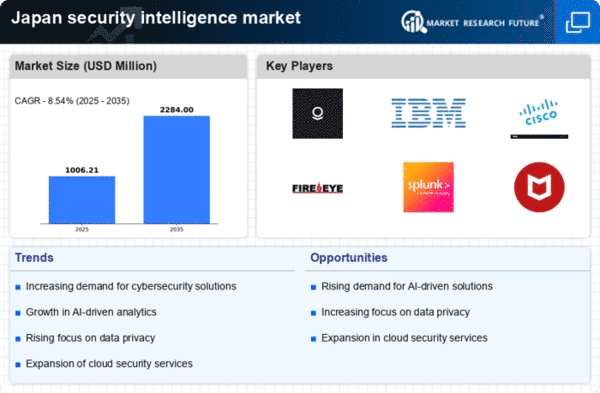
As per Market Research Future analysis, the Japan security intelligence market size was estimated at 927.04 USD Million in 2024. The Japan security intelligence market is projected to grow from 1006.21 USD Million in 2025 to 2284.0 USD Million by 2035, exhibiting a compound annual growth rate (CAGR) of 8.5% during the forecast period 2025 - 2035

Key Market Trends & Highlights

The Japan security intelligence market is experiencing robust growth driven by technological advancements and regulatory demands.

  • The integration of AI and Machine Learning is transforming security intelligence solutions, enhancing threat detection and response capabilities.
  • Cloud-based security solutions are gaining traction, reflecting a shift towards more flexible and scalable security architectures.
  • The market is witnessing increased focus on regulatory compliance, particularly in sectors such as finance and healthcare, which are heavily regulated.
  • Key drivers include the growing cyber threat landscape and rising awareness of data privacy, prompting organizations to invest more in security technologies.

Market Size & Forecast

2024 Market Size 927.04 (USD Million)
2035 Market Size 2284.0 (USD Million)
CAGR (2025 - 2035) 8.54%

Major Players

Palantir Technologies (US), IBM (US), Cisco Systems (US), FireEye (US), Splunk (US), McAfee (US), Check Point Software Technologies (IL), CrowdStrike (US), Fortinet (US)

Our Impact
Enabled $4.3B Revenue Impact for Fortune 500 and Leading Multinationals
Partnering with 2000+ Global Organizations Each Year
30K+ Citations by Top-Tier Firms in the Industry

Japan Security Intelligence Market Trends

The security intelligence market is currently experiencing a dynamic evolution, driven by the increasing complexity of security threats and the growing reliance on technology. Organizations are prioritizing the integration of advanced analytics and artificial intelligence to enhance their security posture. This shift is evident as businesses seek to proactively identify vulnerabilities and mitigate risks. Moreover, the regulatory landscape is becoming more stringent, compelling companies to adopt comprehensive security measures. As a result, investments in security intelligence solutions are on the rise, reflecting a broader recognition of the need for robust defense mechanisms against cyber threats. In addition, the demand for real-time threat intelligence is intensifying. Organizations are recognizing the importance of timely information to respond effectively to potential security incidents. This trend is further fueled by the increasing sophistication of cybercriminals, who are employing advanced tactics to breach defenses. Consequently, the security intelligence market is likely to witness continued growth as businesses strive to stay ahead of emerging threats and safeguard their assets. The emphasis on collaboration between public and private sectors is also noteworthy, as it fosters a more resilient security ecosystem.

Integration of AI and Machine Learning

The security intelligence market is witnessing a notable trend towards the integration of artificial intelligence (AI) and machine learning technologies. These innovations enable organizations to analyze vast amounts of data swiftly, identifying patterns and anomalies that may indicate security threats. By automating threat detection and response processes, businesses can enhance their operational efficiency and reduce response times.

Increased Focus on Regulatory Compliance

There is a growing emphasis on regulatory compliance within the security intelligence market. Organizations are compelled to adhere to stringent regulations that govern data protection and privacy. This trend drives the adoption of comprehensive security frameworks, ensuring that businesses not only protect their assets but also meet legal obligations, thereby minimizing potential liabilities.

Rise of Cloud-Based Security Solutions

The shift towards cloud-based security solutions is becoming increasingly prominent in the security intelligence market. Organizations are recognizing the benefits of scalable and flexible security measures that cloud services offer. This trend allows businesses to enhance their security posture while optimizing costs, as cloud solutions often provide advanced features without the need for significant upfront investments.

Japan Security Intelligence Market Drivers

Growing Cyber Threat Landscape

The security intelligence market in Japan is experiencing a surge due to the escalating cyber threat landscape. With cyberattacks becoming increasingly sophisticated, organizations are compelled to invest in advanced security solutions. Reports indicate that cybercrime costs in Japan could reach ¥1 trillion by 2025, highlighting the urgent need for robust security measures. This environment fosters a demand for security intelligence solutions that can proactively identify and mitigate threats. As businesses recognize the potential financial and reputational damage from breaches, the focus on security intelligence market offerings intensifies. Consequently, companies are prioritizing investments in threat detection and response capabilities, driving growth in the security intelligence market.

Rising Awareness of Data Privacy

In Japan, the rising awareness of data privacy among consumers and businesses is significantly impacting the security intelligence market. As individuals become more conscious of their personal data rights, organizations are compelled to adopt stringent security measures to protect sensitive information. This shift is evident in the growing demand for security intelligence solutions that offer comprehensive data protection capabilities. A recent study suggests that 80% of consumers are concerned about data breaches, prompting businesses to prioritize security investments. Consequently, the security intelligence market is likely to expand as organizations seek to enhance their data privacy practices and build consumer trust through robust security frameworks.

Digital Transformation Initiatives

The ongoing digital transformation initiatives across various sectors in Japan are driving the security intelligence market. As organizations migrate to digital platforms, the attack surface expands, necessitating advanced security measures. A recent survey indicates that 70% of Japanese companies are prioritizing digital transformation, which inherently increases their vulnerability to cyber threats. This shift compels businesses to invest in security intelligence solutions that provide real-time insights and threat intelligence. The integration of security into digital transformation strategies is becoming essential, as organizations aim to protect sensitive data and maintain operational continuity. Thus, the security intelligence market is poised for growth as companies seek to secure their digital assets.

Regulatory Pressures and Compliance

In Japan, the security intelligence market is significantly influenced by regulatory pressures and compliance requirements. The introduction of stringent data protection laws, such as the Act on the Protection of Personal Information, mandates organizations to enhance their security frameworks. Non-compliance can result in hefty fines, which may reach up to ¥100 million. As a result, businesses are increasingly adopting security intelligence solutions to ensure adherence to these regulations. This trend not only mitigates legal risks but also enhances customer trust. The growing emphasis on compliance is likely to propel the security intelligence market, as organizations seek to implement comprehensive security strategies that align with regulatory standards.

Increased Investment in Security Technologies

The security intelligence market in Japan is witnessing increased investment in security technologies, driven by the recognition of cybersecurity as a critical business priority. Organizations are allocating larger budgets to enhance their security postures, with spending on security solutions projected to grow by 15% annually. This trend reflects a broader understanding that effective security intelligence is vital for safeguarding assets and ensuring business resilience. Companies are increasingly adopting advanced technologies, such as threat intelligence platforms and security information and event management (SIEM) systems, to bolster their defenses. As the market evolves, the focus on innovative security technologies is likely to shape the future landscape of the security intelligence market.


Market Segment Insights

By Solution: Threat Intelligence (Largest) vs. Security Information and Event Management (Fastest-Growing)

The market share distribution among the different solution segments in the Japan security intelligence market reveals a pronounced dominance by Threat Intelligence, attributed to its critical role in predicting and mitigating cyber threats. Following closely, Security Information and Event Management is witnessing a surge in uptake, making it a pivotal segment for organizations focusing on real-time monitoring and compliance adherence. Other segments such as Identity and Access Management, Network Security, and Endpoint Security hold important shares but are currently overshadowed by the leading segments. Growth trends show an increasing reliance on automated threat detection and response mechanisms, driving the popularity of Security Information and Event Management as businesses seek to fortify their defenses against emerging threats. Moreover, the push for robust identity verification protocols has propelled Identity and Access Management into the spotlight, while a heightened focus on compliance and regulatory requirements is enabling consistent growth across all segments, particularly in dynamic industries like finance and healthcare.

Threat Intelligence (Dominant) vs. Endpoint Security (Emerging)

Threat Intelligence serves as the backbone of cybersecurity strategies, providing crucial insights into potential vulnerabilities and attack vectors, thereby maintaining its dominant position in the market. It empowers organizations to proactively address threats before they materialize. In contrast, Endpoint Security is gaining traction as an emerging area, spotlighted by the increasing number of devices connected to corporate networks. The proliferation of remote work and mobile usage underscores the necessity for robust endpoint protection solutions. While Threat Intelligence stands firm as a critical asset for security teams, the swift adaptation and implementation of Endpoint Security solutions reflect the evolving landscape and the need for comprehensive protection methodologies.

By Deployment Type: Cloud (Largest) vs. Hybrid (Fastest-Growing)

In the Japan security intelligence market, the deployment type segment is dominated by cloud solutions, which account for a significant share of the overall market. On-premises deployments have seen a decline in traction, as companies lean toward more flexible and scalable options. Hybrid solutions are gaining attention but still represent a smaller portion of the market share compared to cloud, reflecting a shift in preferences among enterprises. Growth trends in the deployment type segment are prominently influenced by increasing cybersecurity threats and the digital transformation of businesses. Organizations are opting for cloud deployment for its cost efficiency and ease of management, while hybrid solutions are emerging as businesses seek the agility of cloud without compromising on security. This upward trajectory indicates a clear move towards adopting advanced security measures tailored to modern challenges.

Cloud (Dominant) vs. Hybrid (Emerging)

Cloud deployment continues to dominate the Japan security intelligence market, offering scalable solutions that align with the growing need for real-time data analysis and threat detection. Its flexibility allows organizations to quickly adapt to changing security landscapes. Conversely, hybrid deployment solutions are emerging as attractive alternatives, allowing businesses to combine the best of cloud and on-premises systems. This hybrid approach offers enhanced security and control for sensitive data, making it a preferred choice for companies still wary of fully transitioning to the cloud. Together, these deployment types are reshaping the market, reflecting the varying needs of organizations in their security strategies.

By End User: Government (Largest) vs. Healthcare (Fastest-Growing)

In the Japan security intelligence market, the distribution of market share among end user segments reveals that the Government sector holds a significant portion, reflecting its essential role in national security and public safety. This dominance is largely due to consistent investments in cybersecurity measures and intelligence frameworks to combat evolving threats. Conversely, sectors like BFSI and Retail also maintain notable shares with their own security needs, yet they do not surpass the influence of governmental activities. On the other hand, the Healthcare sector is recognized as the fastest-growing segment within the market, primarily driven by increasing cyber threats targeting sensitive patient information and the rising adoption of digital health solutions. With the acceleration of technological advancements, Healthcare organizations are prioritizing the implementation of robust security intelligence solutions to safeguard confidential data and comply with regulatory mandates. The growth in this sector underscores a broader trend of enhanced awareness and readiness against potential cyber risks.

Government: Dominant vs. Healthcare: Emerging

The Government sector stands out as the dominant force within the Japan security intelligence market, characterized by extensive budgets allocated towards national defense and cybersecurity initiatives. Its robust infrastructure is constantly evolving to address the complexities of modern threats while ensuring the protection of critical information. In contrast, the Healthcare sector is rapidly emerging, fueled by an urgent need to defend against cyberattacks that target sensitive medical records. This sector's growth is propelled by increasing investments in technological solutions that enhance data protection and improve compliance with health regulations, making it a critical area of focus for security intelligence providers.

By Service: Consulting (Largest) vs. Managed Services (Fastest-Growing)

The service segment of the Japan security intelligence market showcases a diverse distribution among its values. Consulting holds the largest share, leveraging its established reputation and comprehensive offerings. In contrast, Managed Services, while smaller in market share, is rapidly gaining traction due to the increasing complexity of security needs that organizations face. Integration and Training follow, contributing to the overall dynamics of the service segment with their specialized capabilities that cater to specific organizational requirements. Growth trends within this segment indicate a robust demand for Managed Services, driven by the need for continuous monitoring and risk management. Consulting continues to thrive, spurred by organizations seeking strategic insights. The emphasis on security awareness and compliance further fuels the growth of Training services, while Integration remains essential as businesses seek cohesive and unified security solutions to combat evolving threats. Overall, the segment is poised for sustained growth as security challenges evolve.

Consulting (Dominant) vs. Managed Services (Emerging)

Consulting in the Japan security intelligence market serves as a dominant force, offering strategic expertise and holistic solutions to organizations. Its established presence enables it to maintain a significant share, with firms relying on consultancy for tailored security strategies and risk assessments. Conversely, Managed Services is emerging as a vital component, particularly as businesses prioritize outsourced security management. This shift is motivated by the need for specialized skills and resources that allow firms to focus on core operations while ensuring robust security measures are in place. The interplay between these two segments illustrates the need for comprehensive security approaches, blending strategic consulting with proactive management solutions to address the growing complexities of the security landscape.

Get more detailed insights about Japan Security Intelligence Market

Key Players and Competitive Insights

The security intelligence market in Japan is characterized by a dynamic competitive landscape, driven by increasing cyber threats and the growing need for advanced security solutions. Major players such as Palantir Technologies (US), IBM (US), and CrowdStrike (US) are at the forefront, each adopting distinct strategies to enhance their market presence. Palantir Technologies (US) focuses on leveraging its data analytics capabilities to provide tailored solutions for government and enterprise clients, while IBM (US) emphasizes its hybrid cloud offerings and AI-driven security solutions. CrowdStrike (US) positions itself as a leader in endpoint protection, utilizing its cloud-native platform to deliver real-time threat intelligence and incident response services. Collectively, these strategies contribute to a competitive environment that is increasingly centered around innovation and technological advancement.Key business tactics within this market include localizing manufacturing and optimizing supply chains to enhance responsiveness to regional demands. The competitive structure appears moderately fragmented, with a mix of established players and emerging startups. This fragmentation allows for diverse offerings, yet the influence of key players remains substantial, as they set benchmarks for quality and innovation that smaller firms strive to meet.

In September IBM (US) announced a strategic partnership with a leading Japanese telecommunications company to enhance its cybersecurity offerings in the region. This collaboration aims to integrate IBM's AI-driven security solutions with the telecom's extensive network infrastructure, thereby providing customers with a more robust defense against cyber threats. The strategic importance of this partnership lies in its potential to expand IBM's market reach while simultaneously addressing the unique security challenges faced by Japanese enterprises.

In October CrowdStrike (US) launched a new threat intelligence service specifically designed for the Japanese market, incorporating local language support and compliance with regional regulations. This move is significant as it demonstrates CrowdStrike's commitment to understanding and addressing the specific needs of Japanese customers, thereby enhancing its competitive edge in a market that values localized solutions. By tailoring its offerings, CrowdStrike may strengthen its position against competitors who may not fully cater to local requirements.

In August Palantir Technologies (US) secured a multi-million dollar contract with a Japanese government agency to provide advanced data analytics for national security purposes. This contract underscores Palantir's strategic focus on government partnerships and its ability to deliver sophisticated solutions that meet the stringent demands of public sector clients. Such engagements not only bolster Palantir's revenue but also enhance its reputation as a trusted provider of security intelligence solutions.

As of November current trends in the security intelligence market are heavily influenced by digitalization, AI integration, and a growing emphasis on sustainability. Strategic alliances are increasingly shaping the competitive landscape, as companies recognize the value of collaboration in addressing complex security challenges. Looking ahead, competitive differentiation is likely to evolve from traditional price-based competition to a focus on innovation, technological advancement, and supply chain reliability. This shift suggests that companies that prioritize these elements will be better positioned to thrive in an increasingly complex and competitive environment.

Key Companies in the Japan Security Intelligence Market include

Industry Developments

The Japan Security Intelligence Market has seen significant activity recently, highlighting key developments among major companies. Notable firms like SoftBank Technology, Cisco Systems, and Trend Micro are adapting to the growing demand for cybersecurity solutions driven by increased cyber threats and data breaches. In terms of market valuations, leading companies in this sector have observed a notable growth trajectory, significantly impacting their market standing. Recent mergers and acquisitions in this area include CyberAgent's acquisition of a cybersecurity firm in August 2023, which aimed at enhancing its capabilities.

Additionally, Kaspersky Lab announced a strategic collaboration with NEC Corporation in June 2023 to bolster cybersecurity solutions for enterprises. 

In the past couple of years, market movements have consistently pointed towards consolidation and an increase in strategic partnerships to combat evolving security challenges. Furthermore, the Japanese government has initiated several cybersecurity strategies, focusing on national infrastructure protection and raising public awareness against cyber threats, indicating a robust response to the increasing significance of security intelligence in the region. This proactive stance reflects Japan's commitment to enhancing its cybersecurity resilience across multiple sectors.

Future Outlook

Japan Security Intelligence Market Future Outlook

The Security Intelligence Market in Japan is projected to grow at 8.54% CAGR from 2025 to 2035, driven by technological advancements and increasing cyber threats.

New opportunities lie in:

  • Development of AI-driven threat detection systems
  • Expansion of cloud-based security intelligence solutions
  • Integration of IoT security frameworks for real-time monitoring

By 2035, the market is expected to achieve substantial growth and innovation.

Market Segmentation

Japan Security Intelligence Market Service Outlook

  • Consulting
  • Integration
  • Managed Services
  • Training

Japan Security Intelligence Market End User Outlook

  • Government
  • BFSI
  • Healthcare
  • Retail
  • IT and Telecommunications

Japan Security Intelligence Market Solution Outlook

  • Threat Intelligence
  • Security Information and Event Management
  • Identity and Access Management
  • Network Security
  • Endpoint Security

Japan Security Intelligence Market Deployment Type Outlook

  • On-Premises
  • Cloud
  • Hybrid

Report Scope

MARKET SIZE 2024 927.04(USD Million)
MARKET SIZE 2025 1006.21(USD Million)
MARKET SIZE 2035 2284.0(USD Million)
COMPOUND ANNUAL GROWTH RATE (CAGR) 8.54% (2025 - 2035)
REPORT COVERAGE Revenue Forecast, Competitive Landscape, Growth Factors, and Trends
BASE YEAR 2024
Market Forecast Period 2025 - 2035
Historical Data 2019 - 2024
Market Forecast Units USD Million
Key Companies Profiled Palantir Technologies (US), IBM (US), Cisco Systems (US), FireEye (US), Splunk (US), McAfee (US), Check Point Software Technologies (IL), CrowdStrike (US), Fortinet (US)
Segments Covered Solution, Deployment Type, End User, Service
Key Market Opportunities Integration of artificial intelligence in security intelligence market enhances threat detection and response capabilities.
Key Market Dynamics Rising demand for advanced threat detection solutions drives innovation in the security intelligence market.

Countries Covered Japan
Leave a Comment

FAQs

What is the market size of the Japan Security Intelligence Market in 2024?

The Japan Security Intelligence Market is expected to be valued at 900.0 million USD in 2024.

What is the projected market size of the Japan Security Intelligence Market by 2035?

By 2035, the Japan Security Intelligence Market is expected to reach a valuation of 2250.0 million USD.

What is the estimated CAGR for the Japan Security Intelligence Market from 2025 to 2035?

The estimated CAGR for the Japan Security Intelligence Market from 2025 to 2035 is 8.687 percent.

What are the major segments of the Japan Security Intelligence Market?

The Japan Security Intelligence Market is segmented into Threat Intelligence, Security Information and Event Management, Identity and Access Management, Network Security, and Endpoint Security.

How much is the Threat Intelligence segment valued at in 2024?

The Threat Intelligence segment is valued at 150.0 million USD in 2024.

What is the projected value of the Security Information and Event Management segment by 2035?

The Security Information and Event Management segment is projected to reach 600.0 million USD by 2035.

Who are the key players in the Japan Security Intelligence Market?

Key players in the Japan Security Intelligence Market include SoftBank Technology, Sophos, CyberAgent, Fortinet, and Kaspersky Lab.

What will be the market size for Identity and Access Management in 2035?

The Identity and Access Management segment is expected to be valued at 475.0 million USD in 2035.

What opportunities exist in the Japan Security Intelligence Market?

There are significant opportunities driven by increasing cyber threats and the need for advanced security solutions in the Japan Security Intelligence Market.

What challenges might impact the growth of the Japan Security Intelligence Market?

The market may face challenges such as evolving cyber threats and regulatory compliance, which can impact its growth trajectory.

Download Free Sample

Kindly complete the form below to receive a free sample of this Report

Compare Licence

×
Features License Type
Single User Multiuser License Enterprise User
Price $4,950 $5,950 $7,250
Maximum User Access Limit 1 User Upto 10 Users Unrestricted Access Throughout the Organization
Free Customization
Direct Access to Analyst
Deliverable Format
Platform Access
Discount on Next Purchase 10% 15% 15%
Printable Versions