×
Request Free Sample ×

Kindly complete the form below to receive a free sample of this Report

* Please use a valid business email

Leading companies partner with us for data-driven Insights

clients tt-cursor
Hero Background

Japan Robo Advisory Software Market

ID: MRFR/ICT/59905-HCR
200 Pages
Aarti Dhapte
February 2026

Japan Robo-Advisory Software Market Size, Share and Trends Analysis Report By Deployment Type (On-Premise, Cloud-Based, Hybrid), By End User (Individual Investors, Institutional Investors, Wealth Management Firms, Financial Advisors), By Investment Type (Equities, Bonds, Real Estate, Cryptocurrencies) and By Features (Portfolio Management, Robo-Advisory Platforms, Risk Assessment, Automated Investment)- Forecast to 2035

Share:
Download PDF ×

We do not share your information with anyone. However, we may send you emails based on your report interest from time to time. You may contact us at any time to opt-out.

Japan Robo Advisory Software Market Infographic
Purchase Options

Japan Robo Advisory Software Market Summary

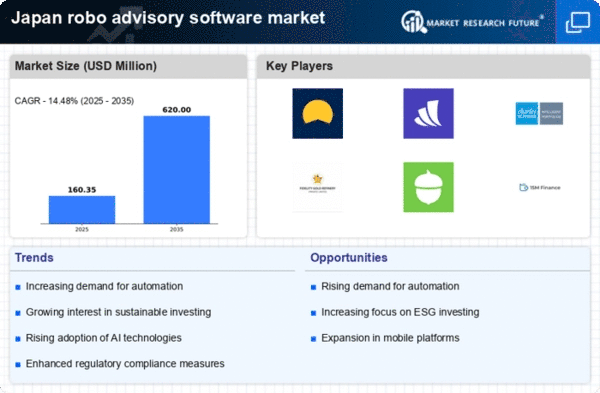
As per Market Research Future analysis, the Japan robo advisory software market size was estimated at 140.07 USD Million in 2024. The Japan robo advisory-software market is projected to grow from 160.35 USD Million in 2025 to 620.0 USD Million by 2035, exhibiting a compound annual growth rate (CAGR) of 14.4% during the forecast period 2025 - 2035

Key Market Trends & Highlights

The Japan robo advisory-software market is experiencing robust growth driven by technological advancements and changing consumer preferences.

  • The market is witnessing increased adoption of AI technologies, enhancing the efficiency of robo advisory services.
  • Regulatory support for digital finance is fostering a conducive environment for market expansion.
  • There is a growing focus on user experience and personalization, particularly in the largest segment of retail investors.
  • Key market drivers include the rising demand for cost-effective investment solutions and the shift towards digital financial services.

Market Size & Forecast

2024 Market Size 140.07 (USD Million)
2035 Market Size 620.0 (USD Million)
CAGR (2025 - 2035) 14.48%

Major Players

Betterment (US), Wealthfront (US), Schwab Intelligent Portfolios (US), Fidelity Go (US), Acorns (US), M1 Finance (US), Nutmeg (GB), Scalable Capital (DE), Moneyfarm (IT)

Our Impact
Enabled $4.3B Revenue Impact for Fortune 500 and Leading Multinationals
Partnering with 2000+ Global Organizations Each Year
30K+ Citations by Top-Tier Firms in the Industry

Japan Robo Advisory Software Market Trends

The robo advisory-software market is experiencing notable growth, driven by increasing demand for automated financial services. In Japan, the adoption of technology in finance has accelerated, as consumers seek efficient and cost-effective investment solutions. This trend is further supported by a rising awareness of personal finance management among the population. As traditional financial institutions face pressure to innovate, many are integrating robo advisory solutions to enhance their service offerings. This shift not only caters to tech-savvy investors but also appeals to a broader audience looking for accessible financial advice. Moreover, regulatory frameworks in Japan are evolving to accommodate the rise of digital financial services. The government appears to be fostering an environment conducive to innovation, which may lead to increased competition in the robo advisory-software market. As more players enter the field, consumers could benefit from improved services and lower fees. The emphasis on user experience and personalization is likely to shape the future landscape, as firms strive to differentiate themselves in a crowded marketplace. Overall, the outlook for the robo advisory-software market in Japan seems promising, with potential for continued expansion and diversification of services.

Increased Adoption of AI Technologies

The integration of artificial intelligence in the robo advisory software market is becoming more prevalent. AI technologies enhance the ability to analyze vast amounts of data, allowing for more personalized investment strategies. This trend indicates a shift towards more sophisticated algorithms that can adapt to individual user preferences and market conditions.

Regulatory Support for Digital Finance

Japan's regulatory environment is evolving to support the growth of digital financial services. Authorities are implementing frameworks that encourage innovation while ensuring consumer protection. This regulatory backing may facilitate the entry of new players into the robo advisory-software market, fostering competition and improving service offerings.

Focus on User Experience and Personalization

There is a growing emphasis on enhancing user experience within the robo advisory-software market. Companies are investing in user-friendly interfaces and personalized services to attract a wider audience. This trend suggests that firms are recognizing the importance of catering to individual needs and preferences to remain competitive.

Japan Robo Advisory Software Market Drivers

Increased Focus on Retirement Planning

An increased focus on retirement planning is emerging as a significant driver for the robo advisory-software market in Japan. With an aging population and rising concerns about financial security in retirement, individuals are actively seeking tools to help them prepare for their future. Robo advisors, which often provide retirement planning features and automated investment strategies, are well-positioned to meet this demand. As more people recognize the importance of early and effective retirement planning, the adoption of robo advisory services is likely to rise. This trend indicates a growing market opportunity for firms that offer comprehensive retirement solutions within their robo advisory-software offerings.

Shift Towards Digital Financial Services

The shift towards digital financial services is a key driver of the robo advisory-software market in Japan. With the proliferation of smartphones and internet access, consumers are increasingly turning to digital platforms for their financial needs. This trend is reflected in the growing number of users engaging with robo advisory services, as they offer convenience and accessibility that traditional financial services may lack. According to recent data, the number of users of robo advisory platforms in Japan has increased by over 30% in the past year alone. This shift towards digital solutions is likely to continue, as consumers seek efficient and user-friendly ways to manage their investments, thereby propelling the growth of the robo advisory-software market.

Rise of Financial Literacy Among Consumers

The rise of financial literacy among consumers in Japan is significantly impacting the robo advisory-software market. As individuals become more educated about financial products and investment strategies, they are increasingly inclined to take control of their financial futures. This trend is evident in the growing number of online resources and educational platforms that empower consumers to make informed investment decisions. Consequently, a more financially literate population is likely to embrace robo advisory services, viewing them as accessible tools for managing investments. The increasing demand for self-directed investment solutions may drive growth in the robo advisory-software market, as these platforms cater to the needs of a more knowledgeable clientele.

Technological Advancements in Financial Services

Technological advancements are playing a crucial role in shaping the robo advisory-software market in Japan. Innovations such as machine learning, big data analytics, and artificial intelligence are enhancing the capabilities of robo advisors, allowing them to provide more personalized and efficient services. For instance, the integration of AI algorithms enables these platforms to analyze vast amounts of data to offer tailored investment strategies based on individual risk profiles and financial goals. As technology continues to evolve, it is expected that the robo advisory-software market will witness increased adoption, with more sophisticated tools being developed to meet the diverse needs of investors. This trend suggests a promising future for the industry, as firms that leverage cutting-edge technology may gain a competitive edge.

Growing Demand for Cost-Effective Investment Solutions

The robo advisory-software market in Japan is experiencing a notable surge in demand for cost-effective investment solutions. As traditional financial advisory services often entail high fees, many investors are seeking alternatives that offer lower costs without compromising on quality. Robo advisors typically charge fees ranging from 0.25% to 0.75% of assets under management, significantly less than the 1% to 2% charged by traditional advisors. This shift towards more affordable options is particularly appealing to younger investors and those with smaller portfolios, thereby expanding the customer base for robo advisory services. The increasing awareness of investment management costs is likely to drive further growth in the robo advisory-software market, as more individuals recognize the potential for enhanced returns through lower fees.


Market Segment Insights

By Deployment Type: Cloud-Based (Largest) vs. On-Premise (Fastest-Growing)

In the Japan robo advisory-software market, the deployment type segment is primarily dominated by the Cloud-Based solutions, which hold the largest share. This model is favored for its scalability, cost-effectiveness, and ease of access. Conversely, On-Premise solutions are gaining traction, especially among traditional institutions that prioritize control over data security. Companies are increasingly exploring these solutions to stay competitive in a rapidly evolving market. Growth trends indicate a robust shift towards Cloud-Based services, driven by user demand for flexibility and real-time insights. On-Premise systems, though currently smaller in market share, are emerging as the fastest-growing segment due to the need for customized services and data governance. Factors such as regulatory compliance and security concerns are also influencing the adoption of hybrid models, further signaling a dynamic shift in deployment preferences.

Cloud-Based (Dominant) vs. On-Premise (Emerging)

Cloud-Based solutions in the Japan robo advisory-software market are characterized by their accessibility and cost efficiency, making them a popular choice for startups and tech-savvy financial institutions. They provide enhanced scalability and integration capabilities, catering to a wide range of user needs. On the other hand, On-Premise solutions have become increasingly relevant as emerging entities seek tailored functionalities and enhanced control over sensitive data. These systems allow firms to comply with local regulations while managing client funds more securely. Despite being currently overshadowed, the On-Premise segment is witnessing a rise in interest as companies look for flexibility and customization, positioning it as an emerging solution in the competitive landscape.

By End User: Individual Investors (Largest) vs. Wealth Management Firms (Fastest-Growing)

In the Japan robo advisory-software market, the distribution of market share among the various end users reflects a diverse landscape. Individual investors hold a significant portion of the market, driven by a growing interest in personal finance management and automated investment solutions. Conversely, wealth management firms are emerging as a fast-growing segment, propelled by the need to offer innovative services to their clients and enhance operational efficiency. The growth trends for these segments indicate a shift in preferences among investors. Individual investors are increasingly adopting robo advisory solutions as they seek accessibility and convenience in investment management. Meanwhile, wealth management firms are investing in technology to optimize client interactions and streamline their services. This dynamic highlights the important role of technology in facilitating growth and adapting to changing customer needs across the Japan robo advisory-software market.

Individual Investors (Dominant) vs. Wealth Management Firms (Emerging)

Individual investors represent a dominant segment in the Japan robo advisory-software market, characterized by a vast user base that values low-cost, automated investment options. This demographic includes tech-savvy individuals seeking to optimize their portfolios with minimal human intervention. On the other hand, wealth management firms are emerging as a significant player by integrating robo advisory solutions to enhance traditional investment strategies. These firms recognize the need for efficiency and personalization in service delivery, which positions them well in a competitive landscape. As both segments evolve, their respective strategies and adoption rates are crucial in defining the future trajectory of the market.

By Investment Type: Equities (Largest) vs. Cryptocurrencies (Fastest-Growing)

In the Japan robo advisory-software market, the investment segment distribution showcases equities holding the largest market share, appealing to traditional investors and those seeking steady returns. Bonds follow, offering lower risk yet reliable income, while real estate remains a stable option for long-term investments. Conversely, cryptocurrencies, although currently holding a smaller share, are rapidly gaining traction among younger investors looking for high-risk, high-reward opportunities. The growth trends within this segment reveal a robust adoption of crypto assets among the tech-savvy population in Japan. Innovative investment solutions are emerging, driven by demand for portfolio diversification and higher returns. Factors such as increasing awareness of blockchain technology and favorable regulations further propel the growth of cryptocurrencies, indicating a thrilling shift in investment preferences and strategies.

Equities: Dominant vs. Cryptocurrencies: Emerging

Equities have established themselves as the dominant investment type within the Japan robo advisory-software market, appealing to risk-averse investors due to their historical performance and resilience. They facilitate participation in various sectors, allowing for diversification and capital growth over time. Conversely, cryptocurrencies are marked as an emerging sector where volatility and potential for rapid returns attract a new demographic of investors. Their integration into robo advisory platforms indicates a shift towards embracing digital assets, fostering innovation, and capturing the interest of a younger, tech-oriented audience. The blending of traditional and digital investment strategies signifies a pivotal evolution in how investments are perceived and utilized.

By Features: Portfolio Management (Largest) vs. Robo-Advisory Platforms (Fastest-Growing)

In the Japan robo advisory-software market, Portfolio Management captures the largest share due to its essential role in providing users with tailored investment strategies that meet their financial goals. This segment has established itself as a cornerstone for both individual investors and institutions seeking automated solutions to optimize asset distribution. On the other hand, Robo-Advisory Platforms, while currently holding a smaller share, are rapidly gaining traction as more users seek seamless, cost-effective, and user-friendly platforms for investment management. The growth trends in the Japan robo advisory-software market indicate that while Portfolio Management remains the dominant feature, the demand for Robo-Advisory Platforms is surging. This shift is driven by a younger, tech-savvy demographic that prioritizes convenience and accessibility in investment management. As financial literacy improves and technology evolves, the adoption of automated investment solutions is expected to accelerate, particularly among millennials and Generation Z, who are more inclined toward utilizing digital platforms for financial planning.

Portfolio Management: Dominant vs. Robo-Advisory Platforms: Emerging

Portfolio Management stands out as the dominant feature in the Japan robo advisory-software market, primarily due to its comprehensive approach to asset allocation and risk assessment tailored for individual investor profiles. It effectively integrates market trends, user preferences, and performance metrics to provide effective management solutions. Conversely, Robo-Advisory Platforms, although emerging, are characterized by their innovative algorithms and user-friendly interfaces, facilitating a more accessible investment journey for users. These platforms leverage artificial intelligence and machine learning to deliver real-time insights and automated investment solutions, thereby capturing the attention of tech-savvy investors. As the financial landscape evolves, both segments serve distinct but complementary roles in meeting the diverse needs of investors.

Get more detailed insights about Japan Robo Advisory Software Market

Key Players and Competitive Insights

The robo advisory software market in Japan is currently characterized by a dynamic competitive landscape, driven by technological advancements and evolving consumer preferences. Key players such as Betterment (US), Schwab Intelligent Portfolios (US), and Nutmeg (GB) are actively shaping the market through innovative strategies and operational focuses. Betterment (US) has positioned itself as a leader in personalized investment strategies, leveraging advanced algorithms to enhance user experience. Meanwhile, Schwab Intelligent Portfolios (US) emphasizes a robust platform that integrates financial planning tools, appealing to a broad demographic. Nutmeg (GB), on the other hand, focuses on transparency and user engagement, which resonates well with the increasingly discerning Japanese consumer base. Collectively, these strategies contribute to a competitive environment that is both collaborative and competitive, as companies seek to differentiate themselves through technology and customer-centric approaches.In terms of business tactics, companies are increasingly localizing their offerings to better align with Japanese consumer preferences. This includes optimizing user interfaces and enhancing customer support services. The market structure appears moderately fragmented, with several players vying for market share, yet dominated by a few key firms that exert considerable influence. The collective actions of these companies suggest a trend towards consolidation, as smaller firms may struggle to compete against the technological prowess and brand recognition of larger entities.

In October Betterment (US) announced a strategic partnership with a leading Japanese fintech firm to enhance its service offerings in the region. This collaboration is expected to facilitate localized investment strategies, thereby increasing Betterment's appeal to Japanese investors. The strategic importance of this move lies in its potential to significantly expand Betterment's market presence and customer base in Japan, aligning with the growing demand for tailored financial solutions.

In September Schwab Intelligent Portfolios (US) launched a new feature that integrates AI-driven insights into its investment platform. This innovation aims to provide users with real-time market analysis and personalized investment recommendations. The introduction of AI capabilities is likely to enhance user engagement and retention, positioning Schwab as a forward-thinking leader in the robo advisory space.

In August Nutmeg (GB) expanded its product offerings by introducing a sustainable investment portfolio tailored for environmentally conscious investors. This strategic move not only aligns with global trends towards sustainability but also caters to the increasing demand for ethical investment options among Japanese consumers. Nutmeg's focus on sustainability may serve to differentiate it from competitors, appealing to a niche market segment that prioritizes environmental responsibility.

As of November the competitive trends in the robo advisory-software market are increasingly defined by digitalization, sustainability, and the integration of AI technologies. Strategic alliances are becoming more prevalent, as companies recognize the value of collaboration in enhancing their service offerings. Looking ahead, competitive differentiation is likely to evolve from traditional price-based competition towards a focus on innovation, technological advancements, and supply chain reliability. This shift suggests that companies that prioritize these elements will be better positioned to thrive in an increasingly competitive landscape.

Key Companies in the Japan Robo Advisory Software Market include

Industry Developments

The Japan Robo-Advisory Software Market has seen significant developments recently, driven by advancements in technology and increased financial literacy among investors. Companies such as WealthNavi and THEO continue to expand their customer base with innovative investment strategies tailored to user preferences. In August 2023, SBI Securities launched an upgraded platform that integrates Artificial Intelligence features to enhance user experience, a move that aligns with increasing demand for personalized services. Current affairs also highlight a growing competitive landscape as firms like Rakuten Securities and Monex Group strive to differentiate their offerings through unique fee structures and investment options. 

In terms of mergers and acquisitions, there have been no significant public transactions reported among the key players in the market, like J.P. Morgan Asset Management or Daiwa Securities. The overall market valuation of robo-advisory services in Japan is expected to reach new heights, with projections indicating an annual growth rate driven by enhanced accessibility to investment tools. Noteworthy movements in the market over the last two years include a surge in digital investment platform users, spurred by increased technological adoption and a shift in consumer preferences towards automated financial solutions.

Future Outlook

Japan Robo Advisory Software Market Future Outlook

The Robo Advisory Software Market in Japan is projected to grow at a 14.48% CAGR from 2025 to 2035, driven by technological advancements and increasing demand for automated financial services.

New opportunities lie in:

  • Integration of AI-driven analytics for personalized investment strategies.
  • Development of mobile platforms to enhance user engagement and accessibility.
  • Partnerships with fintech startups to expand service offerings and market reach.

By 2035, the market is expected to achieve substantial growth, positioning itself as a leader in financial technology.

Market Segmentation

Japan Robo Advisory Software Market End User Outlook

  • Individual Investors
  • Institutional Investors
  • Wealth Management Firms
  • Financial Advisors

Japan Robo Advisory Software Market Features Outlook

  • Portfolio Management
  • Robo-Advisory Platforms
  • Risk Assessment
  • Automated Investment

Japan Robo Advisory Software Market Deployment Type Outlook

  • On-Premise
  • Cloud-Based
  • Hybrid

Japan Robo Advisory Software Market Investment Type Outlook

  • Equities
  • Bonds
  • Real Estate
  • Cryptocurrencies

Report Scope

MARKET SIZE 2024 140.07(USD Million)
MARKET SIZE 2025 160.35(USD Million)
MARKET SIZE 2035 620.0(USD Million)
COMPOUND ANNUAL GROWTH RATE (CAGR) 14.48% (2025 - 2035)
REPORT COVERAGE Revenue Forecast, Competitive Landscape, Growth Factors, and Trends
BASE YEAR 2024
Market Forecast Period 2025 - 2035
Historical Data 2019 - 2024
Market Forecast Units USD Million
Key Companies Profiled Betterment (US), Wealthfront (US), Schwab Intelligent Portfolios (US), Fidelity Go (US), Acorns (US), M1 Finance (US), Nutmeg (GB), Scalable Capital (DE), Moneyfarm (IT)
Segments Covered Deployment Type, End User, Investment Type, Features
Key Market Opportunities Integration of artificial intelligence enhances personalization in the robo advisory-software market.
Key Market Dynamics Rising demand for personalized investment solutions drives innovation in the robo advisory-software market.
Countries Covered Japan
Leave a Comment

FAQs

What is the projected market size of the Japan Robo-Advisory Software Market in 2024?

The Japan Robo-Advisory Software Market is expected to be valued at 130.2 million USD in 2024.

What is the expected market size of the Japan Robo-Advisory Software Market by 2035?

By 2035, the Japan Robo-Advisory Software Market is projected to reach a value of 733.78 million USD.

What is the expected CAGR for the Japan Robo-Advisory Software Market from 2025 to 2035?

The expected CAGR for the Japan Robo-Advisory Software Market between 2025 and 2035 is 17.022%.

What is the market value for Cloud-Based deployment in the Japan Robo-Advisory Software Market for 2024?

In 2024, the market value for Cloud-Based deployment is anticipated to be 70.0 million USD.

What will be the market value for On-Premise deployment in the Japan Robo-Advisory Software Market by 2035?

The market value for On-Premise deployment is expected to rise to 115.88 million USD by 2035.

Who are the major players in the Japan Robo-Advisory Software Market?

Some key players in the market include FOLIO, Mitsubishi UFJ Morgan Stanley, and Monex Group among others.

What is the projected market value for Hybrid deployment in the Japan Robo-Advisory Software Market in 2024?

The projected market value for Hybrid deployment in 2024 is 40.0 million USD.

How much is the Cloud-Based segment expected to grow by 2035?

The Cloud-Based segment is expected to grow significantly, reaching around 420.28 million USD by 2035.

What is the anticipated growth trend for the Japan Robo-Advisory Software Market from 2025 to 2035?

The market is anticipated to grow at a substantial rate indicated by a CAGR of 17.022% from 2025 to 2035.

What challenges and opportunities exist in the Japan Robo-Advisory Software Market?

The market presents key opportunities in technology integration and customer engagement, alongside challenges like regulatory compliance.

Download Free Sample

Kindly complete the form below to receive a free sample of this Report

Compare Licence

×
Features License Type
Single User Multiuser License Enterprise User
Price $4,950 $5,950 $7,250
Maximum User Access Limit 1 User Upto 10 Users Unrestricted Access Throughout the Organization
Free Customization
Direct Access to Analyst
Deliverable Format
Platform Access
Discount on Next Purchase 10% 15% 15%
Printable Versions