×
Request Free Sample ×

Kindly complete the form below to receive a free sample of this Report

* Please use a valid business email

Leading companies partner with us for data-driven Insights

clients tt-cursor
Hero Background

Japan Recommendation Search Engine Market

ID: MRFR/ICT/62540-HCR
200 Pages
Aarti Dhapte
February 2026

Japan Recommendation Search Engine Market Size, Share and Trends Analysis Report By Application (E-commerce, Media and Entertainment, Social Networking, Travel and Hospitality, Online Learning), By Type of Algorithm (Collaborative Filtering, Content-Based Filtering, Hybrid Methods, Knowledge-Based Systems), By Deployment Model (Cloud-Based, On-Premises) and By End User (Small Enterprises, Medium Enterprises, Large Enterprises) - Forecast to 2035

Share:
Download PDF ×

We do not share your information with anyone. However, we may send you emails based on your report interest from time to time. You may contact us at any time to opt-out.

Japan Recommendation Search Engine Market Infographic
Purchase Options

Japan Recommendation Search Engine Market Summary

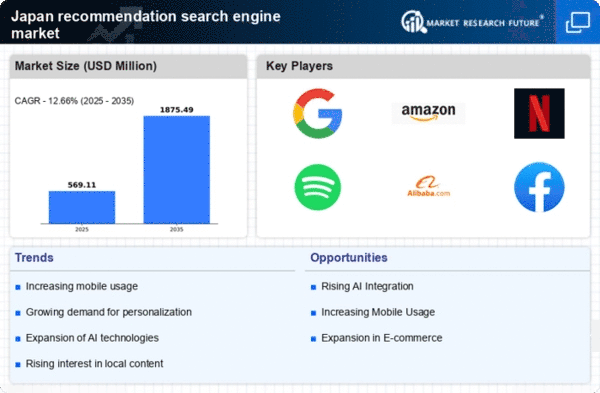
As per Market Research Future analysis, the Japan recommendation search-engine market size was estimated at 505.16 USD Million in 2024. The Japan recommendation search-engine market is projected to grow from 569.11 USD Million in 2025 to 1875.49 USD Million by 2035, exhibiting a compound annual growth rate (CAGR) of 12.6% during the forecast period 2025 - 2035

Key Market Trends & Highlights

The Japan recommendation search-engine market is experiencing robust growth driven by technological advancements and evolving consumer preferences.

  • Personalization and user engagement are becoming increasingly vital in enhancing user experiences within the recommendation search-engine market.
  • The integration of AI technologies is transforming how recommendations are generated, leading to more accurate and relevant results for users.
  • Collaborative partnerships among tech companies are emerging as a strategy to enhance service offerings and expand market reach.
  • Rising demand for tailored content and advancements in machine learning are key drivers propelling the market forward.

Market Size & Forecast

2024 Market Size 505.16 (USD Million)
2035 Market Size 1875.49 (USD Million)
CAGR (2025 - 2035) 12.66%

Major Players

Google (US), Amazon (US), Netflix (US), Spotify (SE), Alibaba (CN), Facebook (US), Apple (US), Microsoft (US)

Our Impact
Enabled $4.3B Revenue Impact for Fortune 500 and Leading Multinationals
Partnering with 2000+ Global Organizations Each Year
30K+ Citations by Top-Tier Firms in the Industry

Japan Recommendation Search Engine Market Trends

the recommendation search-engine market is experiencing notable growth, driven by advancements in artificial intelligence and machine learning technologies. These innovations enhance the ability of search engines to provide personalized results, thereby improving user experience. As consumers increasingly seek tailored content, businesses are compelled to adopt sophisticated algorithms that analyze user behavior and preferences. This shift not only boosts engagement but also fosters customer loyalty, as users are more likely to return to platforms that understand their needs. Furthermore, the integration of natural language processing is transforming how users interact with search engines, making queries more intuitive and results more relevant. In addition, the competitive landscape of the recommendation search-engine market is evolving. Companies are investing in partnerships and collaborations to enhance their offerings. This trend indicates a collective effort to leverage shared resources and expertise, ultimately benefiting end-users. As the market matures, regulatory considerations are also coming to the forefront, with stakeholders advocating for transparency in data usage and privacy protection. These dynamics suggest that the recommendation search-engine market is not only expanding but also adapting to the changing expectations of consumers and regulatory bodies alike.

Personalization and User Engagement

The emphasis on personalized search results is becoming increasingly pronounced. Businesses are utilizing advanced algorithms to analyze user data, which allows for tailored recommendations. This trend enhances user engagement, as individuals are more likely to interact with content that aligns with their interests.

Integration of AI Technologies

Artificial intelligence is playing a pivotal role in transforming the recommendation search-engine market. The incorporation of machine learning and natural language processing technologies is enabling more accurate and relevant search results, thereby improving overall user satisfaction.

Collaborative Partnerships

Companies are forming strategic partnerships to enhance their capabilities within the recommendation search-engine market. These collaborations allow for resource sharing and innovation, which can lead to improved services and a more competitive edge in the marketplace.

Japan Recommendation Search Engine Market Drivers

Increased Mobile Usage

The proliferation of mobile devices in Japan is reshaping the recommendation search-engine market. With over 80% of the population owning smartphones, there is a growing reliance on mobile applications for content consumption. This shift necessitates the development of mobile-optimized recommendation engines that can deliver seamless user experiences. As mobile usage continues to rise, companies are investing in technologies that enhance mobile recommendations, leading to higher user engagement. Data indicates that mobile users are 50% more likely to interact with personalized recommendations compared to desktop users. This trend underscores the importance of mobile optimization in the recommendation search-engine market, as businesses strive to capture the attention of on-the-go consumers.

Evolving Consumer Behavior

Evolving consumer behavior in Japan is a critical driver for the recommendation search-engine market. As consumers increasingly prioritize convenience and efficiency, they are more inclined to rely on recommendation engines to guide their purchasing decisions. This shift is evident in the growing use of e-commerce platforms, where recommendations play a vital role in influencing consumer choices. Recent statistics suggest that approximately 70% of online shoppers in Japan utilize recommendations when making purchases. This trend highlights the necessity for businesses to invest in robust recommendation systems that can adapt to changing consumer preferences. By understanding and anticipating consumer behavior, companies can enhance their offerings and improve customer satisfaction, thereby driving growth in the recommendation search-engine market.

Advancements in Machine Learning

Advancements in machine learning technologies are significantly influencing the recommendation search-engine market in Japan. These technologies enable more sophisticated algorithms that can process vast amounts of data to generate accurate recommendations. The integration of machine learning allows for real-time analysis of user interactions, leading to improved personalization. As of November 2025, the market is witnessing a surge in the adoption of machine learning tools, with an estimated 40% of companies in the sector implementing these technologies. This trend not only enhances the efficiency of recommendation engines but also contributes to higher conversion rates, as users are more likely to engage with content that aligns with their interests. Consequently, the ongoing evolution of machine learning is a pivotal driver for the recommendation search-engine market.

Focus on Data Privacy and Security

The focus on data privacy and security is becoming increasingly prominent in the recommendation search-engine market in Japan. As consumers become more aware of data protection issues, companies are compelled to implement stringent measures to safeguard user information. This heightened awareness has led to a demand for transparent recommendation systems that prioritize user consent and data security. In response, many businesses are investing in technologies that ensure compliance with data protection regulations, which is essential for maintaining consumer trust. As of November 2025, it is estimated that 60% of consumers in Japan consider data privacy a key factor when engaging with recommendation engines. This trend underscores the importance of prioritizing data security in the development of recommendation systems, as it directly impacts user engagement and market growth.

Rising Demand for Tailored Content

the market in Japan is experiencing a notable increase in demand for tailored content. As consumers become more discerning, they seek personalized experiences that resonate with their preferences. This trend is reflected in the growing investment in recommendation algorithms, which are designed to analyze user behavior and deliver customized suggestions. According to recent data, the market for personalized content is projected to grow at a CAGR of 15% over the next five years. This shift towards tailored content not only enhances user satisfaction but also drives engagement, making it a crucial driver for the recommendation search-engine market. Companies that effectively leverage data analytics to understand consumer behavior are likely to gain a competitive edge in this evolving landscape.


Market Segment Insights

By Application: E-commerce (Largest) vs. Online Learning (Fastest-Growing)

In the Japan recommendation search-engine market, the application segment is dominated by E-commerce, which captures the largest share of user engagement. Following closely are Media and Entertainment, Social Networking, Travel and Hospitality, and Online Learning, each contributing to the overall dynamics of user preference and interaction. The diverse applications showcase the market's broad appeal and highlight the importance of tailored recommendations in enhancing user experiences across various platforms. The growth trends within this segment are particularly pronounced for Online Learning, which has rapidly gained traction due to increased digitalization and a shift towards remote education. E-commerce remains strong, driven by robust consumer demand for personalized shopping experiences. Social Networking and Media and Entertainment also exhibit growth, fueled by evolving content preferences and engagement strategies that leverage AI-driven recommendations.

E-commerce: Dominant vs. Online Learning: Emerging

E-commerce stands as a dominant force in the ecosystem of the application segment, primarily due to its vast offerings and integration of recommendation algorithms that cater to shopper preferences. The segment thrives on providing users with highly relevant product suggestions, contributing to increased sales and customer satisfaction. On the other hand, Online Learning is an emerging player, rapidly climbing in popularity as more users engage with educational platforms that leverage recommendation engines to suggest courses and learning materials tailored to individual needs. Both segments employ advanced technologies to refine user experiences, but E-commerce benefits from established market penetration, whereas Online Learning represents a growing frontier in an increasingly digital world.

By Type of Algorithm: Collaborative Filtering (Largest) vs. Hybrid Methods (Fastest-Growing)

In the Japan recommendation search-engine market, Collaborative Filtering holds the largest share, significantly outpacing other algorithms like Content-Based Filtering and Knowledge-Based Systems. This method excels in leveraging user behavior and preferences, making it a cornerstone for personalized recommendations and contributing immensely to user engagement and satisfaction. Conversely, Hybrid Methods, which combine various algorithmic strategies, are emerging rapidly due to their versatility and improved accuracy in delivering recommendations, appealing to both developers and consumers. The growth of the Hybrid Methods segment is propelled by advancements in machine learning and increased demand for more personalized user experiences across platforms. Market players are investing in hybrid solutions to enhance recommendation quality, improve customer retention, and cater to diverse user preferences. As data analytics becomes more sophisticated, the demand for Hybrid Methods is expected to rise, positioning them as a critical player in the evolving market landscape.

Collaborative Filtering (Dominant) vs. Hybrid Methods (Emerging)

Collaborative Filtering is the dominant algorithm in the Japan recommendation search-engine market, recognized for its ability to provide personalized content by analyzing user interactions and preferences. This method thrives on large datasets, enabling it to deliver highly relevant recommendations that foster user engagement. Its effectiveness in various applications, from e-commerce to streaming services, solidifies its position as a preferred choice for businesses looking to enhance user experience. On the other hand, Hybrid Methods represent an emerging trend, integrating the strengths of both collaborative and content-based systems. These methods offer more accurate recommendations by utilizing multiple data sources, appealing to a broader range of users. Their growing adoption indicates a shift towards more comprehensive and adaptable recommendation strategies, catering to the demands of diverse consumer preferences.

By Deployment Model: Cloud-Based (Largest) vs. On-Premises (Fastest-Growing)

In the Japan recommendation search-engine market, the deployment model segment showcases a distinct division between cloud-based and on-premises approaches. Cloud-based solutions dominate the market, capturing the largest share due to their scalability, flexibility, and ease of integration. On-premises solutions, while smaller in market share, are gaining traction as businesses seek more control over their data and operations. The growth trends indicate a rising demand for on-premises solutions, driven by increased concerns around data security and regulatory compliance. Despite the superior growth rate of on-premises, cloud-based models continue to thrive, benefiting from advancements in cloud technologies and an expanding ecosystem of services tailored for the recommendation search-engine sector. This dynamic landscape reveals a competitive interplay between immediate accessibility and long-term strategic control.

Deployment Model: Cloud-Based (Dominant) vs. On-Premises (Emerging)

Cloud-based deployment models in the Japan recommendation search-engine market are characterized by their dominant position, offering high scalability and user convenience. These solutions enable businesses to leverage powerful algorithms and vast data sets without the need for significant infrastructure investments. On the other hand, on-premises solutions, while emerging, are increasingly appealing to enterprises looking for customized control over their recommendation systems and compliance with local regulations. The trend towards hybrid approaches is also notable, where companies combine both deployment types to balance flexibility and control. As businesses evolve, the need for adaptable systems that can cater to specific operational requirements will continue to shape the market landscape.

By End User: Small Enterprises (Largest) vs. Medium Enterprises (Fastest-Growing)

The market share distribution in the segment reveals that Small Enterprises hold a dominant presence, reflecting their adaptability and widespread use of recommendation search engines. This segment benefits from a strong inclination towards digital solutions, enabling them to enhance customer engagement and streamline operations. Medium Enterprises are catching up rapidly, fueled by their increasing investment in technology and the robust growth of e-commerce, which necessitates sophisticated recommendation systems. Growth trends indicate that Small Enterprises are leveraging recommendation search engines to optimize marketing strategies and improve sales performance. Conversely, the Medium Enterprises segment is characterized by its agile approach to technology adoption, showcasing the fastest growth as they seek innovative solutions to remain competitive. This shift underscores a broader industry trend towards personalization and customer-centric platforms, driving demand across both segments.

Small Enterprises (Dominant) vs. Medium Enterprises (Emerging)

Small Enterprises represent the dominant segment within the landscape, primarily due to their extensive integration of recommendation search engines into marketing strategies. These businesses are often more agile and adaptable, allowing them to respond effectively to consumer trends and behavior. In contrast, Medium Enterprises, labeled as emerging within this context, are harnessing the power of recommendation engines to enhance user experiences and explore new revenue streams. This segment is rapidly adapting to technological advancements, which positions them for growth as they implement personalized marketing strategies. The competition between these segments is driving innovation, with both focusing on creating tailored experiences for users to maximize engagement and satisfaction.

Get more detailed insights about Japan Recommendation Search Engine Market

Key Players and Competitive Insights

The recommendation search-engine market in Japan is characterized by a dynamic competitive landscape, driven by rapid technological advancements and evolving consumer preferences. Major players such as Google (US), Amazon (US), and Netflix (US) are at the forefront, leveraging their extensive data analytics capabilities to enhance user experience through personalized recommendations. Google (US) focuses on integrating AI-driven algorithms to refine search results, while Amazon (US) emphasizes its vast product ecosystem to provide tailored shopping experiences. Netflix (US) continues to innovate in content delivery, utilizing viewer data to suggest personalized viewing options, thereby shaping the competitive environment through a blend of technology and consumer engagement.Key business tactics within this market include localized content offerings and supply chain optimization, which are essential for catering to the unique preferences of Japanese consumers. The market structure appears moderately fragmented, with a mix of established giants and emerging players vying for market share. The collective influence of these key players fosters a competitive atmosphere where innovation and customer-centric strategies are paramount.

In October Amazon (US) announced the launch of a new AI-driven recommendation engine designed specifically for the Japanese market. This strategic move aims to enhance user engagement by providing more relevant product suggestions based on local shopping behaviors. The introduction of this technology is likely to strengthen Amazon's position in Japan, as it aligns with the growing demand for personalized shopping experiences.

In September Netflix (US) expanded its partnership with local content creators to enhance its recommendation algorithms. By integrating culturally relevant content into its platform, Netflix (US) aims to improve viewer satisfaction and retention rates. This strategic action not only enriches the content library but also positions Netflix (US) as a leader in understanding and catering to local tastes, which is crucial in a competitive market.

In November Google (US) unveiled a new feature in its search engine that allows users to receive personalized recommendations based on their search history and preferences. This development underscores Google's commitment to enhancing user experience through advanced AI technologies. By refining its recommendation capabilities, Google (US) is likely to maintain its competitive edge in the market, appealing to users seeking tailored search results.

As of November current trends in the recommendation search-engine market include a strong emphasis on digitalization, sustainability, and AI integration. Strategic alliances among key players are increasingly shaping the competitive landscape, fostering innovation and collaboration. Looking ahead, competitive differentiation is expected to evolve, with a shift from price-based competition to a focus on technological innovation and supply chain reliability. Companies that prioritize these aspects are likely to thrive in an increasingly complex market.

Key Companies in the Japan Recommendation Search Engine Market include

Industry Developments

In September 2023, SmartNews announced the expansion of its services within Japan, enhancing its algorithm for personalized content recommendations and aiming to increase user engagement significantly. Meanwhile, LINE has been focusing on improving its recommendation engine by integrating artificial intelligence, thus enriching content suggestions for its users.In May 2025, Accenture announced the acquisition of Yumemi, a leading provider of digital services and products based in Japan. This acquisition aims to accelerate the launch of innovative and influential digital products, enhancing Accenture's capabilities in delivering user-centric solutions to clients in Japan.

In November 2024, Bridgewise, a financial investment intelligence platform, entered into a strategic partnership with Rakuten Securities Inc. This collaboration focuses on providing AI-powered financial investment analysis solutions to Rakuten Securities' customers, aiming to enhance investment decision-making processes in Japan's financial sector.In May 2025, the Japan M&A market experienced significant activity, with a notable increase in deal volume compared to the same period in the previous year. This surge in mergers and acquisitions reflects a growing trend of consolidation and strategic partnerships within the Japanese market, impacting various sectors, including technology and digital services.

The market is witnessing an upward trend, with company valuations increasing as businesses invest heavily in improved search engine technology, subsequently impacting overall digital content consumption. Last reported figures indicated that the recommendation search engine market in Japan saw a growth of approximately 15% from 2021 to 2022, driven by heightened interest in personalized user experiences.

Future Outlook

Japan Recommendation Search Engine Market Future Outlook

The Recommendation Search Engine Market is projected to grow at 12.66% CAGR from 2025 to 2035, driven by advancements in AI, increased data availability, and consumer demand for personalized experiences.

New opportunities lie in:

  • Development of AI-driven personalization algorithms for enhanced user engagement.
  • Integration of recommendation engines in e-commerce platforms to boost sales.
  • Expansion into niche markets with tailored recommendation solutions for specific industries.

By 2035, the market is expected to achieve substantial growth, driven by innovative technologies and strategic partnerships.

Market Segmentation

Japan Recommendation Search Engine Market End User Outlook

  • Small Enterprises
  • Medium Enterprises
  • Large Enterprises

Japan Recommendation Search Engine Market Application Outlook

  • E-commerce
  • Media and Entertainment
  • Social Networking
  • Travel and Hospitality
  • Online Learning

Japan Recommendation Search Engine Market Deployment Model Outlook

  • Cloud-Based
  • On-Premises

Japan Recommendation Search Engine Market Type of Algorithm Outlook

  • Collaborative Filtering
  • Content-Based Filtering
  • Hybrid Methods
  • Knowledge-Based Systems

Report Scope

MARKET SIZE 2024 505.16(USD Million)
MARKET SIZE 2025 569.11(USD Million)
MARKET SIZE 2035 1875.49(USD Million)
COMPOUND ANNUAL GROWTH RATE (CAGR) 12.66% (2025 - 2035)
REPORT COVERAGE Revenue Forecast, Competitive Landscape, Growth Factors, and Trends
BASE YEAR 2024
Market Forecast Period 2025 - 2035
Historical Data 2019 - 2024
Market Forecast Units USD Million
Key Companies Profiled Google (US), Amazon (US), Netflix (US), Spotify (SE), Alibaba (CN), Facebook (US), Apple (US), Microsoft (US)
Segments Covered Application, Type of Algorithm, Deployment Model, End User
Key Market Opportunities Integration of artificial intelligence to enhance personalized user experiences in the recommendation search-engine market.
Key Market Dynamics Rising consumer demand for personalized content drives innovation in recommendation search-engine technologies and competitive strategies.
Countries Covered Japan
Leave a Comment

FAQs

What is the expected market size of the Japan Recommendation Search Engine Market by 2024?

The Japan Recommendation Search Engine Market is expected to be valued at 505.05 million USD in 2024.

What will be the projected market value in 2035?

By 2035, the Japan Recommendation Search Engine Market is projected to reach a value of 1250.0 million USD.

What is the expected CAGR for the Japan Recommendation Search Engine Market from 2025 to 2035?

The expected compound annual growth rate for the Japan Recommendation Search Engine Market from 2025 to 2035 is 8.587%.

Which application in the Japan Recommendation Search Engine Market is expected to dominate in 2035?

The E-commerce segment is expected to dominate with a projected value of 350.0 million USD in 2035.

What will be the market value for Media and Entertainment in 2035?

The Media and Entertainment application is projected to be valued at 300.0 million USD by 2035.

Who are the key players in the Japan Recommendation Search Engine Market?

Key players in the market include SmartNews, Niconico, Google, Twitter, LINE, and Instagram.

What is the projected market size for Social Networking by 2035?

The Social Networking segment is expected to reach a market size of 180.0 million USD by 2035.

How much is the Travel and Hospitality application projected to be valued at in 2035?

In 2035, the Travel and Hospitality application is projected to be valued at 200.0 million USD.

What is the forecasted market size for Online Learning in 2035?

Online Learning is expected to reach a market valuation of 220.0 million USD by 2035.

What are the emerging trends expected to influence the Japan Recommendation Search Engine Market?

Emerging trends likely to influence the market include the growth of personalized content and advancements in AI-driven recommendations.

Download Free Sample

Kindly complete the form below to receive a free sample of this Report

Compare Licence

×
Features License Type
Single User Multiuser License Enterprise User
Price $4,950 $5,950 $7,250
Maximum User Access Limit 1 User Upto 10 Users Unrestricted Access Throughout the Organization
Free Customization
Direct Access to Analyst
Deliverable Format
Platform Access
Discount on Next Purchase 10% 15% 15%
Printable Versions