×
Request Free Sample ×

Kindly complete the form below to receive a free sample of this Report

* Please use a valid business email

Leading companies partner with us for data-driven Insights

clients tt-cursor
Hero Background

Japan Personal Loans Market

ID: MRFR/BS/42587-HCR
200 Pages
Garvit Vyas
February 2026

Japan Personal Loans Market Size, Share and Research Report By Type (P2P Marketplace Lending, Balance Sheet Lending), By Age (Less Than 30, 30-50, More Than 50), By Marital Status (Married, Single, Others) and By Employment Status (Salaried, Business) - Industry Forecast Till 2035

Share:
Download PDF ×

We do not share your information with anyone. However, we may send you emails based on your report interest from time to time. You may contact us at any time to opt-out.

Japan Personal Loans Market Infographic
Purchase Options

Japan Personal Loans Market Summary

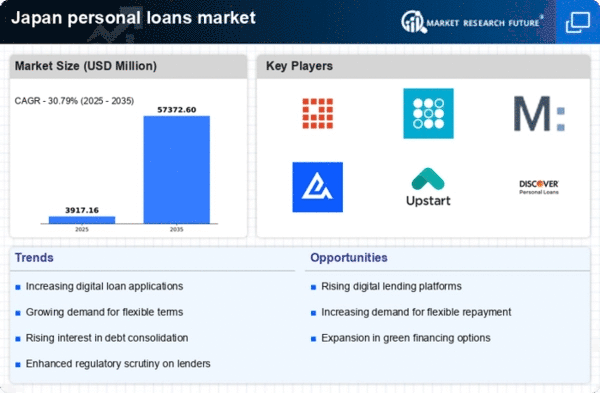
As per Market Research Future analysis, the Japan personal loans market Size was estimated at 2995.0 USD Million in 2024. The Japan personal loans market is projected to grow from 3917.16 USD Million in 2025 to 57372.6 USD Million by 2035, exhibiting a compound annual growth rate (CAGR) of 30.7% during the forecast period 2025 - 2035

Key Market Trends & Highlights

The Japan personal loans market is experiencing a transformative shift towards digitalization and consumer-centric services.

  • The rise of digital lending platforms is reshaping the personal loans landscape, enhancing accessibility for borrowers.
  • Increased focus on financial literacy is empowering consumers to make informed borrowing decisions, particularly among younger demographics.
  • Regulatory enhancements for consumer protection are fostering a more secure lending environment, which is crucial for market stability.
  • Technological advancements in financial services and rising consumer demand for flexible financing are key drivers propelling market growth.

Market Size & Forecast

2024 Market Size 2995.0 (USD Million)
2035 Market Size 57372.6 (USD Million)
CAGR (2025 - 2035) 30.79%

Major Players

LendingClub (US), SoFi (US), Marcus by Goldman Sachs (US), Avant (US), Upstart (US), Discover Personal Loans (US), LightStream (US), Best Egg (US)

Our Impact
Enabled $4.3B Revenue Impact for Fortune 500 and Leading Multinationals
Partnering with 2000+ Global Organizations Each Year
30K+ Citations by Top-Tier Firms in the Industry

Japan Personal Loans Market Trends

The personal loans market in Japan is currently experiencing a notable transformation, driven by evolving consumer preferences and technological advancements. As individuals increasingly seek financial flexibility, the demand for personal loans appears to be on the rise. This trend is likely influenced by a growing awareness of various lending options available, including online platforms that facilitate quicker access to funds. Furthermore, the competitive landscape among financial institutions is intensifying, prompting lenders to innovate their offerings and enhance customer experiences. In addition, regulatory changes may also play a role in shaping the personal loans market. Authorities are focusing on consumer protection and transparency, which could lead to more favorable borrowing conditions. As a result, borrowers may find themselves with better terms and lower interest rates. Overall, the personal loans market in Japan seems poised for growth, with a combination of consumer demand, technological integration, and regulatory support driving its evolution.

Rise of Digital Lending Platforms

The emergence of digital lending platforms is reshaping the personal loans market. These platforms offer streamlined application processes and faster approvals, appealing to tech-savvy consumers. As more individuals turn to online solutions, traditional banks may need to adapt their services to remain competitive.

Increased Focus on Financial Literacy

There is a growing emphasis on financial literacy among consumers in Japan. Educational initiatives aim to inform potential borrowers about the implications of personal loans, fostering responsible borrowing practices. This trend may lead to more informed decisions and healthier financial behaviors.

Regulatory Enhancements for Consumer Protection

Recent regulatory enhancements are likely to impact the personal loans market positively. Authorities are implementing measures to ensure transparency and fairness in lending practices. These changes may result in improved borrower confidence and a more stable lending environment.

Japan Personal Loans Market Drivers

Increased Competition Among Lenders

The personal loans market in Japan is witnessing intensified competition among lenders, which is reshaping the landscape of borrowing. As new entrants, including fintech companies, emerge alongside traditional banks, consumers are presented with a wider array of options. This competitive environment is driving lenders to innovate and enhance their product offerings, often resulting in lower interest rates and more favorable terms for borrowers. Recent data indicates that the average interest rate for personal loans has decreased by approximately 2% over the past year, making borrowing more accessible. The personal loans market is thus characterized by a dynamic interplay of competition and consumer choice, which is likely to stimulate growth and improve overall market efficiency.

Rising Consumer Demand for Flexible Financing

In Japan, there is a growing consumer demand for flexible financing options, which is significantly impacting the personal loans market. As individuals seek to manage their finances more effectively, the desire for loans that offer customizable repayment terms and lower interest rates has surged. Recent data suggests that around 45% of borrowers prioritize flexibility when choosing personal loans, indicating a shift in consumer preferences. This trend is further fueled by the increasing cost of living and the need for financial support in various life events, such as education, home renovations, or medical expenses. The personal loans market is responding to this demand by offering tailored products that cater to diverse financial needs, thereby enhancing customer satisfaction and loyalty.

Technological Advancements in Financial Services

The personal loans market in Japan is experiencing a notable transformation due to rapid technological advancements. Innovations such as artificial intelligence and machine learning are streamlining the loan application process, enhancing customer experience, and reducing operational costs for lenders. As of November 2025, approximately 60% of personal loans are processed through digital platforms, indicating a shift towards online lending solutions. This trend not only increases accessibility for consumers but also allows lenders to assess creditworthiness more efficiently. The integration of technology in the personal loans market is likely to attract a younger demographic, who prefer digital interactions over traditional banking methods. Consequently, this technological evolution is expected to drive growth in the personal loans market, as more individuals seek quick and convenient financing options.

Demographic Shifts and Changing Borrower Profiles

Demographic shifts in Japan are significantly influencing the personal loans market, as the borrower profile evolves. With an aging population and a growing number of young professionals entering the workforce, the demand for personal loans is diversifying. Younger borrowers, who are often tech-savvy and financially literate, are seeking loans for various purposes, including education and entrepreneurship. Conversely, older borrowers may require loans for healthcare or retirement planning. This changing landscape suggests that the personal loans market must adapt its offerings to cater to these distinct segments. As of November 2025, it is estimated that millennials and Gen Z account for over 30% of personal loan borrowers, highlighting the need for lenders to develop targeted marketing strategies and product features that resonate with these demographics.

Economic Recovery and Increased Consumer Confidence

The personal loans market in Japan is benefiting from a phase of economic recovery, which appears to be fostering increased consumer confidence. As the economy stabilizes, individuals are more inclined to take on debt for personal projects or investments. Recent statistics indicate that consumer confidence levels have risen by approximately 15% in the past year, leading to a corresponding increase in loan applications. This renewed optimism is likely to drive growth in the personal loans market, as consumers feel more secure in their financial situations. Additionally, favorable interest rates and competitive lending options are encouraging borrowers to explore personal loans as a viable financial solution. The interplay between economic conditions and consumer sentiment is crucial in shaping the dynamics of the personal loans market.


Market Segment Insights

By Type: Unsecured Loans (Largest) vs. Debt Consolidation Loans (Fastest-Growing)

The Japan personal loans market is characterized by a diverse range of lending options, with secured loans, unsecured loans, debt consolidation loans, and personal lines of credit competing for market share. Unsecured loans dominate this segment, appealing to borrowers who prefer not to put collateral at risk. Meanwhile, debt consolidation loans have emerged as a popular choice for those seeking to simplify their finances, leading to their rapid growth in the market. In the current economic environment, the growth of unsecured loans is driven by low interest rates and increasing consumer confidence, while debt consolidation loans gain traction as individuals look to manage multiple debts efficiently. The rising need for financial flexibility and the proactive approach of lenders are key factors contributing to this segment's dynamics, fostering competition and innovation to cater to diverse consumer needs.

Unsecured Loans (Dominant) vs. Debt Consolidation Loans (Emerging)

Unsecured loans hold a dominant position in the Japan personal loans market due to their convenience and lack of collateral requirements, making them particularly attractive to younger consumers and those with limited assets. These loans often feature competitive interest rates and quick approval processes, appealing to those in need of immediate funds. Conversely, debt consolidation loans are an emerging alternative, designed for consumers looking to streamline their financial obligations into a single, manageable payment. This segment is gaining momentum as lenders enhance their offerings and consumers increasingly recognize the benefits of debt management. As financial literacy improves, both segments are likely to evolve, with borrowers becoming more discerning and lenders adapting to meet their changing needs.

By Borrower Type: Individual Borrowers (Largest) vs. Joint Borrowers (Fastest-Growing)

In the Japan personal loans market, Individual Borrowers hold the largest share among all borrower types, demonstrating a stable preference for personal loans tailored to individual needs. Joint Borrowers have also gained traction, particularly among younger couples and families seeking larger amounts, further diversifying the market landscape. Moreover, Borrowers with Bad Credit and First-Time Borrowers play significant roles, though they represent smaller segments of the overall market. Growth trends indicate a shift towards increased acceptance of Joint Borrowers, which is attributed to evolving social norms that favor shared financial responsibilities. Furthermore, technological advancements facilitating easier access to credit for Borrowers with Bad Credit are boosting their market presence. First-Time Borrowers are also witnessing increased support from financial institutions aiming to capture this demographic, emphasizing tailored offerings and competitive rates.

Individual Borrowers (Dominant) vs. Joint Borrowers (Emerging)

Individual Borrowers dominate the landscape of the Japan personal loans market, reflecting a strong inclination toward loans that cater to personal financial needs, such as home renovations, education, and unexpected expenses. This segment is characterized by straightforward application processes and personalized loan structures. In contrast, Joint Borrowers represent an emerging segment gaining momentum, driven by changing family dynamics and a collective approach to financial obligations. This segment often applies for more substantial loans, facilitating investments in shared assets, such as homes. Financial institutions recognize the potential in catering to Joint Borrowers, leading to customized offerings designed to attract couples and families seeking joint financial solutions.

By Purpose of Loan: Home Improvement (Largest) vs. Medical Expenses (Fastest-Growing)

In the Japan personal loans market, the distribution among segment values reveals that Home Improvement holds the largest market share, appealing to homeowners looking to enhance their living spaces. This segment benefits from stable demand, driven by the aging housing stock and a cultural inclination toward home renovation. Conversely, Medical Expenses is emerging rapidly, being propelled by rising healthcare costs and an increased awareness of health-related financing options. Growth trends indicate that while Home Improvement maintains its dominance, Medical Expenses is the fastest-growing category, spurred by the increasing need for medical services and financial assistance to cover unexpected health issues. This growth is further supported by recent policy changes and healthcare funding initiatives aimed at providing easier access to personal loans for medical needs, reflecting an evolving consumer focus on health and wellness.

Home Improvement: (Dominant) vs. Education Expenses (Emerging)

Home Improvement stands as the dominant purpose for personal loans in this market, characterized by a strong consumer desire to invest in property enhancement and value addition. Homeowners often prioritize renovations, expansions, or energy-efficient upgrades, reflecting a cultural emphasis on property aesthetics and functionality. In contrast, Education Expenses is recognized as an emerging segment, buoyed by Japan's competitive educational landscape and the increasing costs associated with higher education. As families seek to fund higher educational pursuits for their children, they are increasingly relying on personal loans, signaling a shift in funding strategies in response to evolving educational needs and the high value placed on academic qualifications in society.

By Loan Tenure: Short-Term Loans (Largest) vs. Long-Term Loans (Fastest-Growing)

In the Japan personal loans market, the distribution of market share among loan tenures reveals a strong preference for short-term loans, which dominate the landscape significantly. These loans have captured a considerable portion of the market due to their appealing features, such as quicker approval processes and shorter repayment periods, aligning well with the immediate financial needs of consumers. Meanwhile, medium-term loans showcase a moderate share, occupying a niche segment amidst the dominance of their short-term counterpart. Long-term loans are emerging as the fastest-growing segment in the Japan personal loans market, driven by changing consumer preferences and a growing acceptance of extended repayment plans. This shift can be attributed to rising consumer confidence, as borrowers seek larger amounts to finance significant purchases or consolidate debt. Additionally, competitive interest rates offered by lenders in this tenure category have further propelled their growth, signaling a shift towards more flexible borrowing options.

Short-Term Loans (Dominant) vs. Long-Term Loans (Emerging)

Short-term loans are characterized by their quick access to funds and immediate relief for borrowers facing urgent financial needs. As the dominant force in the Japan personal loans market, they typically feature shorter repayment periods, often ranging from a few weeks to a year, appealing to consumers who prefer to manage their debts swiftly. On the other hand, long-term loans are emerging as a preferred choice for those looking for higher loan amounts with extended repayment terms. These loans, usually defined by repayment periods longer than one year, cater to individuals making significant investments or needing to manage larger financial burdens, positioning them as an increasingly attractive alternative in a changing market landscape.

Get more detailed insights about Japan Personal Loans Market

Key Players and Competitive Insights

The personal loans market in Japan is characterized by a dynamic competitive landscape, driven by evolving consumer preferences and technological advancements. Key players such as LendingClub (US), SoFi (US), and Marcus by Goldman Sachs (US) are actively shaping the market through innovative offerings and strategic partnerships. LendingClub (US) has positioned itself as a leader in the digital lending space, focusing on enhancing user experience through advanced technology and streamlined processes. Meanwhile, SoFi (US) emphasizes a holistic approach to personal finance, integrating personal loans with investment and insurance products, thereby creating a comprehensive financial ecosystem. Marcus by Goldman Sachs (US) leverages its strong brand reputation to attract customers seeking reliable and competitive loan options, focusing on transparency and customer service.
The business tactics employed by these companies reflect a moderately fragmented market structure, where competition is intense yet diverse. Localizing services to meet regional demands and optimizing digital platforms for user engagement are common strategies. The collective influence of these key players fosters a competitive environment that encourages innovation and responsiveness to consumer needs, ultimately benefiting borrowers through improved loan terms and accessibility.
In September 2025, LendingClub (US) announced a strategic partnership with a leading fintech firm to enhance its AI-driven credit assessment tools. This move is expected to refine the accuracy of loan approvals and reduce processing times, thereby improving customer satisfaction. Such advancements in technology not only streamline operations but also position LendingClub (US) as a frontrunner in the competitive landscape, potentially attracting a larger customer base seeking efficient loan solutions.
In October 2025, SoFi (US) expanded its product offerings by introducing a new personal loan product tailored specifically for freelancers and gig economy workers. This strategic initiative aims to address the unique financial needs of this growing demographic, which often faces challenges in securing traditional loans. By catering to this niche market, SoFi (US) enhances its competitive edge and demonstrates its commitment to inclusivity in financial services.
In August 2025, Marcus by Goldman Sachs (US) launched a new digital platform designed to provide personalized financial advice alongside its loan products. This initiative reflects a broader trend towards integrating advisory services with lending, allowing customers to make informed financial decisions. By enhancing its service offerings, Marcus (US) not only strengthens customer loyalty but also differentiates itself in a crowded market.
As of November 2025, the competitive trends in the personal loans market are increasingly defined by digitalization, sustainability, and the integration of AI technologies. Strategic alliances among key players are shaping the landscape, fostering innovation and enhancing service delivery. Looking ahead, competitive differentiation is likely to evolve from traditional price-based competition towards a focus on technological innovation, customer experience, and supply chain reliability. This shift underscores the importance of adaptability and forward-thinking strategies in maintaining a competitive advantage.

Key Companies in the Japan Personal Loans Market include

Industry Developments

Recent developments in the Japan Personal Loans Market reflect a dynamic environment for financial services, showcasing enhanced competition and innovation. As of October 2023, major players like Toyota Financial Services and SBI Holdings have been increasingly targeting younger consumers through digital platforms, enabling faster and more convenient loan processing. In September 2023, Resona Holdings announced an initiative to expand its loan offerings using advanced AI technology, aiming to improve decision-making processes in lending. Furthermore, the market has seen significant valuation growth, driven by rising demand for personal loans, partly due to recovery from the pandemic.

In mid-2022, Acom introduced personalized loan products tailored for small businesses, signifying a shift in customer-centric strategies among lenders. Additionally, Mizuho Financial Group and Rakuten Bank have actively explored partnerships to enhance their digital services. Regarding mergers and acquisitions, in July 2023, ORIX Corporation acquired a stake in a fintech startup focusing on automated lending solutions, reflecting trends toward digital transformation. Overall, the competitive landscape continues to evolve with a focus on consumer engagement and technological advancements.

Future Outlook

Japan Personal Loans Market Future Outlook

The personal loans market in Japan is projected to grow at a 30.79% CAGR from 2025 to 2035, driven by digitalization, consumer demand, and competitive lending rates.

New opportunities lie in:

  • Integration of AI-driven credit scoring systems for personalized loan offerings.
  • Expansion of mobile lending platforms to enhance customer accessibility.
  • Development of targeted marketing strategies for niche consumer segments.

By 2035, the personal loans market is expected to achieve substantial growth and innovation.

Market Segmentation

Japan Personal Loans Market Type Outlook

  • Secured Loans
  • Unsecured Loans
  • Debt Consolidation Loans
  • Personal Lines of Credit

Japan Personal Loans Market Loan Tenure Outlook

  • Short-Term Loans
  • Medium-Term Loans
  • Long-Term Loans

Japan Personal Loans Market Borrower Type Outlook

  • Individual Borrowers
  • Joint Borrowers
  • Borrowers with Bad Credit
  • First-Time Borrowers

Japan Personal Loans Market Purpose of Loan Outlook

  • Home Improvement
  • Medical Expenses
  • Education Expenses
  • Travel and Vacation

Report Scope

MARKET SIZE 2024 2995.0(USD Million)
MARKET SIZE 2025 3917.16(USD Million)
MARKET SIZE 2035 57372.6(USD Million)
COMPOUND ANNUAL GROWTH RATE (CAGR) 30.79% (2025 - 2035)
REPORT COVERAGE Revenue Forecast, Competitive Landscape, Growth Factors, and Trends
BASE YEAR 2024
Market Forecast Period 2025 - 2035
Historical Data 2019 - 2024
Market Forecast Units USD Million
Key Companies Profiled LendingClub (US), SoFi (US), Marcus by Goldman Sachs (US), Avant (US), Upstart (US), Discover Personal Loans (US), LightStream (US), Best Egg (US)
Segments Covered Type, Borrower Type, Purpose of Loan, Loan Tenure
Key Market Opportunities Integration of digital platforms enhances accessibility and efficiency in the personal loans market.
Key Market Dynamics Rising consumer demand for flexible repayment options drives innovation in the personal loans market.

Countries Covered Japan
Leave a Comment

FAQs

What is the expected market size of the Japan Personal Loans Market in 2024?

The Japan Personal Loans Market is expected to be valued at 2.6 billion USD in 2024.

What is the projected market size for the Japan Personal Loans Market by 2035?

By 2035, the Japan Personal Loans Market is projected to reach a value of 8.0 billion USD.

What is the compound annual growth rate (CAGR) for the Japan Personal Loans Market from 2025 to 2035?

The CAGR for the Japan Personal Loans Market is expected to be 10.758 percent from 2025 to 2035.

How is the Japan Personal Loans Market segmented by type?

The Japan Personal Loans Market is segmented into P2P Marketplace Lending and Balance Sheet Lending.

What is the estimated value of P2P Marketplace Lending in the Japan Personal Loans Market in 2024?

P2P Marketplace Lending is estimated to be valued at 1.2 billion USD in 2024.

What is the expected market value of Balance Sheet Lending in the Japan Personal Loans Market in 2024?

Balance Sheet Lending is expected to be valued at 1.4 billion USD in 2024.

Who are the key players in the Japan Personal Loans Market?

Major players in the Japan Personal Loans Market include Toyota Financial Services, Resona Holdings, and Rakuten Bank among others.

What market opportunities exist in the Japan Personal Loans Market?

Emerging trends and technological advancements offer significant growth opportunities in the Japan Personal Loans Market.

What are the anticipated challenges in the Japan Personal Loans Market?

Market competition and regulatory changes are potential challenges within the Japan Personal Loans Market.

Which segment of the Japan Personal Loans Market is expected to grow rapidly between 2025 and 2035?

Both P2P Marketplace Lending and Balance Sheet Lending are expected to see significant growth during this period.

What is the expected market size of the Japan Personal Loans Market by 2024?

The Japan Personal Loans Market is expected to be valued at 2.6 USD Billion by 2024.

What is the projected market size for the Japan Personal Loans Market in 2035?

By 2035, the market is anticipated to grow to a value of 30.0 USD Billion.

What is the expected CAGR for the Japan Personal Loans Market from 2025 to 2035?

The market is projected to grow at a compound annual growth rate of 24.899% from 2025 to 2035.

Which are the major players in the Japan Personal Loans Market?

Key players in the market include Mitsubishi UFJ Financial Group, Promise Co Ltd, and Nomura Holdings among others.

How is the Japan Personal Loans Market segmented by type for 2024?

The market is divided into P2P Marketplace Lending and Balance Sheet Lending, with each segment valued at 1.3 USD Billion in 2024.

What is the market value forecast for P2P Marketplace Lending by 2035?

The P2P Marketplace Lending segment is expected to reach a valuation of 15.0 USD Billion by 2035.

What is the financial outlook for Balance Sheet Lending in 2035?

Balance Sheet Lending is also projected to reach a value of 15.0 USD Billion by 2035.

What are the growth drivers for the Japan Personal Loans Market?

Key growth drivers include increased consumer demand for personal loans and advancements in digital lending technologies.

How are current global scenarios impacting the Japan Personal Loans Market?

Current global scenarios may create both challenges and opportunities for growth in the Japan Personal Loans Market.

What are the emerging trends in the Japan Personal Loans Market?

Emerging trends include the rise of fintech solutions and increased competition from P2P lending platforms.

Download Free Sample

Kindly complete the form below to receive a free sample of this Report

Compare Licence

×
Features License Type
Single User Multiuser License Enterprise User
Price $4,950 $5,950 $7,250
Maximum User Access Limit 1 User Upto 10 Users Unrestricted Access Throughout the Organization
Free Customization
Direct Access to Analyst
Deliverable Format
Platform Access
Discount on Next Purchase 10% 15% 15%
Printable Versions