×
Request Free Sample ×

Kindly complete the form below to receive a free sample of this Report

* Please use a valid business email

Leading companies partner with us for data-driven Insights

clients tt-cursor
Hero Background

Japan Patient Access Solutions Market

ID: MRFR/HC/48893-HCR
200 Pages
Rahul Gotadki
February 2026

Japan Patient Access Solutions Market Research Report: Size, Share, Trend Analysis By Service (Support & Maintenance, Implementation) and By Software (Eligibility Verification Software, Medical Necessity Management Software) - Growth Outlook & Industry Forecast 2025 To 2035

Share:
Download PDF ×

We do not share your information with anyone. However, we may send you emails based on your report interest from time to time. You may contact us at any time to opt-out.

Japan Patient Access Solutions Market Infographic
Purchase Options

Japan Patient Access Solutions Market Summary

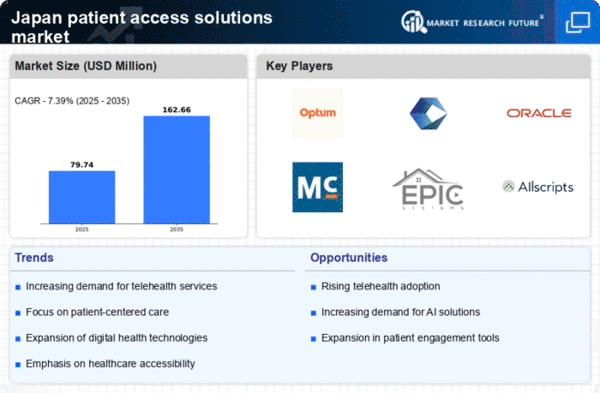
As per Market Research Future analysis, the Japan Patient Access Solutions Market size was estimated at 74.25 USD Million in 2024. The Patient Access-solutions market is projected to grow from 79.74 USD Million in 2025 to 162.66 USD Million by 2035, exhibiting a compound annual growth rate (CAGR) of 7.3% during the forecast period 2025 - 2035

Key Market Trends & Highlights

The Japan patient access-solutions market is experiencing a robust shift towards digital transformation and patient-centric approaches.

  • The market is witnessing a significant digital transformation in healthcare, enhancing patient access and engagement.
  • Policy-driven initiatives are increasingly shaping the landscape, promoting innovative solutions for patient access.
  • The largest segment in this market is the telehealth solutions segment, while the fastest-growing segment is the patient engagement technology segment.
  • Key market drivers include technological advancements in healthcare and the aging population, which are fueling demand for effective patient access solutions.

Market Size & Forecast

2024 Market Size 74.25 (USD Million)
2035 Market Size 162.66 (USD Million)
CAGR (2025 - 2035) 7.39%

Major Players

Optum (US), Cognizant (US), Cerner (US), McKesson (US), Epic Systems (US), Allscripts (US), Change Healthcare (US), R1 RCM (US)

Our Impact
Enabled $4.3B Revenue Impact for Fortune 500 and Leading Multinationals
Partnering with 2000+ Global Organizations Each Year
30K+ Citations by Top-Tier Firms in the Industry

Japan Patient Access Solutions Market Trends

The Japan Patient Access Solutions Market is experiencing notable transformations., driven by evolving healthcare policies and technological advancements. In Japan, the emphasis on improving patient access to healthcare services has led to the development of innovative solutions that streamline processes and enhance patient experiences. The government has implemented various initiatives aimed at reducing barriers to healthcare access, which has resulted in a more patient-centric approach. This shift appears to be fostering collaboration among healthcare providers, technology firms, and policymakers, ultimately aiming to create a more efficient healthcare ecosystem. Moreover, the integration of digital health technologies is becoming increasingly prevalent within the patient access-solutions market. Telemedicine, electronic health records, and mobile health applications are gaining traction, enabling patients to access services more conveniently. This trend suggests a growing recognition of the importance of patient engagement and empowerment in managing health. As the landscape continues to evolve, stakeholders are likely to focus on enhancing interoperability and data security, ensuring that patient information is both accessible and protected. Overall, the patient access-solutions market is poised for continued growth, reflecting the changing dynamics of healthcare delivery in Japan.

Digital Transformation in Healthcare

The patient access-solutions market is witnessing a significant shift towards digital transformation. This trend encompasses the adoption of telehealth services, mobile applications, and electronic health records, which facilitate easier access to healthcare for patients. As technology becomes more integrated into healthcare delivery, patients are likely to benefit from improved communication with providers and more streamlined processes.

Policy-Driven Initiatives

Government initiatives aimed at enhancing healthcare access are shaping the patient access-solutions market. Policies that focus on reducing administrative burdens and improving service delivery are being implemented. These efforts are likely to encourage healthcare providers to adopt innovative solutions that align with national health objectives, ultimately benefiting patients.

Focus on Patient-Centric Solutions

There is a growing emphasis on patient-centric solutions within the patient access-solutions market. This trend indicates a shift towards understanding and addressing the unique needs of patients. By prioritizing patient experiences and outcomes, healthcare providers are likely to develop more tailored services that enhance overall satisfaction and engagement.

Japan Patient Access Solutions Market Drivers

Rising Consumer Expectations

Consumer expectations regarding healthcare services are evolving, significantly influencing the patient access-solutions market. Patients in Japan are increasingly seeking convenient, timely, and personalized healthcare experiences. This shift in expectations is prompting healthcare providers to adopt innovative access solutions, such as online appointment scheduling and remote consultations. In 2025, surveys indicate that over 70% of patients prefer digital solutions for managing their healthcare needs. This trend suggests that healthcare organizations must adapt to meet these demands, thereby driving growth in the patient access-solutions market as they implement more user-friendly and accessible services.

Government Initiatives and Funding

The Japanese government is actively promoting initiatives aimed at improving healthcare access, which is a crucial driver for the patient access-solutions market. Recent policies have focused on increasing funding for healthcare infrastructure and technology adoption. For instance, the government allocated approximately $2 billion in 2025 to enhance digital health initiatives, which are expected to improve patient access to services. These initiatives not only aim to reduce healthcare disparities but also encourage innovation within the market. As a result, the patient access-solutions market is likely to benefit from increased investment and support from governmental bodies.

Aging Population and Chronic Diseases

Japan's demographic landscape is characterized by a rapidly aging population, which significantly impacts the patient access-solutions market. By 2025, it is projected that over 30% of the population will be aged 65 and older, leading to a higher prevalence of chronic diseases such as diabetes and cardiovascular conditions. This demographic shift necessitates enhanced access to healthcare services, prompting healthcare providers to invest in patient access solutions that cater to the needs of older adults. Consequently, the market is likely to see increased demand for tailored services that facilitate easier access to care, thereby driving growth in the patient access-solutions market.

Integration of Artificial Intelligence

The integration of artificial intelligence (AI) into healthcare systems is emerging as a pivotal driver for the patient access-solutions market. AI technologies are being utilized to enhance patient engagement, streamline administrative tasks, and improve diagnostic accuracy. In Japan, the AI healthcare market is projected to reach $1 billion by 2025, indicating a growing reliance on these technologies. As healthcare providers increasingly leverage AI to optimize patient access and care delivery, the patient access-solutions market is likely to expand. This integration not only improves operational efficiency but also enhances the overall patient experience, making healthcare more accessible.

Technological Advancements in Healthcare

The patient access-solutions market in Japan is experiencing a surge due to rapid technological advancements. Innovations such as telemedicine, electronic health records, and mobile health applications are transforming how patients access healthcare services. In 2025, it is estimated that the telehealth market in Japan will reach approximately $1.5 billion, reflecting a growth rate of around 20% annually. These technologies not only enhance patient engagement but also streamline administrative processes, thereby improving overall efficiency. As healthcare providers increasingly adopt these solutions, the patient access-solutions market is likely to expand, driven by the demand for more accessible and efficient healthcare delivery systems.


Market Segment Insights

By Service: Support & Maintenance (Largest) vs. Implementation (Fastest-Growing)

In the Japan patient access-solutions market, the service segment is primarily dominated by Support & Maintenance, which has established itself as the largest segment in terms of market share. Its significance lies in the critical role it plays in ensuring seamless operational functionalities for healthcare providers. This segment often garners client loyalty due to the continuous need for reliable support services, thus maintaining its market position effectively. On the other hand, the Implementation segment is emerging as the fastest-growing segment within the larger service category. This growth can be attributed to the increasing complexity of patient access solutions that require specialized knowledge and expertise for proper deployment. Providers are focusing more on tailoring solutions right from the implementation stage to enhance effectiveness and compliance, signaling a trend toward greater investment in this domain.

Support & Maintenance (Dominant) vs. Implementation (Emerging)

Support & Maintenance in the Japan patient access-solutions market is characterized by its robust customer base and longstanding industry presence, making it a dominant force. This segment facilitates ongoing assistance, troubleshooting, and updates, helping firms uphold their operational efficiency. Conversely, Implementation is an emerging segment that is rapidly gaining traction, driven by the need for customized solutions and advanced integration in healthcare practices. The growing emphasis on user-friendly systems and quick adaptation has made the Implementation segment vital, as it often determines the success of software solutions in real-world applications.

By Software: Eligibility Verification Software (Largest) vs. Medical Necessity Management Software (Fastest-Growing)

In the Japan patient access-solutions market, the distribution of market share between various software types showcases distinct differences, with Eligibility Verification Software commanding the largest share. This software is pivotal in streamlining the patient admission process, ensuring that patients meet the necessary criteria for insurance benefits, thereby becoming an essential tool for healthcare providers. On the other hand, Medical Necessity Management Software is emerging as a significant player, capturing increasing attention for its role in ensuring that treatments and procedures are covered by insurance, thus contributing to its rapid growth in the market. The growth trends in this segment are largely attributed to the ongoing digital transformation within the healthcare sector in Japan. With an increasing emphasis on efficiency and compliance, healthcare providers are turning towards innovative software solutions to enhance patient access and ensure timely reimbursements. The rising complexity of healthcare regulations and the demand for better patient outcomes drive investments into solutions that reduce administrative burdens and improve workflow processes, paving the way for Medical Necessity Management Software to expand its footprint in the market.

Eligibility Verification Software (Dominant) vs. Medical Necessity Management Software (Emerging)

Eligibility Verification Software is characterized by its extensive adoption among healthcare facilities, ensuring that patient eligibility is assessed swiftly and accurately. This segment remains dominant due to its critical role in mitigating financial risks associated with patient admissions. Conversely, Medical Necessity Management Software is emerging rapidly as healthcare providers seek tools to validate the medical necessity of treatments before they are carried out. This software helps in reducing claim denials and streamlining prior authorization processes, thus gaining traction in a market that increasingly values efficiency and compliance.

Get more detailed insights about Japan Patient Access Solutions Market

Key Players and Competitive Insights

The patient access-solutions market in Japan is characterized by a dynamic competitive landscape, driven by the increasing demand for efficient healthcare delivery and enhanced patient experiences. Key players such as Optum (US), Cognizant (US), and Cerner (US) are strategically positioned to leverage technological advancements and partnerships to enhance their service offerings. Optum (US) focuses on integrating data analytics and artificial intelligence to streamline patient access processes, while Cognizant (US) emphasizes digital transformation initiatives to improve operational efficiencies. Cerner (US) is actively pursuing collaborations with local healthcare providers to tailor solutions that meet specific regional needs, thereby shaping a competitive environment that prioritizes innovation and localized service delivery.In terms of business tactics, companies are increasingly localizing their operations to better align with the unique demands of the Japanese healthcare system. This localization often involves optimizing supply chains and enhancing service delivery models to ensure responsiveness to patient needs. The market appears moderately fragmented, with several key players exerting influence through strategic partnerships and technological advancements. The collective efforts of these companies contribute to a competitive structure that fosters innovation while addressing the complexities of patient access in Japan.

In October Optum (US) announced a partnership with a leading Japanese healthcare provider to implement a new patient access platform that utilizes AI-driven analytics. This strategic move is expected to enhance patient engagement and streamline appointment scheduling, reflecting a growing trend towards personalized healthcare solutions. The collaboration signifies Optum's commitment to expanding its footprint in Japan and adapting its offerings to local market demands.

In September Cognizant (US) launched a new initiative aimed at integrating telehealth services into its patient access solutions. This initiative is particularly relevant in the context of Japan's aging population, as it seeks to provide more accessible healthcare options for elderly patients. By enhancing its service portfolio, Cognizant positions itself as a leader in addressing the evolving needs of the Japanese healthcare market.

In August Cerner (US) expanded its operations in Japan by acquiring a local health IT firm specializing in patient engagement solutions. This acquisition is likely to bolster Cerner's capabilities in delivering tailored patient access solutions, thereby enhancing its competitive edge. The strategic importance of this move lies in Cerner's ability to leverage local expertise to better serve the Japanese market, which is increasingly focused on patient-centered care.

As of November the competitive trends in the patient access-solutions market are heavily influenced by digitalization, sustainability, and the integration of AI technologies. Strategic alliances among key players are shaping the landscape, fostering innovation and enhancing service delivery. Looking ahead, it appears that competitive differentiation will increasingly hinge on technological advancements and the reliability of supply chains, rather than solely on price. This shift underscores the importance of innovation and adaptability in meeting the evolving demands of the healthcare sector.

Key Companies in the Japan Patient Access Solutions Market include

Industry Developments

Recent developments in the Japan Patient Access Solutions Market reflect significant activity, particularly among major companies like Eisai, Gilead Sciences, and Takeda Pharmaceutical. In October 2023, Gilead Sciences expanded its partnership with Japanese healthcare providers to enhance patient access to its innovative therapies, following regulatory approvals that facilitated smoother patient engagement processes. Additionally, in September 2023, Takeda Pharmaceutical announced its acquisition of a local healthcare technology firm to improve patient navigation solutions, further demonstrating the growing trend of digitalization in the patient access space.

Over the past few years, notable market growth has been observed, with the Japanese government emphasizing the need for enhanced patient access to cutting-edge therapies, aligning with the global shift towards patient-centric healthcare models. Companies like AbbVie and Merck and Co are also adapting their strategies to optimize accessibility for patients facing medical complexities. Moreover, the collaboration between pharmaceutical firms and local health authorities is fostering innovation in patient support programs, significantly impacting market dynamics and driving competitive advantages among leading companies such as Johnson and Johnson and Roche Holdings.

Future Outlook

Japan Patient Access Solutions Market Future Outlook

The Patient Access Solutions Market in Japan is projected to grow at a 7.39% CAGR from 2025 to 2035, driven by technological advancements and increasing demand for efficient healthcare services.

New opportunities lie in:

  • Integration of AI-driven patient scheduling systems
  • Expansion of telehealth platforms for remote consultations
  • Development of mobile applications for patient engagement and access

By 2035, the market is expected to achieve substantial growth, enhancing patient access and operational efficiency.

Market Segmentation

Japan Patient Access Solutions Market Service Outlook

  • Support & Maintenance
  • Implementation

Japan Patient Access Solutions Market Software Outlook

  • Eligibility Verification Software
  • Medical Necessity Management Software

Report Scope

MARKET SIZE 2024 74.25(USD Million)
MARKET SIZE 2025 79.74(USD Million)
MARKET SIZE 2035 162.66(USD Million)
COMPOUND ANNUAL GROWTH RATE (CAGR) 7.39% (2025 - 2035)
REPORT COVERAGE Revenue Forecast, Competitive Landscape, Growth Factors, and Trends
BASE YEAR 2024
Market Forecast Period 2025 - 2035
Historical Data 2019 - 2024
Market Forecast Units USD Million
Key Companies Profiled Optum (US), Cognizant (US), Cerner (US), McKesson (US), Epic Systems (US), Allscripts (US), Change Healthcare (US), R1 RCM (US)
Segments Covered Service, Software
Key Market Opportunities Integration of digital health technologies enhances patient engagement in the patient access-solutions market.
Key Market Dynamics Rising demand for digital patient access solutions driven by regulatory changes and technological advancements in Japan.
Countries Covered Japan
Leave a Comment

FAQs

What is the expected market size of the Japan Patient Access Solutions Market in 2024?

The Japan Patient Access Solutions Market is expected to be valued at 74.25 million USD in 2024.

What is the projected market size for the Japan Patient Access Solutions Market by 2035?

By 2035, the Japan Patient Access Solutions Market is projected to attain a valuation of 145.02 million USD.

What is the expected compound annual growth rate (CAGR) for the Japan Patient Access Solutions Market between 2025 and 2035?

The expected CAGR for the Japan Patient Access Solutions Market between 2025 and 2035 is 6.275%.

Which companies are considered major players in the Japan Patient Access Solutions Market?

Major players in the market include Eisai, Gilead Sciences, Celgene, Merck & Co, AbbVie, Amgen, and Bristol-Myers Squibb, among others.

What is the market value for 'Support & Maintenance' services in 2024?

The 'Support & Maintenance' services segment is valued at 37.13 million USD in 2024.

What will be the value of 'Implementation' services in the year 2035?

The 'Implementation' services segment is projected to be valued at 70.9 million USD in 2035.

How does the market for patient access solutions in Japan compare to other regions?

While the exact regional comparisons may vary, the Japan Patient Access Solutions Market exhibits strong growth potential relative to other regional markets.

What are the key growth drivers for the Japan Patient Access Solutions Market?

Key growth drivers include technological advancements in healthcare and increasing demand for patient support services.

Are there any notable challenges impacting the Japan Patient Access Solutions Market?

Challenges such as regulatory complexities and competition from alternative healthcare solutions may impact market growth.

What emerging trends are shaping the Japan Patient Access Solutions Market?

Emerging trends include increased digitalization of healthcare services and a focus on personalized patient care solutions.

Download Free Sample

Kindly complete the form below to receive a free sample of this Report

Compare Licence

×
Features License Type
Single User Multiuser License Enterprise User
Price $4,950 $5,950 $7,250
Maximum User Access Limit 1 User Upto 10 Users Unrestricted Access Throughout the Organization
Free Customization
Direct Access to Analyst
Deliverable Format
Platform Access
Discount on Next Purchase 10% 15% 15%
Printable Versions