×
Request Free Sample ×

Kindly complete the form below to receive a free sample of this Report

* Please use a valid business email

Leading companies partner with us for data-driven Insights

clients tt-cursor
Hero Background

Japan Passive Authentication Market

ID: MRFR/ICT/60689-HCR
200 Pages
Aarti Dhapte
February 2026

Japan Passive Authentication Market Size, Share and Trends Analysis Report By Component (Solution, Service) and By Function (Compliance Management, Marketing Management, Risk Management, Others)- Forecast to 2035

Share:
Download PDF ×

We do not share your information with anyone. However, we may send you emails based on your report interest from time to time. You may contact us at any time to opt-out.

Japan Passive Authentication Market Infographic
Purchase Options

Japan Passive Authentication Market Summary

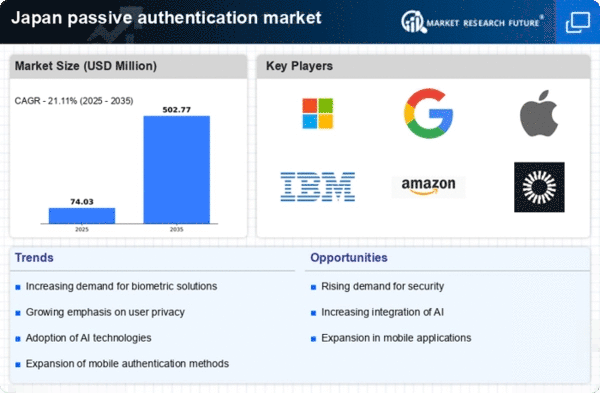
As per Market Research Future analysis, the Japan passive authentication market size was estimated at 61.12 USD Million in 2024. The Japan passive authentication market is projected to grow from 74.03 USD Million in 2025 to 502.77 USD Million by 2035, exhibiting a compound annual growth rate (CAGR) of 21.1% during the forecast period 2025 - 2035

Key Market Trends & Highlights

The Japan passive authentication market is experiencing robust growth driven by technological advancements and increasing security demands.

  • The integration of biometric technologies is becoming prevalent in the Japan passive authentication market.
  • Behavioral analytics implementation is gaining traction, enhancing user verification processes.
  • The market is supported by regulatory frameworks that promote secure authentication practices.
  • Rising cybersecurity concerns and consumer demand for seamless experiences are key drivers of market growth.

Market Size & Forecast

2024 Market Size 61.12 (USD Million)
2035 Market Size 502.77 (USD Million)
CAGR (2025 - 2035) 21.11%

Major Players

Microsoft (US), Google (US), Apple (US), IBM (US), Amazon (US), Okta (US), Ping Identity (US), Auth0 (US)

Our Impact
Enabled $4.3B Revenue Impact for Fortune 500 and Leading Multinationals
Partnering with 2000+ Global Organizations Each Year
30K+ Citations by Top-Tier Firms in the Industry

Japan Passive Authentication Market Trends

The passive authentication market is experiencing notable growth, driven by advancements in technology and increasing demand for seamless user experiences. In Japan, the integration of biometric systems and behavioral analytics is becoming more prevalent, as organizations seek to enhance security while minimizing user friction. This trend aligns with the broader shift towards digital transformation, where businesses prioritize efficient and secure authentication methods. As a result, the market is witnessing a surge in investments aimed at developing innovative solutions that cater to diverse industries, including finance, healthcare, and retail. Moreover, the regulatory landscape in Japan is evolving, with government initiatives promoting the adoption of secure authentication practices. This regulatory support is likely to encourage organizations to invest in passive authentication technologies, thereby fostering a more secure digital environment. The emphasis on privacy and data protection is also influencing market dynamics, as consumers become increasingly aware of their digital footprints. Consequently, the passive authentication market is poised for continued expansion, driven by technological advancements and a growing focus on user-centric security solutions.

Integration of Biometric Technologies

The adoption of biometric technologies is on the rise within the passive authentication market. Organizations are increasingly utilizing fingerprint recognition, facial recognition, and voice recognition systems to enhance security measures. This trend reflects a broader commitment to improving user experience while ensuring robust protection against unauthorized access.

Behavioral Analytics Implementation

Behavioral analytics is gaining traction as a key component of passive authentication strategies. By analyzing user behavior patterns, organizations can identify anomalies and potential security threats. This approach not only strengthens security but also allows for a more personalized user experience, as systems adapt to individual behaviors.

Regulatory Support for Secure Practices

The regulatory environment in Japan is evolving to support the adoption of secure authentication methods. Government initiatives are encouraging businesses to implement passive authentication technologies, which may lead to increased investments in security solutions. This regulatory backing is likely to shape the future landscape of the market, promoting a culture of security awareness.

Japan Passive Authentication Market Drivers

Increased Mobile Device Usage

The proliferation of mobile devices in Japan is significantly impacting the passive authentication market. With over 80% of the population using smartphones, there is a pressing need for secure yet user-friendly authentication methods. The rise in mobile transactions and online services necessitates solutions that can authenticate users without requiring active input. In 2025, mobile commerce in Japan is expected to exceed $50 billion, further emphasizing the need for effective passive authentication solutions. The passive authentication market is likely to benefit from this trend, as businesses seek to implement technologies that facilitate secure access to mobile applications and services. This shift towards mobile-centric solutions may drive innovation and growth within the market.

Rising Cybersecurity Concerns

The increasing frequency of cyberattacks in Japan has heightened the demand for advanced security measures, including those offered by the passive authentication market. Organizations are increasingly recognizing the need to protect sensitive data from unauthorized access. In 2025, it is estimated that cybercrime could cost Japanese businesses over $100 billion annually. This alarming trend drives companies to adopt passive authentication solutions that enhance security without compromising user experience. The passive authentication market is thus positioned to benefit from this growing awareness, as businesses seek to implement seamless security measures that do not require active user participation. As a result, the market is likely to see a surge in investment and innovation aimed at addressing these pressing cybersecurity challenges.

Technological Advancements in AI

The rapid advancements in artificial intelligence (AI) are significantly influencing the passive authentication market in Japan. AI technologies enable more sophisticated methods of user verification, such as behavioral biometrics and machine learning algorithms that analyze user patterns. In 2025, the AI market in Japan is projected to reach approximately $20 billion, indicating a robust growth trajectory. This growth is likely to enhance the capabilities of passive authentication solutions, making them more effective and reliable. The passive authentication market stands to gain from these technological innovations, as organizations increasingly seek to leverage AI to improve security measures while maintaining user convenience. Consequently, the integration of AI into passive authentication solutions may lead to a more secure digital environment.

Consumer Demand for Seamless Experiences

In Japan, there is a growing consumer expectation for seamless digital experiences, which is driving the passive authentication market. Users increasingly prefer authentication methods that do not disrupt their interactions with digital platforms. As of 2025, surveys indicate that over 70% of Japanese consumers favor solutions that allow for frictionless access to services. This trend compels businesses to adopt passive authentication technologies that enhance user experience while ensuring security. The passive authentication market is thus likely to expand as companies prioritize user-centric solutions that align with consumer preferences. By focusing on seamless authentication processes, businesses can improve customer satisfaction and loyalty, ultimately contributing to the growth of the market.

Regulatory Compliance and Data Protection

Japan's stringent data protection regulations are influencing the passive authentication market. The Personal Information Protection Act (PIPA) mandates that organizations implement robust security measures to protect user data. As compliance becomes increasingly critical, businesses are turning to passive authentication solutions that align with regulatory requirements. In 2025, it is anticipated that the demand for compliant security solutions will drive market growth by approximately 15%. The passive authentication market is thus positioned to thrive as organizations seek to meet legal obligations while enhancing their security posture. This regulatory landscape encourages innovation and investment in passive authentication technologies, ensuring that businesses can protect sensitive information effectively.


Market Segment Insights

By Application: Online Banking (Largest) vs. E-commerce (Fastest-Growing)

In the Japan passive authentication market, Online Banking holds the largest share, reflecting its critical role in financial transactions and customer trust. E-commerce is rapidly rising, driven by the increasing online shopping habits of consumers and the growing need for secure transaction methods. The Government Services and Healthcare segments also play significant roles but remain smaller in comparison, indicating a more niche application of passive authentication technology. The growth in the E-commerce segment is fueled by heightened digital transformation, as businesses prioritize secure access for users. Online Banking continues to innovate to maintain its leading position, improving user experiences and enhancing security features. Government Services show potential for expansion with digital identification initiatives, while the Healthcare segment is gradually adopting such technologies for patient confidentiality and streamlined access to services. This dynamic landscape indicates a shift towards security-centric solutions across various applications.

Online Banking (Dominant) vs. E-commerce (Emerging)

Online Banking is characterized by its necessity for robust authentication protocols, ensuring user data protection and transaction security. This segment is marked by traditional banking institutions investing heavily in secure technology to safeguard customer trust. On the other hand, E-commerce is emerging as a significant player, appealing to consumers with diverse payment options and innovative user interfaces. This segment focuses on user convenience, prompting rapid advancements in authentication methods. The rise of mobile transactions and global marketplaces compels E-commerce platforms to adopt stringent security measures, positioning them as competitive challengers to Online Banking. With sectors like Government Services and Healthcare gradually adopting passive authentication, the synergy between these segments can lead to more comprehensive solutions in the future.

By Technology: Behavioral Biometrics (Largest) vs. Device Recognition (Fastest-Growing)

In the Japan passive authentication market, behavioral biometrics holds the largest share, significantly contributing to the overall market dynamics. Device recognition follows closely, exhibiting impressive growth rates as awareness and implementation of sophisticated authentication methods increase. Other segment values, including user environment analysis and geolocation, play essential roles but do not match the share or growth trajectory of the leading segments. The growth of behavioral biometrics is driven by the rising demand for secure and seamless user experiences, while device recognition is gaining traction due to advancements in AI and machine learning technologies. Emerging trends, such as increased regulatory focus on security and privacy, further propel these technologies as businesses adopt multifactor authentication strategies to protect sensitive information.

Technology: Behavioral Biometrics (Dominant) vs. Device Recognition (Emerging)

Behavioral biometrics has established itself as the dominant technology in the Japan passive authentication market, recognized for its ability to analyze unique user patterns and behaviors for enhanced security. This segment uses advanced algorithms to assess various factors, such as typing speed and mouse movement, making it difficult to spoof. On the other hand, device recognition is an emerging technology that is rapidly gaining traction. It utilizes the unique characteristics of devices to identify users, providing a complementary layer of security. The synergy between these technologies represents a comprehensive approach to authentication, where behavioral biometrics ensures user fidelity, and device recognition enhances accessibility and convenience in user verification processes.

By End Use: Financial Institutions (Largest) vs. Retail (Fastest-Growing)

The market share distribution among the segments in the Japan passive authentication market reveals that financial institutions hold the largest share, reflecting their need for robust security mechanisms. Retail follows closely, showing a notable inclination towards adopting these technologies as customer engagement and security concerns escalate in the sector. Healthcare providers and government entities are also significant, though they lag behind in market presence. Growth trends indicate that the financial sector will continue to invest heavily in passive authentication technologies to protect sensitive data and enhance customer trust. Meanwhile, the retail sector is emerging as the fastest-growing segment, driven by the increasing use of digital payment systems and a heightened focus on personalizing customer experiences. Healthcare providers are focusing on safeguarding patient data, and government entities are enforcing regulations that foster broader adoption.

Financial Institutions: Dominant vs. Retail: Emerging

Financial institutions represent the dominant segment in the Japan passive authentication market, characterized by their extensive implementation of advanced security measures to protect financial transactions and customer data. The demand for reliable and seamless authentication solutions is driven by the need to combat fraud and ensure compliance with regulatory requirements. On the other hand, retail is identified as an emerging segment, rapidly adopting passive authentication technologies to streamline the customer journey and enhance transaction security. With the rise of e-commerce and mobile payments, retailers are increasingly integrating these solutions to provide a frictionless shopping experience, focusing on user convenience while maintaining high-security standards.

By Deployment Type: Cloud-Based (Largest) vs. On-Premises (Fastest-Growing)

In the Japan passive authentication market, the deployment type segment is predominantly led by cloud-based solutions, which command a significant market share due to their scalability and flexibility. This segment appeals to a wide range of businesses, offering ease of access and reduced infrastructure costs as key advantages. On-premises solutions, while holding a smaller share, are becoming increasingly attractive to enterprises seeking enhanced control and security, especially in regulated industries. The growth trends for the deployment type segment highlight a shift towards cloud-based offerings as organizations embrace digital transformation. The convenience and lower upfront costs associated with cloud services are contributing to their dominance. Conversely, the on-premises segment is marked as the fastest-growing due to rising demands for data sovereignty and enhanced security measures, making it a compelling choice for businesses prioritizing control and compliance.

Cloud-Based (Dominant) vs. On-Premises (Emerging)

Cloud-based solutions in the Japan passive authentication market are characterized by their robustness, flexibility, and easy integration with existing systems, making them the preferred choice for diverse enterprises. These solutions enable organizations to rapidly scale their authentication services to meet varying demands without significant upfront investment. Conversely, on-premises solutions offer an emerging alternative for companies needing stringent data security and regulatory compliance. Though currently trailing in market share, on-premises deployments are witnessing increased adoption driven by concerns over data privacy and the desire for control over sensitive information. This segment's growth reflects a balanced demand for both innovative cloud solutions and traditional systems.

Get more detailed insights about Japan Passive Authentication Market

Key Players and Competitive Insights

The passive authentication market in Japan is characterized by a dynamic competitive landscape, driven by the increasing demand for seamless user experiences and enhanced security measures. Major players such as Microsoft (US), Google (US), and Apple (US) are at the forefront, leveraging their technological prowess to innovate and expand their offerings. Microsoft (US) focuses on integrating advanced AI capabilities into its authentication solutions, while Google (US) emphasizes user-centric design and privacy features. Apple (US) continues to enhance its biometric authentication methods, positioning itself as a leader in secure user identification. Collectively, these strategies foster a competitive environment that prioritizes innovation and user trust, shaping the market's trajectory.Key business tactics within this market include localized service offerings and strategic partnerships aimed at optimizing supply chains and enhancing customer engagement. The competitive structure appears moderately fragmented, with a mix of established tech giants and emerging players vying for market share. This fragmentation allows for diverse approaches to passive authentication, as companies tailor their solutions to meet specific regional needs and regulatory requirements, thereby influencing overall market dynamics.

In October Microsoft (US) announced a partnership with a leading Japanese telecommunications provider to enhance its Azure Active Directory services, integrating advanced passive authentication features tailored for local enterprises. This strategic move not only strengthens Microsoft's foothold in Japan but also aligns with the growing demand for cloud-based security solutions, indicating a shift towards more integrated and user-friendly authentication processes.

In September Google (US) launched a new initiative aimed at improving its authentication services by incorporating machine learning algorithms that adapt to user behavior patterns. This development is significant as it enhances the security framework while providing a more personalized user experience, reflecting the company's commitment to innovation in the authentication space. Such advancements may potentially set new standards for user authentication practices in Japan.

In August Apple (US) unveiled an upgraded version of its Face ID technology, which now includes enhanced passive authentication capabilities that utilize on-device processing to improve speed and security. This upgrade is crucial as it not only reinforces Apple's market position but also addresses growing consumer concerns regarding privacy and data security, thereby fostering greater user confidence in its products.

As of November the competitive trends in the passive authentication market are increasingly defined by digital transformation, AI integration, and a heightened focus on sustainability. Strategic alliances among key players are reshaping the landscape, facilitating the sharing of resources and expertise. Looking ahead, competitive differentiation is likely to evolve from traditional price-based strategies to a focus on innovation, technological advancements, and supply chain reliability. This shift underscores the importance of developing robust, user-centric solutions that not only meet regulatory standards but also enhance the overall user experience.

Key Companies in the Japan Passive Authentication Market include

Industry Developments

The Japan Passive Authentication Market has recently seen various developments, notably the growing adoption of biometric authentication methods among companies such as NEC and Fujitsu, in response to the increasing demand for enhanced security. In June 2023, Panasonic announced its intention to integrate more advanced passive authentication technologies into its products. Concurrently, cybersecurity firms like Trend Micro have been focusing on expanding their offerings to incorporate passive authentication methods, which are gaining attention as vital tools for fraud prevention.

In terms of mergers and acquisitions, there were no publicly reported activities involving the targeted companies in the last few months. However, the market's growth is evident, with NEC achieving a significant increase in revenue from its security solutions, contributing positively to the overall market valuation. During the past 2-3 years, there has been a noticeable shift towards cloud-based authentication services, with SoftBank actively investing in startups that specialize in innovative authentication solutions. This trend aligns with Japan's government initiatives promoting digital transformation and cyber resilience across various sectors, bolstering the market's forward momentum. As a result, major players like Sony and Denso are also expected to adapt and innovate within the expanding landscape.

Future Outlook

Japan Passive Authentication Market Future Outlook

The Passive Authentication Market in Japan is projected to grow at a 21.11% CAGR from 2025 to 2035, driven by advancements in AI, increased security demands, and user convenience.

New opportunities lie in:

  • Integration of biometric sensors in mobile devices
  • Development of AI-driven fraud detection systems
  • Expansion of passive authentication in e-commerce platforms

By 2035, the market is expected to achieve substantial growth, driven by innovative technologies and increasing adoption.

Market Segmentation

Japan Passive Authentication Market End Use Outlook

  • Financial Institutions
  • Retail
  • Healthcare Providers
  • Government

Japan Passive Authentication Market Technology Outlook

  • Behavioral Biometrics
  • Device Recognition
  • User Environment Analysis
  • Geolocation

Japan Passive Authentication Market Application Outlook

  • Online Banking
  • E-commerce
  • Government Services
  • Healthcare

Japan Passive Authentication Market Deployment Type Outlook

  • Cloud-Based
  • On-Premises

Report Scope

MARKET SIZE 2024 61.12(USD Million)
MARKET SIZE 2025 74.03(USD Million)
MARKET SIZE 2035 502.77(USD Million)
COMPOUND ANNUAL GROWTH RATE (CAGR) 21.11% (2025 - 2035)
REPORT COVERAGE Revenue Forecast, Competitive Landscape, Growth Factors, and Trends
BASE YEAR 2024
Market Forecast Period 2025 - 2035
Historical Data 2019 - 2024
Market Forecast Units USD Million
Key Companies Profiled Microsoft (US), Google (US), Apple (US), IBM (US), Amazon (US), Okta (US), Ping Identity (US), Auth0 (US)
Segments Covered Application, Technology, End Use, Deployment Type
Key Market Opportunities Integration of AI-driven solutions enhances security and user experience in the passive authentication market.
Key Market Dynamics Rising demand for seamless user experiences drives innovation in passive authentication technologies across various sectors.
Countries Covered Japan
Leave a Comment

FAQs

What is the expected market size of the Japan Passive Authentication Market in 2024?

The expected market size of the Japan Passive Authentication Market in 2024 is valued at 81.5 million USD.

What will be the market size of the Japan Passive Authentication Market in 2035?

The market size of the Japan Passive Authentication Market is projected to reach 464.7 million USD by 2035.

What is the expected Compound Annual Growth Rate (CAGR) for the Japan Passive Authentication Market from 2025 to 2035?

The expected CAGR for the Japan Passive Authentication Market from 2025 to 2035 is 17.146%.

Who are the key players in the Japan Passive Authentication Market?

Key players in the Japan Passive Authentication Market include NEC, Panasonic, CyberAgent, Fujitsu, and Denso.

What was the market value of the Solution component in the Japan Passive Authentication Market in 2024?

The market value of the Solution component in 2024 is estimated at 40.5 million USD.

What will be the market value of the Service component in the Japan Passive Authentication Market in 2035?

The market value of the Service component is projected to be 230.6 million USD by 2035.

What growth trends are expected in the Japan Passive Authentication Market between 2025 and 2035?

The Japan Passive Authentication Market is expected to experience significant growth driven by technological advancements and increased demand for secure authentication.

How does the Japan Passive Authentication Market compare to other regions in terms of growth?

The Japan Passive Authentication Market is anticipated to show robust growth relative to other regions due to high cybersecurity investments.

What challenges does the Japan Passive Authentication Market face in its growth?

Challenges in the Japan Passive Authentication Market include evolving security threats and the need for continuous innovation.

What applications are driving the growth of the Japan Passive Authentication Market?

Applications in finance, e-commerce, and mobile services are significantly driving the growth of the Japan Passive Authentication Market.

Download Free Sample

Kindly complete the form below to receive a free sample of this Report

Compare Licence

×
Features License Type
Single User Multiuser License Enterprise User
Price $4,950 $5,950 $7,250
Maximum User Access Limit 1 User Upto 10 Users Unrestricted Access Throughout the Organization
Free Customization
Direct Access to Analyst
Deliverable Format
Platform Access
Discount on Next Purchase 10% 15% 15%
Printable Versions