×
Request Free Sample ×

Kindly complete the form below to receive a free sample of this Report

* Please use a valid business email

Leading companies partner with us for data-driven Insights

clients tt-cursor
Hero Background

Japan Oxygen Therapy Equipment Market

ID: MRFR/MED/52293-HCR
200 Pages
Rahul Gotadki
February 2026

Japan Oxygen Therapy Equipment Market Research Report By Product Type (Continuous Positive Airway Pressure, Nasal Cannulas, Oxygen Concentrators, Liquid Oxygen Systems, Portable Oxygen Cylinders), By Technology (Conventional Oxygen Therapy, Hyperbaric Oxygen Therapy, Ventilation Techniques, Transcutaneous Oxygen Monitoring), By End Use (Home Care, Hospitals, Emergency Services, Long-term Care Facilities) and By Patient Type (Adult, Pediatric, Geriatric) - Growth & Industry Forecast 2025 To 2035

Share:
Download PDF ×

We do not share your information with anyone. However, we may send you emails based on your report interest from time to time. You may contact us at any time to opt-out.

Japan Oxygen Therapy Equipment Market Infographic
Purchase Options

Japan Oxygen Therapy Equipment Market Summary

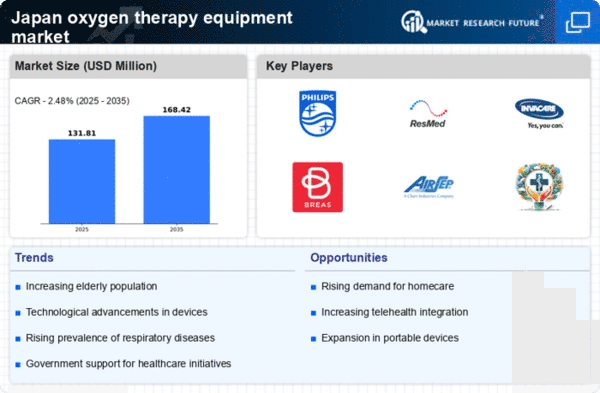
As per Market Research Future analysis, the Japan oxygen therapy equipment market size was estimated at 128.62 USD Million in 2024. The Japan oxygen therapy-equipment market is projected to grow from 131.81 USD Million in 2025 to 168.42 USD Million by 2035, exhibiting a compound annual growth rate (CAGR) of 2.4% during the forecast period 2025 - 2035

Key Market Trends & Highlights

The Japan oxygen therapy-equipment market is experiencing robust growth driven by technological advancements and demographic shifts.

  • Technological advancements in oxygen therapy equipment are enhancing treatment efficacy and patient comfort.
  • The aging population in Japan is contributing to an increased demand for oxygen therapy solutions.
  • Home healthcare is emerging as a significant segment, reflecting a shift towards more personalized patient care.
  • Rising prevalence of respiratory disorders and government initiatives are key drivers propelling market expansion.

Market Size & Forecast

2024 Market Size 128.62 (USD Million)
2035 Market Size 168.42 (USD Million)
CAGR (2025 - 2035) 2.48%

Major Players

Philips (NL), ResMed (AU), Invacare (US), Breas Medical (SE), AirSep Corporation (US), OxyGo (US), DeVilbiss Healthcare (US), Nidek Medical (JP)

Our Impact
Enabled $4.3B Revenue Impact for Fortune 500 and Leading Multinationals
Partnering with 2000+ Global Organizations Each Year
30K+ Citations by Top-Tier Firms in the Industry

Japan Oxygen Therapy Equipment Market Trends

The oxygen therapy-equipment market is currently experiencing notable growth, driven by an increasing prevalence of respiratory diseases and a rising awareness of the importance of oxygen therapy in managing these conditions. The aging population in Japan further contributes to this trend, as older individuals are more susceptible to chronic respiratory issues. Additionally, advancements in technology are leading to the development of more efficient and user-friendly devices, which may enhance patient compliance and overall treatment outcomes. As healthcare systems evolve, there is a growing emphasis on home healthcare solutions, which could potentially expand the market for portable oxygen therapy devices. Moreover, regulatory frameworks in Japan are adapting to support innovation in the oxygen therapy-equipment market. The government appears to be fostering an environment conducive to research and development, which may lead to the introduction of novel products. This shift could result in a more competitive landscape, with various manufacturers striving to meet the diverse needs of patients. Furthermore, the integration of telemedicine and digital health solutions into oxygen therapy may enhance patient monitoring and management, indicating a potential transformation in how care is delivered. Overall, the oxygen therapy-equipment market seems poised for continued expansion, driven by demographic changes, technological advancements, and evolving healthcare practices.

Technological Advancements

Recent innovations in oxygen therapy-equipment are enhancing device efficiency and user-friendliness. Manufacturers are focusing on creating portable and lightweight devices, which may improve patient adherence to therapy. These advancements could lead to a broader acceptance of oxygen therapy among patients, particularly in home settings.

Aging Population

The demographic shift towards an older population in Japan is likely to increase the demand for oxygen therapy-equipment. Older adults are more prone to respiratory ailments, which may drive the need for effective oxygen delivery systems. This trend suggests a growing market for products tailored to the needs of elderly patients.

Regulatory Support

The Japanese government appears to be actively supporting the oxygen therapy-equipment market through favorable regulations and policies. This support may encourage innovation and investment in new technologies, potentially leading to a more dynamic market landscape.

Japan Oxygen Therapy Equipment Market Drivers

Government Initiatives and Funding

Government initiatives aimed at improving healthcare access and funding for respiratory care are pivotal for the oxygen therapy-equipment market. In Japan, the government has implemented various programs to enhance the quality of life for patients with chronic respiratory conditions. These initiatives often include subsidies for medical equipment, making oxygen therapy more accessible to those in need. Additionally, public health campaigns focused on raising awareness about respiratory diseases and the importance of oxygen therapy are likely to drive market growth. The financial support provided by the government can significantly reduce the burden of costs associated with oxygen therapy equipment, thereby encouraging more patients to seek treatment. As a result, the oxygen therapy-equipment market is expected to benefit from these supportive measures, leading to increased adoption and utilization of therapeutic devices.

Growing Awareness of Home Healthcare

The rising awareness and acceptance of home healthcare solutions are transforming the landscape of the oxygen therapy-equipment market. Patients and caregivers are increasingly recognizing the benefits of receiving treatment in the comfort of their homes, which is particularly relevant for those with chronic respiratory conditions. This shift is likely to drive demand for portable and user-friendly oxygen therapy devices that can be easily integrated into home settings. Moreover, the trend towards home healthcare is supported by advancements in telemedicine, allowing healthcare professionals to monitor patients remotely. As a result, the oxygen therapy-equipment market is expected to expand, as more individuals opt for home-based therapies that offer convenience and flexibility in managing their health.

Technological Innovations in Equipment

Technological advancements in the design and functionality of oxygen therapy equipment are significantly influencing the market in Japan. Innovations such as portable oxygen concentrators and advanced delivery systems are enhancing patient convenience and compliance. These devices are becoming increasingly user-friendly, allowing patients to manage their therapy more effectively at home or on the go. The introduction of smart technology, including mobile applications that monitor oxygen levels and usage, is also gaining traction. This trend is likely to attract a broader consumer base, as patients seek more efficient and adaptable solutions for their oxygen therapy needs. Consequently, the oxygen therapy-equipment market is poised for growth, as manufacturers continue to invest in research and development to create cutting-edge products that meet the evolving demands of healthcare providers and patients alike.

Rising Prevalence of Respiratory Disorders

The increasing incidence of respiratory disorders in Japan is a crucial driver for the oxygen therapy-equipment market. Conditions such as chronic obstructive pulmonary disease (COPD) and asthma are becoming more prevalent, affecting a significant portion of the population. According to recent health statistics, approximately 5.5 million individuals in Japan are diagnosed with COPD, which necessitates the use of oxygen therapy. This growing patient base is likely to propel demand for oxygen therapy equipment, as healthcare providers seek effective solutions to manage these chronic conditions. Furthermore, the aging population, which is more susceptible to respiratory ailments, further amplifies this trend. As a result, the oxygen therapy-equipment market is expected to experience substantial growth, driven by the need for innovative and efficient therapeutic devices to cater to this demographic.

Increased Investment in Healthcare Infrastructure

The ongoing investment in healthcare infrastructure in Japan is a significant driver for the oxygen therapy-equipment market. The government and private sector are focusing on enhancing healthcare facilities, which includes upgrading equipment and technology for respiratory care. This investment is likely to lead to improved access to oxygen therapy services, particularly in rural and underserved areas. Enhanced healthcare infrastructure can facilitate better patient outcomes by ensuring that individuals have access to the necessary therapeutic devices. Furthermore, as hospitals and clinics modernize their facilities, the demand for advanced oxygen therapy equipment is expected to rise. Consequently, the oxygen therapy-equipment market is poised for growth, driven by these infrastructural improvements that aim to provide comprehensive care for patients with respiratory conditions.


Market Segment Insights

By Type: Oxygen Concentrators (Largest) vs. Oximeters (Fastest-Growing)

In the Japan oxygen therapy-equipment market, Oxygen Concentrators hold the largest share, reflecting widespread adoption due to their efficiency and reliability for home use. Oxygen Cylinders and Liquid Oxygen Systems follow, catering to varying patient needs, while Oximeters are gaining traction, attributed to an increasing focus on home healthcare and remote patient monitoring. As healthcare systems evolve, these products' market distribution reveals a preference for portable and user-friendly solutions that can be utilized in everyday settings. Growth trends indicate a robust uptake of Oxygen Concentrators, spurred by technological advancements and supportive government policies favoring home healthcare. Meanwhile, Oximeters are recognized as the fastest-growing segment, driven by rising awareness of respiratory diseases and the importance of monitoring oxygen levels regularly. The demand for compact and easy-to-use devices highlights the shift towards more proactive healthcare practices among patients and providers, influencing future product development and offerings in this segment.

Oxygen Concentrators (Dominant) vs. Oximeters (Emerging)

Oxygen Concentrators are characterized by their ability to provide a continuous supply of oxygen, making them a reliable choice for patients requiring long-term therapy. Their dominance in the market stems from their multifunctionality and lower operational costs compared to traditional Oxygen Cylinders. In contrast, Oximeters, as an emerging technology, are gaining popularity due to their role in non-invasively monitoring oxygen saturation levels, especially in an era of increasing health consciousness. The growing trend of telehealth and remote monitoring devices places Oximeters at the forefront of innovation, enhancing patient engagement and enabling better health management. Together, these segment values represent a dynamic landscape that caters to both established needs and evolving healthcare practices.

By Application: Chronic Obstructive Pulmonary Disease (Largest) vs. Sleep Apnea (Fastest-Growing)

In the Japan oxygen therapy-equipment market, Chronic Obstructive Pulmonary Disease (COPD) stands as the dominant application, capturing the largest market share due to the high prevalence of the condition. This segment is significantly aided by an increase in the aging population and rising pollution levels, which contribute to respiratory ailments. On the other hand, Sleep Apnea is rapidly gaining traction as a key application, driven by increased awareness and diagnosis rates, making it the fastest-growing segment in the market. The growth trends in the Japan oxygen therapy-equipment market underscore a robust rise in the demand for portable oxygen devices for individuals with respiratory distress. Continuous innovations and advancements in technology are enhancing the effectiveness and convenience of treatment options. Factors such as the increase in lifestyle diseases, environmental factors, and healthcare investments are further propelling this sector, creating opportunities for new entrants and established players to innovate in oxygen delivery solutions.

Chronic Obstructive Pulmonary Disease (Dominant) vs. Sleep Apnea (Emerging)

Chronic Obstructive Pulmonary Disease (COPD) represents a stable and dominant segment in the Japan oxygen therapy-equipment market, characterized by a well-established range of products specifically designed for long-term use. The need for supplemental oxygen in COPD patients has led to a strong demand for both stationary and portable oxygen solutions. In contrast, Sleep Apnea is emerging as a significant segment, primarily due to improvements in diagnostic technologies and rising patient expectations. This segment is witnessing the introduction of advanced therapies and devices such as CPAP machines, which are making oxygen therapy more accessible to those suffering from sleep-related disorders. Together, these segments illustrate the diverse application landscape within the market.

By End User: Home Care Settings (Largest) vs. Hospitals (Fastest-Growing)

In the Japan oxygen therapy-equipment market, the distribution of market share among end users highlights that Home Care Settings hold a significant position, recently emerging as the largest segment. This growth can be attributed to the increasing demand for at-home healthcare solutions, which enable patients to receive effective treatment in the comfort of their homes. Hospitals, while currently trailing, are identified as the fastest-growing segment due to the rising prevalence of respiratory conditions, driving heightened investment in hospital-based oxygen therapy solutions. Growth trends within this segment underscore a shift towards more patient-centric care models. The increasing geriatric population and the prevalence of chronic respiratory diseases are major drivers of demand. Additionally, advancements in technology have made portable oxygen systems more feasible for home use, enhancing patient adherence to prescribed therapies. This evolution in care settings is paving the way for a dynamic and expanding oxygen therapy-equipment market.

Home Care Settings (Dominant) vs. Hospitals (Emerging)

Home Care Settings have become the dominant force in the Japan oxygen therapy-equipment market, mainly due to the shift towards outpatient care and the convenience of at-home treatments for patients with chronic conditions. This segment benefits from growing consumer preference for personalized healthcare solutions, such as portable oxygen concentrators that offer mobility and ease of use. Conversely, Hospitals represent an emerging segment with considerable growth potential. The increasing focus on advanced medical treatments and expanded hospital infrastructure drives this market segment, as healthcare facilities adopt more sophisticated oxygen therapy technologies to meet patient needs.

By Distribution Channel: Direct Sales (Largest) vs. Online Sales (Fastest-Growing)

In the Japan oxygen therapy-equipment market, Direct Sales holds the largest share, dominating the distribution landscape. Medical Supply Distributors also play a vital role in channeling products to healthcare facilities, while Online Sales is emerging as a strong contender given the rapid rise in e-commerce across healthcare sectors in Japan. The growth trends are notably influenced by increased demand for home healthcare solutions, driving patients and providers towards easy access points for oxygen therapy products. The expanding digital transformation in healthcare is further propelling Online Sales, making it the fastest-growing channel as consumers increasingly prefer purchasing equipment online for convenience.

Direct Sales (Dominant) vs. Online Sales (Emerging)

Direct Sales is characterized by personalized customer interaction and tailored service, positioning it firmly as the dominant channel. This approach allows manufacturers and suppliers to cultivate strong relationships with healthcare providers and patients, ensuring timely delivery and support. In contrast, Online Sales has emerged as a competitive channel driven by convenience and accessibility, appealing especially to tech-savvy consumers. Its growth is fueled by the increasing trend of remote healthcare services and online shopping preferences, further diversifying the purchasing habits of patients and healthcare professionals in the market.

Get more detailed insights about Japan Oxygen Therapy Equipment Market

Key Players and Competitive Insights

The oxygen therapy-equipment market in Japan is characterized by a competitive landscape that is both dynamic and multifaceted. Key growth drivers include an aging population, increasing prevalence of respiratory diseases, and advancements in technology. Major players such as Philips (NL), ResMed (AU), and Nidek Medical (JP) are strategically positioned to leverage these trends. Philips (NL) focuses on innovation in portable oxygen concentrators, while ResMed (AU) emphasizes digital health solutions to enhance patient management. Nidek Medical (JP) is concentrating on regional expansion and partnerships with local healthcare providers, which collectively shape a competitive environment that is increasingly reliant on technological advancements and patient-centric solutions.In terms of business tactics, companies are localizing manufacturing to reduce costs and optimize supply chains, which is particularly relevant in the context of Japan's unique market demands. The competitive structure appears moderately fragmented, with several key players exerting influence over market dynamics. This fragmentation allows for niche players to thrive, while larger companies consolidate their market share through strategic partnerships and acquisitions.

In October Philips (NL) announced the launch of a new line of portable oxygen concentrators designed specifically for the Japanese market. This strategic move is significant as it not only addresses the growing demand for mobility among patients but also reinforces Philips' commitment to innovation tailored to local needs. The introduction of these devices is likely to enhance patient adherence to therapy, thereby improving health outcomes and solidifying Philips' market position.

In September ResMed (AU) expanded its digital health platform by integrating AI-driven analytics to monitor patient usage of oxygen therapy equipment. This initiative is crucial as it aligns with the increasing trend towards telehealth and remote patient monitoring, allowing healthcare providers to offer more personalized care. The integration of AI may also lead to improved operational efficiencies and better patient engagement, positioning ResMed as a leader in digital transformation within the market.

In August Nidek Medical (JP) entered into a strategic partnership with a local healthcare provider to enhance distribution channels for its oxygen therapy products. This collaboration is indicative of Nidek's focus on strengthening its market presence through localized strategies. By leveraging the established networks of local partners, Nidek is likely to improve its reach and accessibility, which is essential in a market where patient access to therapy is paramount.

As of November current competitive trends are increasingly defined by digitalization, sustainability, and the integration of AI technologies. Strategic alliances are shaping the landscape, enabling companies to pool resources and expertise to innovate more effectively. The shift from price-based competition to a focus on innovation, technology, and supply chain reliability is evident, suggesting that future differentiation will hinge on the ability to deliver advanced, patient-centric solutions that enhance therapeutic outcomes.

Key Companies in the Japan Oxygen Therapy Equipment Market include

Industry Developments

In recent months, the Japan Oxygen Therapy Equipment Market has seen notable developments, reflecting a growing demand for respiratory care solutions driven by an aging population and rising chronic respiratory diseases. Companies like Linde, Philips, and ResMed have been expanding operations, introducing advanced oxygen delivery systems to enhance patient care.

In March 2023, Medtronic launched new portable oxygen concentrators aimed at improving mobility for patients. The market is also witnessing growth in its valuation, with a forecasted CAGR exceeding 5% through 2026, as highlighted by investments and technological advancements.

Notably, there have been reported mergers and acquisitions, including Drive DeVilbiss Healthcare's acquisition of OxyMed in April 2023, which aims to broaden its product range. In addition, in June 2022, Fisher and Paykel Healthcare announced a strategic partnership with Nidec Corporation to enhance respiratory technologies in Japan, aiming to address local market needs more effectively.

These developments signify a responsive market adapting to both technological innovations and demographic shifts, positioning Japan as a crucial hub in global respiratory care.

Future Outlook

Japan Oxygen Therapy Equipment Market Future Outlook

The Oxygen Therapy Equipment Market in Japan is projected to grow at a 2.48% CAGR from 2025 to 2035, driven by technological advancements and increasing healthcare demands.

New opportunities lie in:

  • Development of portable oxygen concentrators for home use
  • Integration of telehealth solutions for remote patient monitoring
  • Expansion of partnerships with healthcare providers for equipment leasing

By 2035, the market is expected to achieve robust growth, reflecting evolving healthcare needs.

Market Segmentation

Japan Oxygen Therapy Equipment Market Type Outlook

  • Oxygen Concentrators
  • Oxygen Cylinders
  • Liquid Oxygen Systems
  • Oximeters

Japan Oxygen Therapy Equipment Market End User Outlook

  • Hospitals
  • Home Care Settings
  • Ambulatory Surgical Centers
  • Long-term Care Facilities

Japan Oxygen Therapy Equipment Market Application Outlook

  • Respiratory Distress
  • Sleep Apnea
  • Chronic Obstructive Pulmonary Disease
  • Pulmonary Hypertension

Japan Oxygen Therapy Equipment Market Distribution Channel Outlook

  • Direct Sales
  • Medical Supply Distributors
  • Online Sales

Report Scope

MARKET SIZE 2024 128.62(USD Million)
MARKET SIZE 2025 131.81(USD Million)
MARKET SIZE 2035 168.42(USD Million)
COMPOUND ANNUAL GROWTH RATE (CAGR) 2.48% (2025 - 2035)
REPORT COVERAGE Revenue Forecast, Competitive Landscape, Growth Factors, and Trends
BASE YEAR 2024
Market Forecast Period 2025 - 2035
Historical Data 2019 - 2024
Market Forecast Units USD Million
Key Companies Profiled Philips (NL), ResMed (AU), Invacare (US), Breas Medical (SE), AirSep Corporation (US), OxyGo (US), DeVilbiss Healthcare (US), Nidek Medical (JP)
Segments Covered Type, Application, End User, Distribution Channel
Key Market Opportunities Integration of advanced telehealth solutions in the oxygen therapy-equipment market enhances patient accessibility and monitoring.
Key Market Dynamics Rising demand for portable oxygen therapy devices driven by aging population and regulatory support in Japan.
Countries Covered Japan
Leave a Comment

FAQs

What is the expected market size of the Japan Oxygen Therapy Equipment Market in 2024?

The Japan Oxygen Therapy Equipment Market is expected to be valued at 1.15 billion USD in 2024.

What will be the projected market size of the Japan Oxygen Therapy Equipment Market by 2035?

By 2035, the Japan Oxygen Therapy Equipment Market is projected to reach 1.87 billion USD.

What is the expected compound annual growth rate (CAGR) for the Japan Oxygen Therapy Equipment Market from 2025 to 2035?

The anticipated CAGR for the Japan Oxygen Therapy Equipment Market from 2025 to 2035 is 4.539%.

Which product type is expected to dominate the Japan Oxygen Therapy Equipment Market?

The Continuous Positive Airway Pressure segment is expected to dominate the market with a projected value of 0.5 billion USD by 2035.

What are the expected market values for Oxygen Concentrators in 2024 and 2035?

Oxygen Concentrators are valued at 0.35 billion USD in 2024, and are expected to reach 0.59 billion USD by 2035.

Who are the key players in the Japan Oxygen Therapy Equipment Market?

Major players in the market include Chart Industries, Philips, Linde, and ResMed among others.

What is the expected market value for Nasal Cannulas in 2035?

The market value for Nasal Cannulas is projected to reach 0.4 billion USD by 2035.

What are the expected growth drivers for the Japan Oxygen Therapy Equipment Market?

Factors driving growth include increased prevalence of respiratory diseases and advancements in oxygen therapy technologies.

What impact does the current global scenario have on the Japan Oxygen Therapy Equipment Market?

The current global scenario has created a heightened demand for oxygen therapy equipment due to increased health awareness.

What is the expected market size for Liquid Oxygen Systems in 2024?

The expected market size for Liquid Oxygen Systems in 2024 is 0.15 billion USD.

Download Free Sample

Kindly complete the form below to receive a free sample of this Report

Compare Licence

×
Features License Type
Single User Multiuser License Enterprise User
Price $4,950 $5,950 $7,250
Maximum User Access Limit 1 User Upto 10 Users Unrestricted Access Throughout the Organization
Free Customization
Direct Access to Analyst
Deliverable Format
Platform Access
Discount on Next Purchase 10% 15% 15%
Printable Versions