×
Request Free Sample ×

Kindly complete the form below to receive a free sample of this Report

* Please use a valid business email

Leading companies partner with us for data-driven Insights

clients tt-cursor
Hero Background

Japan Network Management Market

ID: MRFR/ICT/62439-HCR
200 Pages
Aarti Dhapte
February 2026

Japan Network Management Market Size, Share and Trends Analysis Report By Component (Transcoding & Processing, Video Management, Video Delivery & Distribution, Video Security), By Streaming Type (Live, Video-On-Demand) and By Vertical (BFSI, Healthcare, Education, Media & Entertainment, Travel & Tourism, Defense Government)-Forecast to 2035

Share:
Download PDF ×

We do not share your information with anyone. However, we may send you emails based on your report interest from time to time. You may contact us at any time to opt-out.

Japan Network Management Market Infographic
Purchase Options

Japan Network Management Market Summary

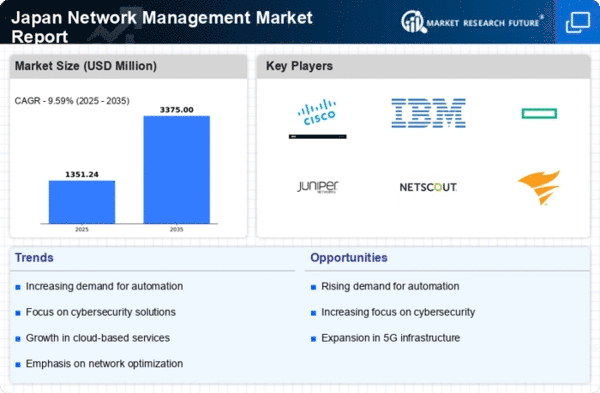
As per Market Research Future analysis, the Japan Network Management Market Size was estimated at 1233.0 USD Million in 2024. The Japan network management market is projected to grow from 1351.24 USD Million in 2025 to 3375.0 USD Million by 2035, exhibiting a compound annual growth rate (CAGR) of 9.5% during the forecast period 2025 - 2035

Key Market Trends & Highlights

The Japan network management market is experiencing a transformative shift towards advanced technologies and enhanced security measures.

  • The market is witnessing increased adoption of cloud-based solutions, reflecting a broader trend towards digital transformation.
  • Focus on cybersecurity enhancements is becoming paramount as organizations seek to protect their networks from evolving threats.
  • Regulatory compliance and data protection are driving organizations to invest in robust network management solutions.
  • Rising demand for network automation and the expansion of IoT devices are key drivers propelling market growth.

Market Size & Forecast

2024 Market Size 1233.0 (USD Million)
2035 Market Size 3375.0 (USD Million)
CAGR (2025 - 2035) 9.59%

Major Players

Cisco Systems (US), IBM (US), Hewlett Packard Enterprise (US), Juniper Networks (US), NetScout Systems (US), SolarWinds (US), ManageEngine (IN), Zabbix (JP), Nagios (US)

Our Impact
Enabled $4.3B Revenue Impact for Fortune 500 and Leading Multinationals
Partnering with 2000+ Global Organizations Each Year
30K+ Citations by Top-Tier Firms in the Industry

Japan Network Management Market Trends

The The network management sector in Japan is currently experiencing a transformative phase. in Japan is currently experiencing a transformative phase, driven by the increasing complexity of network infrastructures and the growing demand for efficient management solutions. Organizations are increasingly recognizing the necessity of robust network management tools to ensure optimal performance, security, and reliability. This shift is largely influenced by the rapid advancements in technology, including the rise of cloud computing and the Internet of Things (IoT). As businesses strive to enhance their operational efficiency, the adoption of sophisticated network management systems is becoming more prevalent. Furthermore, the emphasis on cybersecurity has prompted companies to invest in advanced monitoring and management solutions to safeguard their networks against potential threats. In addition, the regulatory landscape in Japan is evolving, with government initiatives aimed at promoting digital transformation across various sectors. This has led to an increased focus on compliance and data protection, further driving the demand for effective network management solutions. As organizations navigate these changes, they are likely to seek out innovative tools that not only streamline operations but also provide insights into network performance. The future of the network management market appears promising, with continuous advancements in technology and a growing emphasis on security and compliance shaping its trajectory.

Increased Adoption of Cloud-Based Solutions

Organizations are increasingly shifting towards cloud-based network management solutions. This trend is driven by the need for scalability, flexibility, and cost-effectiveness. Cloud solutions allow businesses to manage their networks remotely, facilitating real-time monitoring and management.

Focus on Cybersecurity Enhancements

With the rise in cyber threats, there is a heightened focus on integrating cybersecurity measures within network management systems. Companies are prioritizing solutions that offer advanced security features to protect sensitive data and maintain network integrity.

Regulatory Compliance and Data Protection

As regulations surrounding data protection become more stringent, organizations are seeking network management solutions that ensure compliance. This trend reflects a growing awareness of the importance of safeguarding data and adhering to legal requirements.

Japan Network Management Market Drivers

Expansion of IoT Devices

The proliferation of Internet of Things (IoT) devices in Japan is significantly impacting the The network management sector in Japan is significantly impacted by the proliferation of Internet of Things (IoT) devices.. With an estimated 1.5 billion IoT devices expected to be connected by 2025, the demand for robust network management solutions is intensifying. Organizations are increasingly recognizing the necessity of managing these devices effectively to ensure seamless connectivity and data flow. This trend is likely to drive investments in advanced network management tools that can handle the unique challenges posed by IoT environments. As a result, the network management market is poised for substantial growth, with companies seeking solutions that can provide visibility, control, and security for their expanding IoT ecosystems.

Emergence of 5G Technology

The rollout of 5G technology in Japan is poised to have a profound impact on the The network management sector in Japan is poised to be profoundly impacted by the rollout of 5G technology.. With its promise of ultra-fast data speeds and low latency, 5G is expected to revolutionize various industries, necessitating advanced network management solutions to support its deployment. As businesses prepare for the transition to 5G, there is a growing need for tools that can manage the complexities associated with this new technology. The network management market is likely to see increased demand for solutions that can ensure optimal performance and security in 5G environments. Analysts predict that the adoption of 5G could lead to a market growth rate of approximately 20% in the network management sector over the next few years.

Rising Demand for Network Automation

The The network management sector in Japan is experiencing a notable surge in demand for automation solutions. in Japan is experiencing a notable surge in demand for automation solutions. As organizations strive to enhance operational efficiency, the adoption of automated network management tools is becoming increasingly prevalent. This trend is driven by the need to reduce human error and streamline network operations. According to recent data, the market for network automation tools is projected to grow at a CAGR of approximately 15% over the next five years. This growth is indicative of a broader shift towards more intelligent and self-managing networks, which are essential for supporting the increasing complexity of IT environments. Consequently, the network management market is likely to see a significant transformation as businesses invest in automation technologies to optimize their network performance.

Shift Towards Hybrid Network Architectures

The The network management sector in Japan is witnessing a shift towards hybrid network architectures. in Japan is witnessing a shift towards hybrid network architectures, combining on-premises and cloud-based solutions. This transition is largely influenced by the need for flexibility and scalability in network operations. Organizations are increasingly adopting hybrid models to leverage the benefits of both environments, which necessitates sophisticated network management tools capable of integrating diverse infrastructures. Recent studies indicate that approximately 60% of enterprises in Japan are planning to implement hybrid networks by 2026. This trend is expected to create new opportunities for vendors in the network management market, as businesses seek solutions that can provide comprehensive visibility and control across their hybrid environments.

Increased Focus on Network Performance Optimization

In Japan, there is a growing emphasis on optimizing network performance to support business operations. As digital transformation initiatives accelerate, organizations are prioritizing the need for high-performance networks that can handle increased data traffic and application demands. This focus on performance optimization is driving investments in advanced network management solutions that offer real-time monitoring, analytics, and troubleshooting capabilities. The The network management sector in Japan is experiencing a growing emphasis on optimizing network performance. is likely to benefit from this trend, as companies seek to enhance their network reliability and efficiency. It is estimated that investments in performance optimization tools could account for up to 30% of total network management expenditures in the coming years.


Market Segment Insights

By Components: Transcoding & Processing (Largest) vs. Video Security (Fastest-Growing)

In the Japan network management market, the components segment showcases dynamic market share distribution, with Transcoding & Processing holding a significant share due to its vital role in enhancing video content quality and accessibility. Following closely are Video Management and Video Delivery & Distribution segments, as they support seamless interaction and distribution of multimedia content across platforms, reflecting their essential nature in today’s digital ecosystem. Growth trends in this segment indicate an increasing demand for integrated solutions that encompass various functionalities. The rise in video streaming traffic and the necessity for high-quality video delivery are major drivers. Additionally, the growing emphasis on security within video content management fosters investment in Video Security, marking it as the fastest-growing component, driven by heightened concerns surrounding data privacy and security breaches.

Transcoding & Processing (Dominant) vs. Video Delivery & Distribution (Emerging)

Transcoding & Processing stands as the dominant force in the Japan network management market's components segment, primarily due to its essential role in converting video formats, ensuring compatibility across diverse devices and platforms. It focuses on optimizing video quality and reducing file sizes, thus enhancing user experience. On the other hand, Video Delivery & Distribution is emerging as a crucial segment as demand for efficient and effective content delivery rises. This segment prioritizes the scalability and reliability of video distribution networks, addressing consumer expectations for immediate access to high-quality content across an array of devices. As users increasingly gravitate towards on-demand video services, the relevance and importance of Video Delivery & Distribution are poised for significant growth.

By Streaming Type: Video-On-Demand (Largest) vs. Live (Fastest-Growing)

In the Japan network management market, Video-On-Demand (VOD) holds a commanding position, dominating the streaming type segment with the greatest market share. This segment has gained substantial traction among consumers who prefer flexible viewing options without the constraints of scheduled broadcasts. Live streaming, while currently smaller in terms of market share, is rapidly gaining popularity as it caters to the growing demand for real-time content engagement, especially during events and live broadcasts. The growth trends reveal that while Video-On-Demand maintains its lead due to consistent user preference, the Live segment is on the rise, driven by advancements in technology and changing consumer behavior. Factors such as increased internet penetration, improved streaming quality, and a surge in demand for immediate content are propelling the Live streaming segment forward, marking it as the fastest-growing area within the market. The convergence of these trends indicates an evolving landscape, where traditional viewing habits are shifting significantly.

Video-On-Demand (Dominant) vs. Live (Emerging)

Video-On-Demand (VOD) is a dominant force in the streaming type segment of the Japan network management market, primarily appealing to users demanding flexibility and control over their viewing experiences. With a library of content available for on-demand access, VOD services cater to diverse audience preferences, enabling consumers to watch shows and movies at their leisure. In contrast, Live streaming, while regarded as emerging, is rapidly transforming the landscape by offering immediate access to events and interactive experiences. As social viewing becomes more prevalent, Live streaming enhances audience engagement through real-time interaction, positioning it as a crucial player in the evolving market. Both segments are evolving, yet they serve distinct consumer needs in an increasingly digital world.

By Vertical: BFSI (Largest) vs. Healthcare (Fastest-Growing)

The Japan network management market exhibits a diverse distribution of market share among key vertical segments. The Banking, Financial Services, and Insurance (BFSI) sector holds the largest share, reflecting the critical need for robust network solutions in managing financial transactions and securing sensitive data. In contrast, the Healthcare sector is rapidly increasing its share, driven by the growing reliance on digital health technologies and telemedicine, which demand efficient network management systems to handle vast amounts of data. As digital transformation accelerates across various industries, the demand for effective network management solutions is expected to rise. Healthcare is emerging as the fastest-growing segment, propelled by advancements in IoT and increased regulatory requirements for data security and accessibility. Additionally, BFSI continues to innovate, integrating advanced network technologies to enhance service delivery and customer experience. These trends indicate a dynamic and competitive landscape where both segments play crucial roles in shaping the future of network management solutions.

BFSI: Dominant vs. Healthcare: Emerging

The BFSI segment is the dominant player in the Japan network management market, characterized by its significant investments in advanced security protocols and real-time data management systems. This sector's critical need for maintaining operational integrity and enhancing customer services drives its demand for innovative network solutions. Conversely, the Healthcare sector is labeled as emerging, as it rapidly adopts network management technologies to support telehealth initiatives and improve patient data handling. The integration of AI and machine learning in healthcare networks is enhancing operational efficiencies and patient outcomes, positioning this segment for substantial growth in the coming years. The competition between these segments reflects the evolving demands of network infrastructures in response to technological advancements and regulatory frameworks.

Get more detailed insights about Japan Network Management Market

Key Players and Competitive Insights

The network management market in Japan is characterized by a dynamic competitive landscape, driven by rapid technological advancements and increasing demand for efficient network solutions. Key players such as Cisco Systems (US), IBM (US), and Zabbix (JP) are strategically positioned to leverage innovation and regional expertise. Cisco Systems (US) focuses on enhancing its software-defined networking capabilities, while IBM (US) emphasizes its cloud-based solutions to cater to the growing enterprise needs. Zabbix (JP), with its open-source monitoring solutions, capitalizes on local market knowledge, thus shaping a competitive environment that is increasingly reliant on technological differentiation and customer-centric approaches.In terms of business tactics, companies are increasingly localizing their operations to better serve the Japanese market. This includes optimizing supply chains and enhancing customer support services. The market structure appears moderately fragmented, with a mix of global giants and local players. The collective influence of these key players fosters a competitive atmosphere where innovation and service quality are paramount, allowing them to maintain a competitive edge.

In October Cisco Systems (US) announced a strategic partnership with a leading Japanese telecommunications provider to enhance its network security offerings. This collaboration is expected to bolster Cisco's presence in the region, allowing it to tap into the growing demand for secure network solutions. The strategic importance of this partnership lies in its potential to integrate advanced security features into existing network infrastructures, thereby addressing critical vulnerabilities faced by enterprises.

In September IBM (US) launched a new AI-driven network management platform tailored for the Japanese market. This platform aims to automate network operations and improve efficiency through predictive analytics. The introduction of this platform signifies IBM's commitment to leveraging AI technologies, which could potentially transform how organizations manage their networks, enhancing operational efficiency and reducing downtime.

In August Zabbix (JP) expanded its product offerings by introducing a new cloud-based monitoring solution designed specifically for small to medium-sized enterprises (SMEs). This move is strategically significant as it allows Zabbix to cater to a previously underserved segment of the market, potentially increasing its market share and reinforcing its position as a leader in open-source solutions.

As of November current trends in the network management market include a strong emphasis on digitalization, sustainability, and the integration of AI technologies. Strategic alliances are increasingly shaping the competitive landscape, enabling companies to pool resources and expertise. Looking ahead, competitive differentiation is likely to evolve from traditional price-based competition to a focus on innovation, technological advancements, and supply chain reliability. This shift underscores the importance of agility and responsiveness in meeting the ever-changing demands of the market.

Key Companies in the Japan Network Management Market include

Industry Developments

In recent months, the Japan Network Management Market has seen significant activity, particularly among major companies such as NEC, Toshiba, and Mitsubishi Electric. Notably, ZTE announced enhancements to its network management solutions in September 2023, focused on improving operational efficiencies for telecom providers in Japan. Concurrently, Arista Networks expanded its presence in the market with new offerings tailored for data centers, aiming to support Japan’s evolving digital landscape.

In terms of mergers and acquisitions, Hitachi completed its acquisition of GlobalLogic in September 2022, reinforcing its capabilities in digital solutions and data management within the region. Additionally, IBM is set to strengthen its cloud and network management services, leveraging recent advancements made over the last few years. Market valuations have witnessed growth, as companies invest in Research and Development to keep pace with Japan's robust technological ecosystem, particularly in smart cities and 5G network deployments.

Over the last two to three years, developments in network automation and artificial intelligence have significantly impacted the market dynamics, leading to improved performance and increased competition among the key players mentioned. With continuous investments and strategic initiatives, the Japan Network Management Market is poised for further evolution.

Future Outlook

Japan Network Management Market Future Outlook

The Network Management Market in Japan is poised for growth at a 9.59% CAGR from 2025 to 2035, driven by technological advancements and increasing demand for efficient network solutions.

New opportunities lie in:

  • Development of AI-driven network optimization tools
  • Expansion of cloud-based network management services
  • Integration of IoT solutions for real-time network monitoring

By 2035, the network management market is expected to achieve substantial growth and innovation.

Market Segmentation

Japan Network Management Market Vertical Outlook

  • BFSI
  • Healthcare
  • Education
  • Media & Entertainment
  • Travel & Tourism
  • Defense government

Japan Network Management Market Components Outlook

  • Transcoding & Processing
  • Video Management
  • Video Delivery & Distribution
  • Video Security

Japan Network Management Market Streaming Type Outlook

  • Live
  • Video-On-Demand

Report Scope

MARKET SIZE 2024 1233.0(USD Million)
MARKET SIZE 2025 1351.24(USD Million)
MARKET SIZE 2035 3375.0(USD Million)
COMPOUND ANNUAL GROWTH RATE (CAGR) 9.59% (2025 - 2035)
REPORT COVERAGE Revenue Forecast, Competitive Landscape, Growth Factors, and Trends
BASE YEAR 2024
Market Forecast Period 2025 - 2035
Historical Data 2019 - 2024
Market Forecast Units USD Million
Key Companies Profiled Cisco Systems (US), IBM (US), Hewlett Packard Enterprise (US), Juniper Networks (US), NetScout Systems (US), SolarWinds (US), ManageEngine (IN), Zabbix (JP), Nagios (US)
Segments Covered Components, Streaming Type, Vertical
Key Market Opportunities Adoption of artificial intelligence for enhanced automation in network management solutions.
Key Market Dynamics Rising demand for automated network management solutions driven by technological advancements and regulatory compliance in Japan.
Countries Covered Japan
Leave a Comment

FAQs

What is the projected market size of the Japan Network Management Market in 2024?

The Japan Network Management Market is projected to be valued at approximately 876.8 million USD in 2024.

What is the expected market size for the Japan Network Management Market by 2035?

By 2035, the Japan Network Management Market is expected to reach a valuation of around 2500.0 million USD.

What is the expected compound annual growth rate (CAGR) for the Japan Network Management Market from 2025 to 2035?

The expected CAGR for the Japan Network Management Market from 2025 to 2035 is approximately 9.994 percent.

Which component of the Japan Network Management Market has the highest anticipated growth by 2035?

By 2035, the Video Delivery & Distribution component is anticipated to grow to around 750.0 million USD.

Who are some of the major players in the Japan Network Management Market?

Key players in the Japan Network Management Market include NEC, Toshiba, Mitsubishi Electric, and Cisco Systems.

What is the expected market value for Video Management in the Japan Network Management Market by 2035?

Video Management is expected to be valued at approximately 600.0 million USD by 2035.

How much is the Transcoding & Processing component expected to be worth in 2035?

The Transcoding & Processing component is projected to reach around 440.0 million USD by 2035.

What challenges and opportunities exist in the Japan Network Management Market?

The market presents opportunities driven by technological advancements yet faces challenges related to security concerns.

What is the estimated market size for Video Security in 2024?

The market size for Video Security in 2024 is estimated to be about 256.8 million USD.

What impact does the current global scenario have on the Japan Network Management Market?

Current global dynamics are influencing market strategies and potentially accelerating the need for enhanced network management solutions in Japan.

Download Free Sample

Kindly complete the form below to receive a free sample of this Report

Compare Licence

×
Features License Type
Single User Multiuser License Enterprise User
Price $4,950 $5,950 $7,250
Maximum User Access Limit 1 User Upto 10 Users Unrestricted Access Throughout the Organization
Free Customization
Direct Access to Analyst
Deliverable Format
Platform Access
Discount on Next Purchase 10% 15% 15%
Printable Versions