×
Request Free Sample ×

Kindly complete the form below to receive a free sample of this Report

* Please use a valid business email

Leading companies partner with us for data-driven Insights

clients tt-cursor
Hero Background

Japan Mobile Application Testing Services Market

ID: MRFR/ICT/59585-HCR
200 Pages
Aarti Dhapte
February 2026

Japan Mobile Application Testing Services Market Research Report By Type (Manual, Automation) and By Industry (BFSI, IT & Telecom, Retail, Media, Others)- Forecast to 2035

Share:
Download PDF ×

We do not share your information with anyone. However, we may send you emails based on your report interest from time to time. You may contact us at any time to opt-out.

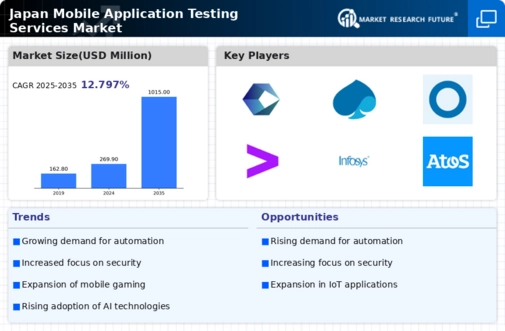
Japan Mobile Application Testing Services Market Infographic
Purchase Options

Japan Mobile Application Testing Services Market Summary

As per analysis, the Japan mobile application testing services market is projected to grow from USD 0.361 Billion in 2024 to USD 1.23 Billion by 2035, exhibiting a compound annual growth rate (CAGR) of 11.82% during the forecast period (2025 - 2035).

Key Market Trends & Highlights

The Japan mobile application testing services market is experiencing a dynamic shift towards enhanced security and automation.

  • The mobile banking segment remains the largest contributor to the market, driven by the increasing reliance on digital financial services.
  • The gaming segment is the fastest-growing area, reflecting the rising popularity of mobile gaming applications among consumers.
  • Functional testing continues to dominate the market, while performance testing is rapidly gaining traction as applications demand higher efficiency.
  • Key market drivers include the rising mobile application usage and the growing demand for quality assurance in an increasingly competitive landscape.

Market Size & Forecast

2024 Market Size 0.361 (USD Billion)
2035 Market Size 1.23 (USD Billion)
CAGR (2025 - 2035) 11.82%

Major Players

Qualitest (JP), Cognizant (JP), Accenture (JP), TCS (JP), Capgemini (JP), Infosys (JP), Wipro (JP), NTT Data (JP), Fujitsu (JP)

Our Impact
Enabled $4.3B Revenue Impact for Fortune 500 and Leading Multinationals
Partnering with 2000+ Global Organizations Each Year
30K+ Citations by Top-Tier Firms in the Industry

Japan Mobile Application Testing Services Market Trends

The japan mobile application testing services market is currently experiencing a notable evolution, driven by the increasing reliance on mobile applications across various sectors. As businesses in Japan continue to embrace digital transformation, the demand for robust testing services has surged. This trend is largely influenced by the need for high-quality user experiences, which necessitates thorough testing processes to ensure functionality, security, and performance. Furthermore, the rise of mobile commerce and the growing popularity of mobile gaming have further propelled the need for specialized testing services tailored to these applications. Companies are increasingly recognizing that effective testing not only enhances user satisfaction but also mitigates risks associated with software failures. In addition, the regulatory landscape in Japan is becoming more stringent, prompting organizations to prioritize compliance in their mobile applications. This shift indicates a growing awareness of the importance of data privacy and security, which are critical in maintaining consumer trust. As a result, testing services that focus on security assessments and compliance checks are likely to gain traction. The convergence of technological advancements, regulatory requirements, and evolving consumer expectations suggests that The Japan mobile application testing services market will continue to expand, presenting opportunities for service providers to innovate and adapt to the changing landscape.

Increased Focus on Security Testing

With the rise of cyber threats, there is a heightened emphasis on security testing within the japan mobile application testing services market. Organizations are prioritizing the identification of vulnerabilities to protect sensitive user data and maintain compliance with regulations.

Integration of Automation in Testing Processes

The adoption of automation tools is becoming more prevalent in the japan mobile application testing services market. This trend allows for faster testing cycles, improved accuracy, and the ability to handle complex applications, thereby enhancing overall efficiency.

Emphasis on User Experience Testing

As competition intensifies, businesses are increasingly focusing on user experience testing. This trend highlights the importance of understanding user behavior and preferences, ensuring that applications meet the expectations of the target audience.

Japan Mobile Application Testing Services Market Drivers

Rising Mobile Application Usage

The proliferation of smartphones in Japan has led to an exponential increase in mobile application usage. As of January 2026, approximately 80 percent of the population utilizes mobile applications for various purposes, including e-commerce, social networking, and entertainment. This surge in mobile app usage necessitates robust testing services to ensure functionality, performance, and security. Consequently, The Japan mobile application testing services market is experiencing heightened demand for comprehensive testing solutions that can accommodate diverse app requirements. Companies are increasingly investing in testing services to enhance user satisfaction and maintain competitive advantage in a saturated market. The need for reliable testing services is further underscored by the growing complexity of mobile applications, which often integrate advanced features such as augmented reality and artificial intelligence. Thus, the rising mobile application usage is a pivotal driver for the Japan mobile application testing services market.

Regulatory Compliance and Standards

Japan's stringent regulatory environment necessitates adherence to various compliance standards, particularly in sectors such as finance and healthcare. As of January 2026, organizations are required to ensure that their mobile applications meet specific security and privacy regulations, including the Act on the Protection of Personal Information (APPI). This regulatory landscape significantly influences The Japan mobile application testing services market, as companies seek to mitigate risks associated with non-compliance. Testing services play a crucial role in validating that applications conform to these regulations, thereby safeguarding user data and maintaining trust. Furthermore, the increasing emphasis on data protection and cybersecurity has prompted businesses to prioritize thorough testing processes. As a result, the demand for specialized testing services that can address regulatory requirements is likely to grow, positioning compliance as a key driver in the Japan mobile application testing services market.

Growing Demand for Quality Assurance

As competition intensifies in the mobile application landscape, the demand for quality assurance has become paramount. In January 2026, businesses in Japan are increasingly recognizing that high-quality applications are essential for user retention and brand loyalty. The Japan mobile application testing services market is responding to this demand by offering comprehensive quality assurance services that encompass functional, performance, and security testing. Companies are investing in testing services to ensure that their applications not only meet user expectations but also perform seamlessly across various devices and platforms. This focus on quality assurance is further driven by user reviews and ratings, which can significantly impact an application's success. As a result, the emphasis on delivering high-quality applications is likely to propel the growth of the Japan mobile application testing services market, as organizations strive to differentiate themselves in a crowded marketplace.

Technological Advancements in Testing Tools

The rapid evolution of technology has led to the development of sophisticated testing tools that enhance the efficiency and effectiveness of mobile application testing. In January 2026, The Japan mobile application testing services market is witnessing a shift towards automation and artificial intelligence in testing processes. These advancements enable faster testing cycles, improved accuracy, and the ability to handle complex applications with ease. Companies are increasingly adopting automated testing solutions to reduce time-to-market and enhance overall product quality. The integration of AI-driven testing tools allows for predictive analytics, which can identify potential issues before they arise. This technological shift not only streamlines testing processes but also reduces operational costs, making it an attractive option for businesses. Consequently, the adoption of advanced testing tools is a significant driver for the growth of the Japan mobile application testing services market.

Increased Investment in Mobile App Development

The mobile app development sector in Japan is experiencing a surge in investment, driven by the growing reliance on digital solutions across industries. As of January 2026, businesses are allocating substantial resources to develop innovative mobile applications that cater to evolving consumer needs. This trend is significantly impacting The Japan mobile application testing services market, as the demand for testing services rises in tandem with app development. Companies are recognizing the importance of integrating testing early in the development lifecycle to identify and address issues proactively. This shift towards a more agile development approach necessitates robust testing services that can keep pace with rapid development cycles. Consequently, the increased investment in mobile app development is a critical driver for the Japan mobile application testing services market, as organizations seek to ensure the quality and reliability of their applications.


Market Segment Insights

By Application Type: Mobile Banking (Largest) vs. Gaming (Fastest-Growing)

In the Japan mobile application testing services market, Mobile Banking holds the largest share among application types. Its widespread adoption by users, supported by high-security requirements and functionalities, ensures a robust demand for testing services. E-commerce and Social Media follow closely, each carving a significant niche as user engagement grows. Meanwhile, Health and Fitness apps have been emerging steadily, reflecting the increasing consumer focus on health management.

E-commerce (Dominant) vs. Health and Fitness (Emerging)

E-commerce applications have established themselves as a dominant force in the Japan mobile application testing services market, driven by the surge in online shopping behaviors and the need for seamless user experiences. They necessitate rigorous testing to ensure functionality across varying devices and operating systems. On the other hand, Health and Fitness applications are considered an emerging segment, gaining traction due to health-conscious trends and digital health solutions. These applications often require specialized testing for features like tracking, user data privacy, and onboarding processes, indicating growth potential in this sector.

By Testing Type: Functional Testing (Largest) vs. Performance Testing (Fastest-Growing)

In the Japan mobile application testing services market, Functional Testing holds the largest share, as it is essential for ensuring that applications perform their intended functions without any issues. This segment encompasses various methodologies to validate app performance in meeting user requirements. Performance Testing follows closely as the fastest-growing segment, driven by an increasing need for apps that deliver a seamless user experience, particularly in terms of response times and load handling capabilities. The growth trends in the mobile application testing services market are significant, fueled by a rise in mobile app usage and the proliferation of devices. As more companies adopt digital strategies, the demand for comprehensive testing solutions that cover all aspects of application performance, usability, compatibility, and security intensifies. With this landscape, we can expect both Functional and Performance testing to continue evolving to meet these pressing market needs.

Functional Testing (Dominant) vs. Compatibility Testing (Emerging)

Functional Testing remains the dominant force in the Japan mobile application testing services market, ensuring that applications function as intended and meet user specifications. Its methodologies are critical in identifying bugs and ensuring compliance with project requirements before the application goes live. On the other hand, Compatibility Testing is emerging as a vital component as diverse mobile devices proliferate. This testing type ensures applications work across various devices, operating systems, and browsers, providing a consistent user experience. As user expectations shift towards seamless interaction across multiple platforms, compatibility testing's relevance increases, making it a key area for growth in the mobile application testing landscape.

By End User: Large Enterprises (Largest) vs. Small and Medium Enterprises (Fastest-Growing)

In the Japan mobile application testing services market, large enterprises hold the largest share, driven by their extensive resources and need for high-quality mobile applications. They benefit from robust budgets and have established protocols that prioritize efficient testing processes. On the other hand, small and medium enterprises are emerging as the fastest-growing segment, owing to the increasing digital transformation initiatives and a burgeoning startup ecosystem in Japan. These SMEs are increasingly recognizing the importance of mobile app testing to remain competitive and cater to a tech-savvy consumer base. As the demand for seamless and flawless mobile applications rises, both segments are poised for growth, but in distinct ways. Large enterprises continue to invest significantly in comprehensive testing services, aiming to enhance user experience and functionality. Conversely, SMEs leverage agile methodologies and cost-effective testing solutions, which are essential for their rapid product development cycles. Collectively, these trends indicate a dynamic shift in the mobile application testing landscape across all end users in Japan.

Large Enterprises: Dominant vs. Small and Medium Enterprises: Emerging

Large enterprises in Japan represent a dominant force in the mobile application testing services market, characterized by their vast resources and systematic approaches to quality assurance. These organizations often possess dedicated QA teams and utilize advanced testing tools, ensuring that their applications meet stringent market standards. The complexity of their projects often requires exhaustive testing phases, and their established presence allows them to influence trends and technologies in the industry. In contrast, small and medium enterprises are seen as an emerging segment, marked by their agility and innovative practices. With limited budgets, they focus on leveraging testing services that offer quick turnaround times without compromising quality. As these SMEs continue to grow in number, their ability to adapt to market needs and implement modern testing solutions will significantly contribute to the evolution of mobile app development in Japan.

By Deployment Model: Cloud-based (Largest) vs. On-premises (Fastest-Growing)

In the Japan mobile application testing services market, the distribution among deployment models shows a clear preference for cloud-based solutions, which dominate the segment thanks to their scalability and flexibility. Enterprises increasingly choose cloud-based services for their ease of integration and cost-effectiveness, making them the largest share in this sector. Meanwhile, on-premises solutions are witnessing significant interest from companies prioritizing data security and control, establishing them as a growing contender in the market.

Deployment Model: Cloud-based (Dominant) vs. On-premises (Emerging)

Cloud-based mobile application testing services provide a robust platform that allows for seamless scaling and rapid deployment of applications. They are characterized by reduced infrastructure costs and increased collaboration capabilities among teams. In contrast, on-premises solutions ensure enhanced data security and compliance, appealing to industries where privacy is paramount. As businesses navigate the complexities of digital transformation, the hybrid model is also gaining traction, combining the reliability of on-premises solutions with the flexibility of the cloud, thus tailoring services to specific needs.

By Service Model: Managed Services (Largest) vs. Consulting Services (Fastest-Growing)

In the Japan mobile application testing services market, Managed Services hold a significant share, positioning themselves as the largest segment due to their comprehensive offerings and increasing demand from businesses seeking efficiency. Consulting Services follow, recognized as the fastest-growing area, driven by the necessity for expert guidance in navigating the complexities of mobile application development and testing processes, particularly with the surge in mobile app usage and the evolving technology landscape. The growth of the Service Model segment is propelled by increasing investments in mobile applications by Japanese companies. Managed Services are preferred for their ability to streamline operations and reduce time-to-market. On the other hand, the rising trend of digital transformation is fueling the demand for Consulting Services, as organizations require specialized knowledge to leverage new testing tools and methodologies effectively.

Managed Services (Dominant) vs. Support Services (Emerging)

Managed Services are the dominant force in the Japan mobile application testing services market, characterized by their holistic approach to application testing and management, often enabling businesses to focus on core operations while outsourcing technical testing functions. These services provide end-to-end support, ensuring comprehensive quality assurance. In contrast, Support Services are emerging in prominence, offering vital assistance post-deployment, such as bug fixing and updates, which are crucial for maintaining high app performance and user satisfaction. As companies increasingly prioritize user experience and app reliability, the importance of Support Services is rapidly growing, making them a key player in supporting mobile application life cycles.

Get more detailed insights about Japan Mobile Application Testing Services Market

Key Players and Competitive Insights

The mobile application testing services market in Japan is characterized by a dynamic competitive landscape, driven by rapid technological advancements and increasing demand for high-quality applications. Key players such as Qualitest (JP), Cognizant (JP), and Accenture (JP) are strategically positioned to leverage their expertise in digital transformation and quality assurance. These companies focus on innovation and partnerships to enhance their service offerings, thereby shaping a competitive environment that emphasizes quality and efficiency in application testing.

The market structure appears moderately fragmented, with several players vying for market share. Companies are adopting various business tactics, including localizing their services to better meet the needs of Japanese clients and optimizing their supply chains to enhance operational efficiency. This collective influence of key players fosters a competitive atmosphere where agility and responsiveness to market demands are paramount.

In December 2025, Qualitest (JP) announced a strategic partnership with a leading Japanese fintech firm to enhance mobile application security testing. This collaboration is significant as it underscores Qualitest's commitment to addressing the growing concerns around cybersecurity in mobile applications, particularly in the financial sector. By aligning with a fintech leader, Qualitest not only strengthens its market position but also expands its service capabilities in a critical area of demand.

In November 2025, Cognizant (JP) launched an innovative AI-driven testing platform aimed at automating the testing process for mobile applications. This move is indicative of Cognizant's focus on integrating advanced technologies to improve testing efficiency and accuracy. The introduction of AI into their testing services may potentially reduce time-to-market for clients, thereby enhancing their competitive edge in a fast-paced environment.

In October 2025, Accenture (JP) expanded its operations in Japan by acquiring a local testing services firm. This acquisition is likely to bolster Accenture's capabilities in mobile application testing, allowing for a more localized approach to service delivery. The strategic importance of this move lies in Accenture's ability to leverage local expertise and resources, which could enhance client relationships and service quality.

As of January 2026, current trends in the mobile application testing services market are heavily influenced by digitalization, sustainability, and the integration of AI technologies. Strategic alliances among key players are shaping the competitive landscape, fostering innovation and collaboration. Looking ahead, it appears that competitive differentiation will increasingly hinge on technological advancements and the reliability of supply chains, rather than solely on price. This shift suggests a future where innovation and quality become the primary drivers of success in the market.

Key Companies in the Japan Mobile Application Testing Services Market include

Industry Developments

In recent months, the Japan Mobile Application Testing Services Market has witnessed significant advancements and developments. Major players like Cognizant, and Accenture are focusing on enhancing mobile application testing through artificial intelligence and automation to improve efficiency and reliability. The market is also seeing increasing demand for cloud-based testing solutions, driving growth in companies such as IBM. In terms of mergers and acquisitions, in September 2023, Capgemini announced its acquisition of a local testing services firm to enhance its mobile application capabilities in Japan, further solidifying its position in the market. 

Additionally, Sauce Labs has increased its market presence by forming strategic partnerships with local enterprises to tailor their testing solutions for the Japanese market needs. Over the last two to three years, the emphasis on mobile security testing has increased notably due to the rising incidence of cybersecurity threats. The Japan government, aiming to support digital transformation, has encouraged investments in mobile technology, which is positively impacting the market's growth trajectory. With such strategic moves, the landscape of mobile application testing services in Japan is rapidly evolving, responding to the changing technological needs and consumer behaviors.

Future Outlook

Japan Mobile Application Testing Services Market Future Outlook

The Japan mobile application testing services market is projected to grow at 11.82% CAGR from 2025 to 2035, driven by increasing mobile app usage and technological advancements.

New opportunities lie in:

  • Integration of AI-driven testing tools for enhanced efficiency.
  • Expansion into IoT application testing services to capture new markets.
  • Development of automated testing frameworks for rapid deployment.

By 2035, the market is expected to be robust, reflecting substantial growth and innovation.

Market Segmentation

Japan Mobile Application Testing Services Market End User Outlook

  • Small and Medium Enterprises
  • Large Enterprises
  • Individual Developers
  • Government Agencies
  • Educational Institutions

Japan Mobile Application Testing Services Market Testing Type Outlook

  • Functional Testing
  • Performance Testing
  • Security Testing
  • Usability Testing
  • Compatibility Testing

Japan Mobile Application Testing Services Market Service Model Outlook

  • Managed Services
  • Consulting Services
  • Support Services

Japan Mobile Application Testing Services Market Application Type Outlook

  • Mobile Banking
  • E-commerce
  • Gaming
  • Social Media
  • Health and Fitness

Japan Mobile Application Testing Services Market Deployment Model Outlook

  • Cloud-based
  • On-premises
  • Hybrid

Report Scope

MARKET SIZE 20240.361(USD Billion)
MARKET SIZE 20250.403(USD Billion)
MARKET SIZE 20351.23(USD Billion)
COMPOUND ANNUAL GROWTH RATE (CAGR)11.82% (2024 - 2035)
REPORT COVERAGERevenue Forecast, Competitive Landscape, Growth Factors, and Trends
BASE YEAR2024
Market Forecast Period2025 - 2035
Historical Data2019 - 2024
Market Forecast UnitsUSD Billion
Key Companies ProfiledQualitest (JP), Cognizant (JP), Accenture (JP), TCS (JP), Capgemini (JP), Infosys (JP), Wipro (JP), NTT Data (JP), Fujitsu (JP)
Segments CoveredApplication Type, Testing Type, End User, Deployment Model, Service Model
Key Market OpportunitiesRising demand for automated testing solutions in the japan mobile application testing services market.
Key Market DynamicsRising demand for mobile application testing services driven by technological advancements and evolving consumer expectations in Japan.
Countries CoveredJapan
Leave a Comment

FAQs

What is the current valuation of the Japan mobile application testing services market?

As of 2024, the market valuation was 0.361 USD Billion.

What is the projected market size for the Japan mobile application testing services market by 2035?

The market is expected to reach a valuation of 1.23 USD Billion by 2035.

What is the expected CAGR for the Japan mobile application testing services market during the forecast period 2025 - 2035?

The market is projected to grow at a CAGR of 11.82% from 2025 to 2035.

Which application types are leading in the Japan mobile application testing services market?

The leading application types include Gaming, E-commerce, and Mobile Banking, with valuations ranging from 0.072 to 0.45 USD Billion.

What are the primary testing types utilized in the Japan mobile application testing services market?

Functional Testing and Performance Testing are among the primary types, with valuations between 0.0725 and 0.3845 USD Billion.

Who are the key players in the Japan mobile application testing services market?

Key players include Qualitest, Cognizant, Accenture, TCS, Capgemini, Infosys, Wipro, NTT Data, and Fujitsu.

What is the market segmentation by end user in the Japan mobile application testing services market?

The market segments by end user include Large Enterprises, Small and Medium Enterprises, and Individual Developers, with valuations from 0.0722 to 0.4926 USD Billion.

How is the Japan mobile application testing services market segmented by deployment model?

The market is segmented into Cloud-based, On-premises, and Hybrid models, with valuations ranging from 0.108 to 0.48 USD Billion.

What service models are prevalent in the Japan mobile application testing services market?

Managed Services and Support Services are prevalent, with valuations between 0.1085 and 0.462 USD Billion.

What trends are influencing the growth of the Japan mobile application testing services market?

Trends such as increasing mobile app usage and the demand for enhanced security and performance testing are driving market growth.

Download Free Sample

Kindly complete the form below to receive a free sample of this Report

Compare Licence

×
Features License Type
Single User Multiuser License Enterprise User
Price $4,950 $5,950 $7,250
Maximum User Access Limit 1 User Upto 10 Users Unrestricted Access Throughout the Organization
Free Customization
Direct Access to Analyst
Deliverable Format
Platform Access
Discount on Next Purchase 10% 15% 15%
Printable Versions