×
Request Free Sample ×

Kindly complete the form below to receive a free sample of this Report

* Please use a valid business email

Leading companies partner with us for data-driven Insights

clients tt-cursor
Hero Background

Japan Mobile Application Market

ID: MRFR/ICT/59533-HCR
200 Pages
Aarti Dhapte
February 2026

Japan Mobile Application Market Research Report By Application (Gaming, Business, E-commerce, Social Media, Health Fitness), By Operating System (Android, iOS, Windows, Others), By Deployment Type (Native Apps, Web Apps, Hybrid Apps) and By End Use (Individuals, Small Businesses, Large Enterprises)-Forecast to 2035

Share:
Download PDF ×

We do not share your information with anyone. However, we may send you emails based on your report interest from time to time. You may contact us at any time to opt-out.

Japan Mobile Application Market Infographic
Purchase Options

Japan Mobile Application Market Summary

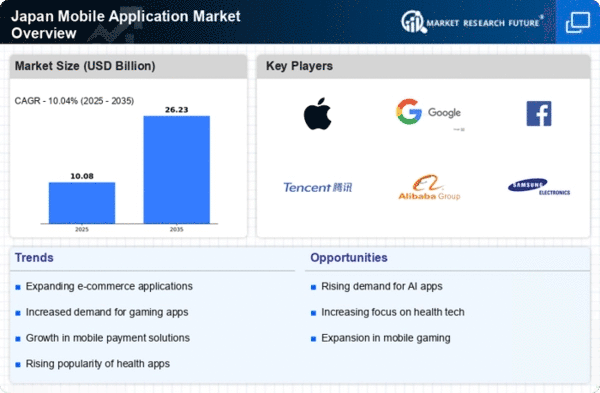
As per Market Research Future analysis, the Japan mobile application market Size was estimated at 9.16 USD Billion in 2024. The Japan mobile application market is projected to grow from 10.08 USD Billion in 2025 to 26.23 USD Billion by 2035, exhibiting a compound annual growth rate (CAGR) of 10.0% during the forecast period 2025 - 2035

Key Market Trends & Highlights

The Japan mobile application market is experiencing dynamic growth driven by technological advancements and evolving consumer preferences.

  • The largest segment in the Japan mobile application market is e-commerce, reflecting the increasing demand for online shopping solutions.
  • Health and fitness applications represent the fastest-growing segment, as consumers prioritize wellness and personal health management.
  • User privacy concerns are prompting developers to enhance security features within mobile applications, influencing user trust and engagement.
  • Rising smartphone penetration and the expansion of 5G technology are key drivers propelling the growth of mobile payment solutions.

Market Size & Forecast

2024 Market Size 9.16 (USD Billion)
2035 Market Size 26.23 (USD Billion)
CAGR (2025 - 2035) 10.04%

Major Players

Apple Inc (US), Google LLC (US), Facebook Inc (US), Tencent Holdings Ltd (CN), Alibaba Group Holding Ltd (CN), Samsung Electronics Co Ltd (KR), Microsoft Corporation (US), ByteDance Ltd (CN), Snap Inc (US)

Our Impact
Enabled $4.3B Revenue Impact for Fortune 500 and Leading Multinationals
Partnering with 2000+ Global Organizations Each Year
30K+ Citations by Top-Tier Firms in the Industry

Japan Mobile Application Market Trends

The mobile application market in Japan is currently experiencing dynamic growth, driven by a combination of technological advancements and changing consumer behaviors. With a high smartphone penetration rate, users increasingly rely on mobile applications for various daily activities, including communication, entertainment, and shopping. The proliferation of 5G technology is enhancing user experiences, enabling faster download speeds and improved app functionalities. Furthermore, the rise of mobile payment solutions is reshaping how consumers engage with services, fostering a more integrated digital ecosystem. As a result, developers are focusing on creating innovative applications that cater to the evolving preferences of users. In addition, the mobile application market is witnessing a surge in demand for applications that prioritize user privacy and data security. This trend reflects a growing awareness among consumers regarding their digital footprints. Consequently, developers are compelled to adopt stringent security measures and transparent data handling practices. The emphasis on user-centric design and functionality is likely to continue shaping the market landscape, as businesses strive to enhance user engagement and retention. Overall, the mobile application market in Japan appears poised for sustained growth, driven by technological innovations and a focus on user experience.

Increased Focus on User Privacy

There is a notable trend towards prioritizing user privacy within the mobile application market. As consumers become more aware of data security issues, developers are implementing enhanced privacy features and transparent data practices. This shift is likely to influence app design and functionality, as businesses aim to build trust with their users.

Integration of AI and Machine Learning

The integration of artificial intelligence and machine learning technologies is transforming the mobile application market. These advancements enable personalized user experiences, predictive analytics, and improved customer service. As a result, applications are becoming more intuitive and responsive to user needs.

Growth of Mobile Payment Solutions

The mobile payment solutions trend is gaining momentum, reflecting a shift in consumer behavior towards cashless transactions. This development is encouraging businesses to incorporate payment functionalities within their applications, enhancing convenience and streamlining the purchasing process for users.

Japan Mobile Application Market Drivers

Expansion of 5G Technology

The rollout of 5G technology in Japan significantly impacts the mobile application market. With faster data speeds and lower latency, 5G enables developers to create more sophisticated applications that require real-time data processing. As of November 2025, over 50% of mobile users in Japan have access to 5G networks, which enhances the user experience and encourages the adoption of data-intensive applications. This technological advancement is likely to stimulate growth in sectors such as gaming, augmented reality, and video streaming within the mobile application market. Consequently, the demand for high-quality applications is expected to rise, further propelling market expansion.

Rising Smartphone Penetration

The mobile application market in Japan experiences a notable boost due to the increasing penetration of smartphones. As of 2025, approximately 80% of the population owns a smartphone, which facilitates access to various applications. This widespread adoption encourages developers to create innovative solutions tailored to user needs. The mobile application market benefits from this trend, as more users engage with apps for communication, entertainment, and productivity. Furthermore, the growing number of smartphone users is likely to drive demand for mobile applications, leading to a projected market growth rate of around 10% annually. This trend indicates a robust ecosystem for app development, fostering competition and creativity within the mobile application market.

Emergence of Subscription-Based Models

The mobile application market in Japan is witnessing a shift towards subscription-based models. This trend allows developers to generate consistent revenue streams while providing users with ongoing access to premium content and features. As of November 2025, it is estimated that subscription-based applications will account for around 30% of total app revenue in the mobile application market. This model appears to resonate well with consumers, as it often includes regular updates and exclusive content. Consequently, developers are likely to invest more in creating high-quality applications that justify subscription fees, thereby fostering a competitive landscape within the mobile application market.

Growing Interest in Health and Fitness Apps

The mobile application market in Japan is experiencing a growing interest in health and fitness applications. As individuals become more health-conscious, there is an increasing demand for apps that promote wellness, exercise, and nutrition tracking. In 2025, it is estimated that the health and fitness app segment will account for approximately 15% of the total mobile application market revenue. This trend suggests that developers are focusing on creating innovative solutions that cater to the health needs of users. The mobile application market is likely to benefit from partnerships with healthcare providers and fitness organizations, further enhancing the credibility and reach of these applications.

Increased Demand for E-commerce Applications

The mobile application market in Japan is witnessing a surge in demand for e-commerce applications. As consumers increasingly prefer online shopping, businesses are investing in mobile platforms to enhance customer engagement. In 2025, e-commerce sales in Japan are projected to reach ¥20 trillion, with a significant portion attributed to mobile transactions. This trend indicates that the mobile application market is adapting to consumer preferences, leading to the development of user-friendly shopping apps. Additionally, the integration of features such as mobile payment solutions and personalized recommendations is likely to enhance user experience, further driving the growth of e-commerce applications.


Market Segment Insights

By Application: Gaming (Largest) vs. E-commerce (Fastest-Growing)

The Japan mobile application market has seen a diverse distribution across its application segments, with Gaming leading the charge, representing the largest share. E-commerce applications are gaining significant traction, driven by increasing consumer demand for convenience in online shopping. Other segments like Social Media and Health & Fitness also maintain notable shares, reflecting the varied interests of mobile users in Japan. Growth trends indicate that while Gaming remains dominant, E-commerce is the fastest-growing segment, propelled by advancements in mobile payment technology and a shift in consumer behavior towards digital shopping. Business applications are also on an upward trajectory, fueled by the increasing adoption of digital tools by enterprises. This growth is underpinned by significant investment in technology and infrastructure enhancements across the country.

Gaming: Dominant vs. E-commerce: Emerging

Gaming applications in the Japan mobile application market are characterized by high user engagement and monetization through in-app purchases and advertisements, solidifying their position as a dominant force. The segment benefits from a vibrant gaming culture and a strong user base that invests heavily in mobile games. In contrast, E-commerce applications are emerging rapidly, reflecting changing shopping habits among consumers seeking efficient and accessible ways to purchase goods online. This segment's growth is supported by platforms offering personalized shopping experiences, seamless payment options, and a broad product assortment, which are becoming essential to capturing the attention of tech-savvy consumers. As E-commerce evolves, it is well-positioned to continue its upward momentum.

By Operating System: Android (Largest) vs. iOS (Fastest-Growing)

In the Japan mobile application market, Android dominates with the largest share among operating systems, catering to diverse users across various demographics. Following closely, iOS has established itself as a robust competitor, especially among premium smartphone users, capturing a significant portion of the market that is increasing steadily. Windows and other operating systems lag in comparison, accounting for a smaller percentage of the overall distribution. The growth trends within the operating system segment are primarily driven by advancements in technology and shifts in user preferences. Android continues to thrive due to its wide range of devices and customizability, appealing to a broad audience. Conversely, iOS is emerging as the fastest-growing segment, driven by the increasing adoption of high-end devices and a strong ecosystem that encourages app development, making it attractive to developers and users alike.

Android (Dominant) vs. iOS (Emerging)

Android's market position is characterized by its flexibility and widespread availability across multiple device manufacturers, making it the dominant operating system in the Japan mobile application market. Its vast app ecosystem, affordability, and customization options cater to both casual and tech-savvy users. In contrast, iOS represents an emerging segment, embodying premium quality and a unique user experience. Its growth is fueled by a dedicated user base willing to spend more on apps, alongside a steady influx of new applications designed to enhance functionality and user engagement within Apple's integrated ecosystem, thus positioning iOS as a compelling choice for developers targeting affluent consumers.

By Deployment Type: Native Apps (Largest) vs. Web Apps (Fastest-Growing)

In the Japan mobile application market, Native Apps hold the largest market share, dominating the landscape with their superior performance and extensive functionality. Web Apps have emerged as a significant player, capturing a growing segment of the market due to their accessibility and ease of use across various devices. Hybrid Apps continue to have a presence, but they are often overshadowed by the benefits offered by Native and Web Apps. Growth trends in this segment are largely driven by the increasing reliance on mobile devices and the demand for applications that work seamlessly across platforms. The convenience of Web Apps attracts a tech-savvy audience looking for quick solutions, while Native Apps benefit from advancements in mobile technology, enhancing user experiences. Hybrid Apps, while slower in growth, appeal to developers seeking to balance functionality with cost-effectiveness, thus maintaining their relevance in the market.

Native Apps (Dominant) vs. Web Apps (Emerging)

Native Apps are considered the dominant force in the realm of mobile applications due to their ability to provide optimized performance and access to device-specific features. Users favor these applications for their responsive design and offline capabilities, making them ideal for resource-intensive tasks such as gaming and multimedia. Meanwhile, Web Apps have positioned themselves as an emerging alternative, recognized for their cross-platform compatibility and ease of updates. They eliminate the need for installation, offering users instant access to functionality via browsers. As both segments continue to evolve, adaptability and user experience remain key differentiators in their respective growth trajectories.

By End-use: Individuals (Largest) vs. Small Businesses (Fastest-Growing)

In the Japan mobile application market, the distribution of market share is quite diverse, with individuals holding the largest share, driven by a high adoption rate of mobile applications for personal use, entertainment, and daily tasks. Small businesses, while not as dominant, have seen a significant increase in their share as they increasingly rely on mobile apps to enhance operations and customer engagement, capitalizing on digital trends. Growth trends indicate that the individual segment will continue to thrive due to ongoing digitalization and the integration of mobile apps into everyday life. Conversely, small businesses are rapidly embracing mobile technologies, particularly in areas such as e-commerce and customer relationship management, making them the fastest-growing segment. This expansion can largely be attributed to increased investment in technology and the rising demand for digital solutions among SMEs.

Individuals: Dominant vs. Small Businesses: Emerging

Individuals in the Japan mobile application market showcase a dominant position, primarily driven by the widespread use of smartphones and the convenience offered by mobile apps for daily activities. This segment has embraced various app categories, including social media, gaming, and productivity tools, contributing to its substantial market share. On the other hand, small businesses represent an emerging force, rapidly adopting mobile solutions to improve customer interactions and service delivery. The growth of this segment is fueled by the increasing recognition of the importance of mobile applications in facilitating business processes and reaching a broader audience, thus establishing a competitive edge in a digital-first economy.

Get more detailed insights about Japan Mobile Application Market

Key Players and Competitive Insights

The mobile application market in Japan is characterized by a dynamic competitive landscape, driven by rapid technological advancements and evolving consumer preferences. Major players such as Apple Inc (US), Google LLC (US), and Tencent Holdings Ltd (CN) are at the forefront, each adopting distinct strategies to enhance their market presence. Apple Inc (US) continues to focus on innovation, particularly in privacy features and user experience, which resonates well with Japanese consumers who prioritize data security. Google LLC (US), on the other hand, emphasizes its ecosystem integration, leveraging its search engine and cloud services to enhance app functionality. Tencent Holdings Ltd (CN) is increasingly investing in gaming applications, capitalizing on Japan's robust gaming culture, while also exploring partnerships with local developers to tailor content to regional tastes.The business tactics employed by these companies reflect a nuanced understanding of the local market. Localization of content and services is paramount, as evidenced by the tailored offerings that resonate with Japanese users. The competitive structure of the market appears moderately fragmented, with a mix of global giants and local players vying for consumer attention. This fragmentation allows for diverse offerings, yet the collective influence of key players like Apple and Google creates a significant impact on market trends and consumer expectations.

In September Apple Inc (US) announced the launch of a new app aimed at enhancing user privacy, which is particularly relevant in the Japanese market where data protection is a growing concern. This strategic move not only reinforces Apple's commitment to privacy but also positions it favorably against competitors who may not prioritize this aspect as strongly. The introduction of this app is likely to attract privacy-conscious consumers, thereby enhancing user loyalty and engagement.

In October Google LLC (US) unveiled a partnership with a leading Japanese telecommunications company to enhance its cloud gaming services. This collaboration is significant as it aims to leverage the high-speed internet infrastructure in Japan, potentially increasing the accessibility and popularity of cloud gaming applications. By aligning with local telecom providers, Google is likely to strengthen its foothold in the gaming sector, which is crucial given Japan's vibrant gaming culture.

In August Tencent Holdings Ltd (CN) expanded its investment in a local gaming studio, aiming to co-develop mobile games tailored for the Japanese audience. This strategic investment underscores Tencent's commitment to understanding and catering to local preferences, which could enhance its competitive edge in a market where cultural nuances play a critical role in consumer engagement. By fostering local partnerships, Tencent is likely to accelerate its growth trajectory in Japan's mobile gaming sector.

As of November the competitive trends in the mobile application market are increasingly defined by digitalization, sustainability, and the integration of AI technologies. Strategic alliances are becoming more prevalent, as companies recognize the value of collaboration in enhancing their service offerings and operational efficiencies. Looking ahead, competitive differentiation is expected to evolve, shifting from traditional price-based competition to a focus on innovation, technological advancements, and supply chain reliability. This transition may redefine how companies engage with consumers, emphasizing the importance of delivering unique value propositions in a rapidly changing market.

Key Companies in the Japan Mobile Application Market include

Industry Developments

Recent developments in the Japan Mobile Application Market have been dynamic, particularly with corporations like Yahoo Japan and Rakuten expanding their digital services. In September 2023, Gree announced a strategic partnership with LINE to enhance their gaming applications, responding to increased consumer demand for interactive entertainment. KLab launched a new mobile game title that quickly rose in popularity, reflecting the ongoing trend of mobile gaming's growth in Japan.

In terms of mergers and acquisitions, Square Enix acquired a smaller app development company in August 2023 to bolster its mobile gaming portfolio and innovation capabilities. The overall market valuation for mobile applications in Japan continues to grow, impacting companies' revenues, especially in sectors such as gaming and social media.

Additionally, the popularity of mobile payment solutions has surged, with Naver investing in secure payment technologies to capture the growing e-commerce traffic. The demand for enhanced mobile experiences has seen significant growth over the past few years, evident from Bandai Namco's initiatives to integrate augmented reality features into their applications. These developments underscore the robust competitive landscape in Japan’s mobile application market, highlighting both challenges and opportunities for established and emerging players.

Future Outlook

Japan Mobile Application Market Future Outlook

The Mobile Application Market in Japan is projected to grow at a 10.04% CAGR from 2025 to 2035, driven by technological advancements, increased smartphone penetration, and evolving consumer preferences.

New opportunities lie in:

  • Development of AI-driven personalized app experiences
  • Expansion of subscription-based revenue models for apps
  • Integration of augmented reality features in mobile applications

By 2035, the mobile application market is expected to be robust, reflecting substantial growth and innovation.

Market Segmentation

Japan Mobile Application Market End-use Outlook

  • Individuals
  • Small Businesses
  • Large Enterprises

Japan Mobile Application Market Application Outlook

  • Gaming
  • Business
  • E-commerce
  • Social Media
  • Health & Fitness

Japan Mobile Application Market Deployment Type Outlook

  • Native Apps
  • Web Apps
  • Hybrid Apps

Japan Mobile Application Market Operating System Outlook

  • Android
  • iOS
  • Windows
  • Others

Report Scope

MARKET SIZE 2024 9.16(USD Billion)
MARKET SIZE 2025 10.08(USD Billion)
MARKET SIZE 2035 26.23(USD Billion)
COMPOUND ANNUAL GROWTH RATE (CAGR) 10.04% (2025 - 2035)
REPORT COVERAGE Revenue Forecast, Competitive Landscape, Growth Factors, and Trends
BASE YEAR 2024
Market Forecast Period 2025 - 2035
Historical Data 2019 - 2024
Market Forecast Units USD Billion
Key Companies Profiled Apple Inc (US), Google LLC (US), Facebook Inc (US), Tencent Holdings Ltd (CN), Alibaba Group Holding Ltd (CN), Samsung Electronics Co Ltd (KR), Microsoft Corporation (US), ByteDance Ltd (CN), Snap Inc (US)
Segments Covered Application, Operating System, Deployment Type, End-use
Key Market Opportunities Integration of artificial intelligence in mobile applications enhances user experience and personalization.
Key Market Dynamics Rising consumer demand for mobile applications drives innovation and competition among developers in Japan's dynamic market.
Countries Covered Japan
Leave a Comment

FAQs

What is the expected market size of the Japan Mobile Application Market in 2024?

The Japan Mobile Application Market is expected to be valued at 7.32 billion USD in 2024.

What is the projected market size by 2035?

By 2035, the overall market is projected to reach 28.76 billion USD.

What is the expected CAGR for the Japan Mobile Application Market from 2025 to 2035?

The expected CAGR for the Japan Mobile Application Market from 2025 to 2035 is 13.247%.

Which segment of the market is expected to have the largest share in terms of value in 2035?

The Gaming segment is expected to dominate with a valuation of 9.65 billion USD in 2035.

What is the projected value of the Business segment in 2035?

The Business segment is projected to reach a value of 4.85 billion USD by 2035.

Who are the key players in the Japan Mobile Application Market?

Major players include Senko, DeNA, Dwango, KLab, LINE, and Square Enix, among others.

What are the expected values for the E-commerce segment in 2024 and 2035?

The E-commerce segment is valued at 1.3 billion USD in 2024 and is expected to grow to 5.35 billion USD by 2035.

What is the expected market size for the Social Media application segment in 2035?

The Social Media application segment is projected to reach 6.2 billion USD in 2035.

How much is the Health & Fitness segment valued at in 2024?

In 2024, the Health & Fitness segment is valued at 1.92 billion USD.

What growth trends are influencing the Japan Mobile Application Market?

Key trends include the rise of mobile gaming, increased e-commerce activity, and growing demand for health-focused applications.

Download Free Sample

Kindly complete the form below to receive a free sample of this Report

Compare Licence

×
Features License Type
Single User Multiuser License Enterprise User
Price $4,950 $5,950 $7,250
Maximum User Access Limit 1 User Upto 10 Users Unrestricted Access Throughout the Organization
Free Customization
Direct Access to Analyst
Deliverable Format
Platform Access
Discount on Next Purchase 10% 15% 15%
Printable Versions