×
Request Free Sample ×

Kindly complete the form below to receive a free sample of this Report

* Please use a valid business email

Leading companies partner with us for data-driven Insights

clients tt-cursor
Hero Background

Japan Mixed Reality Market

ID: MRFR/ICT/59217-HCR
200 Pages
Aarti Dhapte
February 2026

Japan Mixed Reality Market Size, Share and Trends Analysis Report By Application (Gaming, Healthcare, Education, Retail, Real Estate), By Technology (Hardware-based, Software-based, Mixed Reality as a Service), By End Use (Consumer, Commercial, Industrial) and By Device Type (Head-mounted Display, Smart Glasses, Smart Phones, Tablets)- Forecast to 2035

Share:
Download PDF ×

We do not share your information with anyone. However, we may send you emails based on your report interest from time to time. You may contact us at any time to opt-out.

Japan Mixed Reality Market Infographic
Purchase Options

Japan Mixed Reality Market Summary

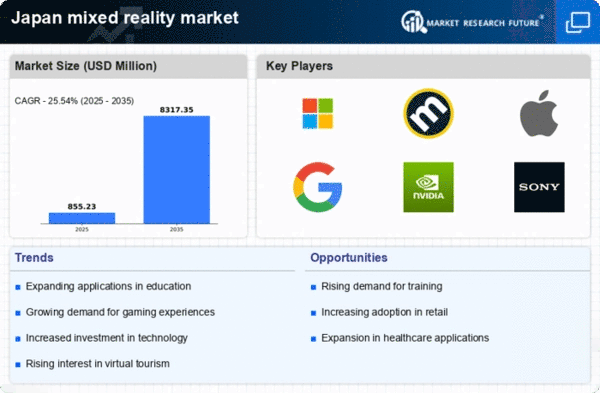
As per Market Research Future analysis, the Japan mixed reality market size was estimated at 681.24 USD Million in 2024. The Japan mixed reality market is projected to grow from 855.23 USD Million in 2025 to 8317.35 USD Million by 2035, exhibiting a compound annual growth rate (CAGR) of 25.5% during the forecast period 2025 - 2035

Key Market Trends & Highlights

The Japan mixed reality market is poised for substantial growth driven by technological advancements and increasing consumer adoption.

  • The largest segment in the Japan mixed reality market is the education and training sector, which is experiencing significant expansion.
  • Consumer adoption of mixed reality technologies is growing rapidly, indicating a shift towards immersive experiences.
  • The fastest-growing segment is the healthcare solutions sector, reflecting a rising demand for innovative applications in medical training and patient care.
  • Key market drivers include technological advancements in hardware and government support initiatives, which are likely to propel market growth.

Market Size & Forecast

2024 Market Size 681.24 (USD Million)
2035 Market Size 8317.35 (USD Million)
CAGR (2025 - 2035) 25.54%

Major Players

Microsoft (US), Meta (US), Apple (US), Google (US), NVIDIA (US), Sony (JP), Magic Leap (US), HTC (TW), Samsung (KR)

Our Impact
Enabled $4.3B Revenue Impact for Fortune 500 and Leading Multinationals
Partnering with 2000+ Global Organizations Each Year
30K+ Citations by Top-Tier Firms in the Industry

Japan Mixed Reality Market Trends

The mixed reality market in Japan is currently experiencing a notable evolution, driven by advancements in technology and increasing adoption across various sectors. Companies are investing in innovative solutions that blend the physical and digital worlds, enhancing user experiences in fields such as education, healthcare, and entertainment. The integration of mixed reality into business operations is becoming more prevalent, as organizations recognize its potential to improve training, collaboration, and customer engagement. This trend is likely to continue as more enterprises seek to leverage immersive technologies to gain a competitive edge. Moreover, the demand for mixed reality applications is being fueled by a growing interest in virtual and augmented reality experiences among consumers. As hardware becomes more accessible and affordable, individuals are increasingly exploring mixed reality for gaming, social interaction, and creative expression. The Japanese government is also supporting this technological shift through initiatives aimed at fostering innovation and digital transformation. This supportive environment may further accelerate the growth of the mixed reality market, positioning Japan as a key player in the development of immersive technologies.

Increased Investment in Technology

There is a rising trend of investment in mixed reality technologies by both private and public sectors. Companies are allocating resources to develop advanced hardware and software solutions, which may enhance the overall user experience. This investment is likely to drive innovation and create new opportunities within the market.

Expansion in Education and Training

The mixed reality market is witnessing a significant expansion in educational applications. Institutions are adopting immersive technologies to facilitate interactive learning experiences. This trend suggests a shift towards more engaging and effective training methods, which could improve knowledge retention and skill acquisition.

Growth in Consumer Adoption

Consumer interest in mixed reality applications is on the rise, particularly in entertainment and gaming. As more individuals seek immersive experiences, the market is likely to see an increase in demand for consumer-oriented products. This trend indicates a broader acceptance of mixed reality in everyday life.

Japan Mixed Reality Market Drivers

Government Support and Initiatives

The mixed reality market in Japan is benefiting from supportive government policies and initiatives aimed at fostering technological innovation. The Japanese government has recognized the potential of mixed reality to drive economic growth and is investing in research and development programs. Initiatives such as funding for startups and partnerships with educational institutions are designed to promote the adoption of mixed reality technologies across various sectors. This support is likely to accelerate market growth, as it encourages collaboration between private and public entities. Additionally, government-led projects focusing on smart cities and digital transformation are expected to incorporate mixed reality solutions, further expanding the market landscape. As these initiatives gain momentum, the mixed reality market is likely to flourish, supported by a conducive regulatory environment.

Integration in Industrial Applications

The mixed reality market is increasingly being integrated into industrial applications in Japan, particularly in manufacturing and maintenance sectors. Companies are recognizing the potential of mixed reality to improve operational efficiency and reduce costs. For example, mixed reality solutions are being utilized for remote assistance, allowing technicians to receive real-time guidance while performing complex tasks. This integration is expected to enhance productivity by up to 25%, as workers can access critical information without interrupting their workflow. Furthermore, Japanese manufacturers are investing in training programs that utilize mixed reality to upskill employees, indicating a commitment to leveraging this technology for workforce development. As industries continue to adopt mixed reality solutions, the market is poised for substantial growth, driven by the need for innovative tools that enhance productivity and safety.

Technological Advancements in Hardware

The mixed reality market in Japan is experiencing a surge due to rapid advancements in hardware technology. Innovations in headsets, sensors, and display technologies are enhancing user experiences, making mixed reality applications more accessible and appealing. For instance, the introduction of lightweight, high-resolution headsets has improved comfort and usability, leading to increased adoption across various sectors. The market is projected to grow at a CAGR of approximately 30% from 2025 to 2030, driven by these technological improvements. Furthermore, Japanese companies are investing heavily in research and development to create cutting-edge devices that cater to both consumer and enterprise needs. This focus on hardware innovation is likely to propel the mixed reality market forward, as enhanced devices enable more immersive and interactive experiences.

Increased Focus on Healthcare Solutions

The mixed reality market is increasingly focusing on healthcare solutions in Japan, where the demand for innovative medical technologies is on the rise. Mixed reality applications are being developed for surgical training, patient education, and rehabilitation, enhancing the overall quality of care. For instance, mixed reality simulations are being utilized to train medical professionals, allowing them to practice complex procedures in a risk-free environment. The healthcare sector is projected to account for a significant share of the mixed reality market, with investments expected to reach approximately $1 billion by 2027. This growth is driven by the need for effective training tools and patient engagement strategies. As healthcare providers continue to explore the benefits of mixed reality, the market is likely to expand, reflecting a growing recognition of its potential to transform medical practices.

Rising Demand in Entertainment and Gaming

The mixed reality market is witnessing a notable increase in demand within the entertainment and gaming sectors in Japan. As consumers seek more immersive experiences, developers are leveraging mixed reality technologies to create engaging content that captivates audiences. The gaming industry, in particular, is projected to contribute significantly to market growth, with revenues expected to reach approximately $3 billion by 2026. This trend is fueled by the popularity of mixed reality games that blend real-world environments with digital elements, providing players with unique experiences. Additionally, entertainment venues are adopting mixed reality solutions to enhance visitor engagement, suggesting a broader acceptance of this technology. As the appetite for innovative entertainment options grows, the mixed reality market is likely to expand, driven by consumer enthusiasm and industry investment.


Market Segment Insights

By Application: Gaming (Largest) vs. Healthcare (Fastest-Growing)

In the Japan mixed reality market, the application segment is driven by diverse sectors such as gaming, healthcare, education, retail, and real estate. Among these, gaming holds the largest market share, attributed to high consumer engagement and technological advancements in VR/AR experiences. Conversely, healthcare emerges as a rapidly growing segment, gaining traction due to the increasing integration of mixed reality technologies in training, diagnostics, and therapeutic applications. Growth trends in the application segment are influenced by innovation and demand for immersive experiences. The gaming industry continues to evolve with enhanced graphics and interactivity, pushing user adoption. In contrast, the healthcare sector is experiencing accelerated growth as institutions leverage mixed reality for surgical simulations and patient education, indicating a shift towards technology-driven healthcare solutions.

Gaming (Dominant) vs. Healthcare (Emerging)

Gaming is considered the dominant application in the Japan mixed reality market, characterized by a robust user base and continuous content development from leading gaming studios. The integration of augmented reality features into popular games has significantly enhanced user experience, fostering higher engagement levels. On the other hand, healthcare is emerging as a pivotal application, promising substantial growth. Mixed reality technologies are being used for advanced training simulations and interactive patient experiences, attracting investments and innovations. This shift is reflective of the broader trend towards digital solutions in healthcare, indicating that while gaming leads the way, healthcare is poised for transformative growth driven by technological advancements.

By Technology: Hardware-based (Largest) vs. Mixed Reality as a Service (Fastest-Growing)

In the Japan mixed reality market, the distribution of market share reveals that the hardware-based segment holds the largest portion, attributed to increasing consumer demand for high-quality devices and robust hardware solutions. This segment is pivotal for the deployment of various mixed reality applications, providing a solid foundation for immersive experiences. Meanwhile, the software-based segment, though significant, trails behind hardware, indicating a strong hardware reliance in this evolving market. Growth trends indicate that the mixed reality as a service segment is emerging rapidly, driven by organizations seeking cost-effective and scalable solutions. The adoption of cloud-based platforms enhances accessibility and aligns with the growing focus on remote working environments. Increasing investments in innovative technologies and partnerships also contribute to the sector’s growth, indicating a promising trajectory for mixed reality services in the coming years.

Technology: Hardware-based (Dominant) vs. Mixed Reality as a Service (Emerging)

The hardware-based segment is characterized by its dominance in the Japan mixed reality market, as it provides essential infrastructure for various applications, including gaming, training, and virtual collaboration. This segment's growth is fueled by advancements in hardware technologies, significant consumer adoption, and the increasing integration of mixed reality into various industries. On the other hand, mixed reality as a service represents an emerging model, appealing to businesses looking to leverage advanced mixed reality solutions without substantial upfront investments. Its rising popularity is driven by flexibility, lower barriers to entry, and the potential for custom solutions, making it an attractive option for various sectors aiming to harness the benefits of mixed reality.

By End Use: Consumer (Largest) vs. Commercial (Fastest-Growing)

In the Japan mixed reality market, the distribution of end-use segments reveals that the consumer segment holds the largest share, driven by increasing adoption of mixed reality devices for gaming and entertainment purposes. Following closely, the commercial segment is witnessing rapid growth as businesses leverage mixed reality for training, marketing, and collaboration efforts, leading to significant investment in this area. The growth trends within these segments are influenced by technological advancements and the rising demand for immersive experiences. In the consumer sector, the proliferation of affordable devices and engaging content has propelled adoption. Meanwhile, the commercial segment is fueled by the need for innovative solutions that enhance productivity and engage customers, making it the fastest-growing part of the market.

Consumer: Dominant vs. Commercial: Emerging

The consumer segment stands out as the dominant force in the Japan mixed reality market, characterized by a diverse range of applications from gaming to social interactions. This segment benefits from widespread consumer interest and the availability of user-friendly devices that promote engagement. Conversely, the commercial segment, while emerging, is rapidly gaining traction as enterprises acknowledge the value of mixed reality in streamlining operations and enhancing customer experiences. Companies are increasingly investing in mixed reality technologies, recognizing their potential in training, design visualization, and marketing strategies. This duality between the established consumer segment and the progressive commercial sector underscores the dynamic nature of the market as it evolves.

By Device Type: Head-mounted Display (Largest) vs. Smart Glasses (Fastest-Growing)

In the Japan mixed reality market, the device type segment showcases a diverse range of technologies, with head-mounted displays commanding the largest share, appealing to both gaming enthusiasts and enterprise solutions. Smart glasses are emerging rapidly, attracting considerable attention from industries looking to enhance operational efficiency and user engagement through augmented reality features. This dynamic distribution reflects the growing interest across various applications among Japanese consumers and businesses. Growth trends indicate a vibrant future for both head-mounted displays and smart glasses, primarily driven by advancements in display technologies and increasing demand for immersive experiences. Factors like the expansion of the gaming sector, collaboration in remote work environments, and innovations in user interface design are propelling the demand for these devices. As companies in Japan invest in mixed reality solutions, the landscape continues to evolve, offering exciting opportunities for growth.

Head-mounted Display: Dominant vs. Smart Glasses: Emerging

Head-mounted displays are the dominant device type in the Japan mixed reality market, favored for their ability to deliver immersive experiences in gaming and training applications. These devices are equipped with high-resolution screens and advanced sensors that provide an unparalleled user experience. On the other hand, smart glasses are emerging as a significant player, particularly in industrial and commercial applications. Their lightweight design and hands-free operation make them ideal for tasks such as remote assistance and real-time data visualization. As more enterprises recognize the benefits of integrating smart glasses into their workflows, their market presence is expected to grow, creating a balanced dynamic in the device type segment.

Get more detailed insights about Japan Mixed Reality Market

Key Players and Competitive Insights

The mixed reality market in Japan is characterized by a dynamic competitive landscape, driven by rapid technological advancements and increasing consumer demand for immersive experiences. Major players such as Microsoft (US), Sony (JP), and Apple (US) are strategically positioned to leverage their technological prowess and brand recognition. Microsoft (US) focuses on enterprise solutions, emphasizing productivity and collaboration through its mixed reality offerings. In contrast, Sony (JP) aims to enhance gaming experiences, integrating mixed reality into its PlayStation ecosystem. Apple (US) appears to be concentrating on consumer applications, potentially revolutionizing personal computing and entertainment through its mixed reality devices. Collectively, these strategies contribute to a competitive environment that is increasingly innovation-driven, with companies vying for market share through unique value propositions.Key business tactics within the mixed reality market include localizing manufacturing and optimizing supply chains to enhance responsiveness to consumer needs. The market structure is moderately fragmented, with a mix of established players and emerging startups. This fragmentation allows for diverse offerings, yet the influence of key players remains substantial, as they set industry standards and drive technological advancements.

In October Microsoft (US) announced a partnership with a leading Japanese telecommunications company to enhance its mixed reality solutions for remote work. This collaboration is strategically significant as it aims to integrate high-speed connectivity with Microsoft’s mixed reality applications, thereby improving user experience and expanding its market reach in Japan. Such partnerships are likely to bolster Microsoft’s position in the enterprise segment, where demand for remote collaboration tools continues to grow.

In September Sony (JP) unveiled its latest mixed reality headset, designed specifically for the Japanese gaming market. This launch is pivotal, as it not only showcases Sony's commitment to innovation but also reinforces its competitive edge in the gaming sector. By tailoring its products to local preferences, Sony is likely to enhance user engagement and drive sales, further solidifying its market presence.

In November Apple (US) revealed plans to invest heavily in augmented reality (AR) development centers in Japan. This move indicates Apple's long-term commitment to the region and its ambition to lead in the consumer mixed reality space. By establishing a local presence, Apple may enhance its ability to innovate and respond to market demands, positioning itself favorably against competitors.

As of November current trends in the mixed reality market include a strong emphasis on digitalization, sustainability, and the integration of artificial intelligence (AI). Strategic alliances are increasingly shaping the competitive landscape, enabling companies to pool resources and expertise. Looking ahead, competitive differentiation is expected to evolve, with a shift from price-based competition to a focus on innovation, technological advancements, and supply chain reliability. This transition may redefine how companies engage with consumers, ultimately fostering a more sustainable and technologically advanced market.

Key Companies in the Japan Mixed Reality Market include

Industry Developments

In recent months, the Japan Mixed Reality Market has seen significant advancements, particularly from notable companies such as Microsoft Japan, which has accelerated its investments in urban digital transformation projects. Similarly, Sony has been enhancing its VR capabilities, focusing on immersive experiences for gamers and enterprises alike. CyberAgent recently showcased innovative applications of mixed reality in gaming and advertising, reflecting growing demand in the entertainment sector. NTT Docomo has also been exploring collaborations in the Mixed Reality space, aimed at improving connectivity and user experience. 

In September 2023, Nikon launched a new Mixed Reality platform aimed at industrial solutions, marking its strategic direction towards this rapidly expanding market. Notably, in February 2023, Fujitsu entered into a partnership with Unity Technologies to develop tailored Mixed Reality applications, enhancing its presence in the sector. The market is projected to grow significantly, driven by increasing technological adoption and digital transformation strategies in Japan. Over the past few years, investments have surged, underscoring the potential of mixed reality to enhance various sectors, including healthcare, retail, and education, with major companies actively pursuing innovative solutions and applications.

Future Outlook

Japan Mixed Reality Market Future Outlook

The Mixed Reality Market in Japan is projected to grow at a 25.54% CAGR from 2025 to 2035, driven by technological advancements and increasing enterprise adoption.

New opportunities lie in:

  • Development of immersive training solutions for corporate sectors.
  • Integration of mixed reality in remote collaboration tools.
  • Creation of customized mixed reality applications for healthcare providers.

By 2035, the mixed reality market is expected to achieve substantial growth and innovation.

Market Segmentation

Japan Mixed Reality Market End Use Outlook

  • Consumer
  • Commercial
  • Industrial

Japan Mixed Reality Market Technology Outlook

  • Hardware-based
  • Software-based
  • Mixed Reality as a Service

Japan Mixed Reality Market Application Outlook

  • Gaming
  • Healthcare
  • Education
  • Retail
  • Real Estate

Japan Mixed Reality Market Device Type Outlook

  • Head-mounted Display
  • Smart Glasses
  • Smart Phones
  • Tablets

Report Scope

MARKET SIZE 2024 681.24(USD Million)
MARKET SIZE 2025 855.23(USD Million)
MARKET SIZE 2035 8317.35(USD Million)
COMPOUND ANNUAL GROWTH RATE (CAGR) 25.54% (2025 - 2035)
REPORT COVERAGE Revenue Forecast, Competitive Landscape, Growth Factors, and Trends
BASE YEAR 2024
Market Forecast Period 2025 - 2035
Historical Data 2019 - 2024
Market Forecast Units USD Million
Key Companies Profiled Microsoft (US), Meta (US), Apple (US), Google (US), NVIDIA (US), Sony (JP), Magic Leap (US), HTC (TW), Samsung (KR)
Segments Covered Application, Technology, End Use, Device Type
Key Market Opportunities Integration of mixed reality in education and training enhances engagement and learning outcomes.
Key Market Dynamics Rising demand for immersive experiences drives innovation and competition in the mixed reality market.
Countries Covered Japan
Leave a Comment

FAQs

What is the expected market size of the Japan Mixed Reality Market in 2024?

The Japan Mixed Reality Market is expected to be valued at 971.4 million USD in 2024.

What is the projected market size of the Japan Mixed Reality Market by 2035?

By 2035, the Japan Mixed Reality Market is expected to reach a value of 13,021.6 million USD.

What is the expected CAGR for the Japan Mixed Reality Market from 2025 to 2035?

The expected CAGR for the Japan Mixed Reality Market from 2025 to 2035 is 26.613%.

Which application segment is projected to have the highest market value in 2035?

The Real Estate application segment is projected to reach a market value of 7,003.638 million USD by 2035.

How much is the Gaming application segment expected to be worth in 2024?

In 2024, the Gaming application segment is expected to be valued at 200.0 million USD.

Who are the major players in the Japan Mixed Reality Market?

Major players in the Japan Mixed Reality Market include Qualcomm, Google Japan, CyberAgent, Nikon, Microsoft Japan, and others.

What is the market value for the Healthcare application in 2035?

The market value for the Healthcare application is projected to be 1,709.606 million USD in 2035.

What growth opportunities exist in the Japan Mixed Reality Market?

Opportunities in the Japan Mixed Reality Market include advancements in gaming, education, and healthcare applications.

What is the expected market value for the Retail application in 2024?

In 2024, the Retail application segment is anticipated to be valued at 120.0 million USD.

What challenges does the Japan Mixed Reality Market face going forward?

The Japan Mixed Reality Market may face challenges related to technology adoption and integration within existing systems.

Download Free Sample

Kindly complete the form below to receive a free sample of this Report

Compare Licence

×
Features License Type
Single User Multiuser License Enterprise User
Price $4,950 $5,950 $7,250
Maximum User Access Limit 1 User Upto 10 Users Unrestricted Access Throughout the Organization
Free Customization
Direct Access to Analyst
Deliverable Format
Platform Access
Discount on Next Purchase 10% 15% 15%
Printable Versions