×
Request Free Sample ×

Kindly complete the form below to receive a free sample of this Report

* Please use a valid business email

Leading companies partner with us for data-driven Insights

clients tt-cursor
Hero Background

Japan Micro Pump Market

ID: MRFR/HC/52867-HCR
200 Pages
Garvit Vyas
February 2026

Japan Micro Pump Market Research Report: Size, Share, Trend Analysis By Product Type (Mechanical Micropump, Piezoelectric Micropump, Syringe Pump, Peristaltic Pump, Non-Mechanical Micropump), By Material (Polymer, Glass, Silicon), By Applications (Drug Delivery Systems, Medical Device, In-Vitro Diagnostics) and By End Users (Biotechnology and Pharmaceutical Companies, Hospitals and Diagnostic Centers, Research Institutes) - Growth Outlook & Industry Forecast 2025 To 2035

Share:
Download PDF ×

We do not share your information with anyone. However, we may send you emails based on your report interest from time to time. You may contact us at any time to opt-out.

Japan Micro Pump Market Infographic
Purchase Options

Japan Micro Pump Market Summary

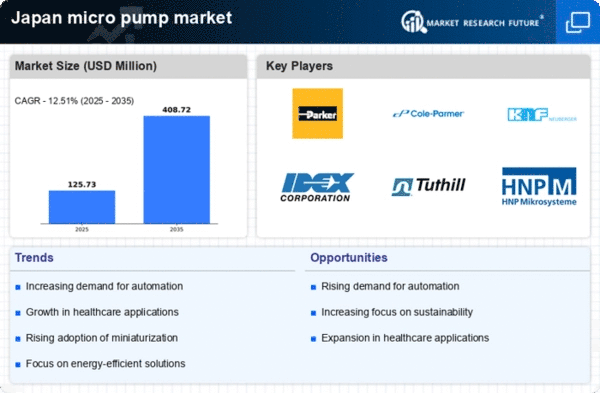
As per Market Research Future analysis, the Japan micro pump market size was estimated at 111.75 USD Million in 2024. The Japan micro pump market is projected to grow from 125.73 USD Million in 2025 to 408.72 USD Million by 2035, exhibiting a compound annual growth rate (CAGR) of 12.5% during the forecast period 2025 - 2035

Key Market Trends & Highlights

The Japan micro pump market is poised for growth driven by technological advancements and increasing healthcare demand.

  • Technological advancements are enhancing the efficiency and precision of micro pumps in various applications.
  • The healthcare segment remains the largest, fueled by rising demand for advanced medical devices and drug delivery systems.
  • Sustainability initiatives are gaining traction, with manufacturers focusing on eco-friendly materials and processes.
  • Rising automation in manufacturing and growth in the pharmaceutical sector are key drivers propelling market expansion.

Market Size & Forecast

2024 Market Size 111.75 (USD Million)
2035 Market Size 408.72 (USD Million)
CAGR (2025 - 2035) 12.51%

Major Players

Parker Hannifin (US), Cole-Parmer (US), KNF Neuberger (DE), Idex Corporation (US), Tuthill Corporation (US), HNP Mikrosysteme (DE), Syringe Pump (US), Xavitech (SE), Festo (DE)

Our Impact
Enabled $4.3B Revenue Impact for Fortune 500 and Leading Multinationals
Partnering with 2000+ Global Organizations Each Year
30K+ Citations by Top-Tier Firms in the Industry

Japan Micro Pump Market Trends

The micro pump market in Japan is currently experiencing notable growth, driven by advancements in technology and increasing demand across various sectors. The healthcare industry, in particular, is a significant contributor, as micro pumps are essential for drug delivery systems and other medical applications. This trend is further supported by the aging population in Japan, which necessitates innovative solutions for chronic disease management. Additionally, the rise of automation in manufacturing processes is propelling the adoption of micro pumps in industrial applications, enhancing efficiency and precision. Moreover, environmental concerns are prompting industries to seek more sustainable solutions, which micro pumps can provide due to their energy efficiency and reduced waste. As companies strive to meet regulatory standards and consumer expectations, the micro pump market is likely to expand further. The interplay of these factors suggests a dynamic landscape where innovation and sustainability are at the forefront, shaping the future of this market in Japan.

Technological Advancements

Recent innovations in micro pump technology are enhancing performance and reliability. Developments in materials and design are leading to more compact and efficient pumps, which are increasingly utilized in medical devices and industrial applications. This trend indicates a shift towards more sophisticated solutions that cater to specific needs.

Healthcare Demand

The healthcare sector's demand for micro pumps is on the rise, primarily due to the need for precise drug delivery systems. As the population ages, the requirement for effective chronic disease management solutions becomes more pressing. This trend highlights the critical role of micro pumps in improving patient outcomes.

Sustainability Initiatives

There is a growing emphasis on sustainability within the micro pump market, as industries seek to minimize their environmental impact. Micro pumps are being recognized for their energy efficiency and potential to reduce waste, aligning with broader environmental goals. This trend suggests a shift towards greener technologies in various applications.

Japan Micro Pump Market Drivers

Growth in Pharmaceutical Sector

Japan's pharmaceutical sector is witnessing robust growth, which is significantly impacting the micro pump market. With an increasing focus on drug delivery systems, micro pumps are being utilized for precise dosing and administration of medications. The pharmaceutical industry in Japan is expected to reach a market value of approximately $100 billion by 2026, creating a substantial demand for micro pumps. These devices are essential for applications such as insulin delivery and other chronic disease management solutions. As the micro pump market aligns with the evolving needs of the pharmaceutical sector, it is poised for expansion, driven by innovations in drug formulation and delivery technologies.

Advancements in Medical Technology

The micro pump market is significantly impacted by advancements in medical technology within Japan. As healthcare providers seek innovative solutions for patient care, micro pumps are increasingly utilized in medical devices for applications such as infusion therapy and diagnostic equipment. The medical technology market in Japan is projected to grow at a CAGR of around 6% over the next few years, indicating a rising demand for sophisticated medical devices. This growth is likely to drive the micro pump market, as manufacturers develop more advanced and reliable micro pump systems to meet the needs of healthcare professionals and patients alike.

Rising Automation in Manufacturing

The micro pump market in Japan is experiencing a notable surge due to the increasing automation in manufacturing processes. As industries strive for efficiency, the demand for precise fluid control systems has escalated. Micro pumps, known for their accuracy and reliability, are becoming integral in various applications, including automotive and electronics manufacturing. The market is projected to grow at a CAGR of approximately 8% over the next five years, driven by the need for advanced manufacturing technologies. This trend indicates a shift towards more automated systems, where micro pumps play a crucial role in enhancing production capabilities. Consequently, the micro pump market is likely to benefit from this automation wave, as manufacturers seek to optimize their operations and reduce costs.

Environmental Regulations and Compliance

The micro pump market in Japan is also influenced by stringent environmental regulations aimed at reducing waste and promoting sustainability. As industries face increasing pressure to comply with these regulations, the demand for efficient fluid management systems is rising. Micro pumps, which minimize waste and enhance energy efficiency, are becoming a preferred choice for many applications. The market is likely to see a shift towards eco-friendly solutions, with micro pumps playing a pivotal role in achieving compliance. This trend suggests that the micro pump market will continue to evolve, adapting to the regulatory landscape while providing sustainable solutions for various sectors.

Emerging Applications in Consumer Electronics

The micro pump market in Japan is witnessing growth due to emerging applications in consumer electronics. As devices become more compact and sophisticated, the need for precise fluid management systems is increasing. Micro pumps are being integrated into products such as printers, cooling systems, and even beauty devices, enhancing their functionality. The consumer electronics market in Japan is expected to reach approximately $50 billion by 2027, creating new opportunities for the micro pump market. This trend indicates a diversification of applications, suggesting that micro pumps will play a vital role in the evolution of consumer electronics, catering to the demands for efficiency and performance.


Market Segment Insights

By Type: Mechanical Micropump (Largest) vs. Piezoelectric Micropump (Fastest-Growing)

In the Japan micro pump market, the mechanical micropump holds the largest market share, driven by its robust design and widespread applications across different industries. Following closely are piezoelectric micropumps, which are becoming increasingly popular due to their efficient operation and compact size. Syringe pumps, peristaltic pumps, and non-mechanical micropumps also contribute to the segment, but they currently hold smaller shares within the overall market. Growth trends indicate that piezoelectric micropumps are on a rapid ascent, buoyed by advancements in micro-technology and rising demand in sectors like pharmaceuticals and biotech. Meanwhile, mechanical micropumps continue to benefit from established use cases and strong distribution networks. Overall, the Japan micro pump market is witnessing a shift towards more innovative solutions, with emerging technologies gaining traction.

Mechanical Micropump (Dominant) vs. Piezoelectric Micropump (Emerging)

Mechanical micropumps are characterized by their durability and ability to handle a wide range of fluid types, making them ideal for various applications in the automotive, healthcare, and chemical industries. Their established position in the market ensures reliability and customer familiarity. In contrast, piezoelectric micropumps are emerging with innovative designs that enable precise flow control and low power consumption. These pumps find applications in laboratory diagnostics, drug delivery systems, and microfluidic devices, attracting interest due to their versatility and efficiency. This dynamic showcases a clear delineation between the dominant traditional technologies and the promising capabilities of newer micropumping solutions.

By Material: Polymer (Largest) vs. Glass (Fastest-Growing)

In the Japan micro pump market, the material segment is primarily dominated by polymer-based pumps, which hold a significant market share due to their lightweight and durable properties. Glass pumps, while having a smaller share, are gaining traction owing to their chemical resistance and suitability for sensitive applications. The competitive landscape of these materials indicates a clear preference for polymers in various applications, while glass is carving out a niche in specific sectors. Growth trends in this segment reveal that polymer is bolstered by increasing demand for lightweight solutions and advancements in polymer technology. On the other hand, glass is experiencing rapid growth as manufacturers seek materials that offer better performance under extreme conditions. The surge in industries such as pharmaceuticals and biotechnology is also driving the shift toward glass micro pumps, positioning them as a significant emerging player in the market.

Polymer (Dominant) vs. Glass (Emerging)

Polymer micro pumps are widely recognized for their versatility and ease of manufacturing, making them the dominant choice in the Japan micro pump market. They are favored for their lightweight construction, affordability, and resistance to corrosion, which makes them suitable for a wide range of applications including automotive and medical fields. Conversely, glass micro pumps are emerging as a strong alternative, particularly in applications that require precision and high chemical compatibility. Their rigidity and ability to withstand high pressures allow them to excel in laboratory settings and other specialized industries. This contrast in characteristics illustrates the ongoing competition and diversification within the material segment.

By Application: Drug Delivery Systems (Largest) vs. In-Vitro Diagnostics (Fastest-Growing)

The Japan micro pump market showcases a diverse application landscape, with Drug Delivery Systems commanding the largest market share. This segment benefits from the increased demand for precision in drug administration, leading to a higher adoption rate among medical practitioners. Meanwhile, Medical Devices and In-Vitro Diagnostics also hold a significant share, reflecting the diverse needs of healthcare providers in various settings. Growth trends in the Japan micro pump market are largely driven by rapid technological advancements and an aging population requiring more sophisticated medical solutions. The In-Vitro Diagnostics segment, in particular, is witnessing the fastest growth due to heightened awareness around early disease detection and the rise of personalized medicine. Innovations such as miniaturized pumps and integration with digital health platforms are further fueling this growth.

Drug Delivery Systems (Dominant) vs. In-Vitro Diagnostics (Emerging)

Drug Delivery Systems have established themselves as the dominant segment in the Japan micro pump market, primarily due to their critical role in enhancing patient compliance and therapeutic efficacy. These systems are characterized by their ability to deliver precise dosages at controlled rates, which is essential for chronic disease management. On the other hand, In-Vitro Diagnostics is rapidly emerging, leveraging advancements in biotech and analysis methods. This segment is increasingly utilized in laboratory settings for testing and diagnostics, reflecting a growing trend towards outpatient and home-based medical testing solutions. Both segments are crucial, yet their market dynamics differ, with Drug Delivery Systems stabilizing their dominance while In-Vitro Diagnostics seeks to capture a larger share of the market.

By End User: Biotechnology and Pharmaceutical Companies (Largest) vs. Hospitals and Diagnostic Centers (Fastest-Growing)

In the Japan micro pump market, the distribution among end users showcases Biotechnology and Pharmaceutical Companies as the largest segment. This segment capitalizes on advancements in drug delivery systems, driving significant utilization of micro pumps. Conversely, Hospitals and Diagnostic Centers are emerging as a rapid growth area, attributed to an increased focus on diagnostics and patient care enhancements, ultimately influencing the adoption of micro pump technologies. Furthermore, the growth trends within this segment are largely driven by technological innovations and a rising demand for precision in drug delivery. The increasing prevalence of chronic diseases and an expanded focus on personalized medicine are propelling Biotechnology and Pharmaceutical Companies further into the limelight. Meanwhile, Hospitals and Diagnostic Centers continue to adopt micro pumps at a faster pace, influenced by advancements in healthcare infrastructure and a heightened emphasis on rapid and accurate diagnostic processes.

Biotechnology and Pharmaceutical Companies (Dominant) vs. Hospitals and Diagnostic Centers (Emerging)

Biotechnology and Pharmaceutical Companies hold a dominant position in the Japan micro pump market due to their extensive investment in research and development for innovative drug delivery systems, allowing for enhanced patient outcomes. These companies frequently require sophisticated fluid management technologies for effective product delivery. In contrast, Hospitals and Diagnostic Centers represent an emerging segment, characterized by their increasing need for efficient diagnostic tools and treatment delivery systems. This shift is powered by evolving healthcare demands, where rapid and accurate administration of treatments becomes essential. Their growth is bolstered by investments in upgraded healthcare technologies, promising a substantial impact on the micro pump landscape in the upcoming years.

Get more detailed insights about Japan Micro Pump Market

Key Players and Competitive Insights

The micro pump market in Japan is characterized by a competitive landscape that is both dynamic and multifaceted. Key growth drivers include the increasing demand for precision fluid handling in various applications such as medical devices, pharmaceuticals, and industrial automation. Major players like Parker Hannifin (US), KNF Neuberger (DE), and Idex Corporation (US) are strategically positioned to leverage innovation and technological advancements. Parker Hannifin (US) focuses on enhancing its product portfolio through continuous innovation, while KNF Neuberger (DE) emphasizes sustainability and energy efficiency in its offerings. Idex Corporation (US) is actively pursuing mergers and acquisitions to expand its market reach, thereby intensifying competition among these key players.In terms of business tactics, companies are increasingly localizing manufacturing to reduce lead times and optimize supply chains. This approach not only enhances operational efficiency but also allows for better responsiveness to market demands. The competitive structure of the micro pump market appears moderately fragmented, with several players vying for market share. However, the collective influence of these key players is significant, as they drive technological advancements and set industry standards.

In October Parker Hannifin (US) announced the launch of a new line of micro pumps designed specifically for medical applications, which is expected to enhance precision and reliability in drug delivery systems. This strategic move underscores the company's commitment to innovation and positions it favorably in a growing segment of the market. The introduction of these pumps may potentially capture a larger share of the medical device market, reflecting a proactive approach to meet evolving customer needs.

In September KNF Neuberger (DE) unveiled its latest eco-friendly micro pump series, which utilizes sustainable materials and energy-efficient technologies. This initiative aligns with global trends towards sustainability and positions the company as a leader in environmentally conscious manufacturing. The strategic importance of this launch lies in its potential to attract environmentally aware customers and enhance brand loyalty in a competitive market.

In August Idex Corporation (US) completed the acquisition of a smaller micro pump manufacturer, which is anticipated to bolster its technological capabilities and expand its product offerings. This acquisition not only enhances Idex's competitive edge but also reflects a broader trend of consolidation within the industry, as companies seek to strengthen their market positions through strategic partnerships and acquisitions.

As of November current competitive trends in the micro pump market are increasingly defined by digitalization, sustainability, and the integration of artificial intelligence. Strategic alliances among companies are shaping the landscape, fostering innovation and enhancing product development. Looking ahead, competitive differentiation is likely to evolve from traditional price-based competition to a focus on innovation, advanced technology, and supply chain reliability. This shift suggests that companies that prioritize these aspects will be better positioned to thrive in an increasingly competitive environment.

Key Companies in the Japan Micro Pump Market include

Industry Developments

Recent developments in the Japan Micro Pump Market highlight significant growth and innovation in this sector. Notable companies such as Iwaki, Yamada Pumps, and NIDEC have been actively enhancing their product offerings to meet diverse industrial needs. In addition, Mitsubishi Electric and Canon are investing heavily in Research and Development for advanced pumping solutions, focusing on efficiency and compact design. A significant merger was reported in March 2023, where Tsurumi Pump acquired the operations of a competing manufacturer, thereby strengthening its market position and expanding its product range.

Within the last couple of years, there have been trends indicating an increased demand for micro pumps in the healthcare and biochemical sectors, with firms like Peristaltic Pumps experiencing considerable growth due to the rising need for precise fluid handling. Infrastructure advancements and government support for manufacturing innovation are also contributing to the rising valuation of these companies in Japan, positioning the micro pump market as a critical component of the broader industrial landscape.

As of recent reports, the market is projected to continue expanding, driven by technological improvements and increasing applications in various industries.

Future Outlook

Japan Micro Pump Market Future Outlook

The Micro pump Market in Japan is projected to grow at a 12.51% CAGR from 2025 to 2035, driven by advancements in healthcare technology, increased automation, and demand for precision fluid control.

New opportunities lie in:

  • Development of smart micro pumps for IoT applications
  • Expansion into renewable energy sectors with micro fluid management
  • Partnerships with biotech firms for customized drug delivery systems

By 2035, the micro pump market is expected to achieve substantial growth and innovation.

Market Segmentation

Japan Micro Pump Market Type Outlook

  • Mechanical Micropump
  • Piezoelectric Micropump
  • Syringe Pump
  • Peristaltic Pump
  • Non-Mechanical Micropump

Japan Micro Pump Market End User Outlook

  • Biotechnology and Pharmaceutical Companies
  • Hospitals and Diagnostic Centers
  • Research Institutes

Japan Micro Pump Market Material Outlook

  • Polymer
  • Glass
  • Silicon

Japan Micro Pump Market Application Outlook

  • Drug Delivery Systems
  • Medical Device
  • In-Vitro Diagnostics

Report Scope

MARKET SIZE 2024 111.75(USD Million)
MARKET SIZE 2025 125.73(USD Million)
MARKET SIZE 2035 408.72(USD Million)
COMPOUND ANNUAL GROWTH RATE (CAGR) 12.51% (2025 - 2035)
REPORT COVERAGE Revenue Forecast, Competitive Landscape, Growth Factors, and Trends
BASE YEAR 2024
Market Forecast Period 2025 - 2035
Historical Data 2019 - 2024
Market Forecast Units USD Million
Key Companies Profiled Parker Hannifin (US), Cole-Parmer (US), KNF Neuberger (DE), Idex Corporation (US), Tuthill Corporation (US), HNP Mikrosysteme (DE), Syringe Pump (US), Xavitech (SE), Festo (DE)
Segments Covered Type, Material, Application, End User
Key Market Opportunities Advancements in micro pump technology enhance precision in medical applications, driving market growth opportunities.
Key Market Dynamics Rising demand for precision micro pumps in healthcare drives innovation and competition among local manufacturers in Japan.
Countries Covered Japan
Leave a Comment

FAQs

What is the projected market value of the Japan Micro Pump Market in 2024?

The Japan Micro Pump Market is expected to be valued at 223.5 million USD in 2024.

What will be the estimated market size of the Japan Micro Pump Market by 2035?

By 2035, the Japan Micro Pump Market is projected to reach approximately 1,670.0 million USD.

What is the expected CAGR for the Japan Micro Pump Market from 2025 to 2035?

The Japan Micro Pump Market is anticipated to grow at a CAGR of 20.061% from 2025 to 2035.

Which product type is expected to hold the largest market share in 2024?

The Non-Mechanical Micropump is expected to hold the largest market share, valued at 53.5 million USD in 2024.

How much is the Mechanical Micropump expected to grow by 2035?

The Mechanical Micropump is forecasted to grow to 400.0 million USD by 2035 from 50.0 million USD in 2024.

Who are the key players in the Japan Micro Pump Market?

Key players in the Japan Micro Pump Market include Hose Master, Yamada Pumps, and Mitsubishi Electric among others.

What is the expected market value for Syringe Pumps in 2035?

Syringe Pumps are anticipated to reach a market value of 250.0 million USD by 2035.

What are the growth drivers for the Japan Micro Pump Market?

Major growth drivers include technological advancements and increased demand in medical and industrial applications.

What impact is expected from global economic conditions on the Japan Micro Pump Market?

Current global economic conditions could influence supply chain stability and pricing strategies within the Japan Micro Pump Market.

What growth rate is anticipated for the Piezoelectric Micropump segment between 2024 and 2035?

The Piezoelectric Micropump segment is anticipated to grow to 350.0 million USD from 45.0 million USD between 2024 and 2035.

Download Free Sample

Kindly complete the form below to receive a free sample of this Report

Compare Licence

×
Features License Type
Single User Multiuser License Enterprise User
Price $4,950 $5,950 $7,250
Maximum User Access Limit 1 User Upto 10 Users Unrestricted Access Throughout the Organization
Free Customization
Direct Access to Analyst
Deliverable Format
Platform Access
Discount on Next Purchase 10% 15% 15%
Printable Versions