×
Request Free Sample ×

Kindly complete the form below to receive a free sample of this Report

* Please use a valid business email

Leading companies partner with us for data-driven Insights

clients tt-cursor
Hero Background

Japan Micro Mobile Data Center Market

ID: MRFR/ICT/59204-HCR
200 Pages
Aarti Dhapte
February 2026

Japan Micro Mobile Data Center Market Size, Share and Research Report: By Application (Instant & Retrofit, High-Density Networks, Remote Office, Mobile Computing), By Rack Size (5-25 RU, 26-50 RU, 51-100 RU) and By Verticals (BFSI, Healthcare, Oil & Gas, Retail, Manufacturing, Mining, IT & Telecommunication, Others)- Industry Forecast to 2035

Share:
Download PDF ×

We do not share your information with anyone. However, we may send you emails based on your report interest from time to time. You may contact us at any time to opt-out.

Japan Micro Mobile Data Center Market Infographic
Purchase Options

Japan Micro Mobile Data Center Market Summary

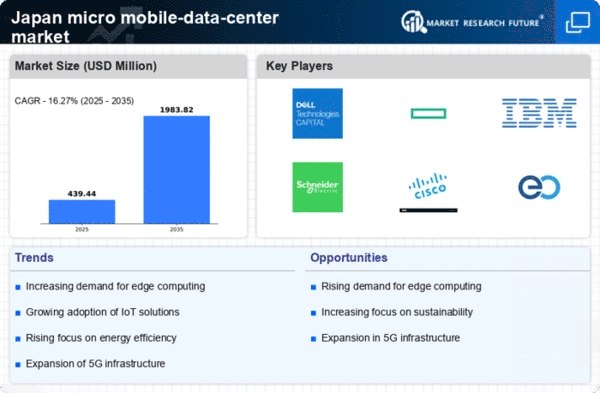
As per Market Research Future analysis, the Japan Micro Mobile Data Center Market size was estimated at 377.95 USD Million in 2024. The Micro Mobile-data-center market is projected to grow from 439.44 USD Million in 2025 to 1983.82 USD Million by 2035, exhibiting a compound annual growth rate (CAGR) of 16.2% during the forecast period 2025 - 2035

Key Market Trends & Highlights

The Japan micro mobile-data-center market is poised for substantial growth driven by technological advancements and evolving consumer needs.

  • The market is witnessing increased demand for edge computing solutions, particularly in urban areas.
  • Energy efficiency and sustainability are becoming central themes in the design and deployment of micro mobile-data-centers.
  • Integration of advanced technologies, such as AI and IoT, is enhancing operational capabilities and service offerings.
  • Key market drivers include the rising need for mobile infrastructure and government initiatives supporting digital transformation.

Market Size & Forecast

2024 Market Size 377.95 (USD Million)
2035 Market Size 1983.82 (USD Million)
CAGR (2025 - 2035) 16.27%

Major Players

Dell Technologies (US), Hewlett Packard Enterprise (US), IBM (US), Schneider Electric (FR), Cisco Systems (US), EdgeConneX (US), Rittal (DE), Vertiv (US), Huawei Technologies (CN)

Our Impact
Enabled $4.3B Revenue Impact for Fortune 500 and Leading Multinationals
Partnering with 2000+ Global Organizations Each Year
30K+ Citations by Top-Tier Firms in the Industry

Japan Micro Mobile Data Center Market Trends

The Japan Micro Mobile Data Center Market is experiencing notable growth, driven by the increasing demand for flexible and efficient data processing solutions. This market segment is characterized by its ability to provide portable data centers that can be deployed in various environments, catering to the needs of businesses seeking to enhance their operational efficiency. The rise of edge computing and the Internet of Things (IoT) has further propelled the adoption of micro mobile-data-centers, as organizations require localized data processing capabilities to manage the influx of data generated by connected devices. Additionally, the emphasis on sustainability and energy efficiency is influencing the design and deployment of these data centers, as companies strive to reduce their carbon footprint while maintaining high performance. Moreover, the regulatory landscape in Japan is evolving to support the growth of the micro mobile-data-center market. Government initiatives aimed at promoting digital transformation and technological innovation are likely to create a conducive environment for market expansion. As businesses increasingly recognize the advantages of micro mobile-data-centers, including reduced latency and improved data security, the market is poised for further development. The integration of advanced technologies such as artificial intelligence and machine learning into these data centers may also enhance their capabilities, making them more attractive to a wider range of industries. Overall, the micro mobile-data-center market appears to be on a promising trajectory, with various factors contributing to its ongoing evolution.

Increased Demand for Edge Computing Solutions

The micro mobile-data-center market is witnessing a surge in demand for edge computing solutions. As organizations seek to process data closer to its source, these portable data centers offer a practical solution. This trend is particularly relevant in sectors such as manufacturing and logistics, where real-time data processing is crucial for operational efficiency.

Focus on Energy Efficiency and Sustainability

There is a growing emphasis on energy efficiency and sustainability within the micro mobile-data-center market. Companies are increasingly prioritizing eco-friendly designs and practices, aiming to minimize their environmental impact. This trend aligns with broader global initiatives to promote sustainable technology solutions.

Integration of Advanced Technologies

Advanced technologies are shaping the future of the micro mobile-data-center market. Innovations such as artificial intelligence and machine learning are being incorporated to enhance data processing capabilities. This trend is likely to attract a diverse range of industries looking for cutting-edge solutions.

Japan Micro Mobile Data Center Market Drivers

Adoption of 5G Technology

The rollout of 5G technology in Japan is poised to have a transformative effect on the micro mobile-data-center market. With 5G networks offering significantly higher speeds and lower latency, the demand for edge computing solutions is expected to rise. Mobile data centers can play a crucial role in processing data closer to the source, thereby optimizing performance and reducing response times. As industries such as automotive, manufacturing, and entertainment increasingly rely on real-time data processing, the micro mobile-data-center market is likely to see a substantial uptick in demand. Analysts estimate that the integration of 5G technology could lead to a market growth of approximately 20% over the next few years, as businesses seek to leverage the advantages of enhanced connectivity and data processing capabilities.

Rising Need for Mobile Infrastructure

The micro mobile-data-center market in Japan is experiencing a surge in demand due to the increasing need for mobile infrastructure. As businesses and organizations seek to enhance their operational flexibility, mobile data centers provide a viable solution. This trend is particularly evident in sectors such as telecommunications and emergency services, where rapid deployment of IT resources is crucial. The market was projected to grow at a CAGR of approximately 15% over the next five years, driven by the necessity for agile and scalable data solutions. Furthermore, the ability to quickly set up data centers in remote locations or during disaster recovery scenarios positions mobile data centers as a strategic asset for many enterprises. This rising need for mobile infrastructure is likely to propel the micro mobile-data-center market forward in Japan.

Growing Interest in Hybrid Cloud Solutions

The micro mobile-data-center market in Japan is witnessing a growing interest in hybrid cloud solutions, which combine on-premises infrastructure with cloud services. This trend is driven by organizations seeking to optimize their IT resources while maintaining control over sensitive data. Mobile data centers provide a flexible option for businesses to manage workloads across different environments, facilitating seamless integration between local and cloud-based resources. As companies increasingly adopt hybrid cloud strategies, the demand for mobile data centers is expected to rise. Market forecasts suggest a growth rate of around 18% as organizations recognize the benefits of agility and scalability offered by hybrid solutions. This growing interest in hybrid cloud solutions is likely to be a key driver for the micro mobile-data-center market in Japan.

Increased Focus on Disaster Recovery Solutions

Japan's geographical vulnerability to natural disasters has led to an increased focus on disaster recovery solutions, thereby influencing the micro mobile-data-center market. Organizations are recognizing the importance of having robust backup systems that can be deployed rapidly in the event of a disaster. Mobile data centers offer a flexible and efficient means to ensure business continuity during such crises. The market is projected to see a growth rate of around 12% as companies invest in mobile solutions that can be quickly transported and set up in affected areas. This emphasis on disaster recovery not only enhances operational resilience but also positions mobile data centers as essential components of comprehensive disaster management strategies. Consequently, the micro mobile-data-center market is likely to benefit from this heightened awareness and preparedness.

Government Initiatives Supporting Digital Transformation

In Japan, government initiatives aimed at promoting digital transformation are significantly impacting the micro mobile-data-center market. The Japanese government has been investing heavily in digital infrastructure to enhance the country's technological capabilities. This includes funding for innovative projects that utilize mobile data centers to support various sectors, including healthcare and education. As part of its strategy, the government aims to increase the adoption of cloud computing and edge solutions, which are often facilitated by mobile data centers. With an estimated investment of over $10 billion in digital infrastructure over the next few years, these initiatives are expected to create a favorable environment for the growth of the micro mobile-data-center market. The alignment of government policies with industry needs is likely to foster innovation and drive market expansion.


Market Segment Insights

By Application: Instant & Retrofit (Largest) vs. High Density Networks (Fastest-Growing)

The market share distribution among the application segment values reveals that Instant & Retrofit holds the largest portion due to its adaptability and suitability in diverse environments. It caters to a wide range of industries, ensuring ease of deployment and significant operational efficiency, which is crucial in today's fast-paced business landscape. Alternatively, High Density Networks are gaining momentum, driven by increasing data demands and the need for more efficient network solutions, making it a competitive player in this sector. Growth trends in this segment indicate a shift towards more flexible and scalable solutions, with Remote Office and Mobile Computing also playing pivotal roles. The rising trend of remote work, alongside improvements in mobile technology, is driving demand in this segment. Companies are increasingly looking for portable and easily deployable solutions that can be tailored to specific needs, reflecting a broader commitment to operational agility and innovation in data management.

Instant & Retrofit (Dominant) vs. High Density Networks (Emerging)

Instant & Retrofit is characterized by its ability to swiftly adapt to various deployment scenarios, making it perfect for businesses that require immediate solutions without lengthy setup times. This segment is favored for its versatility and quick integration, allowing companies to enhance their operational capabilities on short notice. High Density Networks, on the other hand, are emerging as a critical component in the micro mobile-data-center landscape. They offer high capacity and efficiency, which are essential as data traffic escalates. The emergence of 5G technology and IoT devices is pushing demand for high-density solutions, enabling organizations to meet increased data processing requirements while optimizing space utilization.

By Rack Size: 26-50 RU (Largest) vs. 51-100 RU (Fastest-Growing)

In the Japan micro mobile-data-center market, the distribution of market share reveals that the 26-50 RU segment holds a significant portion, driven by its optimal balance of capacity and scalability. This size is preferred by many businesses as it caters to a variety of applications without overwhelming resource requirements. In contrast, the 51-100 RU segment is emerging rapidly, capturing the attention of organizations looking for larger capabilities as they expand their digital infrastructure. Growth trends within this segment are primarily influenced by increasing demand for flexible data solutions. As businesses digitize operations, the need for scalable and efficient micro data centers grows. The 51-100 RU segment is particularly appealing as it can accommodate more robust workloads and IT demands, making it the fastest-growing choice among enterprises seeking agility and performance.

26-50 RU (Dominant) vs. 51-100 RU (Emerging)

The 26-50 RU segment is currently the dominant player in the market due to its capability to efficiently support various applications ranging from edge computing to scalable enterprise solutions. This size allows organizations to balance cost and performance effectively. On the other hand, the 51-100 RU segment is emerging as a preferred option for larger enterprise solutions, demonstrating rapid growth as companies pursue higher computational capacity. Its ability to accommodate advanced IT infrastructure such as AI and machine learning capabilities positions it favorably in the evolving landscape of data management. Together, these segments illustrate the diverse needs of users in the micro mobile-data-center market.

By Verticals: BFSI (Largest) vs. Healthcare (Fastest-Growing)

In the Japan micro mobile-data-center market, the BFSI segment is currently the largest, commanding a significant share driven by the need for robust data security and processing capabilities. This sector has been leveraging mobile data centers for high-frequency transactions and customer data management, resulting in a steady market presence. Meanwhile, the Healthcare sector is emerging strongly, driven by a growing demand for telemedicine solutions and electronic health records that necessitate mobile computing resources. The healthcare industry in Japan is experiencing rapid digital transformation, propelling the demand for innovative data solutions. The increasing reliance on data-driven insights and the push towards integrated health services are key growth drivers for mobile data centers within this vertical. Additionally, regulatory requirements for data management in healthcare amplify the need for agile, efficient data centers, marking it as the fastest-growing segment in the market.

BFSI (Dominant) vs. Healthcare (Emerging)

The BFSI segment stands out as a dominant force in the Japan micro mobile-data-center market due to its critical need for high reliability and security in data transactions. Financial institutions are focusing on maintaining operational continuity while enhancing data processing speeds, with mobile data centers offering them flexible and scalable solutions. On the other hand, the Healthcare sector, while currently smaller, is recognized as an emerging player with significant growth potential. It is increasingly adopting mobile data center solutions to support telehealth initiatives and patient management systems. As healthcare providers seek to enhance operational efficiencies and patient experiences, the demand for mobile data centers is set to grow, making it a vital area of focus for market expansion.

Get more detailed insights about Japan Micro Mobile Data Center Market

Key Players and Competitive Insights

The micro mobile-data-center market in Japan is characterized by a dynamic competitive landscape, driven by the increasing demand for edge computing solutions and the need for efficient data management. Key players such as Dell Technologies (US), Hewlett Packard Enterprise (US), and Schneider Electric (FR) are actively shaping the market through strategic innovations and partnerships. Dell Technologies (US) focuses on enhancing its product offerings with advanced technologies, while Hewlett Packard Enterprise (US) emphasizes digital transformation initiatives to cater to evolving customer needs. Schneider Electric (FR) is leveraging its expertise in energy management to provide sustainable solutions, thereby positioning itself as a leader in the market. Collectively, these strategies contribute to a competitive environment that is increasingly focused on technological advancement and customer-centric solutions.In terms of business tactics, companies are localizing manufacturing and optimizing supply chains to enhance operational efficiency. The market structure appears moderately fragmented, with several key players exerting influence over various segments. This fragmentation allows for a diverse range of offerings, catering to different customer requirements. The collective influence of these major companies fosters a competitive atmosphere where innovation and responsiveness to market demands are paramount.

In October Dell Technologies (US) announced a strategic partnership with a leading telecommunications provider to enhance its micro mobile-data-center solutions. This collaboration aims to integrate advanced connectivity features, thereby improving data processing capabilities at the edge. The strategic importance of this partnership lies in its potential to expand Dell's market reach and enhance its competitive positioning in the rapidly evolving landscape of edge computing.

In September Hewlett Packard Enterprise (US) launched a new line of micro mobile-data-centers designed specifically for remote operations. This initiative reflects the company's commitment to addressing the growing need for flexible and scalable data solutions. The launch is significant as it aligns with the increasing demand for mobile data centers in various sectors, including telecommunications and disaster recovery, thereby reinforcing HPE's market presence.

In August Schneider Electric (FR) unveiled a new sustainability initiative aimed at reducing the carbon footprint of its micro mobile-data-centers. This initiative includes the implementation of energy-efficient technologies and renewable energy sources. The strategic importance of this move is underscored by the rising emphasis on sustainability among consumers and businesses alike, positioning Schneider Electric as a forward-thinking leader in the market.

As of November current competitive trends in the micro mobile-data-center market are heavily influenced by digitalization, sustainability, and the integration of AI technologies. Strategic alliances are increasingly shaping the landscape, enabling companies to leverage complementary strengths and enhance their offerings. Looking ahead, competitive differentiation is likely to evolve from traditional price-based competition to a focus on innovation, technological advancements, and supply chain reliability. This shift underscores the importance of agility and responsiveness in meeting the demands of a rapidly changing market.

Key Companies in the Japan Micro Mobile Data Center Market include

Industry Developments

The Japan Micro Mobile Data Center Market has witnessed notable advancements recently, characterized by increasing investments in IT infrastructure and cloud computing solutions. Companies like Hewlett Packard Enterprise, Schneider Electric, and Dell Technologies are actively enhancing their offerings in response to rising demand for efficient and scalable data center solutions. In October 2023, Hitachi announced a collaboration with Fujitsu to develop innovative micro mobile data center technologies, reflecting the growing trend towards flexible, edge-based computing solutions. Additionally, Vertiv has seen significant growth in market valuation, fueled by its strategic initiatives and partnerships aimed at expanding its footprint in Japan. 

Recent current affairs highlight a continued focus on sustainability within the data center sector, with players like IBM Japan and Huawei launching green initiatives tied to energy efficiency and carbon reduction. Noteworthy past developments include Cisco Systems’ expansion into the Japanese market in early 2022 to meet rising customer needs for localized data processing. As these companies strive to optimize their micro mobile data center solutions, advancements are aligning with Japan's digital transformation goals as outlined by local government initiatives aimed at promoting innovation and technology adoption.

Future Outlook

Japan Micro Mobile Data Center Market Future Outlook

The micro mobile-data-center market in Japan is poised for growth at a 16.27% CAGR from 2025 to 2035, driven by increasing demand for edge computing and mobile solutions.

New opportunities lie in:

  • Development of modular micro data centers for rapid deployment
  • Integration of AI-driven management systems for efficiency
  • Expansion into disaster recovery solutions for businesses

By 2035, the market is expected to achieve substantial growth and innovation.

Market Segmentation

Japan Micro Mobile Data Center Market Rack Size Outlook

  • 5-25 RU
  • 26-50 RU
  • 51-100 RU

Japan Micro Mobile Data Center Market Verticals Outlook

  • BFSI
  • Healthcare
  • Oil & Gas
  • Retail
  • Manufacturing
  • Mining
  • IT & Telecommunication
  • Others

Japan Micro Mobile Data Center Market Application Outlook

  • Instant & Retrofit
  • High Density Networks
  • Remote Office
  • Mobile Computing

Report Scope

MARKET SIZE 2024 377.95(USD Million)
MARKET SIZE 2025 439.44(USD Million)
MARKET SIZE 2035 1983.82(USD Million)
COMPOUND ANNUAL GROWTH RATE (CAGR) 16.27% (2025 - 2035)
REPORT COVERAGE Revenue Forecast, Competitive Landscape, Growth Factors, and Trends
BASE YEAR 2024
Market Forecast Period 2025 - 2035
Historical Data 2019 - 2024
Market Forecast Units USD Million
Key Companies Profiled Dell Technologies (US), Hewlett Packard Enterprise (US), IBM (US), Schneider Electric (FR), Cisco Systems (US), EdgeConneX (US), Rittal (DE), Vertiv (US), Huawei Technologies (CN)
Segments Covered Application, Rack Size, Verticals
Key Market Opportunities Growing demand for energy-efficient solutions drives innovation in the micro mobile-data-center market.
Key Market Dynamics Rising demand for energy-efficient solutions drives innovation in the micro mobile-data-center market.
Countries Covered Japan
Leave a Comment

FAQs

What is the expected market size of the Japan Micro Mobile Data Center Market by 2024?

By 2024, the Japan Micro Mobile Data Center Market is expected to be valued at 377.95 million USD.

What will be the valuation of the Japan Micro Mobile Data Center Market by 2035?

The market is projected to reach a valuation of 1,987.0 million USD by the year 2035.

What is the expected compound annual growth rate (CAGR) for the Japan Micro Mobile Data Center Market between 2025 and 2035?

The market is expected to grow at a CAGR of 16.285% from 2025 to 2035.

Which application in the Japan Micro Mobile Data Center Market is expected to be valued the highest in 2035?

The Mobile Computing application segment is projected to reach a value of 587.0 million USD by 2035.

What are the projected values for the Instant & Retrofit application segment by 2024 and 2035?

The Instant & Retrofit segment is expected to be valued at 110.0 million USD in 2024 and 550.0 million USD by 2035.

Who are the key players in the Japan Micro Mobile Data Center Market?

Major players include Hewlett Packard Enterprise, Schneider Electric, Vertiv, and Dell Technologies.

What is the expected market size for the High-Density Networks application segment by 2035?

By 2035, the High-Density Networks application segment is projected to reach a value of 450.0 million USD.

What is the market size forecast for the Remote Office application by 2035?

The Remote Office application segment is expected to grow to a value of 400.0 million USD by 2035.

How is the Japan Micro Mobile Data Center Market impacted by global trends?

Current global trends are driving demand for flexible solutions, bolstering growth in the Micro Mobile Data Center Market.

What opportunities may arise for the Japan Micro Mobile Data Center Market in the coming years?

Emerging cloud computing and increased remote work trends present significant opportunities for market growth.

Download Free Sample

Kindly complete the form below to receive a free sample of this Report

Compare Licence

×
Features License Type
Single User Multiuser License Enterprise User
Price $4,950 $5,950 $7,250
Maximum User Access Limit 1 User Upto 10 Users Unrestricted Access Throughout the Organization
Free Customization
Direct Access to Analyst
Deliverable Format
Platform Access
Discount on Next Purchase 10% 15% 15%
Printable Versions