×
Request Free Sample ×

Kindly complete the form below to receive a free sample of this Report

* Please use a valid business email

Leading companies partner with us for data-driven Insights

clients tt-cursor
Hero Background

Japan Medical Device Cleaning Market

ID: MRFR/MED/49679-HCR
200 Pages
Garvit Vyas
February 2026

Japan Medical Device Cleaning Market Research Report: Size, Share, Trend Analysis By Applications (Surgical Instruments, Endoscopes, Dental Instruments, Implants, General Equipment), By Types (Detergents, Disinfectants, Ultrasonic Cleaners, Steam Sterilizers), By End Use (Hospitals, Ambulatory Surgical Centers, Dental Clinics, Research Laboratories) andBy Cleaning Method (Manual Cleaning, Automated Cleaning, Ultrasonic Cleaning) - Growth Outlook & Industry Forecast 2025 To 2035

Share:
Download PDF ×

We do not share your information with anyone. However, we may send you emails based on your report interest from time to time. You may contact us at any time to opt-out.

Japan Medical Device Cleaning Market Infographic
Purchase Options

Japan Medical Device Cleaning Market Summary

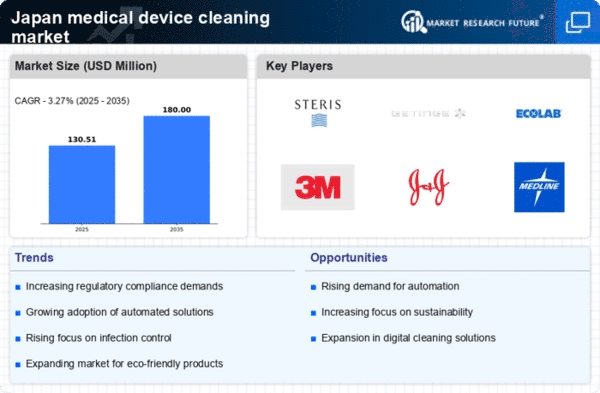
As per Market Research Future analysis, the Japan medical device-cleaning market Size was estimated at 126.38 USD Million in 2024. The Japan medical device-cleaning market is projected to grow from 130.51 USD Million in 2025 to 180.0 USD Million by 2035, exhibiting a compound annual growth rate (CAGR) of 3.2% during the forecast period 2025 - 2035

Key Market Trends & Highlights

The Japan medical device-cleaning market is experiencing robust growth driven by technological advancements and increasing regulatory compliance.

  • Technological advancements in cleaning solutions are enhancing the efficiency and effectiveness of medical device cleaning processes.
  • Sustainability in cleaning products is becoming a focal point, reflecting a broader trend towards environmentally friendly practices in healthcare.
  • Regulatory compliance and standards are increasingly shaping the market, ensuring that cleaning solutions meet stringent health and safety requirements.
  • Rising healthcare expenditure and an aging population are key drivers, contributing to the demand for effective cleaning solutions in surgical procedures.

Market Size & Forecast

2024 Market Size 126.38 (USD Million)
2035 Market Size 180.0 (USD Million)
CAGR (2025 - 2035) 3.27%

Major Players

Steris (US), Getinge (SE), Ecolab (US), 3M (US), Johnson & Johnson (US), Medline Industries (US), Stryker (US), B. Braun (DE), Hygiena (US)

Our Impact
Enabled $4.3B Revenue Impact for Fortune 500 and Leading Multinationals
Partnering with 2000+ Global Organizations Each Year
30K+ Citations by Top-Tier Firms in the Industry

Japan Medical Device Cleaning Market Trends

the medical device cleaning market is currently experiencing notable growth, driven by increasing awareness regarding hygiene and infection control in healthcare settings. As healthcare facilities prioritize patient safety, the demand for effective cleaning solutions has surged. This trend is further supported by advancements in cleaning technologies, which enhance the efficiency and effectiveness of cleaning processes. Moreover, regulatory bodies are emphasizing stringent cleaning protocols, compelling medical facilities to adopt innovative cleaning solutions that meet these standards. The integration of automated cleaning systems is also becoming more prevalent, as these systems offer consistent and reliable cleaning outcomes, thereby reducing the risk of cross-contamination. In addition, the medical device-cleaning market is witnessing a shift towards eco-friendly cleaning products. Stakeholders are increasingly recognizing the importance of sustainability in healthcare practices. This shift is likely to influence product development, with manufacturers focusing on creating biodegradable and non-toxic cleaning agents. Furthermore, the rise of telemedicine and remote healthcare services may also impact the market, as the need for cleaning and sterilization of medical devices remains critical, even in non-traditional healthcare settings. Overall, the medical device-cleaning market appears poised for continued expansion, driven by technological advancements and evolving healthcare needs.

Technological Advancements in Cleaning Solutions

The medical device-cleaning market is seeing a rise in innovative cleaning technologies. Automated systems and advanced cleaning agents are being developed to enhance efficiency and effectiveness. These technologies not only streamline cleaning processes but also ensure compliance with stringent regulatory standards.

Sustainability in Cleaning Products

There is a growing trend towards eco-friendly cleaning solutions within the medical device-cleaning market. Stakeholders are increasingly prioritizing sustainability, leading to the development of biodegradable and non-toxic cleaning agents. This shift reflects a broader commitment to environmentally responsible healthcare practices.

Regulatory Compliance and Standards

The medical device-cleaning market is heavily influenced by regulatory requirements. As healthcare facilities face increasing scrutiny regarding hygiene practices, adherence to cleaning protocols becomes paramount. This trend drives demand for products that meet or exceed established standards, ensuring patient safety.

Japan Medical Device Cleaning Market Drivers

Rising Healthcare Expenditure

The increasing healthcare expenditure in Japan is a pivotal driver for the medical device-cleaning market. As the government allocates more funds towards healthcare services, hospitals and clinics are likely to invest in advanced cleaning solutions to ensure patient safety and compliance with hygiene standards. In 2025, healthcare spending in Japan is projected to reach approximately $500 billion, reflecting a growth rate of around 5% annually. This surge in expenditure is expected to enhance the demand for effective cleaning solutions, thereby propelling the medical device-cleaning market. Furthermore, the emphasis on maintaining high standards of cleanliness in medical facilities is likely to drive the adoption of innovative cleaning technologies, which could further stimulate market growth.

Increased Focus on Infection Control

The heightened focus on infection control within healthcare settings is a crucial driver for the medical device-cleaning market. In Japan, healthcare facilities are increasingly prioritizing infection prevention strategies to safeguard patient health. This focus is reflected in the implementation of rigorous cleaning protocols and the adoption of specialized cleaning products designed to eliminate pathogens effectively. The market for cleaning solutions tailored for infection control is projected to grow significantly, with an expected increase of 6% annually through 2025. As hospitals and clinics strive to maintain high standards of cleanliness, the demand for effective medical device-cleaning solutions is likely to escalate, further supporting market growth.

Technological Integration in Healthcare

The integration of advanced technologies in healthcare is reshaping the medical device-cleaning market. Innovations such as automated cleaning systems and smart monitoring solutions are becoming increasingly prevalent in medical facilities across Japan. These technologies not only enhance the efficiency of cleaning processes but also ensure compliance with stringent hygiene standards. The market for automated cleaning solutions is expected to grow at a CAGR of 7% through 2025, driven by the need for consistent and reliable cleaning outcomes. As healthcare providers seek to optimize their operations and reduce the risk of hospital-acquired infections, the demand for technologically advanced cleaning solutions is likely to rise, thereby propelling the medical device-cleaning market forward.

Regulatory Framework and Compliance Requirements

The regulatory framework governing healthcare practices in Japan plays a vital role in shaping the medical device-cleaning market. Stringent regulations and compliance requirements necessitate that healthcare facilities adhere to specific cleaning standards to ensure patient safety. The Ministry of Health, Labour and Welfare has established guidelines that mandate regular cleaning and disinfection of medical devices. As a result, healthcare providers are compelled to invest in cleaning solutions that meet these regulatory standards. The ongoing evolution of these regulations is expected to drive innovation within the medical device-cleaning market, as manufacturers develop products that comply with the latest guidelines. This dynamic regulatory environment is likely to foster growth and enhance the overall quality of cleaning solutions available in the market.

Aging Population and Increased Surgical Procedures

Japan's aging population is a significant factor influencing the medical device-cleaning market. With a demographic shift towards an older population, there is a corresponding rise in surgical procedures and medical interventions. By 2025, it is estimated that over 30% of the population will be aged 65 and above, leading to an increased demand for surgical services. This trend necessitates stringent cleaning protocols for medical devices to prevent infections and ensure patient safety. Consequently, healthcare facilities are likely to invest more in cleaning solutions that meet the rigorous standards required for surgical instruments and devices. The medical device-cleaning market is thus positioned to benefit from this demographic trend, as the need for effective cleaning solutions becomes more pronounced.


Market Segment Insights

By Application: Surgical Instruments (Largest) vs. Endoscopes (Fastest-Growing)

In the Japan medical device-cleaning market, the application segment is primarily driven by surgical instruments, which command the largest market share. This is largely due to their wide usage across various surgical procedures in hospitals and clinics. Following closely are endoscopes, which, while holding a smaller share, are rapidly gaining traction due to the increasing prevalence of minimally invasive surgeries that require effective cleaning and sterilization processes. Growth trends in this segment are influenced by several factors, including technological advancements, an aging population, and an increased focus on infection control in medical facilities. As healthcare providers continue to invest in high-quality cleaning solutions, the demand for effective cleaning equipment for surgical instruments and endoscopes is poised to rise, reflecting a broader shift toward maintaining higher standards of hygiene and safety in medical environments.

Surgical Instruments (Dominant) vs. Endoscopes (Emerging)

Surgical instruments play a dominant role in the Japan medical device-cleaning market due to their essential function in surgical settings. These instruments require meticulous cleaning processes to ensure sterility, which drives the demand for specialized cleaning solutions. In contrast, endoscopes represent an emerging segment characterized by technological innovation and a growing focus on minimally invasive procedures. As the use of endoscopic techniques increases, the need for effective cleaning and disinfection of these delicate instruments also grows. Both segments face unique challenges, such as the need for specialized materials and processes, but share the common goal of enhancing patient safety through effective cleaning practices.

By Type: Disinfectants (Largest) vs. Ultrasonic Cleaners (Fastest-Growing)

In the Japan medical device-cleaning market, disinfectants represent the largest share of the market, driven by stringent hygiene regulations and increasing awareness of infection control in healthcare settings. Detergents and steam sterilizers also hold significant positions, but disinfectants lead in market distribution, reflecting the prioritization of safety and cleanliness in medical environments. The growth trend for ultrasonic cleaners is noteworthy, as they are becoming the fastest-growing segment among cleaning solutions. The demand for these devices is propelled by their effectiveness in cleaning intricate medical instruments without damaging them. This trend is bolstered by ongoing technological advancements and the rising need for efficient sterilization processes in the healthcare industry.

Disinfectants (Dominant) vs. Ultrasonic Cleaners (Emerging)

Disinfectants dominate the Japan medical device-cleaning market, recognized for their crucial role in maintaining sterile environments in healthcare facilities. Their effectiveness against a broad spectrum of pathogens makes them essential for effective infection control practices. On the other hand, ultrasonic cleaners are gaining traction as an emerging solution due to their ability to clean delicate instruments thoroughly and efficiently. These cleaners utilize high-frequency sound waves to dislodge contaminants, providing deep cleaning capabilities that are increasingly appreciated in surgical and clinical settings. The shift towards automation and advanced cleaning technologies further enhances the appeal of ultrasonic devices, positioning them as a key player in the evolving landscape of medical cleaning solutions.

By End Use: Hospitals (Largest) vs. Ambulatory Surgical Centers (Fastest-Growing)

The market share distribution in the Japan medical device-cleaning market reveals that hospitals continue to dominate the segment, accounting for a significant portion of the overall demand. Ambulatory surgical centers are rapidly gaining traction, reflecting a shift towards outpatient care, which is increasingly prioritizing efficient cleaning solutions to maintain high hygiene standards. Dental clinics and research laboratories also play important roles but have smaller market shares comparatively, indicating a diverse landscape of end users. Growth trends in the Japan medical device-cleaning market are driven primarily by advancements in medical technology and a growing emphasis on patient safety. The increasing number of surgeries performed in ambulatory surgical centers accelerates the demand for effective cleaning solutions. Furthermore, regulatory requirements continue to elevate the standards of cleanliness, pushing healthcare facilities to invest more in cleaning devices. Hospitals remain at the forefront, but the swift expansion of ambulatory surgical centers demonstrates a pivotal change in healthcare dynamics.

Hospitals (Dominant) vs. Ambulatory Surgical Centers (Emerging)

Hospitals, as the dominant end-use segment in the Japan medical device-cleaning market, utilize a wide range of cleaning devices to ensure all medical instruments are free from contaminants. Their extensive infrastructure supports the adoption of advanced cleaning technologies, allowing for high-volume processing of tools and equipment. In contrast, ambulatory surgical centers represent an emerging segment focused on streamlined operations and effective cleaning protocols that are vital for outpatient procedures. These centers favor rapid cleaning processes that minimize turnaround times, reflecting a shift in healthcare delivery. While hospitals invest heavily in comprehensive cleaning solutions, the agile nature of ambulatory surgical centers positions them for significant growth, driven by changing patient preferences and healthcare models.

By Cleaning Method: Automated Cleaning (Largest) vs. Ultrasonic Cleaning (Fastest-Growing)

In the Japan medical device-cleaning market, Automated Cleaning holds the largest market share, driven by advancements in technology and a growing preference for efficiency in cleaning procedures. Manual Cleaning, while still significant, is gradually being overshadowed by these automated solutions due to labor costs and time efficiency. Ultrasonic Cleaning is gaining traction due to its innovative approach, allowing for deep cleaning of complex devices that are difficult to clean manually or with traditional methods. Growth trends in the cleaning method segment are largely influenced by technological innovations and stringent hygiene regulations in medical facilities. The shift towards Automated Cleaning systems is propelled by the need for consistency and reliability, while Ultrasonic Cleaning is rapidly becoming popular among healthcare providers seeking to enhance cleaning effectiveness and decrease the risk of contamination. The combination of these trends is expected to reshape the landscape of cleaning methods for medical devices in the region.

Manual Cleaning (Dominant) vs. Automated Cleaning (Emerging)

Manual Cleaning remains the dominant method in the Japan medical device-cleaning market due to its traditional prevalence and flexibility. Many healthcare facilities still rely on trained personnel to ensure a thorough cleaning process, particularly for delicate instruments that require careful handling. However, Automated Cleaning is emerging as a competitive alternative, offering benefits such as reduced labor costs, enhanced compliance with cleaning protocols, and improved efficiency. As facilities increasingly seek to optimize cleaning processes to meet regulatory standards and improve patient safety, the adoption of Automated Cleaning technologies is expected to grow significantly. The challenge lies in balancing efficiency with the personalized quality that Manual Cleaning provides.

Get more detailed insights about Japan Medical Device Cleaning Market

Key Players and Competitive Insights

The medical device-cleaning market in Japan is characterized by a competitive landscape that is increasingly shaped by innovation, regulatory compliance, and the growing emphasis on infection control. Key players such as Steris (US), Getinge (SE), and Ecolab (US) are at the forefront, leveraging their technological capabilities and extensive product portfolios to enhance operational efficiency and meet stringent healthcare standards. These companies are strategically positioned to capitalize on the rising demand for advanced cleaning solutions, driven by an aging population and the increasing prevalence of chronic diseases, which necessitate higher standards of hygiene in medical facilities.In terms of business tactics, companies are focusing on localizing manufacturing and optimizing supply chains to enhance responsiveness to market needs. The competitive structure of the market appears moderately fragmented, with several players vying for market share. However, the collective influence of major companies like Johnson & Johnson (US) and Stryker (US) suggests a trend towards consolidation, as these firms seek to expand their geographical footprint and product offerings through strategic partnerships and acquisitions.

In October Steris (US) announced the launch of a new line of automated cleaning systems designed to improve the efficiency of surgical instrument decontamination. This strategic move is significant as it aligns with the growing trend towards automation in healthcare, potentially reducing labor costs and enhancing compliance with infection control protocols. The introduction of such innovative solutions may strengthen Steris's market position by addressing the evolving needs of healthcare providers.

In September Getinge (SE) expanded its partnership with a leading Japanese hospital group to implement advanced cleaning technologies across its facilities. This collaboration is indicative of Getinge's commitment to enhancing patient safety and operational efficiency. By integrating its state-of-the-art cleaning solutions into the hospital's workflow, Getinge not only reinforces its presence in the Japanese market but also demonstrates the importance of strategic alliances in driving growth and innovation.

In August Ecolab (US) unveiled a new sustainability initiative aimed at reducing water usage in medical device cleaning processes. This initiative reflects a broader industry trend towards sustainability, as healthcare providers increasingly prioritize environmentally friendly practices. Ecolab's focus on sustainability may enhance its competitive edge, appealing to a growing segment of environmentally conscious customers and aligning with global sustainability goals.

As of November the competitive trends in the medical device-cleaning market are heavily influenced by digitalization, sustainability, and the integration of artificial intelligence (AI) into cleaning processes. Strategic alliances are becoming increasingly vital, as companies recognize the need to collaborate to enhance their technological capabilities and market reach. Looking ahead, the competitive differentiation in this market is likely to evolve from traditional price-based competition to a focus on innovation, advanced technology, and supply chain reliability, as companies strive to meet the complex demands of the healthcare sector.

Key Companies in the Japan Medical Device Cleaning Market include

Industry Developments

The Japan Medical Device Cleaning Market has recently seen several significant developments. In September 2023, Hitachi Ltd announced a partnership aimed at advancing sanitization technology for its medical devices, focusing on improving efficiency and ensuring compliance with stringent regulatory standards. Sysmex Corporation has also been actively enhancing its cleaning protocols for laboratory equipment, further contributing to infection control and safety. Notably, in July 2023, Fujifilm Holdings Corporation introduced a novel cleaning solution specifically designed for endoscopic devices, showcasing a commitment to innovation in this field.

There have been notable mergers and acquisitions as well; in August 2023, Olympus Corporation completed an acquisition of a cleaning technology firm to bolster its product offerings in the medical device sector. The market is witnessing increased investment, with Terumo Corporation reporting a growth in market valuation due to rising demand for advanced cleaning solutions. Key companies are adapting and evolving alongside regulatory changes, which emphasizes the importance of stringent cleaning processes in maintaining high standards of healthcare in Japan.

Future Outlook

Japan Medical Device Cleaning Market Future Outlook

The Medical Device Cleaning Market in Japan is projected to grow at a 3.27% CAGR from 2025 to 2035, driven by technological advancements and increasing regulatory standards.

New opportunities lie in:

  • Development of eco-friendly cleaning agents for medical devices.
  • Integration of IoT for real-time monitoring of cleaning processes.
  • Expansion of automated cleaning systems in healthcare facilities.

By 2035, the market is expected to achieve robust growth, reflecting evolving healthcare demands.

Market Segmentation

Japan Medical Device Cleaning Market Type Outlook

  • Detergents
  • Disinfectants
  • Ultrasonic Cleaners
  • Steam Sterilizers

Japan Medical Device Cleaning Market End Use Outlook

  • Hospitals
  • Ambulatory Surgical Centers
  • Dental Clinics
  • Research Laboratories

Japan Medical Device Cleaning Market Application Outlook

  • Surgical Instruments
  • Endoscopes
  • Dental Instruments
  • Implants
  • General Equipment

Japan Medical Device Cleaning Market Cleaning Method Outlook

  • Manual Cleaning
  • Automated Cleaning
  • Ultrasonic Cleaning

Report Scope

MARKET SIZE 2024 126.38(USD Million)
MARKET SIZE 2025 130.51(USD Million)
MARKET SIZE 2035 180.0(USD Million)
COMPOUND ANNUAL GROWTH RATE (CAGR) 3.27% (2025 - 2035)
REPORT COVERAGE Revenue Forecast, Competitive Landscape, Growth Factors, and Trends
BASE YEAR 2024
Market Forecast Period 2025 - 2035
Historical Data 2019 - 2024
Market Forecast Units USD Million
Key Companies Profiled Steris (US), Getinge (SE), Ecolab (US), 3M (US), Johnson & Johnson (US), Medline Industries (US), Stryker (US), B. Braun (DE), Hygiena (US)
Segments Covered Application, Type, End Use, Cleaning Method
Key Market Opportunities Adoption of advanced cleaning technologies enhances efficiency and compliance in the medical device-cleaning market.
Key Market Dynamics Rising regulatory scrutiny drives innovation and competition in Japan's medical device-cleaning market.
Countries Covered Japan
Leave a Comment

FAQs

What is the expected market size of the Japan Medical Device Cleaning Market in 2024?

The Japan Medical Device Cleaning Market is expected to be valued at 126.37 million USD in 2024.

What is the projected market size for the Japan Medical Device Cleaning Market by 2035?

By 2035, the Japan Medical Device Cleaning Market is projected to reach 204.0 million USD.

What is the expected compound annual growth rate (CAGR) for the Japan Medical Device Cleaning Market between 2025 and 2035?

The expected CAGR for the Japan Medical Device Cleaning Market from 2025 to 2035 is 4.449%.

Which application segment has the largest market share in the Japan Medical Device Cleaning Market?

The Surgical Instruments application segment holds the largest market share, valued at 40.0 million USD in 2024.

What is the market value for Endoscopes in the Japan Medical Device Cleaning Market in 2024?

The market value for Endoscopes is expected to be 30.0 million USD in 2024.

How much is the Dental Instruments segment projected to grow by 2035?

The Dental Instruments segment is projected to grow to 32.0 million USD by 2035.

Who are the major players in the Japan Medical Device Cleaning Market?

Major players include Hitachi Ltd, Sysmex Corporation, and Fujifilm Holdings Corporation among others.

What is the expected market size for the General Equipment application in 2035?

The General Equipment application is expected to reach a market size of 30.0 million USD by 2035.

What growth opportunities exist in the Japan Medical Device Cleaning Market?

Growth opportunities exist in expanding application of cleaning technologies and increasing healthcare standards.

What challenges might the Japan Medical Device Cleaning Market face in the coming years?

The market may face challenges related to regulatory compliance and maintaining product efficacy in cleaning solutions.

Download Free Sample

Kindly complete the form below to receive a free sample of this Report

Compare Licence

×
Features License Type
Single User Multiuser License Enterprise User
Price $4,950 $5,950 $7,250
Maximum User Access Limit 1 User Upto 10 Users Unrestricted Access Throughout the Organization
Free Customization
Direct Access to Analyst
Deliverable Format
Platform Access
Discount on Next Purchase 10% 15% 15%
Printable Versions