×
Request Free Sample ×

Kindly complete the form below to receive a free sample of this Report

* Please use a valid business email

Leading companies partner with us for data-driven Insights

clients tt-cursor
Hero Background

Japan Li Ion Battery Recycling Market

ID: MRFR/EnP/52532-HCR
200 Pages
Snehal Singh
February 2026

Japan Li-Ion Battery Recycling Market Research Report By Application (Consumer Electronics, Electric Vehicles, Energy Storage Systems, Power Tools), By Technology (Hydrometallurgical, Pyrometallurgical, Direct Recycling), By Battery Type (Lithium Nickel Manganese Cobalt Oxide, Lithium Iron Phosphate, Lithium Cobalt Oxide, Lithium Manganese Oxide) and By End Use (Automotive, Industrial, Residential, Commercial) - Growth & Industry Forecast to 2035

Share:
Download PDF ×

We do not share your information with anyone. However, we may send you emails based on your report interest from time to time. You may contact us at any time to opt-out.

Japan Li Ion Battery Recycling Market Infographic
Purchase Options

Japan Li Ion Battery Recycling Market Summary

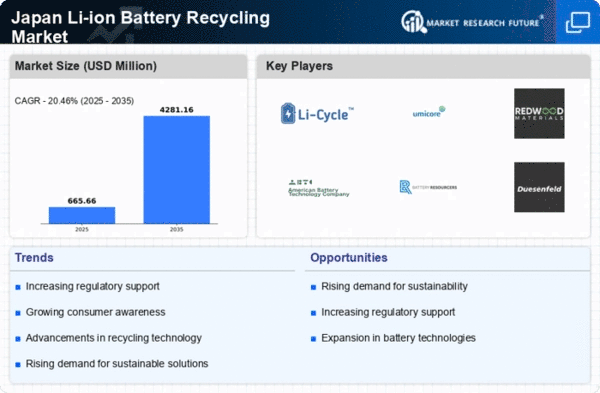
As per Market Research Future analysis, the Japan Li Ion Battery Recycling Market size was estimated at 552.6 USD Million in 2024. The Li Ion-battery-recycling market is projected to grow from 665.66 USD Million in 2025 to 4281.16 USD Million by 2035, exhibiting a compound annual growth rate (CAGR) of 20.4% during the forecast period 2025 - 2035

Key Market Trends & Highlights

The Japan li ion-battery-recycling market is poised for growth driven by regulatory support and technological advancements.

  • Regulatory support is enhancing the framework for sustainable recycling practices in Japan.
  • Technological advancements are streamlining recycling processes, making them more efficient and cost-effective.
  • Consumer awareness regarding environmental impacts is increasing, leading to higher demand for recycling solutions.
  • Rising demand for electric vehicles and government initiatives are key drivers propelling market expansion.

Market Size & Forecast

2024 Market Size 552.6 (USD Million)
2035 Market Size 4281.16 (USD Million)
CAGR (2025 - 2035) 20.46%

Major Players

Li-Cycle (CA), Umicore (BE), Redwood Materials (US), American Battery Technology Company (US), Battery Resourcers (US), Duesenfeld (DE), Recupyl (FR), Aqua Metals (US)

Our Impact
Enabled $4.3B Revenue Impact for Fortune 500 and Leading Multinationals
Partnering with 2000+ Global Organizations Each Year
30K+ Citations by Top-Tier Firms in the Industry

Japan Li Ion Battery Recycling Market Trends

the Japan Li Ion Battery Recycling Market is experiencing notable growth, driven by increasing environmental awareness and stringent regulations. Japan's commitment to sustainability has led to the implementation of policies aimed at enhancing recycling rates and reducing waste. The government actively promotes the circular economy, encouraging manufacturers to adopt eco-friendly practices. This shift is reflected in the rising demand for recycled materials, which are essential for the production of new batteries. As a result, companies are investing in advanced recycling technologies to improve efficiency and recovery rates. Moreover, the collaboration between public and private sectors is fostering innovation in the li ion-battery-recycling market. Research initiatives and partnerships are emerging to develop better recycling methods and to educate consumers about the importance of battery recycling. The focus on resource recovery is not only beneficial for the environment but also presents economic opportunities. As the market evolves, it appears poised for further expansion, with potential advancements in technology and increased consumer participation in recycling programs. In summary, the li ion-battery-recycling market is on a trajectory of growth, influenced by regulatory frameworks and a collective push towards sustainability. The future may hold even greater advancements as stakeholders continue to prioritize eco-friendly solutions and resource efficiency.

Regulatory Support

Japan's government is actively implementing regulations that promote battery recycling. These policies aim to enhance recycling rates and minimize environmental impact. By establishing clear guidelines, the government encourages manufacturers to adopt sustainable practices, which is likely to drive growth in the market.

Technological Advancements

Innovations in recycling technologies are transforming the li ion-battery-recycling market. Companies are investing in advanced methods to improve material recovery and processing efficiency. These technological developments may lead to higher quality recycled materials, making them more attractive for manufacturers.

Consumer Awareness

There is a growing awareness among consumers regarding the importance of recycling batteries. Educational campaigns and initiatives are being launched to inform the public about proper disposal methods. This increased awareness could lead to higher participation rates in recycling programs, positively impacting the market.

Japan Li Ion Battery Recycling Market Drivers

Growing Environmental Concerns

Heightened awareness of environmental issues is driving the li ion-battery-recycling market in Japan. As the public becomes increasingly concerned about the ecological impact of battery waste, there is a growing demand for responsible recycling solutions. Reports indicate that improper disposal of lithium-ion batteries can lead to soil and water contamination, prompting calls for more sustainable practices. This societal shift is encouraging both consumers and businesses to prioritize recycling, thereby expanding the market. Additionally, educational campaigns aimed at informing the public about the benefits of battery recycling are gaining traction, further enhancing market growth. The li ion-battery-recycling market is likely to thrive as environmental consciousness continues to shape consumer behavior and corporate responsibility.

Government Initiatives and Policies

Japan's government has implemented various initiatives aimed at promoting sustainability and environmental protection, which directly influence the li ion-battery-recycling market. Policies encouraging the recycling of batteries are becoming more stringent, with regulations mandating proper disposal and recycling practices. The government has set ambitious targets to increase recycling rates to 50% by 2030, which could significantly boost the market. Additionally, financial incentives for companies engaging in recycling activities are being introduced, further stimulating growth. These initiatives not only enhance the recycling infrastructure but also raise public awareness about the importance of battery recycling, thereby fostering a culture of sustainability. As a result, the li ion-battery-recycling market is likely to experience accelerated growth due to these supportive governmental measures.

Rising Demand for Electric Vehicles

The increasing adoption of electric vehicles (EVs) in Japan is a pivotal driver for the li ion-battery-recycling market. As the government promotes EV usage to reduce carbon emissions, the demand for lithium-ion batteries is surging. In 2025, it is estimated that the number of EVs on Japanese roads will exceed 2 million, leading to a significant rise in battery waste. This trend necessitates efficient recycling solutions to manage the end-of-life batteries, thereby creating a robust market for recycling services. The li ion-battery-recycling market is expected to grow in tandem with the EV sector, as manufacturers and consumers alike seek sustainable disposal methods for used batteries. Furthermore, the potential recovery of valuable materials from recycled batteries, such as lithium and cobalt, adds economic incentives for stakeholders in the recycling industry.

Collaboration Between Industry Stakeholders

Collaboration among various stakeholders in the li ion-battery-recycling market is emerging as a crucial driver for growth. Partnerships between battery manufacturers, recycling companies, and government agencies are being formed to create a more efficient recycling ecosystem. These collaborations facilitate knowledge sharing, resource pooling, and the development of standardized practices, which can enhance the overall effectiveness of recycling efforts. For instance, joint ventures are being established to invest in advanced recycling technologies and infrastructure, which could lead to improved recovery rates and reduced costs. As these partnerships strengthen, they are likely to foster innovation and drive the expansion of the li ion-battery-recycling market, ensuring that it meets the increasing demand for sustainable battery disposal solutions.

Technological Innovations in Recycling Processes

Advancements in recycling technologies are transforming the li ion-battery-recycling market in Japan. Innovative methods, such as hydrometallurgical and pyrometallurgical processes, are being developed to enhance the efficiency of material recovery from spent batteries. These technologies can potentially recover up to 95% of valuable materials, including lithium, nickel, and cobalt, which are critical for new battery production. As these technologies become more commercially viable, they are expected to lower operational costs and improve the profitability of recycling operations. Furthermore, the integration of automation and artificial intelligence in recycling facilities is likely to streamline processes, reduce labor costs, and increase throughput. Consequently, the li ion-battery-recycling market stands to benefit from these technological advancements, making recycling a more attractive option for manufacturers and consumers alike.


Market Segment Insights

By Application: Electric Vehicles (Largest) vs. Consumer Electronics (Fastest-Growing)

In the Japan li ion-battery-recycling market, the application segment is predominantly driven by electric vehicles, which hold the largest market share due to the rapid adoption of EV technology. This sector is appealing not only for the volume of batteries used but also for the increasing investments in EV infrastructure. Consumer electronics follow closely behind, showcasing a significant share as technology becomes more pervasive in daily life, leading to higher battery disposal rates. Growth trends indicate that electric vehicles will continue to dominate as more drivers and manufacturers transition to greener technology. However, consumer electronics are the fastest-growing segment, spurred by ongoing innovations in portable gadgets and sustainability trends among consumers. The push for eco-friendly solutions is driving demand for efficient recycling processes in this area, which is critical for balancing growth with environmental responsibility.

Electric Vehicles (Dominant) vs. Consumer Electronics (Emerging)

Electric vehicles stand as the dominant force in the Japan li ion-battery-recycling market due to their substantial use of lithium-ion batteries and the increasing focus on green technology. This segment is characterized by significant investments in recycling technologies that cater to the specific needs of EV batteries, which are larger and more complex than those found in consumer electronics. On the other hand, consumer electronics are an emerging segment driven by trends in miniaturization and sustainability. The rapid turnover of personal gadgets leads to more spent batteries entering the recycling stream, prompting innovation in recycling methods. This dynamic creates opportunities for companies focusing on eco-friendly solutions to cater to both segments effectively.

By Technology: Hydrometallurgical (Largest) vs. Pyrometallurgical (Fastest-Growing)

In the Japan li ion-battery-recycling market, the hydrometallurgical process holds the largest market share, positioning itself as a dominant method for extracting valuable metals from spent batteries. This method is preferred for its efficiency and lower environmental impact compared to traditional approaches. On the other hand, the pyrometallurgical process, while smaller in market share, is gaining traction rapidly due to advancements in technology and increasing demand for sustainable solutions. The growth trends within the technology segment are significantly influenced by the rising awareness of environmental issues and stringent regulations aimed at reducing waste. Direct recycling methods are also emerging as a viable alternative, appealing to manufacturers seeking to enhance sustainability and reduce costs. Overall, innovation and a shift towards greener practices are key drivers propelling growth in this sector.

Technology: Hydrometallurgical (Dominant) vs. Pyrometallurgical (Emerging)

The hydrometallurgical process is characterized by its effectiveness in recovering resources from lithium-ion batteries, making it the dominant technology in the recycling market. This method allows for precise metal recovery with minimal environmental impact, aligning with global sustainability goals. Conversely, the pyrometallurgical process, though considered emerging, harnesses high temperatures to recover metals but faces challenges regarding emissions and energy consumption. As technology evolves, this segment is anticipated to expand, focusing on addressing environmental concerns and boosting overall efficiency, thereby positioning itself as a strong alternative in the Japan li ion-battery-recycling market.

By Battery Type: Lithium Nickel Manganese Cobalt Oxide (Largest) vs. Lithium Iron Phosphate (Fastest-Growing)

In the Japan li ion-battery-recycling market, the Lithium Nickel Manganese Cobalt Oxide segment holds the largest share, favored for its high energy density and efficiency. This segment's dominance is attributed to the increasing demand for electric vehicles and portable electronics, driving recyclers to prioritize its recovery for sustainable development. In contrast, Lithium Iron Phosphate is emerging as the fastest-growing segment, particularly valued for its stability, safety, and lower environmental impact. As the market evolves, these characteristics are gaining traction among manufacturers and consumers alike. The growth trends in battery types reflect a shift toward sustainability and performance optimization. The demand for Lithium Iron Phosphate is notably fueled by its growing incorporation in renewable energy storage systems and electric buses. Furthermore, advancements in recycling technologies enhance the recovery rates of Lithium Nickel Manganese Cobalt Oxide, making the overall recycling processes more efficient. This dual progression showcases how diverse battery chemistries are adapting to market needs, thus influencing industry dynamics significantly.
Lithium Nickel Manganese Cobalt Oxide (Dominant) vs. Lithium Iron Phosphate (Emerging)

Lithium Nickel Manganese Cobalt Oxide is a dominant player in the Japan li ion-battery-recycling market, known for its high capacity and performance advantages, making it the preferred choice for high-end applications like electric vehicles. Its composition enhances thermal stability and energy density, which are critical for modern energy needs. Conversely, Lithium Iron Phosphate is emerging rapidly due to its excellent thermal stability and safety features, presenting a compelling choice for large-scale energy storage solutions. While it may offer lower energy density compared to its counterpart, its longer life cycle and lower cost position it favorably in the growing green technology sector. Together, these segments illustrate the changing landscape of battery technology and recycling efficiency.

By End Use: Automotive (Largest) vs. Industrial (Fastest-Growing)

The market share distribution within the end-use segment of the Japan li ion-battery-recycling market reveals that automotive applications hold the largest slice of the pie. This dominance can be attributed to the high volume of electric vehicles (EVs) and hybrid vehicles in the market, which require efficient recycling solutions for their batteries. Following the automotive sector, industrial applications are making significant strides, driven by the need for sustainable practices and regulatory support. Growth trends in this segment indicate a robust shift towards eco-friendly practices, particularly in the industrial and residential sectors. The industrial segment is emerging as the fastest-growing area due to increased investments in electric machinery and equipment, which require battery recycling services. Additionally, as the residential market embraces renewable energy solutions, including battery storage for solar systems, the demand for recycling services is expected to grow, aligning with national sustainability goals.

Automotive: Dominant vs. Industrial: Emerging

The automotive sector in the Japan li ion-battery-recycling market is characterized by its significant size and steady demand, largely driven by the rapid adoption of electric vehicles. This sector's dominance is pivotal as it sets the trend for recycling technologies and practices. On the other hand, the industrial segment is emerging, fueled by an increasing recognition of the importance of sustainable practices in various industries. As businesses prioritize eco-friendly solutions, the industrial sector's growth is supported by ongoing technological advancements and regulatory encouragement. Both segments are positioned to evolve, with automotive remaining crucial while industrial experiences a burgeoning transformation towards sustainability and circular economy practices.

Get more detailed insights about Japan Li Ion Battery Recycling Market

Key Players and Competitive Insights

The li ion-battery-recycling market is currently characterized by a dynamic competitive landscape, driven by increasing demand for sustainable practices and the need for efficient resource recovery. Key players such as Li-Cycle (CA), Umicore (BE), and Redwood Materials (US) are at the forefront, each adopting distinct strategies to enhance their market positioning. Li-Cycle (CA) focuses on innovative recycling technologies that maximize material recovery, while Umicore (BE) emphasizes its established expertise in materials technology and sustainability. Redwood Materials (US) is leveraging partnerships with major automotive manufacturers to secure a steady supply of used batteries, thereby reinforcing its operational focus on circular economy principles. Collectively, these strategies contribute to a competitive environment that is increasingly oriented towards sustainability and technological advancement. In terms of business tactics, companies are localizing manufacturing and optimizing supply chains to enhance efficiency and reduce costs. The market structure appears moderately fragmented, with several players vying for market share, yet the influence of key players is substantial. This competitive structure fosters innovation and encourages collaboration among companies, as they seek to address the challenges of battery waste and resource scarcity. In October 2025, Li-Cycle (CA) announced the opening of a new recycling facility in Japan, which is expected to significantly increase its processing capacity. This strategic move not only enhances Li-Cycle's operational footprint in Asia but also aligns with Japan's growing emphasis on sustainable waste management practices. The facility is anticipated to process up to 30,000 t of lithium-ion batteries annually, thereby contributing to the circular economy and reducing reliance on virgin materials. In September 2025, Umicore (BE) expanded its partnership with a leading Japanese automotive manufacturer to develop advanced recycling technologies tailored for electric vehicle batteries. This collaboration is strategically important as it positions Umicore to capitalize on the burgeoning EV market in Japan, while also reinforcing its commitment to sustainability. The partnership is likely to enhance Umicore's technological capabilities and market reach, further solidifying its competitive edge. In August 2025, Redwood Materials (US) secured a $100M investment to scale its battery recycling operations, with a focus on establishing a new facility in Japan. This investment is indicative of Redwood's aggressive growth strategy and its intent to capture a larger share of the Asian market. The new facility is expected to create jobs and foster local economic development, while also addressing the increasing demand for recycled battery materials in the region. As of November 2025, current competitive trends in the li ion-battery-recycling market are heavily influenced by digitalization, sustainability, and the integration of AI technologies. Strategic alliances are becoming increasingly prevalent, as companies recognize the need for collaboration to enhance their technological capabilities and market presence. Looking ahead, competitive differentiation is likely to evolve from traditional price-based competition to a focus on innovation, advanced technology, and supply chain reliability. This shift underscores the importance of sustainable practices and the need for companies to adapt to the changing landscape of resource recovery.

Key Companies in the Japan Li Ion Battery Recycling Market include

Industry Developments

The Japan Li-Ion Battery Recycling Market has seen significant developments recently, with growing emphasis on sustainability and circular economy practices. Companies such as Sumitomo Metal Mining and Mitsubishi Chemical are enhancing their recycling capabilities to address the increasing volume of waste from electric vehicles and consumer electronics. In June 2023, Toyota Tsusho announced a strategic partnership with Dowa Holdings to improve collection and recycling processes for lithium-ion batteries. In recent months, Nissan Chemical has expanded its recycling operations, investing in new technologies for better extraction of valuable materials.

Green Planet is also making strides, focusing on environmentally friendly methods for battery recycling.Over the last few years, there has been a notable growth in market valuations due to enhanced environmental regulations and government initiatives promoting recycling, which is furthering investment from major players like Panasonic and Hitachi. Moreover, the trend towards electric mobility in Japan has catalyzed partnerships and mergers among companies in the sector, creating a more integrated and efficient recycling framework. In March 2022, Ricoh increased its focus on sustainability, driving advancements in battery recycling processes that align with Japan’s commitment to reducing carbon emissions.

Future Outlook

Japan Li Ion Battery Recycling Market Future Outlook

The li ion-battery-recycling market is poised for growth at 20.46% CAGR from 2025 to 2035, driven by regulatory support, technological advancements, and increasing demand for sustainable practices.

New opportunities lie in:

  • Development of automated recycling facilities for efficiency gains. Partnerships with EV manufacturers for battery take-back programs. Investment in R&D for advanced recycling technologies to enhance recovery rates.

By 2035, the market is expected to achieve substantial growth, positioning itself as a leader in sustainable practices.

Market Segmentation

Japan Li Ion Battery Recycling Market End Use Outlook

  • Automotive
  • Industrial
  • Residential
  • Commercial

Japan Li Ion Battery Recycling Market Technology Outlook

  • Hydrometallurgical
  • Pyrometallurgical
  • Direct Recycling

Japan Li Ion Battery Recycling Market Application Outlook

  • Consumer Electronics
  • Electric Vehicles
  • Energy Storage Systems
  • Power Tools

Japan Li Ion Battery Recycling Market Battery Type Outlook

  • Lithium Nickel Manganese Cobalt Oxide
  • Lithium Iron Phosphate
  • Lithium Cobalt Oxide
  • Lithium Manganese Oxide

Report Scope

MARKET SIZE 2024 552.6(USD Million)
MARKET SIZE 2025 665.66(USD Million)
MARKET SIZE 2035 4281.16(USD Million)
COMPOUND ANNUAL GROWTH RATE (CAGR) 20.46% (2025 - 2035)
REPORT COVERAGE Revenue Forecast, Competitive Landscape, Growth Factors, and Trends
BASE YEAR 2024
Market Forecast Period 2025 - 2035
Historical Data 2019 - 2024
Market Forecast Units USD Million
Key Companies Profiled Li-Cycle (CA), Umicore (BE), Redwood Materials (US), American Battery Technology Company (US), Battery Resourcers (US), Duesenfeld (DE), Recupyl (FR), Aqua Metals (US)
Segments Covered Application, Technology, Battery Type, End Use
Key Market Opportunities Advancements in recycling technologies enhance resource recovery in the li ion-battery-recycling market.
Key Market Dynamics Rising regulatory pressures drive innovation and investment in lithium-ion battery recycling technologies in Japan.
Countries Covered Japan
Leave a Comment

FAQs

What is the expected market size of the Japan Li-Ion Battery Recycling Market in 2024?

The Japan Li-Ion Battery Recycling Market is expected to be valued at 273.6 million USD in 2024.

What will be the market valuation of the Japan Li-Ion Battery Recycling Market by 2035?

By 2035, the Japan Li-Ion Battery Recycling Market is projected to reach a valuation of 1680.0 million USD.

What is the CAGR for the Japan Li-Ion Battery Recycling Market from 2025 to 2035?

The market is anticipated to grow at a CAGR of 17.938 percent from 2025 to 2035.

Which application segment holds the largest market share in the Japan Li-Ion Battery Recycling Market?

The Electric Vehicles application segment is expected to hold a significant market share with a value of 120.0 million USD in 2024.

What will be the market value of the Consumer Electronics segment in 2035?

The Consumer Electronics segment is projected to reach a market value of 360.0 million USD by 2035.

Who are the key players in the Japan Li-Ion Battery Recycling Market?

Major players in the market include Sumitomo Metal Mining, Sony, Toyota Tsusho, and Panasonic among others.

How is the Energy Storage Systems segment expected to perform by 2035?

The Energy Storage Systems segment is forecasted to achieve a market value of 420.0 million USD by 2035.

What is the anticipated value of the Power Tools application segment in 2024?

In 2024, the Power Tools application segment is expected to be valued at 23.6 million USD.

What growth opportunity is seen for the Japan Li-Ion Battery Recycling Market?

The growth opportunity is substantial due to increasing applications in Consumer Electronics and Electric Vehicles.

How much is the Electric Vehicles segment expected to be worth in 2035?

The Electric Vehicles segment is projected to reach a market value of 720.0 million USD by 2035.

Download Free Sample

Kindly complete the form below to receive a free sample of this Report

Compare Licence

×
Features License Type
Single User Multiuser License Enterprise User
Price $4,950 $5,950 $7,250
Maximum User Access Limit 1 User Upto 10 Users Unrestricted Access Throughout the Organization
Free Customization
Direct Access to Analyst
Deliverable Format
Platform Access
Discount on Next Purchase 10% 15% 15%
Printable Versions