×
Request Free Sample ×

Kindly complete the form below to receive a free sample of this Report

* Please use a valid business email

Leading companies partner with us for data-driven Insights

clients tt-cursor
Hero Background

Japan Laser Projector Market

ID: MRFR/SEM/55741-HCR
200 Pages
Aarti Dhapte
February 2026

Japan Laser Projector Market Size, Share and Research Report By Illumination Type (Laser Phosphor, Hybrid, RGB Laser, Laser Diode, Others), By Resolution (XGA (1024 x 768 pixels), WXGA (1280 x 800 pixels), HD (1920 x 1080 pixels), 4K (4096 x 2160 pixels), Others) and By Vertical (Retail, Media & Entertainment, Healthcare, Industrial, Education, Others)- Industry Forecast Till 2035

Share:
Download PDF ×

We do not share your information with anyone. However, we may send you emails based on your report interest from time to time. You may contact us at any time to opt-out.

Japan Laser Projector Market Infographic
Purchase Options

Japan Laser Projector Market Summary

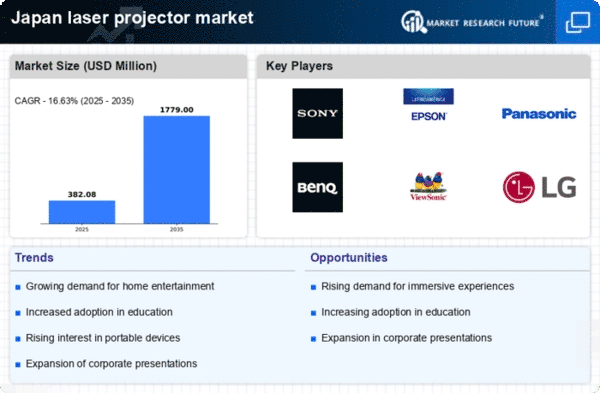
As per Market Research Future analysis, the Japan laser projector market Size was estimated at 327.6 USD Million in 2024. The Japan laser projector market is projected to grow from 382.08 USD Million in 2025 to 1779.0 USD Million by 2035, exhibiting a compound annual growth rate (CAGR) of 16.6% during the forecast period 2025 - 2035

Key Market Trends & Highlights

The Japan laser projector market is experiencing robust growth driven by technological advancements and increasing adoption across various sectors.

  • Technological advancements are enhancing the performance and capabilities of laser projectors, making them more appealing to consumers.
  • The education sector represents the largest segment, with schools and universities increasingly adopting laser projectors for interactive learning.
  • The event and entertainment sectors are the fastest-growing segments, driven by the demand for high-quality visuals in presentations and performances.
  • Rising demand for high-quality visuals and increased investment in education technology are key drivers propelling market growth.

Market Size & Forecast

2024 Market Size 327.6 (USD Million)
2035 Market Size 1779.0 (USD Million)
CAGR (2025 - 2035) 16.63%

Major Players

Sony (JP), Epson (JP), Panasonic (JP), BenQ (TW), ViewSonic (US), LG Electronics (KR), Christie Digital Systems (US), Optoma (TW)

Our Impact
Enabled $4.3B Revenue Impact for Fortune 500 and Leading Multinationals
Partnering with 2000+ Global Organizations Each Year
30K+ Citations by Top-Tier Firms in the Industry

Japan Laser Projector Market Trends

The laser projector market in Japan is currently experiencing a notable transformation, driven by advancements in technology and increasing demand across various sectors. The integration of laser technology into projectors offers enhanced image quality, longer lifespan, and reduced maintenance costs, which appeals to both commercial and educational institutions. As organizations seek to improve their visual presentation capabilities, the adoption of laser projectors is likely to rise, reflecting a shift towards more efficient and sustainable solutions. Furthermore, the growing trend of remote work and online education has led to a heightened need for high-quality projection systems, further propelling the market forward. In addition, the Japanese government’s initiatives to promote digital transformation in education and business sectors are expected to bolster the laser projector market. Investments in smart classrooms and advanced meeting facilities are likely to create opportunities for manufacturers and suppliers. As the market evolves, competition among key players intensifies, leading to innovations in design and functionality. Overall, the landscape of the laser projector market appears promising, with potential for growth driven by technological advancements and changing consumer preferences.

Technological Advancements

Recent innovations in laser technology are enhancing the performance and capabilities of projectors. These advancements lead to improved brightness, color accuracy, and energy efficiency, making laser projectors more appealing to various sectors, including education and corporate environments.

Increased Adoption in Education

Educational institutions are increasingly integrating laser projectors into classrooms to facilitate interactive learning experiences. The demand for high-quality visual aids is rising, as educators seek to engage students more effectively and enhance the overall learning environment.

Sustainability Focus

There is a growing emphasis on sustainability within the laser projector market. As organizations prioritize eco-friendly solutions, laser projectors, which typically have longer lifespans and lower energy consumption, are becoming a preferred choice for businesses aiming to reduce their environmental impact.

Japan Laser Projector Market Drivers

Integration of Smart Technologies

The integration of smart technologies into the laser projector market in Japan is transforming how these devices are utilized. Features such as wireless connectivity, cloud integration, and compatibility with various operating systems are becoming standard. This technological evolution allows for seamless presentations and enhanced user experiences. In 2025, it is estimated that around 30% of laser projectors sold will incorporate smart features, reflecting a shift towards more interactive and user-friendly devices. As consumers increasingly seek convenience and efficiency, the laser projector market is poised to expand in response to these technological advancements.

Shift Towards Eco-Friendly Solutions

The laser projector market in Japan is witnessing a shift towards eco-friendly solutions as sustainability becomes a priority for consumers and businesses alike. Laser projectors are known for their energy efficiency and longer lifespan compared to traditional projectors, which aligns with the growing demand for environmentally responsible products. In 2025, it is projected that eco-friendly models will account for approximately 40% of total sales in the laser projector market. This trend suggests that manufacturers who prioritize sustainable practices may gain a competitive edge in the market.

Rising Demand for High-Quality Visuals

The laser projector market in Japan experiences a notable surge in demand for high-quality visuals across various sectors. Industries such as entertainment, corporate, and education increasingly prioritize superior image quality, which laser projectors provide. The ability to deliver vibrant colors and sharp images enhances presentations and events, making laser projectors a preferred choice. In 2025, the market is projected to grow by approximately 15%, driven by this demand for enhanced visual experiences. As businesses and educational institutions seek to improve engagement and communication, the laser projector market is likely to benefit significantly from this trend.

Growth in Event and Entertainment Sectors

The laser projector market in Japan is significantly influenced by the growth of the event and entertainment sectors. With an increasing number of concerts, exhibitions, and corporate events, the demand for high-quality projection solutions is on the rise. In 2025, the market is expected to see a growth rate of 20% in this segment alone. Event organizers are increasingly opting for laser projectors due to their ability to create immersive experiences with stunning visuals. This trend indicates a robust opportunity for the laser projector market to cater to the evolving needs of the entertainment landscape.

Increased Investment in Education Technology

The laser projector market in Japan is benefiting from increased investment in education technology. Schools and universities are increasingly adopting advanced teaching tools to enhance learning experiences. Laser projectors, with their superior image quality and durability, are becoming essential in classrooms and lecture halls. In 2025, educational institutions are expected to invest over $500 million in projection technologies, with laser projectors representing a significant portion of this expenditure. This trend indicates a strong growth potential for the laser projector market as educational institutions seek to modernize their teaching methods.


Market Segment Insights

By Illumination Type: Laser Phosphor (Largest) vs. RGB Laser (Fastest-Growing)

The illumination type segment of the Japan laser projector market showcases a diverse distribution among its key values. Laser Phosphor holds the largest share, thanks to its superior brightness and efficiency, appealing to both commercial and educational sectors. In contrast, RGB Laser, while smaller in market share, is gaining traction rapidly due to its exceptional color accuracy and performance in high-end applications. Growth trends indicate a shift towards more advanced illumination technologies driven by increasing demand for high-quality visuals in various settings. The expansion of entertainment and events industries in Japan propels the adoption of RGB Laser solutions, positioning them as the fastest-growing segment. Meanwhile, Laser Diode and Hybrid technologies are also featuring prominently, catering to niche applications and complementing the overall market trajectory.

Laser Phosphor (Dominant) vs. RGB Laser (Emerging)

Laser Phosphor technology is recognized as the dominant illumination type in the Japan laser projector market, lauded for its reliability and high-performance capabilities. Its long operational lifespan and reduced maintenance requirements make it an ideal choice for businesses seeking cost-effectiveness. On the other hand, RGB Laser is emerging as a compelling option, particularly in the entertainment and digital signage sectors where vibrant colors are paramount. This segment is characterized by its ability to deliver exceptional image quality and brightness. As users increasingly prioritize visual technologies that enhance audience engagement, RGB Laser is anticipated to capture more market interest and investment, marking its rise alongside the established presence of Laser Phosphor.

By Resolution: HD (Largest) vs. 4K (Fastest-Growing)

In the Japan laser projector market, XGA and WXGA resolutions maintain a steady share, catering to educational and business sectors. However, HD projectors have emerged as the largest segment, dominating market share due to their balance of quality and price. The 4K resolution segment is rapidly growing, appealing to high-end consumers looking for superior visual quality in home theaters and large venues. Growth in the HD segment is driven by its affordability and widespread compatibility with existing media, making it a go-to choice for many environments. Meanwhile, the fast growth of the 4K segment is propelled by increasing consumer demand for high-resolution content, advancements in technology, and falling prices of 4K projectors, making them more accessible to a broader audience.

HD (Dominant) vs. 4K (Emerging)

HD projectors are widely recognized for their exceptional clarity and detail, generating substantial demand across various sectors including education and corporate settings. They provide an effective balance between performance and cost, making them a preferred choice for many consumers. In contrast, the 4K segment, while currently smaller, is showing promising growth patterns as more consumers seek enhanced visual experiences in home entertainment and presentations. With technological advancements driving down costs, 4K projectors are gaining traction, positioning themselves as an emerging favorite among high-end customers who demand vivid imagery and greater detail.

By Vertical: Retail (Largest) vs. Education (Fastest-Growing)

In the Japan laser projector market, the distribution of market shares indicates that the retail segment holds the largest share, reflecting the increasing reliance on high-quality visual displays in retail environments. This segment benefits from the growing demand for immersive shopping experiences, with retailers leveraging advanced projection technology to attract and engage customers. Conversely, the education segment is experiencing rapid growth, driven by the digital transformation in educational institutions and the increasing adoption of innovative teaching tools that facilitate interactive learning. The growth trends within the Japan laser projector market are largely influenced by technological advancements and shifting consumer preferences. The retail sector continues to innovate with creative presentations and promotional displays, while the education sector is witnessing a surge in demand for interactive projectors that enhance classroom experiences. Key drivers include the rising emphasis on visual learning and the need for flexible, easily deployable projection solutions in both commercial and educational settings.

Retail (Dominant) vs. Education (Emerging)

The retail segment of the Japan laser projector market is characterized by its strong demand for high-quality, immersive projection solutions that enhance product visibility and customer engagement. Retailers are increasingly investing in advanced laser projectors to create captivating in-store experiences, thereby driving sales and improving brand loyalty. This dominant segment is marked by innovations in display technology that allow for versatile applications, from advertising to product demonstrations. On the other hand, the education segment is emerging rapidly, fueled by the shift towards digital learning environments. Educational institutions are progressively adopting laser projectors for their reliability, reduced maintenance costs, and ability to deliver clear, bright images. This segment's growth is underscored by a need for tools that promote interactive teaching and engagement among students.

Get more detailed insights about Japan Laser Projector Market

Key Players and Competitive Insights

The laser projector market in Japan is characterized by a dynamic competitive landscape, driven by technological advancements and increasing demand for high-quality visual solutions across various sectors. Major players such as Sony (JP), Epson (JP), and Panasonic (JP) are at the forefront, each adopting distinct strategies to enhance their market positioning. Sony (JP) focuses on innovation, particularly in developing high-resolution laser projectors that cater to both commercial and home entertainment markets. Meanwhile, Epson (JP) emphasizes sustainability, integrating eco-friendly technologies into its product lines, which resonates well with environmentally conscious consumers. Panasonic (JP) is leveraging partnerships with educational institutions to promote its projectors in the education sector, thereby expanding its reach and influence.The business tactics employed by these companies reflect a concerted effort to optimize operations and enhance competitiveness. Localizing manufacturing has become a prevalent strategy, allowing companies to reduce costs and improve supply chain efficiency. The market structure appears moderately fragmented, with several key players exerting influence, yet the presence of niche manufacturers adds complexity to the competitive dynamics. This fragmentation fosters innovation, as companies strive to differentiate their offerings in a crowded marketplace.

In October Sony (JP) announced the launch of its latest 4K laser projector, which features advanced AI capabilities for enhanced image processing. This strategic move is significant as it positions Sony (JP) to capture a larger share of the premium segment, appealing to both commercial and high-end residential customers. The integration of AI technology not only enhances user experience but also aligns with the growing trend of smart home integration.

In September Epson (JP) unveiled a new line of eco-friendly laser projectors designed for corporate use, which utilize recycled materials in their construction. This initiative underscores Epson's commitment to sustainability and is likely to attract businesses looking to reduce their environmental footprint. By prioritizing eco-conscious design, Epson (JP) strengthens its brand image and appeals to a growing demographic of environmentally aware consumers.

In August Panasonic (JP) entered into a strategic partnership with a leading educational technology firm to develop interactive laser projectors tailored for classrooms. This collaboration is pivotal as it not only enhances Panasonic's product offerings but also positions the company as a key player in the educational sector, where demand for interactive learning tools is on the rise. Such partnerships may facilitate access to new markets and customer segments, further solidifying Panasonic's competitive edge.

As of November the laser projector market is witnessing trends that emphasize digitalization, sustainability, and the integration of AI technologies. Strategic alliances are increasingly shaping the competitive landscape, enabling companies to pool resources and expertise to innovate more effectively. Looking ahead, competitive differentiation is likely to evolve from traditional price-based competition to a focus on technological innovation, reliability in supply chains, and sustainable practices. This shift suggests that companies that prioritize these aspects will be better positioned to thrive in an increasingly competitive environment.

Key Companies in the Japan Laser Projector Market include

Industry Developments

In recent months, the Japan Laser Projector Market has witnessed several significant developments. Notably, in October 2023, Epson announced the launch of its new line of high-brightness laser projectors aimed at enhancing presentations in corporate settings, aligning with the rising demand for improved visual technology. Companies like Sony and Canon continue to invest in Research and Development, focusing on 4K resolution and interactive capabilities for educational institutions, which have seen an uptick in remote learning solutions since the pandemic. 

Moreover, LG Electronics has reported a substantial increase in market valuation due to its advanced laser technology, pushing boundaries in home entertainment. There are rumors of potential collaborations between Hitachi and NEC, although no official confirmations have emerged. 

Over the past two to three years, the market has increasingly integrated features such as smart connectivity and seamless integration with mobile devices, reflecting consumer preferences for technology that complements mobile lifestyles. Such shifts are driving competitive advancements among key players like Panasonic and Christie, who have been enhancing their offerings to capture a larger share of the evolving market landscape in Japan.

Future Outlook

Japan Laser Projector Market Future Outlook

The laser projector market in Japan is projected to grow at a 16.63% CAGR from 2025 to 2035, driven by technological advancements and increasing demand in education and entertainment sectors.

New opportunities lie in:

  • Development of compact, high-lumen projectors for mobile applications.
  • Expansion into immersive experiences for entertainment venues.
  • Partnerships with educational institutions for integrated learning solutions.

By 2035, the market is expected to achieve substantial growth, driven by innovation and strategic partnerships.

Market Segmentation

Japan Laser Projector Market Vertical Outlook

  • Retail
  • Media & Entertainment
  • Healthcare
  • Industrial
  • Education
  • Others

Japan Laser Projector Market Resolution Outlook

  • XGA (1024 x 768 pixels)
  • WXGA (1280 x 800 pixels)
  • HD (1920 x 1080 pixels)
  • 4K (4096 x 2160 pixels)
  • Others

Japan Laser Projector Market Illumination Type Outlook

  • Laser Phosphor
  • Hybrid
  • RGB Laser
  • Laser Diode
  • Others

Report Scope

MARKET SIZE 2024 327.6(USD Million)
MARKET SIZE 2025 382.08(USD Million)
MARKET SIZE 2035 1779.0(USD Million)
COMPOUND ANNUAL GROWTH RATE (CAGR) 16.63% (2025 - 2035)
REPORT COVERAGE Revenue Forecast, Competitive Landscape, Growth Factors, and Trends
BASE YEAR 2024
Market Forecast Period 2025 - 2035
Historical Data 2019 - 2024
Market Forecast Units USD Million
Key Companies Profiled Sony (JP), Epson (JP), Panasonic (JP), BenQ (TW), ViewSonic (US), LG Electronics (KR), Christie Digital Systems (US), Optoma (TW)
Segments Covered Illumination Type, Resolution, Vertical
Key Market Opportunities Growing demand for high-resolution displays in education and corporate sectors presents opportunities in the laser projector market.
Key Market Dynamics Technological advancements drive demand for high-resolution laser projectors in Japan's competitive audiovisual market.
Countries Covered Japan
Leave a Comment

FAQs

What is the expected market size of the Japan Laser Projector Market in 2024?

The Japan Laser Projector Market is expected to be valued at 409.5 USD Million in 2024.

How much is the Japan Laser Projector Market projected to grow by 2035?

By 2035, the Japan Laser Projector Market is projected to be valued at 2250.0 USD Million.

What is the expected CAGR for the Japan Laser Projector Market from 2025 to 2035?

The expected CAGR for the Japan Laser Projector Market from 2025 to 2035 is 16.753%.

Which illumination type is expected to dominate the market?

The Laser Phosphor illumination type is expected to dominate the market, valued at 120.0 USD Million in 2024.

What will the market value for Hybrid illumination type be in 2035?

The market value for Hybrid illumination type is projected to reach 495.0 USD Million by 2035.

Who are the major players in the Japan Laser Projector Market?

Major players in the Japan Laser Projector Market include Sharp, Infocus, Canon, NEC, and Epson among others.

What will the RGB Laser illumination type market size be in 2024?

The RGB Laser illumination type market size is 65.0 USD Million in 2024.

How much is the Laser Diode segment expected to be worth by 2035?

The Laser Diode segment is expected to be worth 425.0 USD Million by 2035.

What are the growth drivers for the Japan Laser Projector Market?

The growth drivers include advanced technology integration and increasing demand for high-quality projection solutions.

What is the projected market size for 'Others' illumination type in 2035?

The projected market size for 'Others' illumination type is estimated to reach 255.0 USD Million by 2035.

Download Free Sample

Kindly complete the form below to receive a free sample of this Report

Compare Licence

×
Features License Type
Single User Multiuser License Enterprise User
Price $4,950 $5,950 $7,250
Maximum User Access Limit 1 User Upto 10 Users Unrestricted Access Throughout the Organization
Free Customization
Direct Access to Analyst
Deliverable Format
Platform Access
Discount on Next Purchase 10% 15% 15%
Printable Versions