×
Request Free Sample ×

Kindly complete the form below to receive a free sample of this Report

* Please use a valid business email

Leading companies partner with us for data-driven Insights

clients tt-cursor
Hero Background

Japan IT Service Management Market

ID: MRFR/ICT/54095-HCR
200 Pages
Aarti Dhapte
February 2026

Japan IT Service Management Market Size, Share and Trends Analysis Report By Service Type (Incident Management, Problem Management, Change Management, Service Request Management, Configuration Management), By Deployment Type (On-Premises, Cloud-Based, Hybrid), By Industry (IT and Telecommunications, BFSI, Healthcare, Retail, Manufacturing) and By Organization Size (Small Enterprises, Medium Enterprises, Large Enterprises)-Forecast to 2035

Share:
Download PDF ×

We do not share your information with anyone. However, we may send you emails based on your report interest from time to time. You may contact us at any time to opt-out.

Japan IT Service Management Market Infographic
Purchase Options

Japan IT Service Management Market Summary

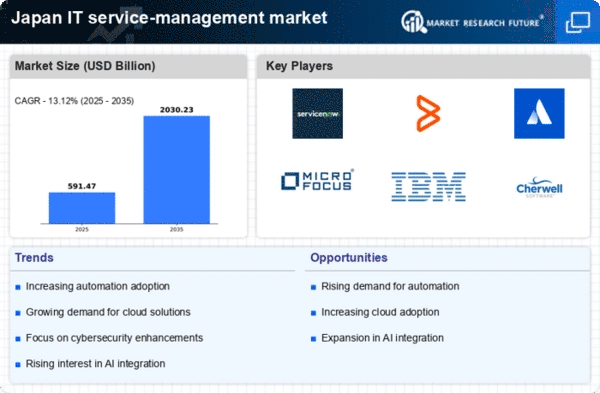
As per Market Research Future analysis, the Japan market size was estimated at 522.87 USD Billion in 2024. The Japan it service-management market is projected to grow from 591.47 USD Billion in 2025 to 2030.23 USD Billion by 2035, exhibiting a compound annual growth rate (CAGR) of 13.1% during the forecast period 2025 - 2035

Key Market Trends & Highlights

The Japan IT service-management market is experiencing a transformative shift driven by automation and evolving customer needs.

  • The market is witnessing increased automation and AI integration, enhancing operational efficiency.
  • A strong focus on data security and compliance is shaping service management strategies across various sectors.
  • Flexible service management solutions are gaining traction, particularly in the largest segment of enterprise IT services.
  • The rising demand for digital transformation and the growing importance of IT governance are key drivers propelling market growth.

Market Size & Forecast

2024 Market Size 522.87 (USD Billion)
2035 Market Size 2030.23 (USD Billion)
CAGR (2025 - 2035) 13.12%

Major Players

ServiceNow (US), BMC Software (US), Atlassian (AU), Micro Focus (GB), IBM (US), Cherwell Software (US), Freshworks (IN), ManageEngine (IN), SAP (DE)

Our Impact
Enabled $4.3B Revenue Impact for Fortune 500 and Leading Multinationals
Partnering with 2000+ Global Organizations Each Year
30K+ Citations by Top-Tier Firms in the Industry

Japan IT Service Management Market Trends

The IT service-management market is currently experiencing a transformative phase., driven by the increasing demand for efficient IT operations and enhanced service delivery. Organizations are recognizing the necessity of integrating advanced technologies to streamline processes and improve customer satisfaction. This shift is largely influenced by the growing complexity of IT environments, which necessitates robust management solutions. As businesses continue to adapt to evolving technological landscapes, the focus on automation and artificial intelligence is becoming more pronounced. These innovations are expected to play a crucial role in optimizing service management practices, thereby fostering greater operational efficiency. In addition, the emphasis on data security and compliance is intensifying within the it service-management market. Companies are prioritizing the implementation of secure frameworks to protect sensitive information and adhere to regulatory requirements. This trend is indicative of a broader awareness regarding the importance of safeguarding digital assets. Furthermore, the rise of remote work arrangements is prompting organizations to invest in flexible service management solutions that can accommodate diverse operational needs. Overall, The IT service-management market is poised for significant growth as it adapts to these emerging challenges and opportunities.

Increased Automation and AI Integration

The trend towards automation and artificial intelligence is reshaping the it service-management market. Organizations are increasingly adopting AI-driven tools to enhance service delivery and streamline operations. This shift not only improves efficiency but also allows for more proactive management of IT resources.

Focus on Data Security and Compliance

As data breaches become more prevalent, the emphasis on security and compliance within the it service-management market is intensifying. Companies are investing in solutions that ensure the protection of sensitive information and adherence to regulatory standards, reflecting a growing commitment to safeguarding digital assets.

Adoption of Flexible Service Management Solutions

The rise of remote work is driving the demand for flexible service management solutions. Organizations are seeking tools that can adapt to various operational needs, enabling them to maintain productivity and service quality regardless of the work environment.

Japan IT Service Management Market Drivers

Emergence of Cloud-Based Solutions

The shift towards cloud-based solutions is a notable driver for the it service-management market in Japan. As organizations increasingly migrate to cloud environments, there is a corresponding need for effective management of IT services in these settings. Approximately 50% of Japanese enterprises are expected to adopt cloud services by the end of 2025, creating a demand for IT service management tools that can seamlessly integrate with cloud platforms. This transition not only facilitates scalability and flexibility but also necessitates robust service management capabilities to ensure optimal performance and security. Consequently, the it service-management market is likely to expand as vendors develop solutions tailored to the unique challenges posed by cloud environments, including service orchestration and multi-cloud management.

Growing Importance of IT Governance

In Japan, the increasing focus on IT governance is shaping the it service-management market. Organizations are recognizing the need for structured frameworks to manage IT resources and ensure compliance with regulations. The implementation of IT governance frameworks, such as COBIT and ITIL, is becoming more prevalent, with around 60% of firms adopting these practices. This trend indicates a shift towards more accountable and transparent IT operations, which in turn drives demand for sophisticated service management solutions. As companies strive to align IT services with business objectives, The IT service-management market is likely to see growth in tools that facilitate governance, risk management, and compliance. This alignment not only enhances operational efficiency but also mitigates risks associated with IT service delivery.

Increased Focus on Customer Experience

The emphasis on customer experience in Japan is significantly influencing the it service-management market. Companies are increasingly aware that superior customer service can lead to competitive advantages. As a result, there is a growing demand for IT service management solutions that enhance service delivery and improve customer interactions. Recent surveys indicate that over 75% of Japanese consumers prioritize service quality, prompting businesses to invest in technologies that support customer-centric service management. This trend is likely to drive the adoption of IT service management tools that offer features such as automated ticketing systems, real-time analytics, and customer feedback mechanisms. By leveraging these solutions, organizations can better meet customer expectations and foster loyalty, thereby enhancing their market position.

Rising Demand for Digital Transformation

The ongoing digital transformation across various sectors in Japan is a primary driver for the it service-management market. Organizations are increasingly adopting digital tools to enhance operational efficiency and customer engagement. According to recent data, approximately 70% of Japanese companies have initiated digital transformation projects, which necessitate robust IT service management solutions. This trend is likely to continue as businesses seek to streamline processes and improve service delivery. The IT service-management market is expected to benefit significantly from this shift., as companies require integrated solutions to manage their IT services effectively. Furthermore, the emphasis on agility and responsiveness in service delivery aligns with the capabilities offered by modern IT service management tools, making them indispensable in the current business landscape.

Regulatory Compliance and Data Protection

In Japan, the increasing regulatory landscape surrounding data protection is a critical driver for the it service-management market. With the implementation of stringent data protection laws, organizations are compelled to adopt IT service management solutions that ensure compliance and safeguard sensitive information. Recent statistics reveal that nearly 80% of Japanese companies are prioritizing data security measures, which directly impacts their choice of IT service management tools. This heightened focus on compliance not only drives demand for solutions that offer robust security features but also necessitates ongoing training and awareness programs for IT staff. As businesses navigate the complexities of regulatory requirements, The IT service-management market is poised for growth, particularly in areas related to data governance and risk management.


Market Segment Insights

By Service Type: Incident Management (Largest) vs. Change Management (Fastest-Growing)

In the Japan it service-management market, incident management holds the largest share among service types, driven by the increasing need for organizations to quickly resolve IT issues and minimize downtime. Following closely, change management has emerged as a significant component, demonstrating the importance of effectively managing IT changes to enhance overall service delivery and minimize disruptions. Looking ahead, the growth trends indicate that change management will experience robust expansion due to the rise in digital transformation initiatives across various sectors in Japan. This is supported by the increasing adoption of cloud services and agile methodologies, which necessitate innovative change management solutions. Additionally, incident management will continue to thrive, fueled by ongoing advancements in automation and artificial intelligence, aiming to improve response times and customer satisfaction.

Incident Management (Dominant) vs. Change Management (Emerging)

Incident management is characterized by its critical role in swiftly addressing and resolving IT incidents, ensuring minimal interruption to business operations. It is recognized as the dominant service type due to its integral function in maintaining IT service quality and performance. Organizations prioritize incident management strategies to enhance operational efficiency and customer satisfaction. In contrast, change management is positioned as an emerging segment, reflecting its growing significance in the landscape of IT service-management. The focus on integrating changes seamlessly while minimizing risk is becoming increasingly vital as businesses adopt more complex and dynamic IT environments. This dual focus creates a balanced approach to maintaining service stability while fostering innovation and adaptation.

By Deployment Type: Cloud-Based (Largest) vs. On-Premises (Fastest-Growing)

In the Japan it service-management market, the deployment type is dominated by Cloud-Based solutions, which command a substantial share of the market due to their scalability, ease of access, and lower maintenance costs. On-Premises solutions also maintain a significant presence, particularly among traditional sectors that prioritize data control and customization. Hybrid solutions are gaining traction as businesses look for flexible options that combine the benefits of both on-premises and cloud-based technologies. Growth trends indicate a shift towards Cloud-Based services, driven by the increasing demand for remote work solutions and the need for efficient resource management. On-Premises services are experiencing a resurgence as companies reassess their data security needs, while Hybrid solutions are emerging as a preferred choice for organizations seeking a balanced approach. The overall trend reflects a dynamic and rapidly evolving landscape in the deployment type category.

Cloud-Based (Dominant) vs. On-Premises (Emerging)

Cloud-Based deployment has established itself as the dominant force in the Japan it service-management market, appealing to a wide range of businesses for its flexibility and cost-effectiveness. Organizations benefit from reduced upfront investment and the ability to scale resources based on demand. Conversely, On-Premises deployment is seeing an emergent position as companies seek enhanced control over their data, particularly in sectors handling sensitive information. This resurgence is facilitated by advancements in security measures and compliance regulations that assure businesses of data safety. As such, the market is witnessing a dynamic interplay between these two deployment types, each catering to specific organizational needs while evolving to meet changing technological landscapes.

By Industry: IT and Telecommunications (Largest) vs. Healthcare (Fastest-Growing)

In the Japan it service-management market, the largest segment is IT and Telecommunications, holding a significant portion of the overall market share. This dominance is due to the continuous demand for innovative IT solutions and telecom services that enhance connectivity and efficiency across various sectors. Other segments like BFSI, Healthcare, Retail, and Manufacturing also contribute to market dynamics, but none match the scale of IT and Telecommunications. The Healthcare sector is recognized as the fastest-growing segment, driven by an increasing emphasis on digital health technologies and the adoption of advanced management systems. With Japan's aging population, the need for IT service-management solutions in healthcare is surging. Retail is also experiencing growth as businesses shift towards digital transformation to enhance customer experiences, while Manufacturing is leveraging IT solutions for improved operational efficiency.

IT and Telecommunications: Dominant vs. Healthcare: Emerging

IT and Telecommunications is a dominant force in the Japan it service-management market, characterized by a robust infrastructure and extensive service offerings, including cloud computing, network management, and cybersecurity solutions. This segment benefits from ongoing technological advancements and an increasing reliance on digital platforms by various industries. In contrast, Healthcare is emerging rapidly with innovative IT solutions tailored to meet the needs of a more digital-centric approach, especially in patient management and telemedicine. The increasing integration of AI and machine learning in healthcare operations is driving this growth, highlighting the sector's adaptability and responsiveness to market demands.

By Organization Size: Large Enterprises (Largest) vs. Medium Enterprises (Fastest-Growing)

In the analysis of the organization size segment within the Japan it service-management market, Large Enterprises dominate the market with a substantial share, driven by their extensive resources and need for comprehensive IT solutions. Medium Enterprises, while smaller in market share, have been experiencing notable growth due to their increasing reliance on IT services to enhance operational efficiency and scalability. The growth trends indicate that Medium Enterprises are increasingly adopting agile IT service-management platforms, paving the way for rapid development within this segment. Factors contributing to this growth include the digital transformation initiatives undertaken by these enterprises and their pursuit of cost-effective solutions. Large Enterprises continue to invest heavily in innovative IT services, but the agility and adaptability of Medium Enterprises position them as the fastest-growing segment in this market.

Large Enterprises (Dominant) vs. Medium Enterprises (Emerging)

Large Enterprises in the Japan it service-management market are characterized by their significant investment capability and their need for tailored IT solutions to support complex operations across various business units. These organizations typically seek comprehensive service management solutions that ensure system reliability and uptime. In contrast, Medium Enterprises are emerging as a vital force in this market. They are increasingly adopting IT service management solutions to optimize their operations, improve service delivery, and enhance customer engagement. This segment is showing a rapid shift towards cloud-based solutions, enabling flexibility and scalability while managing costs effectively. The dynamic nature of Medium Enterprises positions them to capitalize on new opportunities within the market, making their growth trajectory one to watch.

Get more detailed insights about Japan IT Service Management Market

Key Players and Competitive Insights

The it service-management market in Japan is characterized by a dynamic competitive landscape, driven by rapid technological advancements and an increasing demand for efficient IT operations. Major players such as ServiceNow (US), BMC Software (US), and IBM (US) are at the forefront, each adopting distinct strategies to enhance their market positioning. ServiceNow (US) focuses on innovation through its cloud-based solutions, aiming to streamline IT workflows and improve service delivery. BMC Software (US) emphasizes digital transformation, leveraging AI and automation to optimize IT service management processes. Meanwhile, IBM (US) is concentrating on strategic partnerships and acquisitions to bolster its service offerings, particularly in the realm of hybrid cloud solutions. Collectively, these strategies contribute to a competitive environment that is increasingly centered around technological innovation and customer-centric solutions.
Key business tactics within this market include localizing service offerings and optimizing supply chains to better meet regional demands. The competitive structure appears moderately fragmented, with several key players vying for market share while also facing competition from emerging startups. This fragmentation allows for a diverse range of services and solutions, catering to various customer needs and preferences. The influence of established companies remains strong, yet the agility of smaller firms introduces a level of dynamism that can disrupt traditional market practices.
In October 2025, ServiceNow (US) announced a strategic partnership with a leading Japanese telecommunications provider to enhance its service delivery capabilities in the region. This collaboration is expected to leverage the telecom provider's extensive network infrastructure, allowing ServiceNow (US) to offer more robust and reliable IT service management solutions tailored to local enterprises. The strategic importance of this partnership lies in its potential to significantly expand ServiceNow's (US) market reach and improve customer satisfaction through localized support.
In September 2025, BMC Software (US) launched a new AI-driven analytics tool designed to provide real-time insights into IT service performance. This tool aims to empower organizations to make data-driven decisions, thereby enhancing operational efficiency. The introduction of this innovative solution underscores BMC Software's (US) commitment to integrating advanced technologies into its service offerings, positioning the company as a leader in the digital transformation of IT service management.
In August 2025, IBM (US) completed the acquisition of a prominent Japanese IT consultancy firm, which is anticipated to strengthen its capabilities in delivering integrated IT service management solutions. This acquisition is strategically significant as it not only expands IBM's (US) service portfolio but also enhances its local expertise, enabling the company to better address the unique challenges faced by Japanese enterprises. Such moves reflect a broader trend of consolidation within the market, as companies seek to enhance their competitive edge through strategic acquisitions.
As of November 2025, current trends in the it service-management market are heavily influenced by digitalization, sustainability initiatives, and the integration of AI technologies. Strategic alliances are increasingly shaping the competitive landscape, allowing companies to pool resources and expertise to deliver more comprehensive solutions. Looking ahead, it appears that competitive differentiation will evolve from traditional price-based competition to a focus on innovation, technological advancement, and supply chain reliability. This shift suggests that companies that prioritize these areas will likely emerge as leaders in the market.

Key Companies in the Japan IT Service Management Market include

Industry Developments

The Japan IT Service Management Market is currently experiencing significant developments, with sales and solutions from leading firms like Salesforce, ServiceNow, and NTT Data gaining traction. Recent growth has been noted in market valuations, driven by the increasing demand for digital transformation and efficient IT management solutions among Japanese enterprises.

Notable acquisitions include Salesforce's acquisition of Slack in July 2020 and ServiceNow's strategic partnerships to enhance its position in automation services. In November 2021, Fujitsu announced expansion plans for its IT service offerings, which further fueled competitive growth. Market players like Microsoft and IBM are also adapting their strategies to meet evolving business needs.

The demand for integrated service management solutions is on the rise, evidenced by the significant investment by large players and traditional entities such as Hitachi and Fujitsu.

The Japanese government has highlighted the importance of IT innovation as part of its strategy to enhance economic growth, thereby increasing reliance on IT service management solutions. Recent technological advancements and market dynamics are transforming the landscape, allowing companies to improve service efficiency and optimize resources amidst changing consumer expectations.


Future Outlook

Japan IT Service Management Market Future Outlook

The IT service-management market in Japan is projected to grow at a 13.12% CAGR from 2025 to 2035, driven by digital transformation and automation.

New opportunities lie in:

  • Development of AI-driven service desk solutions
  • Expansion of cloud-based ITSM platforms
  • Integration of IoT for proactive service management

By 2035, the market is expected to achieve substantial growth and innovation.

Market Segmentation

Japan IT Service Management Market Industry Outlook

  • IT and Telecommunications
  • BFSI
  • Healthcare
  • Retail
  • Manufacturing

Japan IT Service Management Market Service Type Outlook

  • Incident Management
  • Problem Management
  • Change Management
  • Service Request Management
  • Configuration Management

Japan IT Service Management Market Deployment Type Outlook

  • On-Premises
  • Cloud-Based
  • Hybrid

Japan IT Service Management Market Organization Size Outlook

  • Small Enterprises
  • Medium Enterprises
  • Large Enterprises

Report Scope

MARKET SIZE 2024 522.87(USD Billion)
MARKET SIZE 2025 591.47(USD Billion)
MARKET SIZE 2035 2030.23(USD Billion)
COMPOUND ANNUAL GROWTH RATE (CAGR) 13.12% (2025 - 2035)
REPORT COVERAGE Revenue Forecast, Competitive Landscape, Growth Factors, and Trends
BASE YEAR 2024
Market Forecast Period 2025 - 2035
Historical Data 2019 - 2024
Market Forecast Units USD Billion
Key Companies Profiled ServiceNow (US), BMC Software (US), Atlassian (AU), Micro Focus (GB), IBM (US), Cherwell Software (US), Freshworks (IN), ManageEngine (IN), SAP (DE)
Segments Covered Service Type, Deployment Type, Industry, Organization Size
Key Market Opportunities Integration of artificial intelligence in the it service-management market enhances efficiency and customer satisfaction.
Key Market Dynamics Rising demand for automation in IT service management drives competitive innovation and efficiency in Japan's market.
Countries Covered Japan
Leave a Comment

FAQs

What is the expected market size of the Japan IT Service Management Market in 2024?

The Japan IT Service Management Market is expected to be valued at 1.4 USD Billion in 2024.

What growth rate is projected for the Japan IT Service Management Market from 2025 to 2035?

The market is expected to grow at a CAGR of 5.349% from 2025 to 2035.

What will be the market value of the Japan IT Service Management Market in 2035?

The overall market is expected to be valued at 2.48 USD Billion by 2035.

What are the major service types in the Japan IT Service Management Market?

The market is segmented into Incident Management, Problem Management, Change Management, Service Request Management, and Configuration Management.

Which service type is expected to have the largest market share in 2035?

Incident Management is expected to reach a value of 1.01 USD Billion by 2035.

Who are the key players in the Japan IT Service Management Market?

Major players include Salesforce, ServiceNow, Zoho, NTT Data, Hitachi, and others.

How much is the Problem Management segment valued at in 2024?

The Problem Management segment is valued at 0.25 USD Billion in 2024.

What growth opportunities exist in the Japan IT Service Management Market?

There are significant growth opportunities due to increasing demand for digital transformation and automation in services.

What is the projected market size for Configuration Management by 2035?

The Configuration Management segment is expected to reach a value of 0.47 USD Billion by 2035.

What challenges might impact the Japan IT Service Management Market's growth?

Challenges may include competition among key players and the need for continuous technological advancements.

Download Free Sample

Kindly complete the form below to receive a free sample of this Report

Compare Licence

×
Features License Type
Single User Multiuser License Enterprise User
Price $4,950 $5,950 $7,250
Maximum User Access Limit 1 User Upto 10 Users Unrestricted Access Throughout the Organization
Free Customization
Direct Access to Analyst
Deliverable Format
Platform Access
Discount on Next Purchase 10% 15% 15%
Printable Versions