×
Request Free Sample ×

Kindly complete the form below to receive a free sample of this Report

* Please use a valid business email

Leading companies partner with us for data-driven Insights

clients tt-cursor
Hero Background

Japan Hyperspectral Imaging System Market

ID: MRFR/MED/49404-HCR
200 Pages
Rahul Gotadki
February 2026

Japan Hyperspectral Imaging System Market Research Report: Size, Share, Trend Analysis By Product (Visible/Near-Infrared (VNIR), Short-Wave Infrared (SWIR), Mid-Wave Infrared (MWIR), Long-Wave Infrared (LWIR) and By Applications (Surveillance, Remote Sensing, Machine Vision/Optical, Medical Diagnostics) - Growth Outlook & Industry Forecast 2025 To 2035

Share:
Download PDF ×

We do not share your information with anyone. However, we may send you emails based on your report interest from time to time. You may contact us at any time to opt-out.

Japan Hyperspectral Imaging System Market Infographic
Purchase Options

Japan Hyperspectral Imaging System Market Summary

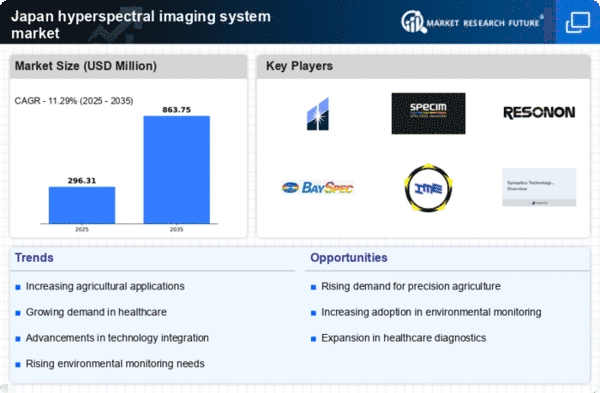
As per Market Research Future analysis, the Japan hyperspectral imaging system market Size was estimated at 266.25 USD Million in 2024. The Japan hyperspectral imaging system market is projected to grow from 296.31 USD Million in 2025 to 863.75 USD Million by 2035, exhibiting a compound annual growth rate (CAGR) of 11.2% during the forecast period 2025 - 2035

Key Market Trends & Highlights

The Japan hyperspectral imaging system market is poised for substantial growth driven by technological advancements and increased adoption across various sectors.

  • Technological advancements are enhancing the capabilities of hyperspectral imaging systems, leading to broader applications.
  • The agriculture segment is the largest, with a notable increase in the adoption of hyperspectral imaging for precision farming.
  • The environmental monitoring segment is the fastest-growing, reflecting a rising focus on sustainability and resource management.
  • Key market drivers include the rising demand for precision agriculture and advancements in remote sensing technologies.

Market Size & Forecast

2024 Market Size 266.25 (USD Million)
2035 Market Size 863.75 (USD Million)
CAGR (2025 - 2035) 11.29%

Major Players

Headwall Photonics (US), Specim, Spectral Imaging Ltd. (FI), Resonon, Inc. (US), BaySpec, Inc. (US), IMEC (BE), SENOPTIQ (DE), Corning Incorporated (US), Norsk Elektro Optikk AS (NO)

Our Impact
Enabled $4.3B Revenue Impact for Fortune 500 and Leading Multinationals
Partnering with 2000+ Global Organizations Each Year
30K+ Citations by Top-Tier Firms in the Industry

Japan Hyperspectral Imaging System Market Trends

The hyperspectral imaging system market is experiencing notable advancements, particularly in Japan, where technological innovation is driving growth. The integration of hyperspectral imaging into various sectors, such as agriculture, environmental monitoring, and healthcare, appears to be gaining traction. This technology enables detailed analysis of materials and substances, providing insights that traditional imaging cannot achieve. As industries increasingly recognize the value of precise data, the demand for hyperspectral imaging systems is likely to rise, fostering a competitive landscape among manufacturers and suppliers. Moreover, the Japanese government is actively promoting research and development in this field, which may further enhance the capabilities and applications of hyperspectral imaging systems. Initiatives aimed at supporting technological advancements and fostering collaboration between academia and industry suggest a robust future for this market. As organizations seek to optimize processes and improve decision-making through data-driven insights, the hyperspectral imaging system market is poised for significant evolution in the coming years.

Technological Advancements

Recent innovations in sensor technology and data processing algorithms are enhancing the capabilities of hyperspectral imaging systems. These advancements enable more accurate and faster analysis, which is crucial for applications in sectors like agriculture and environmental monitoring.

Increased Adoption in Agriculture

The agricultural sector in Japan is increasingly utilizing hyperspectral imaging for precision farming. This technology assists in monitoring crop health, optimizing resource use, and improving yield, thereby contributing to sustainable agricultural practices.

Government Support and Initiatives

The Japanese government is investing in research and development initiatives aimed at advancing hyperspectral imaging technologies. This support is likely to stimulate growth in the market, encouraging collaboration between industry and research institutions.

Japan Hyperspectral Imaging System Market Drivers

Expansion of Industrial Applications

The hyperspectral imaging-system market is witnessing an expansion of industrial applications in Japan. Industries such as food processing, pharmaceuticals, and materials science are increasingly recognizing the value of hyperspectral imaging for quality control and process optimization. For instance, in the food industry, hyperspectral imaging can be utilized for detecting contaminants and assessing product quality. This trend is likely to drive market growth, as companies seek to enhance operational efficiency and ensure compliance with stringent quality standards. The industrial sector's growing reliance on advanced imaging technologies suggests a promising future for the hyperspectral imaging-system market, with potential revenue growth projected to reach several million dollars in the coming years.

Rising Demand for Precision Agriculture

The hyperspectral imaging-system market in Japan is experiencing a notable surge due to the increasing demand for precision agriculture. Farmers are increasingly adopting advanced technologies to enhance crop yield and quality. Hyperspectral imaging systems provide detailed spectral information that aids in monitoring plant health, soil conditions, and nutrient levels. This technology allows for targeted interventions, reducing resource wastage and improving overall efficiency. According to recent estimates, the market for precision agriculture in Japan is projected to grow at a CAGR of approximately 15% over the next five years. This growth is likely to drive the adoption of hyperspectral imaging systems, as they play a crucial role in optimizing agricultural practices and ensuring sustainable food production.

Growing Focus on Environmental Monitoring

The hyperspectral imaging-system market is benefiting from a growing focus on environmental monitoring in Japan. With increasing concerns about climate change and pollution, there is a heightened need for accurate data collection and analysis. Hyperspectral imaging systems offer the ability to detect and quantify environmental changes, such as land use alterations and water quality degradation. This capability is particularly relevant for governmental and non-governmental organizations engaged in environmental protection efforts. The market for environmental monitoring technologies in Japan is expected to expand, with hyperspectral imaging systems playing a pivotal role in providing the necessary data for effective policy-making and resource management.

Advancements in Remote Sensing Technologies

The hyperspectral imaging-system market is significantly influenced by advancements in remote sensing technologies. In Japan, the integration of satellite and aerial imaging with hyperspectral data is enhancing the capabilities of environmental monitoring and resource management. These systems enable the collection of high-resolution data across various wavelengths, facilitating applications in forestry, water quality assessment, and urban planning. The Japanese government has invested heavily in satellite technology, which is expected to bolster the hyperspectral imaging market. As remote sensing technologies continue to evolve, the demand for hyperspectral imaging systems is anticipated to increase, providing critical insights for decision-makers in various sectors.

Increased Investment in Research and Development

Investment in research and development (R&D) is a key driver for the hyperspectral imaging-system market in Japan. The country is known for its strong emphasis on innovation and technology advancement. Various academic institutions and private companies are collaborating to develop new applications and improve existing hyperspectral imaging technologies. This focus on R&D is likely to lead to the introduction of more sophisticated systems that can cater to diverse industries, including healthcare, defense, and manufacturing. As R&D efforts intensify, the market is expected to witness a surge in innovative solutions, further propelling the adoption of hyperspectral imaging systems across different sectors.


Market Segment Insights

By Product: VNIR (Largest) vs. SWIR (Fastest-Growing)

In the Japan hyperspectral imaging-system market, the Visible/Near-Infrared (VNIR) segment holds a significant share due to its widespread applications in agriculture, environmental monitoring, and food quality analysis. Short-Wave Infrared (SWIR) follows as an emerging segment, capturing attention for its ability to penetrate moisture and provide insights into chemical compositions, making it favorable for industrial applications. The growth trends indicate a steady increase in the adoption of SWIR technology, particularly driven by advancements in sensor technology and a rising emphasis on quality control in manufacturing. The ongoing shift towards precision agriculture and enhanced spectral imaging techniques are further propelling the demand for VNIR systems, while SWIR's capability in detecting specific materials is paving its path as a reliable choice in diverse sectors.

VNIR (Dominant) vs. SWIR (Emerging)

The VNIR segment is characterized by its ability to capture detailed spectral information in the visible to near-infrared wavelengths, making it versatile for various applications such as vegetation monitoring and mineral classification. Its dominance in the market can be attributed to the established technologies and methodologies that have proven effective over time. On the other hand, the SWIR segment is gaining traction as an emerging player, benefiting from breakthroughs in sensor design and decreasing costs, which makes it more accessible for new applications. SWIR's unique ability to detect moisture content and its utility in industrial processes like sorting and quality assurance further enhance its appeal. Therefore, while VNIR remains the dominant force, the SWIR segment is rapidly becoming a vital contributor to the overall growth.

By Application: Surveillance (Largest) vs. Medical Diagnostics (Fastest-Growing)

In the Japan hyperspectral imaging-system market, the application segment shows a diverse distribution of market share among key areas including Surveillance, Remote Sensing, Machine Vision/Optical, and Medical Diagnostics. Surveillance is currently the largest application, driven by the increased demand for security and monitoring systems. Following this, Remote Sensing and Machine Vision/Optical are also significant but have relatively smaller shares in comparison to Surveillance. Medical Diagnostics, while initially a smaller player, is rapidly gaining traction.

Surveillance (Dominant) vs. Medical Diagnostics (Emerging)

Surveillance continues to dominate the Japan hyperspectral imaging-system market, primarily due to the growing emphasis on public safety and security measures. The systems are increasingly utilized in monitoring urban areas, border security, and critical infrastructure. On the other hand, Medical Diagnostics is emerging as a significant player, propelled by advancements in medical imaging technologies and a rising focus on precision medicine. These systems enable enhanced detection and analysis of diseases, often outperforming traditional methods. The convergence of these applications underscores the diverse capabilities of hyperspectral imaging, catering to both security and healthcare-related demands.

Get more detailed insights about Japan Hyperspectral Imaging System Market

Key Players and Competitive Insights

The hyperspectral imaging system market in Japan is characterized by a dynamic competitive landscape, driven by technological advancements and increasing applications across various sectors, including agriculture, environmental monitoring, and healthcare. Key players such as Headwall Photonics (US), Specim, Spectral Imaging Ltd. (FI), and Corning Incorporated (US) are strategically positioned to leverage innovation and partnerships to enhance their market presence. Headwall Photonics (US) focuses on developing cutting-edge imaging solutions, while Specim, Spectral Imaging Ltd. (FI) emphasizes regional expansion and product diversification. Corning Incorporated (US) is known for its strong emphasis on research and development, which collectively shapes a competitive environment that is increasingly reliant on technological differentiation and strategic collaborations.
In terms of business tactics, companies are localizing manufacturing and optimizing supply chains to enhance operational efficiency. The market structure appears moderately fragmented, with several players vying for market share. This fragmentation allows for a diverse range of offerings, yet the collective influence of key players like Resonon, Inc. (US) and BaySpec, Inc. (US) is significant, as they contribute to shaping industry standards and driving innovation.
In October 2025, Headwall Photonics (US) announced a partnership with a leading agricultural technology firm to develop hyperspectral imaging solutions tailored for precision farming. This collaboration is strategically important as it aligns with the growing demand for sustainable agricultural practices, potentially enhancing crop yield and resource management. The partnership underscores Headwall's commitment to innovation and its ability to adapt to market needs.
In September 2025, Specim, Spectral Imaging Ltd. (FI) launched a new hyperspectral camera designed for industrial applications, which integrates advanced AI algorithms for real-time data analysis. This move is indicative of the company's focus on digital transformation and positions it to capture a larger share of the industrial market, where efficiency and speed are paramount. The integration of AI into their products may also enhance user experience and operational capabilities.
In August 2025, Corning Incorporated (US) expanded its manufacturing capabilities in Japan, investing approximately $10M to enhance production efficiency for hyperspectral imaging systems. This strategic investment not only strengthens Corning's supply chain but also reflects its long-term commitment to the Japanese market. By increasing local production, Corning aims to reduce lead times and improve service delivery, which is crucial in a competitive landscape.
As of November 2025, current trends in the hyperspectral imaging-system market include a strong emphasis on digitalization, sustainability, and AI integration. Strategic alliances are increasingly shaping the competitive landscape, as companies recognize the value of collaboration in driving innovation. The shift from price-based competition to a focus on technological advancement and supply chain reliability is evident. Moving forward, competitive differentiation will likely hinge on the ability to innovate and adapt to evolving market demands, suggesting a promising outlook for companies that prioritize these aspects.

Key Companies in the Japan Hyperspectral Imaging System Market include

Industry Developments

The Japan Hyperspectral Imaging System Market has witnessed significant developments recently, particularly with advancements stemming from companies such as Teledyne Technologies and Specim, are enhancing their imaging technologies for applications in agriculture and environmental monitoring. In March 2023, Teledyne announced the launch of innovative imaging solutions tailored for industrial applications, improving data acquisition capabilities. Additionally, BAE Systems has been focusing on the military and defense sectors, providing hyperspectral sensors that enhance situational awareness and reconnaissance efforts.Growth in market valuations has been noted, attributed to increasing demand in sectors such as healthcare, agriculture, and environmental analysis. 

Significant advancements in Research and Development initiatives by companies like MicaSense have led to more accurate and efficient crop monitoring solutions. In terms of mergers and acquisitions, while recent news regarding specific deals involving GoPro or NASA was limited, the potential for partnerships focusing on enhancing imaging technology remains pivotal. Japan's governmental support for technological innovations reflects a robust market outlook, fostering collaborations aimed at improving hyperspectral imaging applications across various industries. The Japanese market continues to evolve with a strong emphasis on leveraging hyperspectral imaging for advanced analytics and decision-making capabilities.

Future Outlook

Japan Hyperspectral Imaging System Market Future Outlook

The Hyperspectral Imaging System Market in Japan is projected to grow at 11.29% CAGR from 2025 to 2035, driven by advancements in technology and increasing applications across various sectors.

New opportunities lie in:

  • Development of portable hyperspectral sensors for field applications.
  • Integration of AI algorithms for enhanced data analysis capabilities.
  • Expansion into agricultural monitoring solutions for crop health assessment.

By 2035, the market is expected to achieve substantial growth, positioning itself as a leader in innovative imaging solutions.

Market Segmentation

Japan Hyperspectral Imaging System Market Product Outlook

  • Visible/Near-Infrared (VNIR)
  • Short-Wave Infrared (SWIR)
  • Mid-Wave Infrared (MWIR)
  • Long-Wave Infrared (LWIR)

Japan Hyperspectral Imaging System Market Application Outlook

  • Surveillance
  • Remote Sensing
  • Machine Vision/Optical
  • Medical Diagnostics

Report Scope

MARKET SIZE 2024 266.25(USD Million)
MARKET SIZE 2025 296.31(USD Million)
MARKET SIZE 2035 863.75(USD Million)
COMPOUND ANNUAL GROWTH RATE (CAGR) 11.29% (2025 - 2035)
REPORT COVERAGE Revenue Forecast, Competitive Landscape, Growth Factors, and Trends
BASE YEAR 2024
Market Forecast Period 2025 - 2035
Historical Data 2019 - 2024
Market Forecast Units USD Million
Key Companies Profiled Headwall Photonics (US), Specim, Spectral Imaging Ltd. (FI), Resonon, Inc. (US), BaySpec, Inc. (US), IMEC (BE), SENOPTIQ (DE), Corning Incorporated (US), Norsk Elektro Optikk AS (NO)
Segments Covered Product, Application
Key Market Opportunities Advancements in agricultural applications drive growth in the hyperspectral imaging-system market.
Key Market Dynamics Rising demand for precision agriculture drives innovation in hyperspectral imaging systems across various sectors.
Countries Covered Japan
Leave a Comment

FAQs

What is the projected market size of the Japan Hyperspectral Imaging System Market in 2024?

The Japan Hyperspectral Imaging System Market is expected to be valued at 258.31 million USD in 2024.

What will be the expected market value of the Japan Hyperspectral Imaging System Market by 2035?

By 2035, the Japan Hyperspectral Imaging System Market is projected to reach a value of 1217.0 million USD.

What is the expected CAGR for the Japan Hyperspectral Imaging System Market from 2025 to 2035?

The expected CAGR for the Japan Hyperspectral Imaging System Market is 15.132% during the period from 2025 to 2035.

Which product segment is projected to dominate the Japan Hyperspectral Imaging System Market by 2035?

The Visible/Near-Infrared (VNIR) segment is projected to dominate the market with an estimated value of 450.0 million USD by 2035.

What are the projected market values for the Short-Wave Infrared (SWIR) segment in 2024 and 2035?

The Short-Wave Infrared (SWIR) segment is expected to be valued at 70.0 million USD in 2024 and 350.0 million USD by 2035.

What will be the market value of the Mid-Wave Infrared (MWIR) segment in 2035?

The Mid-Wave Infrared (MWIR) segment is anticipated to be valued at 250.0 million USD by 2035.

Who are some of the key players in the Japan Hyperspectral Imaging System Market?

Key players in the market include Bae Systems, GoPro, NASA, Specim, Zebra Imaging, and Teledyne Technologies.

What are the projected market figures for the Long-Wave Infrared (LWIR) segment in 2024?

The Long-Wave Infrared (LWIR) segment is expected to be valued at 38.31 million USD in 2024.

How significant is the growth opportunity in the Japan Hyperspectral Imaging System Market?

There is significant growth opportunity in the Japan Hyperspectral Imaging System Market, driven by a forecast CAGR of 15.132% from 2025 to 2035.

What is the expected value of the Japan Hyperspectral Imaging System Market for the LWIR segment by 2035?

The Japan Hyperspectral Imaging System Market for the Long-Wave Infrared (LWIR) segment is projected to reach 167.0 million USD by 2035.

Download Free Sample

Kindly complete the form below to receive a free sample of this Report

Compare Licence

×
Features License Type
Single User Multiuser License Enterprise User
Price $4,950 $5,950 $7,250
Maximum User Access Limit 1 User Upto 10 Users Unrestricted Access Throughout the Organization
Free Customization
Direct Access to Analyst
Deliverable Format
Platform Access
Discount on Next Purchase 10% 15% 15%
Printable Versions