×
Request Free Sample ×

Kindly complete the form below to receive a free sample of this Report

* Please use a valid business email

Leading companies partner with us for data-driven Insights

clients tt-cursor
Hero Background

Japan Human Capital Management Software Market

ID: MRFR/ICT/58814-HCR
200 Pages
Aarti Dhapte
February 2026

Japan Human Capital Management Software Market Size, Share and Research Report: By Service (Integration, Consulting), By Software (Core HR, Workforce Management, Staffing Vendor Management) and By Deployment (On-Premise, On-Cloud)- Industry Forecast to 2035

Share:
Download PDF ×

We do not share your information with anyone. However, we may send you emails based on your report interest from time to time. You may contact us at any time to opt-out.

Japan Human Capital Management Software Market Infographic
Purchase Options

Japan Human Capital Management Software Market Summary

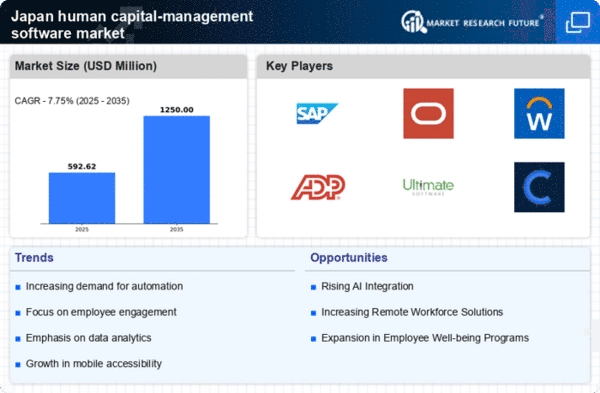
As per Market Research Future analysis, the Japan Human Capital Management Software Market size was estimated at 550.0 USD Million in 2024. The Human Capital-management-software market is projected to grow from 592.62 USD Million in 2025 to 1250.0 USD Million by 2035, exhibiting a compound annual growth rate (CAGR) of 7.7% during the forecast period 2025 - 2035

Key Market Trends & Highlights

The Japan human capital-management-software market is experiencing a transformative shift driven by technological advancements and evolving workforce needs.

  • The integration of AI and automation is reshaping the landscape of human capital management software in Japan.
  • There is a growing emphasis on enhancing employee experience, which is becoming a critical focus for organizations.
  • Compliance and data security are increasingly prioritized as businesses adapt to regulatory changes and labor laws.
  • The rising demand for workforce analytics and the shift towards remote work solutions are key drivers propelling market growth.

Market Size & Forecast

2024 Market Size 550.0 (USD Million)
2035 Market Size 1250.0 (USD Million)
CAGR (2025 - 2035) 7.75%

Major Players

SAP (DE), Oracle (US), Workday (US), ADP (US), Ultimate Software (US), Ceridian (CA), Cornerstone OnDemand (US), Paycor (US), Zenefits (US)

Our Impact
Enabled $4.3B Revenue Impact for Fortune 500 and Leading Multinationals
Partnering with 2000+ Global Organizations Each Year
30K+ Citations by Top-Tier Firms in the Industry

Japan Human Capital Management Software Market Trends

The Japan Human Capital Management Software Market in Japan is currently experiencing a notable evolution, driven by the increasing need for organizations to optimize their workforce management. Companies are increasingly recognizing the value of integrating technology into their human resources processes, which enhances efficiency and productivity. This shift is largely influenced by the growing emphasis on data-driven decision-making, allowing businesses to leverage analytics for better talent acquisition, employee engagement, and performance management. Furthermore, the rise of remote work and flexible employment arrangements has prompted organizations to seek solutions that facilitate seamless communication and collaboration among employees, regardless of their physical location. In addition, the regulatory landscape in Japan is evolving, with new labor laws and compliance requirements shaping the operational framework for businesses. This has led to a heightened demand for software solutions that not only streamline HR functions but also ensure adherence to legal standards. As organizations navigate these complexities, the human capital-management-software market is poised for continued growth, with innovative solutions emerging to address the unique challenges faced by Japanese companies. The focus on user-friendly interfaces and customizable features is likely to enhance user adoption and satisfaction, further propelling market expansion.

Integration of AI and Automation

The human capital-management-software market is witnessing a significant trend towards the integration of artificial intelligence (AI) and automation. This development aims to streamline various HR processes, such as recruitment, onboarding, and performance evaluation. By utilizing AI-driven tools, organizations can enhance their decision-making capabilities, reduce administrative burdens, and improve overall efficiency.

Emphasis on Employee Experience

There is a growing emphasis on enhancing employee experience within the human capital-management-software market. Companies are increasingly investing in solutions that prioritize user engagement and satisfaction. This trend reflects a broader recognition that a positive workplace culture and employee well-being are crucial for retaining talent and driving organizational success.

Focus on Compliance and Data Security

As regulatory requirements become more stringent, the human capital-management-software market is placing a stronger focus on compliance and data security. Organizations are seeking software solutions that not only facilitate HR functions but also ensure the protection of sensitive employee information. This trend highlights the importance of maintaining trust and transparency in HR practices.

Japan Human Capital Management Software Market Drivers

Shift Towards Remote Work Solutions

The human capital-management-software market is witnessing a shift towards solutions that support remote work. As more companies in Japan adopt flexible work arrangements, there is a growing need for software that facilitates remote employee management, performance tracking, and collaboration. This shift is expected to drive market growth, with estimates suggesting that the remote work software segment could account for over 30% of the total market by 2025. Consequently, organizations are increasingly investing in human capital-management-software that can seamlessly integrate remote work functionalities, thereby enhancing productivity and employee engagement.

Integration of Cloud-Based Solutions

The human capital-management-software market is experiencing a significant shift towards cloud-based solutions. Organizations in Japan are increasingly adopting cloud technology to enhance accessibility, scalability, and cost-effectiveness. This transition is expected to drive market growth, with cloud-based human capital-management-software projected to account for over 50% of the total market share by 2025. The flexibility offered by cloud solutions allows companies to streamline HR processes and improve collaboration among teams. As such, the human capital-management-software market is likely to see continued expansion as more organizations embrace cloud technology.

Rising Demand for Workforce Analytics

The human capital-management-software market in Japan is experiencing a notable increase in demand for workforce analytics. Organizations are increasingly recognizing the value of data-driven decision-making in managing human resources. This trend is reflected in the growing investment in analytics tools, which are projected to reach approximately $1.5 billion by 2026. Companies are leveraging these insights to enhance employee performance, optimize talent acquisition, and improve retention rates. As a result, the human capital-management-software market is likely to expand, driven by the need for organizations to harness data for strategic workforce planning.

Regulatory Compliance and Labor Law Adaptation

The human capital-management-software market in Japan is increasingly influenced by the need for regulatory compliance and adaptation to evolving labor laws. Organizations are required to navigate complex regulations, which necessitates the implementation of software solutions that ensure compliance with local labor standards. This demand is expected to drive market growth, as companies seek to mitigate risks associated with non-compliance. The market for compliance-focused human capital-management-software is projected to grow by approximately 20% over the next few years, indicating a strong trend towards integrating compliance features into HR software solutions.

Increased Focus on Employee Training and Development

In Japan, there is a heightened emphasis on employee training and development, which is significantly impacting the human capital-management-software market. Companies are recognizing that continuous learning is essential for maintaining a competitive edge. As a result, investments in learning management systems (LMS) are on the rise, with projections indicating a growth rate of around 15% annually. This trend suggests that organizations are prioritizing software solutions that offer robust training modules, thereby enhancing employee skills and overall organizational performance. The human capital-management-software market is likely to benefit from this focus on development.


Market Segment Insights

By Deployment Type: Cloud-Based (Largest) vs. On-Premises (Fastest-Growing)

In the Japan human capital-management-software market, the deployment type segment is characterized by a dynamic distribution of market share among cloud-based, on-premises, and hybrid solutions. Cloud-based solutions currently command the largest share due to their flexibility, scalability, and cost-effectiveness, making them an appealing choice for organizations aiming for digital transformation. Conversely, on-premises solutions are gradually gaining traction as businesses seek more control over their data and security, though they still represent a smaller segment of the market. Growth trends indicate a significant shift towards cloud-based deployments, driven by the increasing demand for remote work solutions and the necessity for streamlined HR processes. The hybrid model is emerging as a compromise, enabling organizations to leverage the strengths of both cloud and on-premises systems. Factors such as the rise in digital literacy and the need for efficient talent management are propelling these trends forward, making deployment type a critical focus area for future innovations.

Cloud-Based (Dominant) vs. On-Premises (Emerging)

Cloud-based solutions stand as the dominant force in the deployment type segment, favored for their ability to provide real-time access, lower initial investment costs, and effortless scalability, ideal for the rapidly evolving demands of businesses. In contrast, on-premises solutions are emerging as companies look for heightened data security and customization, although they often require higher upfront costs and maintenance. The hybrid model bridges the gap between the two, offering flexibility and control while optimizing costs. This combination caters well to a diverse range of organizational needs, thus supporting both traditional setups and innovative approaches within the Japan human capital-management-software market.

By Functionality: Recruitment (Largest) vs. Talent Management (Fastest-Growing)

In the Japan human capital-management-software market, Recruitment currently holds the largest market share, demonstrating its critical role in the hiring processes of organizations. Talent Management, while smaller in terms of market share, is rapidly gaining attention as companies increasingly prioritize the development and retention of their human resources. Payroll Management, Performance Management, and Learning and Development are essential components that complement these primary functions, but they do not compare in terms of overall market dominance. The growth trends within this segment indicate a robust shift towards integrated solutions that offer more than just basic functionalities. Businesses are investing in innovative technologies, such as AI and machine learning, to enhance the capabilities of Talent Management and Recruitment systems. As companies recognize the value of these investments, they will likely contribute to steady growth in software solutions geared towards performance analytics and learning platforms, thereby reshaping the competitive landscape of the market.

Recruitment: Dominant vs. Talent Management: Emerging

Recruitment remains the dominant force within the segment, characterized by sophisticated tools that streamline the hiring process and improve candidate management. The emphasis on enhancing applicant experiences and reducing time-to-hire underscores its importance to businesses striving to attract top talent in a competitive job market. Conversely, Talent Management is emerging as a crucial area of focus, driven by the need for organizations to nurture talent and align employee goals with overarching business objectives. This segment focuses on performance tracking, employee engagement, and learning initiatives, reflecting a shift towards a more holistic approach in human capital management. As organizations invest in these areas, the competitive dynamics within the Japan human capital-management-software market will continue to evolve.

By End User: Large Enterprises (Largest) vs. Small and Medium Enterprises (Fastest-Growing)

In the Japan human capital-management-software market, large enterprises command a significant share of the market. They leverage comprehensive solutions to manage their extensive workforce and complex operational demands, making them the dominant segment. The adoption of advanced technologies in large organizations facilitates streamlined processes, contributing to their robust position in the market. Conversely, small and medium enterprises (SMEs) are emerging as one of the fastest-growing segments due to their increasing need for efficient HR solutions to compete effectively. SMEs are progressively embracing digital transformation, thereby boosting their market presence and share. Growth in the segment is driven by factors like increasing adoption of cloud-based solutions and evolving workforce management practices. Large enterprises benefit from economies of scale and are investing heavily in innovative HR technologies to enhance employee engagement and productivity. On the other hand, SMEs are experiencing rapid growth driven by a renewed focus on efficiency and cost-effectiveness in managing human resources. The landscape is shifting towards tailored solutions that cater specifically to the unique needs of SMEs, thereby opening new avenues for growth within the Japan human capital-management-software market.

Large Enterprises: Dominant vs. Small and Medium Enterprises: Emerging

Large enterprises are characterized by extensive resources and a comprehensive approach to human capital management, utilizing sophisticated software systems that offer a range of functionalities from recruitment to payroll management. These organizations prioritize integrating advanced analytics and AI-driven insights to optimize their HR processes. In contrast, small and medium enterprises are marked by agility and a growing demand for scalable and affordable solutions. As they adapt to changing market conditions, SMEs are increasingly focusing on user-friendly HR software that enables them to manage talent effectively while keeping costs under control. This dynamic is fostering a competitive environment where small and medium enterprises are becoming significant players in the Japan human capital-management-software market.

By Industry: Information Technology (Largest) vs. Healthcare (Fastest-Growing)

In the Japan human capital-management-software market, the Information Technology sector holds the largest market share, reflecting the increasing reliance on technology-driven solutions for workforce management. Conversely, the Healthcare industry is witnessing rapid growth, driven by the need for enhanced employee management systems to support a burgeoning workforce in the medical field. Growth in the Healthcare sector is propelled by ongoing digital transformation efforts, particularly around telemedicine and patient data management. As healthcare organizations seek to streamline operations and improve employee engagement, investment in human capital management software is escalating. The Information Technology sector, while already dominant, continues to innovate with new software solutions, further solidifying its central role in the market.

Information Technology: IT (Dominant) vs. Healthcare (Emerging)

The Information Technology sector in the Japan human capital-management-software market is characterized by its mature and extensive deployment of software solutions that enhance operational efficiency and workforce collaboration. Companies in this sector leverage advanced HR technologies such as AI and cloud-based platforms to maintain competitive advantages. Additionally, the Healthcare sector is emerging rapidly, characterized by a strong focus on digital solutions that facilitate workforce management in an industry under significant strain. The need for scalable, efficient systems that can adapt to the ever-changing demands of healthcare professionals highlights the importance of investing in robust human capital management software, making it a vital area of growth.

Get more detailed insights about Japan Human Capital Management Software Market

Key Players and Competitive Insights

The human capital-management-software market in Japan is characterized by a dynamic competitive landscape, driven by the increasing demand for digital transformation and enhanced employee engagement solutions. Major players such as SAP (DE), Oracle (US), and Workday (US) are strategically positioned to leverage their technological advancements and extensive service offerings. SAP (DE) focuses on integrating AI capabilities into its solutions, enhancing user experience and operational efficiency. Oracle (US) emphasizes cloud-based solutions, aiming to streamline HR processes and improve data analytics. Workday (US) is known for its user-friendly interface and robust reporting tools, which appeal to organizations seeking to optimize workforce management. Collectively, these strategies foster a competitive environment that prioritizes innovation and customer-centric solutions.Key business tactics within this market include localizing software offerings to meet specific regional needs and optimizing supply chains to enhance service delivery. The competitive structure appears moderately fragmented, with several key players holding substantial market shares while also facing competition from emerging startups. This fragmentation allows for diverse offerings, catering to various organizational sizes and sectors, thus influencing the overall market dynamics.

In October SAP (DE) announced a partnership with a leading Japanese technology firm to enhance its AI-driven HR solutions tailored for local businesses. This strategic move is likely to strengthen SAP's foothold in the Japanese market, enabling it to better address the unique challenges faced by local enterprises. By leveraging local expertise, SAP aims to enhance its product offerings and improve customer satisfaction.

In September Oracle (US) launched a new suite of cloud-based HR tools specifically designed for the Japanese market, incorporating features that address local labor laws and cultural nuances. This initiative reflects Oracle's commitment to regional customization, which may enhance its competitive edge by providing solutions that resonate more effectively with Japanese organizations. Such tailored offerings could potentially lead to increased market penetration and customer loyalty.

In August Workday (US) expanded its operations in Japan by opening a new regional office aimed at enhancing customer support and engagement. This expansion signifies Workday's dedication to the Japanese market and its intention to foster closer relationships with clients. By improving local support, Workday may enhance its service delivery and responsiveness, which are critical factors in maintaining a competitive advantage.

As of November current trends in the human capital-management-software market include a pronounced shift towards digitalization, sustainability, and the integration of AI technologies. Strategic alliances among key players are increasingly shaping the competitive landscape, fostering innovation and collaborative solutions. Looking ahead, it appears that competitive differentiation will evolve from traditional price-based competition to a focus on technological innovation, enhanced user experience, and supply chain reliability. This shift may redefine how companies position themselves in the market, emphasizing the importance of adaptability and forward-thinking strategies.

Key Companies in the Japan Human Capital Management Software Market include

Industry Developments

The Japan Human Capital Management Software Market has recently witnessed significant developments, particularly with the ongoing digital transformation in the workplace. SmartHR, a Japanese HR-tech firm, raised $140 million in a Series-E fundraising round headed by KKR and Teachers' Ventures Growth on July 1, 2024. 

This increased the company's ARR to around $100 million and demonstrates the strong demand for cloud-based HR and labor management solutions in Japan. In March 2025, Hitachi launched AI-powered onboarding solutions in Japan, lowering onboarding durations by four days per hire and minimizing HR participation. This highlights the growing acceptance of AI in Japan's human capital management.

Future Outlook

Japan Human Capital Management Software Market Future Outlook

The Human Capital Management Software Market in Japan is projected to grow at a 7.75% CAGR from 2025 to 2035, driven by digital transformation and workforce optimization.

New opportunities lie in:

  • Integration of AI-driven analytics for talent management solutions.
  • Development of mobile platforms for real-time employee engagement.
  • Expansion of compliance management features to meet regulatory demands.

By 2035, the market is expected to achieve robust growth, reflecting evolving workforce needs.

Market Segmentation

Japan Human Capital Management Software Market End User Outlook

  • Small and Medium Enterprises
  • Large Enterprises
  • Government Organizations

Japan Human Capital Management Software Market Industry Outlook

  • Information Technology
  • Healthcare
  • Retail
  • Manufacturing
  • Financial Services

Japan Human Capital Management Software Market Functionality Outlook

  • Recruitment
  • Talent Management
  • Payroll Management
  • Performance Management
  • Learning and Development

Japan Human Capital Management Software Market Deployment Type Outlook

  • Cloud-Based
  • On-Premises
  • Hybrid

Report Scope

MARKET SIZE 2024 550.0(USD Million)
MARKET SIZE 2025 592.62(USD Million)
MARKET SIZE 2035 1250.0(USD Million)
COMPOUND ANNUAL GROWTH RATE (CAGR) 7.75% (2025 - 2035)
REPORT COVERAGE Revenue Forecast, Competitive Landscape, Growth Factors, and Trends
BASE YEAR 2024
Market Forecast Period 2025 - 2035
Historical Data 2019 - 2024
Market Forecast Units USD Million
Key Companies Profiled SAP (DE), Oracle (US), Workday (US), ADP (US), Ultimate Software (US), Ceridian (CA), Cornerstone OnDemand (US), Paycor (US), Zenefits (US)
Segments Covered Deployment Type, Functionality, End User, Industry
Key Market Opportunities Integration of artificial intelligence to enhance talent acquisition and employee engagement in the human capital-management-software market.
Key Market Dynamics Rising demand for integrated human capital-management-software solutions driven by technological advancements and regulatory compliance in Japan.
Countries Covered Japan
Leave a Comment

FAQs

What is the expected market size of the Japan Human Capital Management Software Market in 2024?

The Japan Human Capital Management Software Market is expected to be valued at 819.0 USD Million in 2024.

What is the projected market value of the Japan Human Capital Management Software Market by 2035?

The market is projected to reach a value of 1450.0 USD Million by 2035.

What is the expected CAGR for the Japan Human Capital Management Software Market from 2025 to 2035?

The expected CAGR for this market from 2025 to 2035 is 5.33%.

Who are the key players in the Japan Human Capital Management Software Market?

Major players include Workday, ADP, SAP, PeopleSoft, Gusto, BambooHR, Zenefits, and others.

What are the valued segments of the Japan Human Capital Management Software Market for Integration and Consulting in 2024?

In 2024, the Integration segment is valued at 250.0 USD Million, while the Consulting segment is valued at 569.0 USD Million.

What are the projected values for Integration and Consulting segments by 2035?

By 2035, the Integration segment is projected to reach 450.0 USD Million, and the Consulting segment is anticipated to be valued at 1000.0 USD Million.

What are the growth drivers for the Japan Human Capital Management Software Market?

Key growth drivers include increasing digital transformation and the need for efficient workforce management solutions.

What opportunities and challenges exist in the Japan Human Capital Management Software Market?

Opportunities include advanced analytics adoption, while challenges involve data security and integration complexities.

How do current global scenarios impact the Japan Human Capital Management Software Market?

Current global scenarios can affect market dynamics through shifts in supply chain and changes in demand for software solutions.

What is the expected market growth rate for specific segments in the Japan Human Capital Management Software Market?

The market is expected to witness steady growth across all segments due to rising investments in human capital technology.

Download Free Sample

Kindly complete the form below to receive a free sample of this Report

Compare Licence

×
Features License Type
Single User Multiuser License Enterprise User
Price $4,950 $5,950 $7,250
Maximum User Access Limit 1 User Upto 10 Users Unrestricted Access Throughout the Organization
Free Customization
Direct Access to Analyst
Deliverable Format
Platform Access
Discount on Next Purchase 10% 15% 15%
Printable Versions