×
Request Free Sample ×

Kindly complete the form below to receive a free sample of this Report

* Please use a valid business email

Leading companies partner with us for data-driven Insights

clients tt-cursor
Hero Background

Japan Holographic Communication Market

ID: MRFR/ICT/58738-HCR
200 Pages
Aarti Dhapte
February 2026

Japan Holographic Communication Market Research Report By Type (Electro-Holographic, Laser, Touchable), By Dimension (2D, 3D), By Holographic Images (Dot Matrix, 3D Models, 2D Models, Stereograms), By Technology (Semi-Transparent, Laser, Touchable) and By End User (Pharmaceutical & Biotechnology Companies, Research Organizations, Academic Medical Centers, Hospitals, Consumer Electronics, Automotive, Security, Others)- Forecast to 2035

Share:
Download PDF ×

We do not share your information with anyone. However, we may send you emails based on your report interest from time to time. You may contact us at any time to opt-out.

Japan Holographic Communication Market Infographic
Purchase Options

Japan Holographic Communication Market Summary

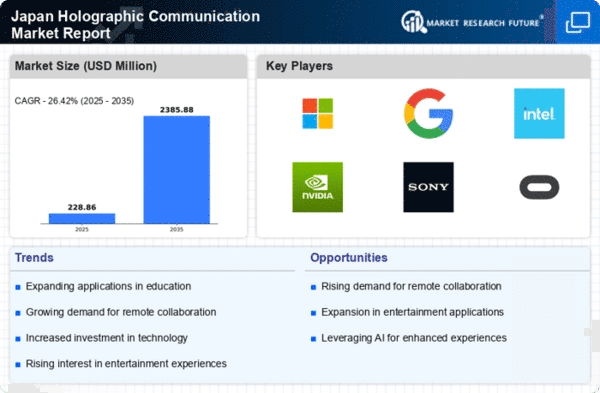
As per Market Research Future analysis, the Japan holographic communication market Size was estimated at 181.03 USD Million in 2024. The Japan holographic communication market is projected to grow from 228.86 USD Million in 2025 to 2385.88 USD Million by 2035, exhibiting a compound annual growth rate (CAGR) of 26.4% during the forecast period 2025 - 2035

Key Market Trends & Highlights

The Japan holographic communication market is poised for substantial growth driven by technological advancements and increasing applications across various sectors.

  • Technological advancements are enhancing the capabilities of holographic communication systems, making them more accessible and effective.
  • The education sector is witnessing increased adoption of holographic communication for immersive learning experiences, indicating a shift in pedagogical approaches.
  • Healthcare applications are expanding, with holographic communication facilitating remote consultations and surgical training, thus improving patient outcomes.
  • Rising demand for remote collaboration and government initiatives are key drivers propelling the market forward, particularly in the largest segment of education.

Market Size & Forecast

2024 Market Size 181.03 (USD Million)
2035 Market Size 2385.88 (USD Million)
CAGR (2025 - 2035) 26.42%

Major Players

Microsoft (US), Google (US), Intel (US), NVIDIA (US), Sony (JP), Oculus (US), Magic Leap (US), Vive (TW)

Our Impact
Enabled $4.3B Revenue Impact for Fortune 500 and Leading Multinationals
Partnering with 2000+ Global Organizations Each Year
30K+ Citations by Top-Tier Firms in the Industry

Japan Holographic Communication Market Trends

The holographic communication market in Japan is experiencing notable advancements, driven by technological innovations and increasing demand for immersive communication solutions. As businesses and consumers alike seek more engaging ways to interact, the market appears to be evolving rapidly. Companies are investing in research and development to enhance holographic technologies, which may lead to improved applications across various sectors, including education, healthcare, and entertainment. Furthermore, the integration of artificial intelligence and machine learning into holographic systems suggests a potential for more personalized and efficient communication experiences. In addition, the regulatory environment in Japan seems to be supportive of emerging technologies, fostering an ecosystem conducive to growth. Government initiatives aimed at promoting digital transformation may further accelerate the adoption of holographic communication solutions. As organizations recognize the benefits of holographic interactions, the market is likely to expand, offering new opportunities for businesses and consumers. The future of this market appears promising, with ongoing advancements and a growing acceptance of holographic technologies in everyday life.

Technological Advancements

Recent innovations in holographic technology are enhancing the capabilities of communication systems. Developments in display technologies and data transmission methods are likely to improve the quality and accessibility of holographic communication, making it more appealing to various industries.

Increased Adoption in Education

Educational institutions in Japan are beginning to embrace holographic communication as a tool for interactive learning. This trend suggests a shift towards more engaging teaching methods, potentially transforming the educational landscape and improving student outcomes.

Healthcare Applications

The holographic communication market is witnessing growing interest from the healthcare sector. Applications such as remote consultations and surgical training using holograms may enhance medical practices, indicating a significant potential for improving patient care and professional training.

Japan Holographic Communication Market Drivers

Growing Interest in Smart Cities

The concept of smart cities is gaining traction in Japan, with holographic communication playing a pivotal role in urban development. As cities strive to enhance connectivity and improve public services, holographic technology can facilitate better communication between citizens and local authorities. This technology can be utilized for urban planning, public safety, and community engagement initiatives. The market for smart city solutions is projected to reach $3 trillion by 2030, indicating a substantial opportunity for the holographic communication market to contribute to these developments. As municipalities invest in smart technologies, the demand for holographic communication solutions is likely to increase.

Government Initiatives and Support

The Japanese government is actively promoting the development of advanced communication technologies, including holographic communication. Various initiatives aim to foster innovation and support research in this field. For instance, funding programs and partnerships with private sectors are being established to accelerate the adoption of holographic solutions across industries. This governmental backing is crucial for the growth of the holographic communication market, as it encourages investment and development. With an estimated budget of ¥10 billion allocated for technology innovation in the upcoming fiscal year, the government’s commitment is likely to stimulate advancements in holographic communication.

Rising Demand for Remote Collaboration

The increasing need for effective remote collaboration tools is driving the holographic communication market in Japan. As businesses seek innovative solutions to enhance communication among distributed teams, holographic technology offers a unique approach. This technology allows for real-time, three-dimensional interactions, which can significantly improve engagement and productivity. According to recent estimates, the market for remote collaboration tools is projected to grow at a CAGR of approximately 15% over the next five years. This trend indicates a strong potential for holographic communication solutions to capture a substantial share of the market, as organizations prioritize seamless collaboration in their operations.

Enhancement of Entertainment Experiences

The entertainment industry in Japan is increasingly adopting holographic communication technology to create immersive experiences for audiences. This trend is particularly evident in live performances, gaming, and virtual reality applications. Holographic displays can provide a more engaging and interactive experience, which is appealing to consumers. The market for holographic entertainment solutions is expected to reach $1 billion by 2027, reflecting a growing interest in innovative entertainment formats. As companies invest in holographic technology, the holographic communication market is likely to benefit from this expansion, offering new avenues for content delivery and audience engagement.

Integration with Artificial Intelligence

The integration of artificial intelligence (AI) with holographic communication technology is emerging as a key driver in Japan. AI enhances the capabilities of holographic systems, enabling more intuitive interactions and personalized experiences. For instance, AI algorithms can analyze user behavior and preferences, allowing holographic displays to adapt in real-time. This synergy between AI and holographic communication is expected to create new applications in various sectors, including marketing and customer service. As businesses increasingly recognize the potential of this integration, the holographic communication market is poised for growth, with projections indicating a potential increase in market size by 20% over the next few years.


Market Segment Insights

By Type: Laser (Largest) vs. Touchable (Fastest-Growing)

In the Japan holographic communication market, the segment share is led by the Laser technology, which dominates the landscape due to its superior image quality and reliability. The Electro-Holographic segment, while significant, has a smaller market presence compared to Laser technology, which is widely adopted across various industries for its efficiency and effectiveness in holographic display solutions. On the growth front, Touchable technology is emerging as the fastest-growing segment, driven by increasing consumer demand for interactive and immersive experiences. This growth is fueled by advancements in touchscreen technology and the integration of tactile feedback in holographic solutions, providing users with a sense of realism and engagement in communication. Manufacturers are focusing on enhancing the capabilities of Touchable displays, expecting significant uptake in applications ranging from virtual reality experiences to advanced training simulations.

Laser (Dominant) vs. Touchable (Emerging)

Laser technology in the Japan holographic communication market is characterized by its established market presence and dominance due to its ability to produce high-resolution holograms. This technology is preferred in professional settings such as advertising and medical imaging, where clarity and precision are crucial. In contrast, Touchable technology is gaining momentum as an emerging force, offering unique features that allow users to interact with holograms in a dynamic way. This segment is appealing to industries focused on enhancing user engagement, such as gaming and education. As both segments evolve, the competition is expected to intensify, particularly as advancements in holographic technology continue to break new ground in user experience.

By Dimension: 3D (Largest) vs. 2D (Fastest-Growing)

In the Japan holographic communication market, the 3D dimension segment holds the largest share, driven by its advanced technological capabilities and appealing visual experiences. As businesses and consumers alike seek immersive and interactive solutions, 3D holography has become a preferred choice over its 2D counterpart, which remains a vital segment, though with a smaller market presence. The distribution reflects a shift towards more sophisticated communication methods, emphasizing the need for high-quality displays. Emerging trends indicate that the 2D segment is experiencing rapid growth as more industries explore holographic applications. Factors such as cost-effectiveness and simplicity in implementation are driving this expansion, making 2D a viable option for various sectors, including retail and education. As the technology matures and awareness increases, 2D holography is poised to capture a larger audience, balancing out the dominance of the 3D segment.

Dimension: 3D (Dominant) vs. 2D (Emerging)

The 3D dimension segment is characterized by its immersive quality and ability to deliver a dynamic user experience, placing it in a dominant position within the Japan holographic communication market. It is widely adopted in high-end applications such as entertainment, advertising, and medical imaging, where visual impact is crucial. In contrast, the 2D segment, while emerging, is gaining traction due to its affordable technology and ease of use. It finds utility in various sectors, including education and retail, where straightforward displays are often sufficient. As such, both segments hold distinct market positions, with 3D leading in sophistication while 2D captures growth through accessibility.

By Holographic Images: Dot Matrix (Largest) vs. 3D Models (Fastest-Growing)

In the Japan holographic communication market, the distribution of market share among segment values reveals that Dot Matrix holds a significant portion, establishing itself as the largest segment by leveraging its established technology and wide applications. Meanwhile, 3D Models are rapidly gaining traction, appealing to various industries for their immersive experience, thus emerging as a strong contender in the market. Growth drivers for the holographic images segment include advancements in display technologies and an increasing demand for interactive applications in sectors such as entertainment and advertising. As more companies recognize the potential of 3D imaging, investments are being funneled into this area, contributing to its rapid growth. Moreover, the proliferation of Augmented Reality (AR) and Virtual Reality (VR) technologies further bolsters this segment's expansion, indicating a promising future.

Dot Matrix (Dominant) vs. 2D Models (Emerging)

Dot Matrix technology stands out as the dominant force in the holographic images segment, celebrated for its reliability and versatility across numerous applications, from advertising displays to complex visual representations in industry. It caters primarily to traditional markets where visual clarity and detail are paramount. On the other hand, 2D Models, while currently considered an emerging segment, are attracting interest due to their simplicity and adaptability for quick visual communication. Their affordability makes them appealing for budget-conscious businesses seeking to enhance customer engagement. As the demand for static displays continues, 2D Models are likely to find an expanding audience, yet they face competition from more dynamic technologies, positioning them as a noteworthy yet secondary player within the market.

By Technology: Semi-Transparent (Largest) vs. Laser (Fastest-Growing)

In the Japan holographic communication market, the segment values are showing distinct market share distributions. Semi-Transparent technology holds the largest market share, largely favored for its ability to blend into various environments while providing holographic displays. This is largely due to advancements in semi-transparent materials that enhance visibility without compromising aesthetics. On the other hand, Laser technology, known for its precision and clarity, is rapidly gaining traction, appealing to sectors demanding high-quality visual experiences. The growth trends within the technology segment are being driven by increasing investments in R&D and a growing demand for immersive communication experiences. As sectors like healthcare, entertainment, and education begin to adopt holographic communication technologies, the Laser segment is expected to expand at a faster rate due to its innovative capabilities. Additionally, the rise in urbanization and smart city initiatives in Japan further fuels the demand for more sophisticated communication methods, giving rise to both Semi-Transparent and Laser technologies.

Technology: Semi-Transparent (Dominant) vs. Laser (Emerging)

Semi-Transparent technology is characterized by its unique ability to create layered visual effects, making it ideal for retail environments and public displays. Its dominance in the Japan holographic communication market is attributed to its versatility and user-friendly interface, making it accessible for various applications. In contrast, Laser technology is emerging as a vital player, marked by its high-resolution capabilities and effective performance even in brightly lit conditions. This technology is gaining prominence in industries requiring precise visual representation, such as medical imaging and virtual simulations. As consumer preferences evolve, both technologies are expected to complement each other, enhancing the overall landscape of holographic communication.

By End-User: Pharmaceutical & Biotechnology Companies (Largest) vs. Automotive (Fastest-Growing)

In the Japan holographic communication market, the distribution of market share among end-user segments reveals that Pharmaceutical & Biotechnology Companies hold the largest share, driven by their need for innovative communication solutions in research and development. Following closely are Hospitals & Clinics, which adopt holographic communication for improved patient engagement and surgical training. Other segments such as Consumer Electronics and Automotive are also notable, though they reflect a smaller portion of the overall market share. Growth trends in the market are being significantly influenced by rapid technological advancements and increasing investment in research from Pharmaceutical & Biotechnology Companies. The Automotive sector is emerging as the fastest-growing segment, fueled by the rising demand for augmented reality and holography in vehicle design, enhancing safety features, and improving user experience. As holographic solutions become more mainstream, their role in communication will expand across all sectors.

Pharmaceutical & Biotechnology Companies (Dominant) vs. Automotive (Emerging)

Pharmaceutical & Biotechnology Companies dominate the Japan holographic communication market, leveraging these technologies to enhance collaboration in research projects and clinical trials. Their applications range from visualizing complex biological processes to remote consultations with specialists, which are crucial for the industry. In contrast, the Automotive sector is emerging with a keen interest in utilizing holographic communication for improving design, prototyping, and user interaction in vehicles. This segment is increasingly focusing on integrating holographic displays into dashboards and driver interfaces, responding to consumer demand for more interactive and intuitive driving experiences. Both segments illustrate the diverse applicability of holographic communication, with distinct drivers shaping their development trajectories.

Get more detailed insights about Japan Holographic Communication Market

Key Players and Competitive Insights

The holographic communication market in Japan is characterized by a dynamic competitive landscape, driven by rapid technological advancements and increasing demand for immersive communication solutions. Major players such as Microsoft (US), Sony (JP), and NVIDIA (US) are strategically positioned to leverage their technological expertise and market presence. Microsoft (US) focuses on innovation through its Azure cloud services, enhancing holographic applications for enterprise solutions. Meanwhile, Sony (JP) emphasizes regional expansion, particularly in entertainment and gaming, integrating holographic technology into its product offerings. NVIDIA (US) is heavily invested in AI integration, which enhances the realism and interactivity of holographic experiences. Collectively, these strategies foster a competitive environment that prioritizes technological innovation and user engagement.Key business tactics within this market include localizing manufacturing and optimizing supply chains to enhance responsiveness to consumer demands. The competitive structure appears moderately fragmented, with several key players vying for market share. This fragmentation allows for diverse offerings, yet the influence of major companies remains substantial, as they set industry standards and drive technological advancements.

In October Microsoft (US) announced a partnership with a leading Japanese telecommunications firm to develop next-generation holographic communication solutions. This collaboration aims to enhance connectivity and user experience, indicating Microsoft's commitment to expanding its footprint in the Japanese market. The strategic importance of this partnership lies in its potential to integrate advanced holographic capabilities into existing telecommunications infrastructure, thereby enhancing service delivery and customer engagement.

In September Sony (JP) unveiled a new holographic display technology at a major tech expo, showcasing its application in live events and gaming. This development signifies Sony's focus on enhancing user experiences through immersive technology. The strategic importance of this innovation is profound, as it positions Sony to capture a larger share of the entertainment market, appealing to consumers seeking cutting-edge experiences.

In August NVIDIA (US) launched a new AI-driven holographic rendering engine, aimed at improving the efficiency and quality of holographic content creation. This move underscores NVIDIA's commitment to integrating AI into its product offerings, enhancing the capabilities of developers and content creators. The strategic significance of this launch is evident, as it not only strengthens NVIDIA's market position but also sets a new standard for quality in holographic communications.

As of November current trends in the holographic communication market are increasingly defined by digitalization, sustainability, and AI integration. Strategic alliances among key players are shaping the competitive landscape, fostering innovation and collaboration. Looking ahead, competitive differentiation is likely to evolve, shifting from price-based competition to a focus on innovation, technological advancements, and supply chain reliability. This transition suggests that companies will need to prioritize R&D and strategic partnerships to maintain a competitive edge in an ever-evolving market.

Key Companies in the Japan Holographic Communication Market include

Industry Developments

Recent developments in the Japan Holographic Communication Market include significant advancements in technology and increasing investments from major companies like KDDI, Panasonic, and Sony, enhancing their holographic capabilities for telecommunications and entertainment sectors. June 2023 saw Vcube unveil a breakthrough holographic conference technology aimed at facilitating remote collaboration, signaling a shift toward more immersive communication solutions. 

Meanwhile, Hitachi has been collaborating with NEC to develop advanced holographic imaging technologies for medical applications, which is expected to enhance telemedicine services. Asahi Kasei announced in September 2022 its plans to expand into the holographic tech space, targeting manufacturing uses. Notably, there were reports in August 2023 regarding Omron's strategic partnership with Fujitsu to explore AI-integrated holographic technologies for smart cities, aiming to create more interactive environments. 

In June 2023, Canon's acquisition of a holographic startup was a key move to bolster its product line in professional imaging. The overall market valuation has shown an upward trajectory due to these innovations and strategic partnerships, indicating robust growth and a potential market expansion influenced by such major players.

Future Outlook

Japan Holographic Communication Market Future Outlook

The Holographic Communication Market in Japan is poised for growth at 26.42% CAGR from 2025 to 2035, driven by technological advancements and increasing demand for immersive experiences.

New opportunities lie in:

  • Development of holographic telepresence solutions for remote collaboration.
  • Integration of holographic displays in retail environments for enhanced customer engagement.
  • Creation of customized holographic marketing campaigns leveraging AR technology.

By 2035, the holographic communication market is expected to achieve substantial growth and innovation.

Market Segmentation

Japan Holographic Communication Market Type Outlook

  • Electro-Holographic
  • Laser
  • Touchable

Japan Holographic Communication Market End-User Outlook

  • Pharmaceutical & Biotechnology Companies
  • Research Organizations
  • Academic Medical Centers
  • Hospitals & Clinics
  • Consumer Electronics
  • Automotive
  • Security
  • Others

Japan Holographic Communication Market Dimension Outlook

  • 2D
  • 3D

Japan Holographic Communication Market Technology Outlook

  • Semi-Transparent
  • Laser
  • Touchable

Japan Holographic Communication Market Holographic Images Outlook

  • Dot Matrix
  • 3D Models
  • 2D Models
  • Stereograms

Report Scope

MARKET SIZE 2024 181.03(USD Million)
MARKET SIZE 2025 228.86(USD Million)
MARKET SIZE 2035 2385.88(USD Million)
COMPOUND ANNUAL GROWTH RATE (CAGR) 26.42% (2025 - 2035)
REPORT COVERAGE Revenue Forecast, Competitive Landscape, Growth Factors, and Trends
BASE YEAR 2024
Market Forecast Period 2025 - 2035
Historical Data 2019 - 2024
Market Forecast Units USD Million
Key Companies Profiled Microsoft (US), Google (US), Intel (US), NVIDIA (US), Sony (JP), Oculus (US), Magic Leap (US), Vive (TW)
Segments Covered Type, Dimension, Holographic Images, Technology, End-User
Key Market Opportunities Advancements in holographic technology enhance remote collaboration and immersive experiences in various sectors.
Key Market Dynamics Rising demand for immersive experiences drives innovation and competition in the holographic communication market.
Countries Covered Japan
Leave a Comment

FAQs

What is the expected market size of the Japan Holographic Communication Market in 2024?

The Japan Holographic Communication Market is expected to be valued at 180.8 million USD in 2024.

What is the projected market size by 2035 for the Japan Holographic Communication Market?

By 2035, the market is projected to reach 2150.0 million USD.

What is the expected CAGR for the Japan Holographic Communication Market from 2025 to 2035?

The expected CAGR for the market during this period is 25.242%.

Which segment is expected to dominate the Japan Holographic Communication Market by 2035?

The Laser segment is expected to dominate the market, reaching 870.4 million USD by 2035.

Who are the key players in the Japan Holographic Communication Market?

Major players include Omron, KDDI, Canon, Sony, Hitachi, and Panasonic, among others.

What is the market size for the Electro-Holographic segment in 2024?

The Electro-Holographic segment is valued at 64.08 million USD in 2024.

What is the projected growth statement for the Touchable segment by 2035?

The Touchable segment is expected to grow to 496.06 million USD by 2035.

What are the current growth drivers of the Japan Holographic Communication Market?

Key growth drivers include advancements in technology and increasing demand for enhanced communication methods.

How is the Japan Holographic Communication Market expected to perform in the Asia-Pacific region?

The market is set to exhibit significant growth in Asia-Pacific, driven by technological innovation and increasing adoption.

What challenges might impact the Japan Holographic Communication Market in the coming years?

Challenges could include high costs of implementation and competition from alternative communication technologies.

Download Free Sample

Kindly complete the form below to receive a free sample of this Report

Compare Licence

×
Features License Type
Single User Multiuser License Enterprise User
Price $4,950 $5,950 $7,250
Maximum User Access Limit 1 User Upto 10 Users Unrestricted Access Throughout the Organization
Free Customization
Direct Access to Analyst
Deliverable Format
Platform Access
Discount on Next Purchase 10% 15% 15%
Printable Versions