×
Request Free Sample ×

Kindly complete the form below to receive a free sample of this Report

* Please use a valid business email

Leading companies partner with us for data-driven Insights

clients tt-cursor
Hero Background

Japan High Flow Nasal Cannula Market

ID: MRFR/HC/50475-HCR
200 Pages
Garvit Vyas
February 2026

Japan High Flow Nasal Cannula Market Research Report: Size, Share, Trend Analysis By Component (Nasal Cannulas, Air Humidifiers, Single Heated Tubes, Air/Oxygen Blenders, Others), By Applications (Carbon Monoxide Toxicity, Acute Respiratory Failure, Bronchiectasis, Chronic Obstructive Pulmonary Disease (COPD), Sleep Apnea, Others) andBy End-User (Long-Term Care Centers, Hospitals, Ambulatory Care Services, Others) - Growth Outlook & Industry Forecast 2025 To 2035

Share:
Download PDF ×

We do not share your information with anyone. However, we may send you emails based on your report interest from time to time. You may contact us at any time to opt-out.

Japan High Flow Nasal Cannula Market Infographic
Purchase Options

Japan High Flow Nasal Cannula Market Summary

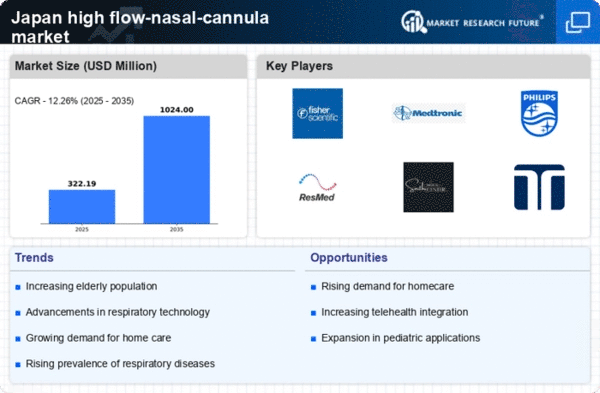
As per Market Research Future analysis, the Japan High Flow Nasal Cannula Market size was estimated at 287.0 USD Million in 2024. The High Flow-nasal-cannula market is projected to grow from 322.19 USD Million in 2025 to 1024.0 USD Million by 2035, exhibiting a compound annual growth rate (CAGR) of 12.2% during the forecast period 2025 - 2035

Key Market Trends & Highlights

The Japan high flow-nasal-cannula market is poised for growth driven by technological advancements and increasing healthcare demands.

  • Technological advancements in high flow-nasal-cannula devices are enhancing patient outcomes and comfort.
  • The largest segment in the market is the hospital segment, while the home healthcare segment is the fastest-growing.
  • Regulatory developments are shaping the market landscape, ensuring safety and efficacy in respiratory care.
  • Rising prevalence of respiratory disorders and an aging population are key drivers fueling market expansion.

Market Size & Forecast

2024 Market Size 287.0 (USD Million)
2035 Market Size 1024.0 (USD Million)
CAGR (2025 - 2035) 12.26%

Major Players

Fisher & Paykel Healthcare (NZ), Medtronic (US), Philips (NL), ResMed (AU), Smiths Medical (US), Teleflex (US), Vyaire Medical (US), Becton Dickinson (US)

Our Impact
Enabled $4.3B Revenue Impact for Fortune 500 and Leading Multinationals
Partnering with 2000+ Global Organizations Each Year
30K+ Citations by Top-Tier Firms in the Industry

Japan High Flow Nasal Cannula Market Trends

The Japan High Flow Nasal Cannula Market is experiencing notable developments, particularly in Japan, where advancements in respiratory care technology are becoming increasingly prominent. The integration of high flow-nasal-cannula systems into clinical practice is being driven by a growing recognition of their benefits in managing respiratory distress. This market is characterized by a shift towards more patient-centered approaches, with healthcare providers emphasizing comfort and efficacy in treatment options. As a result, the demand for high flow-nasal-cannula devices is likely to rise, reflecting a broader trend towards innovative solutions in respiratory therapy. Moreover, the regulatory landscape in Japan appears to be evolving, with authorities focusing on ensuring the safety and effectiveness of medical devices. This regulatory scrutiny may lead to enhanced product quality and increased trust among healthcare professionals and patients alike. Additionally, the high flow-nasal-cannula market is witnessing a surge in research and development activities aimed at improving device functionality and user experience. Such initiatives may contribute to the overall growth of the market, as stakeholders seek to address the diverse needs of patients requiring respiratory support. In summary, the high flow-nasal-cannula market in Japan is poised for growth, driven by technological advancements and a commitment to improving patient outcomes.

Technological Advancements

The high flow-nasal-cannula market is benefiting from continuous technological innovations. Newer devices are being developed with enhanced features, such as improved flow rates and better humidification systems. These advancements are likely to enhance patient comfort and treatment efficacy, making high flow-nasal-cannula systems more appealing to healthcare providers.

Regulatory Developments

In Japan, regulatory bodies are increasingly focusing on the safety and effectiveness of medical devices, including high flow-nasal-cannula systems. This heightened scrutiny may lead to stricter compliance requirements, ensuring that products meet high standards. Such developments could foster greater trust among healthcare professionals and patients.

Increased Research and Development

There is a growing emphasis on research and development within the high flow-nasal-cannula market. Companies are investing in studies to explore new applications and improve existing technologies. This focus on innovation may result in more effective solutions for patients requiring respiratory support, thereby expanding the market.

Japan High Flow Nasal Cannula Market Drivers

Rising Prevalence of Respiratory Disorders

The increasing incidence of respiratory disorders in Japan is a primary driver for the high flow-nasal-cannula market. Conditions such as chronic obstructive pulmonary disease (COPD) and asthma are becoming more prevalent, leading to a higher demand for effective oxygen delivery systems. According to recent health statistics, approximately 5.5 million individuals in Japan are diagnosed with COPD, which necessitates advanced respiratory support. This growing patient population is likely to propel the adoption of high flow-nasal-cannula systems, as they provide enhanced oxygenation and comfort compared to traditional methods. The high flow-nasal-cannula market is thus positioned to benefit from this trend, as healthcare providers seek to improve patient outcomes through innovative respiratory therapies.

Increased Focus on Home Healthcare Solutions

The shift towards home healthcare solutions is a notable driver for the high flow-nasal-cannula market. As patients prefer receiving care in the comfort of their homes, there is a growing demand for portable and user-friendly respiratory devices. This trend is particularly relevant in Japan, where home healthcare services are expanding rapidly. The high flow-nasal-cannula market is likely to benefit from this shift, as manufacturers develop products that cater to home use, ensuring ease of operation and maintenance. The convenience of home-based care is expected to drive sales, as patients and caregivers seek effective solutions for managing respiratory conditions outside of traditional clinical settings.

Technological Innovations in Respiratory Care

Technological advancements in respiratory care are transforming the high flow-nasal-cannula market. Innovations such as improved flow rate control, integrated humidification systems, and portable devices are enhancing patient comfort and compliance. These advancements are crucial in a market where patient experience is paramount. The high flow-nasal-cannula market is witnessing a surge in demand for devices that offer both efficiency and ease of use. As healthcare providers increasingly adopt these technologies, the market is expected to expand, with a projected growth rate of around 8% annually over the next five years. This trend indicates a robust future for the industry as it adapts to evolving patient needs.

Aging Population and Increased Healthcare Demand

Japan's demographic shift towards an aging population is significantly impacting the high flow-nasal-cannula market. With over 28% of the population aged 65 and older, there is a corresponding rise in healthcare needs, particularly for respiratory support. Older adults are more susceptible to respiratory illnesses, which drives the demand for effective oxygen delivery solutions. The high flow-nasal-cannula market is likely to see increased utilization in hospitals and home care settings as healthcare systems adapt to meet the needs of this demographic. Furthermore, the government is investing in healthcare infrastructure to support this aging population, which may further enhance market growth.

Government Initiatives and Funding for Respiratory Health

Government initiatives aimed at improving respiratory health are influencing the high flow-nasal-cannula market. In Japan, public health policies are increasingly focusing on enhancing respiratory care services, which includes funding for advanced medical technologies. These initiatives are designed to improve patient outcomes and reduce healthcare costs associated with respiratory diseases. The high flow-nasal-cannula market stands to gain from these investments, as healthcare facilities are encouraged to adopt innovative solutions. With government support, the market is likely to experience growth, as more resources are allocated to respiratory health programs and technologies that improve patient care.


Market Segment Insights

By Component: Nasal Cannulas (Largest) vs. Air Humidifiers (Fastest-Growing)

In the Japan high flow-nasal-cannula market, Nasal Cannulas hold the largest market share, primarily due to their extensive application in both hospital and home care environments. This segment is largely driven by the increasing prevalence of respiratory disorders, which boosts the demand for effective respiratory assistance. In contrast, Air Humidifiers, while holding a smaller share, are recognized as the fastest-growing segment, attributed to their rising adoption in settings requiring moisture control for patients utilizing nasal cannulas. The growth trends in this segment are influenced by advancements in technology and increasing awareness regarding respiratory health. The demand for high flow nasal cannulas with integrated humidification systems is on the rise, as these solutions enhance patient comfort and therapy efficiency. Furthermore, the growing aging population in Japan is a significant driver, contributing to a higher incidence of chronic respiratory conditions that necessitate the use of these components.

Nasal Cannulas (Dominant) vs. Air Humidifiers (Emerging)

Nasal Cannulas are characterized by their versatile use and strong acceptance among healthcare providers, owing to their effectiveness in delivering high concentrations of oxygen. This segment is critical for treating patients with chronic respiratory diseases and is favored for its ease of use and comfort. In contrast, Air Humidifiers are emerging as essential adjuncts in respiratory therapy, enhancing the efficacy of nasal cannulas by preventing mucosal dryness and improving overall patient experience. Their growing popularity can be attributed to innovative designs and features that ensure optimal humidification, making them indispensable in patient care settings. As awareness about the benefits of humidity in respiratory treatments increases, Air Humidifiers are gaining traction, indicating a significant shift in market dynamics.

By Application: Chronic Obstructive Pulmonary Disease (COPD) (Largest) vs. Sleep Apnea (Fastest-Growing)

The market share distribution among the application segment of the Japan high flow-nasal-cannula market reveals that Chronic Obstructive Pulmonary Disease (COPD) represents the largest portion, driven by the high prevalence of respiratory conditions in the country. Following closely are other conditions such as Acute Respiratory Failure and Carbon Monoxide Toxicity, which also hold significant shares. Sleep Apnea, though smaller in share, is rapidly gaining traction due to increasing awareness and diagnosis rates of the condition. Growth trends in this segment are being shaped by several key drivers. Advances in clinical practices, rising disposable incomes, and an increasing geriatric population predisposed to respiratory diseases are influencing market dynamics. Furthermore, the heightened focus on effective treatment options for chronic conditions is expected to propel the demand for high flow-nasal-cannulas, especially in sleep apnea care, ultimately leading to its fastest growth within the segment.

Chronic Obstructive Pulmonary Disease (COPD) (Dominant) vs. Sleep Apnea (Emerging)

Chronic Obstructive Pulmonary Disease (COPD) is the dominant application segment within the Japan high flow-nasal-cannula market, primarily due to its high prevalence and the chronic nature of the disease, which necessitates long-term oxygen therapy. This segment is characterized by a well-established clinical protocol that often mandates the use of high flow systems in patient management. Meanwhile, Sleep Apnea is emerging as a significant segment, experiencing rapid growth driven by technological advancements in diagnosis and treatment, along with increasing public awareness. As healthcare providers innovate with new devices and therapies, the market position of sleep apnea treatment is improving, potentially reshaping the treatment landscape in the near future.

By End-user: Hospitals (Largest) vs. Long-Term Care Centers (Fastest-Growing)

In the Japan high flow-nasal-cannula market, Hospitals hold the largest market share, reflecting their critical role in acute care and respiratory management. Following closely, Long-Term Care Centers are emerging as significant players, catering to patients requiring ongoing support and specialized treatments. The distribution across these segments indicates a robust demand for effective respiratory solutions, particularly in settings that prioritize patient care and recovery. Growth trends in this segment are driven by an aging population and increasing prevalence of respiratory conditions, which necessitate expanded services in both Hospitals and Long-Term Care Centers. Additionally, advancements in high flow-nasal cannula technology are enhancing patient outcomes, further propelling their adoption in ambulatory settings. As healthcare infrastructures evolve, the need for versatile and efficient respiratory support systems continues to grow, shaping the landscape of care delivery.

Hospitals (Dominant) vs. Long-Term Care Centers (Emerging)

Hospitals are the dominant segment in the Japan high flow-nasal-cannula market due to their capacity for comprehensive respiratory care and continuous patient monitoring. As major healthcare institutions, they utilize advanced high flow-nasal cannula systems to manage critical respiratory challenges efficiently. On the other hand, Long-Term Care Centers are emerging as a significant segment, rapidly gaining traction as they cater to patients needing extended respiratory support. These facilities focus on personalized care, and their growth is influenced by increasing demand for home-like environments paired with professional medical assistance. Their evolving role highlights the shift towards sustained respiratory management solutions in non-acute settings, positioning them as integral to the overall healthcare continuum.

Get more detailed insights about Japan High Flow Nasal Cannula Market

Key Players and Competitive Insights

The high flow-nasal-cannula market in Japan is characterized by a competitive landscape that is increasingly shaped by innovation and strategic partnerships. Key players such as Fisher & Paykel Healthcare (NZ), Medtronic (US), and Philips (NL) are actively pursuing growth through technological advancements and regional expansions. Fisher & Paykel Healthcare (NZ) has positioned itself as a leader in respiratory care, focusing on enhancing patient comfort and outcomes through innovative product designs. Medtronic (US) emphasizes its commitment to integrating advanced technologies into its offerings, while Philips (NL) is leveraging its expertise in connected care to enhance patient monitoring and management solutions. Collectively, these strategies contribute to a dynamic competitive environment, where differentiation is increasingly reliant on technological prowess and patient-centric solutions.
In terms of business tactics, companies are localizing manufacturing and optimizing supply chains to enhance operational efficiency and responsiveness to market demands. The competitive structure of the market appears moderately fragmented, with several players vying for market share. However, the influence of major companies is substantial, as they set benchmarks for quality and innovation that smaller firms often strive to meet. This competitive interplay fosters an environment where continuous improvement and adaptation are essential for success.
In October 2025, Fisher & Paykel Healthcare (NZ) announced the launch of a new high flow-nasal-cannula system designed to improve oxygen delivery efficiency. This strategic move is significant as it not only reinforces the company's commitment to innovation but also addresses the growing demand for effective respiratory solutions in clinical settings. The introduction of this system is likely to enhance patient outcomes and solidify Fisher & Paykel's market position.
In September 2025, Medtronic (US) expanded its product portfolio by acquiring a small technology firm specializing in AI-driven respiratory monitoring solutions. This acquisition is indicative of Medtronic's strategy to integrate cutting-edge technology into its offerings, potentially transforming how respiratory care is delivered. By enhancing its capabilities in data analytics and patient monitoring, Medtronic may improve clinical decision-making and patient management.
In August 2025, Philips (NL) entered into a strategic partnership with a leading telehealth provider to enhance its high flow-nasal-cannula offerings. This collaboration aims to integrate telehealth solutions with respiratory care, allowing for remote monitoring and management of patients. Such a partnership underscores the growing trend of digitalization in healthcare, where technology plays a pivotal role in improving patient access and care delivery.
As of November 2025, current competitive trends in the high flow-nasal-cannula market are increasingly defined by digitalization, sustainability, and the integration of AI technologies. Strategic alliances are becoming more prevalent, as companies recognize the value of collaboration in enhancing their product offerings and market reach. Looking ahead, competitive differentiation is likely to evolve from traditional price-based competition to a focus on innovation, technological advancements, and supply chain reliability. This shift suggests that companies that prioritize these areas will be better positioned to thrive in an increasingly complex and demanding market.

Key Companies in the Japan High Flow Nasal Cannula Market include

Industry Developments

Recent developments in the Japan High Flow Nasal Cannula Market show significant growth influenced by the increasing prevalence of respiratory diseases and technological advancements in respiratory care. Key players such as Nihon Kohden, Fisher and Paykel Healthcare, and Teleflex are concurrently enhancing their product lines and expanding their market presence.

In July 2023, Gentherm launched an innovative high flow nasal cannula system aimed at improving patient comfort and clinical outcomes, aligning with growing consumer demands for sophisticated medical devices. Furthermore, in September 2023, Smiths Medical announced the strategic expansion of its distribution network across Japan, thereby bolstering its market share.

Mergers and acquisitions have also been notable, with Vyaire Medical acquiring certain assets of a local company in February 2023 to strengthen its foothold in the region, a move likely to enhance its competitive edge within Japan's medical device landscape. The overall market valuation continues to rise, driven by robust healthcare investments by the Japanese government, which has pledged increased funding to enhance hospital infrastructure and patient care systems over the last two years.

This momentum indicates a vibrant and rapidly evolving market landscape for high flow nasal cannula systems in Japan.

Future Outlook

Japan High Flow Nasal Cannula Market Future Outlook

The High Flow Nasal Cannula Market is projected to grow at a 12.26% CAGR from 2025 to 2035, driven by technological advancements, increasing respiratory disorders, and rising healthcare expenditure.

New opportunities lie in:

  • Development of portable high flow-nasal-cannula devices for home care settings.
  • Partnerships with telehealth platforms for remote patient monitoring solutions.
  • Expansion into emerging markets with tailored product offerings and pricing strategies.

By 2035, the market is expected to achieve substantial growth, driven by innovation and strategic partnerships.

Market Segmentation

Japan High Flow Nasal Cannula Market End-user Outlook

  • Long-Term Care Centers
  • Hospitals
  • Ambulatory Care Services
  • Others

Japan High Flow Nasal Cannula Market Component Outlook

  • Nasal Cannulas
  • Air Humidifiers
  • Single Heated Tubes
  • Air/Oxygen Blenders
  • Others

Japan High Flow Nasal Cannula Market Application Outlook

  • Carbon Monoxide Toxicity
  • Acute Respiratory Failure
  • Bronchiectasis
  • Chronic Obstructive Pulmonary Disease (COPD)
  • Sleep Apnea
  • Others

Report Scope

MARKET SIZE 2024 287.0(USD Million)
MARKET SIZE 2025 322.19(USD Million)
MARKET SIZE 2035 1024.0(USD Million)
COMPOUND ANNUAL GROWTH RATE (CAGR) 12.26% (2025 - 2035)
REPORT COVERAGE Revenue Forecast, Competitive Landscape, Growth Factors, and Trends
BASE YEAR 2024
Market Forecast Period 2025 - 2035
Historical Data 2019 - 2024
Market Forecast Units USD Million
Key Companies Profiled Fisher & Paykel Healthcare (NZ), Medtronic (US), Philips (NL), ResMed (AU), Smiths Medical (US), Teleflex (US), Vyaire Medical (US), Becton Dickinson (US)
Segments Covered Component, Application, End-user
Key Market Opportunities Growing demand for advanced respiratory support solutions in healthcare facilities enhances high flow-nasal-cannula market potential.
Key Market Dynamics Rising demand for high flow-nasal-cannula devices driven by advancements in respiratory care technologies and patient management.
Countries Covered Japan
Leave a Comment

FAQs

What is the expected market size of the Japan High Flow Nasal Cannula Market in 2024?

The Japan High Flow Nasal Cannula Market is expected to be valued at 445.0 million USD in 2024.

What will be the market size of the Japan High Flow Nasal Cannula Market by 2035?

By 2035, the Japan High Flow Nasal Cannula Market is projected to reach a value of 1500.0 million USD.

What is the expected CAGR for the Japan High Flow Nasal Cannula Market from 2025 to 2035?

The market is expected to witness a compound annual growth rate (CAGR) of 11.68% during the period from 2025 to 2035.

Who are the key players in the Japan High Flow Nasal Cannula Market?

Major players in the market include Civco Medical, Gentherm, Apex Medical, Airvo, and Vyaire Medical among others.

Which component of the Japan High Flow Nasal Cannula Market has the highest projected growth from 2024 to 2035?

Nasal Cannulas are projected to grow from 150.0 million USD in 2024 to 525.0 million USD by 2035.

What is the expected market value for Air Humidifiers in the Japan High Flow Nasal Cannula Market in 2024?

The market value for Air Humidifiers is anticipated to reach 130.0 million USD in 2024.

What challenges might the Japan High Flow Nasal Cannula Market face in the coming years?

Potential challenges include competition from alternative therapies and regulatory hurdles in product approvals.

What is the expected market size for Single Heated Tubes in 2035?

The market size for Single Heated Tubes is expected to grow to 280.0 million USD by 2035.

What are the projected market values for Air/Oxygen Blenders from 2024 to 2035?

Air/Oxygen Blenders are expected to grow from 70.0 million USD in 2024 to 220.0 million USD by 2035.

How do current trends impact the growth of the Japan High Flow Nasal Cannula Market?

Current trends point towards increased demand for advanced respiratory therapies, driving market growth.

Download Free Sample

Kindly complete the form below to receive a free sample of this Report

Compare Licence

×
Features License Type
Single User Multiuser License Enterprise User
Price $4,950 $5,950 $7,250
Maximum User Access Limit 1 User Upto 10 Users Unrestricted Access Throughout the Organization
Free Customization
Direct Access to Analyst
Deliverable Format
Platform Access
Discount on Next Purchase 10% 15% 15%
Printable Versions