×
Request Free Sample ×

Kindly complete the form below to receive a free sample of this Report

* Please use a valid business email

Leading companies partner with us for data-driven Insights

clients tt-cursor
Hero Background

Japan Heparin Market

ID: MRFR/HC/50583-HCR
200 Pages
Rahul Gotadki
February 2026

Japan Heparin Market Research Report: Size, Share, Trend Analysis By Product (Unfractionated Heparin (UFH), Low Molecular Weight Heparin (LMWH), By Source (Bovine, Porcine), By Applications (Deep Vein Thrombosis & Pulmonary Embolism, Atrial Fibrillation, Heart Attacks, Stroke, Others), By Route of Administration (Intravenous Infusion, Subcutaneous Injection) and By End Users (Hospitals & ASCS, Clinics, Others) - Growth Outlook & Industry Forecast 2025 To 2035

Share:
Download PDF ×

We do not share your information with anyone. However, we may send you emails based on your report interest from time to time. You may contact us at any time to opt-out.

Japan Heparin Market Infographic
Purchase Options

Japan Heparin Market Summary

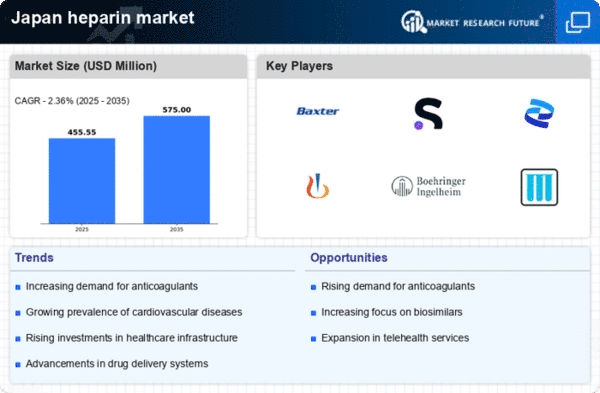
As per Market Research Future analysis, the Japan Heparin Market size was estimated at 445.05 $ Million in 2024. The Heparin market is projected to grow from 455.55 $ Million in 2025 to 575.0 $ Million by 2035, exhibiting a compound annual growth rate (CAGR) of 2.3% during the forecast period 2025 - 2035

Key Market Trends & Highlights

The Japan heparin market is experiencing robust growth driven by increasing demand for anticoagulants and advancements in healthcare.

  • The heparin market in Japan is witnessing a rising demand for anticoagulants, particularly in the largest segment of therapeutic applications.
  • Technological advancements in drug delivery systems are enhancing the efficacy and safety of heparin products, contributing to market growth.
  • Regulatory changes are facilitating improved market access, which is crucial for the expansion of heparin offerings.
  • Key market drivers include the increasing prevalence of cardiovascular diseases and the expansion of healthcare facilities, which are likely to bolster heparin consumption.

Market Size & Forecast

2024 Market Size 445.05 (USD Million)
2035 Market Size 575.0 (USD Million)
CAGR (2025 - 2035) 2.36%

Major Players

Baxter International (US), Sanofi (FR), Pfizer (US), Novartis (CH), Boehringer Ingelheim (DE), Mylan (US), Teva Pharmaceutical Industries (IL), Aspen Pharmacare (ZA)

Our Impact
Enabled $4.3B Revenue Impact for Fortune 500 and Leading Multinationals
Partnering with 2000+ Global Organizations Each Year
30K+ Citations by Top-Tier Firms in the Industry

Japan Heparin Market Trends

The Japan Heparin Market in Japan is currently experiencing notable developments, driven by increasing healthcare demands and advancements in medical technology. The rising prevalence of conditions requiring anticoagulation therapy, such as cardiovascular diseases, has led to a heightened focus on heparin products. Furthermore, the aging population in Japan is contributing to a greater need for effective treatment options, thereby influencing market dynamics. Regulatory frameworks are also evolving, which may impact the approval and distribution of heparin products, suggesting a complex landscape for stakeholders. In addition, the heparin market is witnessing innovations in drug formulations and delivery methods. Manufacturers are exploring ways to enhance the efficacy and safety profiles of heparin, which could lead to improved patient outcomes. Collaborations between pharmaceutical companies and research institutions are likely to foster the development of novel heparin-based therapies. As the market continues to evolve, it appears that both challenges and opportunities will shape the future of heparin products in Japan, necessitating strategic approaches from industry players.

Rising Demand for Anticoagulants

The demand for anticoagulant therapies is increasing in Japan, primarily due to the growing incidence of cardiovascular diseases. This trend indicates a shift towards more effective treatment options, with heparin being a key player in this therapeutic area.

Technological Advancements in Drug Delivery

Innovations in drug delivery systems are emerging within the heparin market. Enhanced delivery methods may improve patient compliance and therapeutic outcomes, suggesting a potential shift in how heparin is administered.

Regulatory Changes and Market Access

Evolving regulatory frameworks in Japan are likely to influence market access for heparin products. These changes may affect approval processes and market entry strategies, indicating a need for adaptability among manufacturers.

Japan Heparin Market Drivers

Expansion of Healthcare Facilities

The expansion of healthcare facilities across Japan is anticipated to positively influence the heparin market. With an increasing number of hospitals and clinics, the accessibility of heparin treatments is likely to improve. This expansion is driven by the need to accommodate the aging population and the rising prevalence of chronic diseases. According to recent data, the number of healthcare facilities in Japan has increased by approximately 5% over the past few years. This growth may lead to higher demand for anticoagulants, including heparin, as healthcare providers seek to offer comprehensive treatment options. Consequently, the heparin market could experience significant growth as more patients gain access to essential therapies.

Advancements in Pharmaceutical Research

Advancements in pharmaceutical research and development are expected to play a pivotal role in shaping the heparin market in Japan. Innovative formulations and delivery methods for heparin are being explored, which may enhance its efficacy and safety profile. Research institutions and pharmaceutical companies are increasingly focusing on developing new heparin derivatives and formulations that could cater to specific patient needs. This trend indicates a potential for growth in the heparin market, as improved products may attract more healthcare providers and patients. The ongoing investment in research suggests that the heparin market could witness a transformation in product offerings, leading to increased competition and market expansion.

Rising Awareness of Preventive Healthcare

There is a growing awareness of preventive healthcare measures among the Japanese population, which is likely to impact the heparin market positively. As individuals become more informed about the risks associated with thromboembolic disorders, the demand for preventive anticoagulant therapies, such as heparin, may increase. Educational campaigns and healthcare initiatives aimed at promoting awareness of cardiovascular health are becoming more prevalent. This shift in consumer behavior suggests that patients are more inclined to seek preventive treatments, thereby driving the heparin market. The potential for increased adoption of heparin as a preventive measure could lead to a notable rise in market demand.

Increasing Prevalence of Cardiovascular Diseases

The rising incidence of cardiovascular diseases in Japan is a crucial driver for the heparin market. As the population ages, the demand for anticoagulants, including heparin, is expected to surge. Reports indicate that cardiovascular diseases account for a significant portion of mortality in Japan, prompting healthcare providers to seek effective treatment options. The heparin market is likely to benefit from this trend, as healthcare systems prioritize anticoagulant therapies to manage these conditions. Furthermore, the Japanese government has been investing in healthcare infrastructure, which may enhance access to heparin treatments. This growing focus on cardiovascular health suggests a robust future for the heparin market in Japan.

Government Initiatives to Improve Healthcare Access

Government initiatives aimed at improving healthcare access in Japan are likely to have a significant impact on the heparin market. Policies that promote the availability of essential medications, including anticoagulants, are being implemented to ensure that patients receive timely and effective treatments. The Japanese government has been actively working to reduce healthcare disparities, which may enhance access to heparin therapies for underserved populations. This focus on equitable healthcare access suggests that the heparin market could experience growth as more individuals gain access to necessary treatments. The potential for increased patient enrollment in anticoagulant therapies may drive demand for heparin in the coming years.


Market Segment Insights

By Product: Low Molecular Weight Heparin (Largest) vs. Unfractionated Heparin (Fastest-Growing)

In the Japan heparin market, the segmentation reveals that Low Molecular Weight Heparin (LMWH) holds a significant share of the market, driven by its advantages in terms of efficacy and safety. Meanwhile, Unfractionated Heparin (UFH) is witnessing a remarkable surge in use, attributed to its quick-action properties and broad-spectrum applications in various medical procedures. The growth trends indicate a strong preference for LMWH due to its user-friendly administration and favorable pharmacokinetics. However, the rising incidence of thromboembolic disorders has propelled UFH into the spotlight as the fastest-growing segment. This increasing demand is supported by ongoing clinical research highlighting the versatility of UFH, reinforcing its importance in critical care settings while LMWH continues to lead in general therapeutic use.

Heparin: Low Molecular Weight Heparin (Dominant) vs. Unfractionated Heparin (Emerging)

Low Molecular Weight Heparin (LMWH) remains the dominant force in the Japan heparin market, characterized by its predictable anticoagulant effects, ease of use through subcutaneous administration, and reduced need for monitoring. As a result, it has become the preferred choice for outpatient treatment of various clotting disorders. Conversely, Unfractionated Heparin (UFH) is emerging as a valuable alternative, particularly in hospital settings where immediate anticoagulation is essential. UFH is favored in surgical and critically ill patients due to its rapid onset of action and reversible effects. Both segments continue to evolve, driven by innovations in formulations and delivery mechanisms, catering to the diverse needs of healthcare providers.

By Source: Porcine (Largest) vs. Bovine (Fastest-Growing)

In the Japan heparin market, the source segment is primarily dominated by porcine heparin, which has secured the largest market share due to its widespread use and established supply chains within the pharmaceutical industry. Bovine heparin, although accounting for a smaller portion of the market, is experiencing an upward trend in adoption, especially in specialized applications where its specific characteristics are beneficial. Growth trends in this segment are driven by the increasing demand for anticoagulant therapies, alongside a rise in surgical procedures requiring heparin. Bovine heparin, as the fastest-growing category, is benefiting from its unique properties that cater to particular medical needs, leading to expanded research and application areas. Regulatory support and innovations in extraction methods further bolster the prospects of both sources in the evolving heparin landscape.

Source: Porcine (Dominant) vs. Bovine (Emerging)

Porcine heparin stands out as the dominant source in the Japan heparin market, primarily due to its effectiveness and the established processes for extraction and purification. This segment has been integrated into many therapeutic protocols, leading to its solidified position among healthcare professionals. On the other hand, bovine heparin is regarded as an emerging player, gaining traction for specific medical uses that leverage its unique properties. The clinical versatility and improvements in sourcing practices are causing an increase in interest and market share for bovine-derived products. Together, these sources reflect the diverse needs within the heparin landscape, catering to various applications and patient preferences.

By Application: Deep Vein Thrombosis & Pulmonary Embolism (Largest) vs. Atrial Fibrillation (Fastest-Growing)

In the Japan heparin market, Deep Vein Thrombosis & Pulmonary Embolism stands out as the largest application segment, significantly impacting overall market dynamics. This segment captures a considerable share of the market, driven by an increasing prevalence of venous thromboembolism related to aging populations and lifestyle factors. Meanwhile, Atrial Fibrillation is positioned as the fastest-growing segment, reflecting rising awareness and diagnoses, as well as advancements in treatment options specific to this condition. The growth trends in the Japan heparin market indicate a pronounced shift towards more efficient treatment strategies, facilitated by technological improvements and a surge in clinical research. Additionally, the rise in surgical procedures and subsequent demand for anticoagulation therapy boosts the application of heparin across various conditions. As healthcare professionals continue to explore personalized treatment plans, the application segments are anticipated to evolve, meeting diverse patient requirements while aligning with regulatory frameworks.

Deep Vein Thrombosis & Pulmonary Embolism (Dominant) vs. Atrial Fibrillation (Emerging)

Deep Vein Thrombosis & Pulmonary Embolism serves as the dominant application in the Japan heparin market, attributed to a high incidence rate associated with prolonged immobility and postoperative complications. This segment enjoys widespread utilization in hospitals and outpatient settings, underscoring the necessity of effective anticoagulation therapy for managing thromboembolic conditions. Conversely, Atrial Fibrillation is emerging rapidly, drawing attention due to its high prevalence and the consequent demand for anticoagulants. Recent innovations in treatment modalities, along with better diagnosis rates, enhance its market position significantly. The growing focus on preventative care and increased patient education regarding heart health further drive the uptake of heparin products tailored for both segments, showcasing a dynamic landscape in therapeutic applications.

By Route of Administration: Intravenous Infusion (Largest) vs. Subcutaneous Injection (Fastest-Growing)

In the Japan heparin market, the 'Route of Administration' segment is primarily dominated by Intravenous Infusion, holding a significant share due to its effectiveness in delivering rapid therapeutic effects. Subcutaneous Injection, although smaller in market share, has begun to capture attention and is experiencing growth, driven by an increase in outpatient procedures and patient preference for self-administration. Growth trends within this segment indicate a shift towards ease of use and patient compliance, with Subcutaneous Injection emerging as a preferred option due to its convenience. The increasing prevalence of anticoagulation therapies and advancements in injection technology further propel the demand for this route, making Subcutaneous Injection the fastest-growing avenue in the market, appealing to both patients and healthcare providers alike.

Intravenous Infusion (Dominant) vs. Subcutaneous Injection (Emerging)

Intravenous Infusion remains the dominant route for administering heparin in the Japan heparin market, favored for its quick action and suitability for patients requiring immediate treatment in clinical settings. Its widespread use in hospitals and surgical environments reinforces its strong market position. Conversely, Subcutaneous Injection is emerging as a popular alternative, particularly among outpatient settings and for patients who prefer to manage their treatment at home. This method is gaining traction due to innovations in delivery devices that enhance ease and safety of administration, providing patients with autonomy over their treatment regimen, thus driving its market expansion.

By End user: Hospitals & ASCS (Largest) vs. Clinics (Fastest-Growing)

The distribution of market share among the different end-users in the Japan heparin market reveals that Hospitals & ASCS command the largest portion. This segment accounts for a significant share, underlining the critical role of these institutions in providing advanced medical care and the necessity of heparin in various procedures. On the other hand, the clinics segment, while smaller, is rapidly gaining traction, showcasing an increasing utilization of heparin for outpatient treatments and other quick medical interventions. Growth trends in the end-user segment are primarily driven by an increase in surgical procedures performed in hospitals and outpatient settings. Factors such as an aging population and a rise in chronic diseases contribute to the higher demand for anticoagulants like heparin. Additionally, advancements in healthcare technology and drug delivery systems support the growth of clinics, making them a key player in the evolving market landscape.

Hospitals & ASCS (Dominant) vs. Clinics (Emerging)

The Hospitals & ASCS segment represents the dominant force in the Japan heparin market, characterized by their extensive infrastructure and capacity to manage complex patient needs. These establishments are equipped with state-of-the-art facilities, enabling them to administer heparin efficiently during surgeries and treatments. Conversely, the Clinics segment stands out as an emerging player. With a focus on outpatient care, clinics are adapting to the increasing preference for less invasive procedures, thus driving the demand for heparin in a more accessible manner. As this segment evolves, its potential for rapid growth is evident, especially as more patients seek convenient healthcare options.

Get more detailed insights about Japan Heparin Market

Key Players and Competitive Insights

The heparin market exhibits a dynamic competitive landscape characterized by a blend of established players and emerging entities. Key growth drivers include the increasing prevalence of thromboembolic disorders and the rising demand for anticoagulants in surgical procedures. Major companies such as Baxter International (US), Sanofi (FR), and Pfizer (US) are strategically positioned to leverage their extensive product portfolios and robust distribution networks. Baxter International (US) focuses on innovation in heparin formulations, while Sanofi (FR) emphasizes regional expansion and partnerships to enhance market penetration. Pfizer (US) is actively pursuing digital transformation initiatives to streamline operations and improve patient access to therapies. Collectively, these strategies shape a competitive environment that is increasingly focused on innovation and operational efficiency.Key business tactics within the heparin market include localizing manufacturing and optimizing supply chains to enhance responsiveness to market demands. The market structure appears moderately fragmented, with several key players exerting influence over pricing and distribution channels. This fragmentation allows for a diverse range of products and services, fostering competition that drives innovation and quality improvements across the sector.

In October Baxter International (US) announced the launch of a new heparin product line aimed at improving patient outcomes in surgical settings. This strategic move underscores the company's commitment to innovation and positions it to capture a larger share of the growing surgical anticoagulant market. By enhancing its product offerings, Baxter International (US) is likely to strengthen its competitive edge and respond effectively to evolving healthcare needs.

In September Sanofi (FR) entered into a strategic partnership with a leading biotechnology firm to co-develop next-generation heparin therapies. This collaboration is expected to accelerate the development of novel formulations that could address unmet medical needs, thereby enhancing Sanofi's market position. Such partnerships reflect a broader trend in the industry towards collaborative innovation, which may yield significant advancements in treatment options.

In August Pfizer (US) expanded its digital health initiatives by integrating AI-driven analytics into its heparin product management systems. This integration aims to optimize supply chain operations and improve forecasting accuracy, thereby enhancing overall efficiency. The move indicates a shift towards leveraging technology to gain a competitive advantage in the market, aligning with broader industry trends towards digitalization.

As of November current competitive trends in the heparin market are increasingly defined by digitalization, sustainability, and the integration of AI technologies. Strategic alliances are playing a crucial role in shaping the landscape, enabling companies to pool resources and expertise for innovative solutions. Looking ahead, competitive differentiation is likely to evolve from traditional price-based competition to a focus on innovation, technological advancements, and supply chain reliability. This shift may redefine market dynamics, compelling companies to invest in R&D and collaborative ventures to maintain their competitive positions.

Key Companies in the Japan Heparin Market include

Industry Developments

Recent developments in the Japan Heparin Market have seen significant activities from key players such as Teva Pharmaceutical Industries, Sanofi, and Takeda Pharmaceutical Company, among others. The market continues to experience growth, driven by an increasing prevalence of thromboembolic disorders and an aging population that demands effective anticoagulant therapies. Noteworthy is the completion of the acquisition of a manufacturing facility by Fujifilm Diosynth Biotechnologies in June 2023, expanding its capabilities in producing biologics, which includes heparin products.

Additionally, in November 2022, Baxter International announced the launch of a new heparin formulation aimed at enhancing patient outcomes. The Japanese market has also shown interest in maximizing the production of heparin sodium for therapeutic applications to meet domestic needs, with the government facilitating research initiatives to support this. In terms of market valuation, the Japan Heparin Market has reportedly grown in response to increased healthcare expenditures and a push for improved healthcare infrastructure, reflecting a broader global trend of innovation and investment in pharmaceutical technologies.

This growth trend is significant as it impacts both supply chains and the accessibility of heparin-based treatments across Japan.

Future Outlook

Japan Heparin Market Future Outlook

The Heparin Market in Japan is projected to grow at a 2.36% CAGR from 2025 to 2035, driven by increasing demand for anticoagulants and advancements in drug delivery systems.

New opportunities lie in:

  • Development of biosimilar heparin products to enhance market access.
  • Investment in automated heparin dispensing technologies for hospitals.
  • Expansion of heparin-based therapies in outpatient settings to capture new patient demographics.

By 2035, the heparin market is expected to demonstrate robust growth and increased market penetration.

Market Segmentation

Japan Heparin Market Source Outlook

  • Bovine
  • Porcine

Japan Heparin Market Product Outlook

  • Unfractionated Heparin (UFH)
  • Low Molecular Weight Heparin (LMWH)

Japan Heparin Market End user Outlook

  • Hospitals & ASCS
  • Clinics
  • Others

Japan Heparin Market Application Outlook

  • Deep Vein Thrombosis & Pulmonary Embolism
  • Atrial Fibrillation
  • Heart Attacks
  • Stroke
  • Others

Japan Heparin Market Route of Administration Outlook

  • Intravenous Infusion
  • Subcutaneous Injection

Report Scope

MARKET SIZE 2024 445.05(USD Million)
MARKET SIZE 2025 455.55(USD Million)
MARKET SIZE 2035 575.0(USD Million)
COMPOUND ANNUAL GROWTH RATE (CAGR) 2.36% (2025 - 2035)
REPORT COVERAGE Revenue Forecast, Competitive Landscape, Growth Factors, and Trends
BASE YEAR 2024
Market Forecast Period 2025 - 2035
Historical Data 2019 - 2024
Market Forecast Units USD Million
Key Companies Profiled Baxter International (US), Sanofi (FR), Pfizer (US), Novartis (CH), Boehringer Ingelheim (DE), Mylan (US), Teva Pharmaceutical Industries (IL), Aspen Pharmacare (ZA)
Segments Covered Product, Source, Application, Route of Administration, End user
Key Market Opportunities Emerging biopharmaceutical innovations enhance heparin market growth potential in Japan.
Key Market Dynamics Regulatory changes and technological advancements are reshaping the competitive landscape of the heparin market.
Countries Covered Japan
Leave a Comment

FAQs

What is the expected market size of the Japan Heparin Market in 2024?

The Japan Heparin Market is expected to be valued at 485.0 USD Million in 2024.

What is the projected market value for the Japan Heparin Market by 2035?

By 2035, the Japan Heparin Market is expected to reach a value of 605.0 USD Million.

What is the expected compound annual growth rate (CAGR) of the Japan Heparin Market from 2025 to 2035?

The Japan Heparin Market is expected to experience a CAGR of 2.03% from 2025 to 2035.

What is the market size for Unfractionated Heparin (UFH) in 2024?

The market for Unfractionated Heparin (UFH) is valued at 210.0 USD Million in 2024.

What is the projected market size for Low Molecular Weight Heparin (LMWH) in 2035?

The market for Low Molecular Weight Heparin (LMWH) is expected to reach 350.0 USD Million by 2035.

Who are some of the key players in the Japan Heparin Market?

Major players include Teva Pharmaceutical Industries, Sanofi, Baxter International, and Pfizer among others.

What is the market size of Unfractionated Heparin (UFH) expected to be in 2035?

By 2035, the market size for Unfractionated Heparin (UFH) is expected to increase to 255.0 USD Million.

What are the applications driving growth in the Japan Heparin Market?

The primary applications include anticoagulation therapy during surgeries and the treatment of thromboembolic disorders.

How does the growth rate of the Japan Heparin Market compare to previous years?

The market is expected to grow at a steady rate of 2.03% from 2025 to 2035, indicating stable growth.

What are the emerging trends in the Japan Heparin Market?

Emerging trends include the development of newer heparin formulations and increasing demand for anticoagulant therapies.

Download Free Sample

Kindly complete the form below to receive a free sample of this Report

Compare Licence

×
Features License Type
Single User Multiuser License Enterprise User
Price $4,950 $5,950 $7,250
Maximum User Access Limit 1 User Upto 10 Users Unrestricted Access Throughout the Organization
Free Customization
Direct Access to Analyst
Deliverable Format
Platform Access
Discount on Next Purchase 10% 15% 15%
Printable Versions