×
Request Free Sample ×

Kindly complete the form below to receive a free sample of this Report

* Please use a valid business email

Leading companies partner with us for data-driven Insights

clients tt-cursor
Hero Background

Japan Flow Computer Market

ID: MRFR/ICT/58565-HCR
200 Pages
Garvit Vyas
February 2026

Japan Flow Computer Market Research Report: By Type (Portable Flow Computers, Field Flow Computers, Stationary Flow Computers, Integrated Flow Computers), By Application (Oil and Gas, Water and Wastewater, Chemical Industry, Food and Beverage, Pharmaceuticals), By Technology (Electromagnetic Flow Meters, Ultrasonic Flow Meters, Magnetic Flow Meters, Mechanical Flow Meters) and By End Use (Industrial, Commercial, Residential) - Forecast to 2035

Share:
Download PDF ×

We do not share your information with anyone. However, we may send you emails based on your report interest from time to time. You may contact us at any time to opt-out.

Japan Flow Computer Market Infographic
Purchase Options

Japan Flow Computer Market Summary

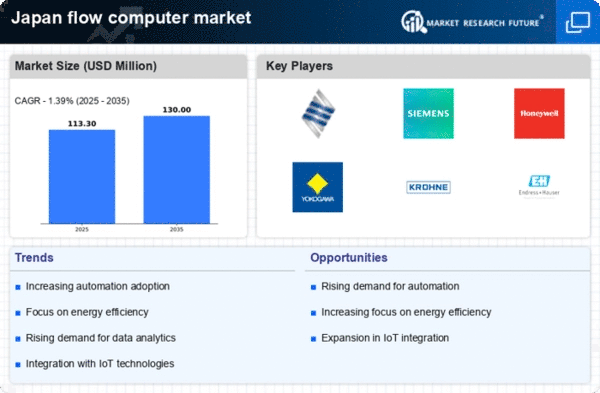
As per analysis, the Japan flow computer market size was estimated at 111.75 USD Million in 2024. The Japan flow computer market is projected to grow from 113.3 USD Million in 2025 to 130.0 USD Million by 2035, exhibiting a compound annual growth rate (CAGR) of 1.3% during the forecast period 2025 - 2035

Key Market Trends & Highlights

The Japan The Japan flow computer market is experiencing robust growth. This growth is driven by technological advancements and regulatory compliance.

  • Technological advancements are enhancing the accuracy and efficiency of flow measurement systems.
  • The oil and gas segment remains the largest, while the water and wastewater segment is the fastest-growing in the market.
  • Regulatory compliance is becoming increasingly critical as industries face heightened scrutiny and standards.
  • Rising demand for automation and investment in smart infrastructure are key drivers propelling market expansion.

Market Size & Forecast

2024 Market Size 111.75 (USD Million)
2035 Market Size 130.0 (USD Million)
CAGR (2025 - 2035) 1.39%

Major Players

Emerson (US), Siemens (DE), Honeywell (US), Yokogawa (JP), KROHNE (DE), Endress+Hauser (CH), Azbil (JP), Rockwell Automation (US), Schneider Electric (FR)

Our Impact
Enabled $4.3B Revenue Impact for Fortune 500 and Leading Multinationals
Partnering with 2000+ Global Organizations Each Year
30K+ Citations by Top-Tier Firms in the Industry

Japan Flow Computer Market Trends

The flow computer market in Japan is currently experiencing a notable evolution, driven by advancements in technology and increasing demand for accurate measurement solutions. The integration of digital technologies, such as IoT and AI, is enhancing the capabilities of flow computers, allowing for real-time data analysis and improved operational efficiency. This shift towards automation and smart systems is likely to reshape the landscape of the industry, as companies seek to optimize their processes and reduce costs. Furthermore, the emphasis on environmental sustainability is prompting organizations to adopt more efficient flow measurement systems, which could lead to a rise in the adoption of innovative solutions. In addition, regulatory frameworks in Japan are becoming increasingly stringent, necessitating the need for precise flow measurement in various sectors, including oil and gas, water management, and chemical processing. As industries strive to comply with these regulations, the demand for reliable flow computers is expected to grow. The market appears poised for expansion, with potential opportunities for both established players and new entrants. Overall, the The flow computer market is likely to witness significant developments in the coming years, influenced by regulatory pressures.

Technological Advancements

The flow computer market is witnessing rapid technological advancements, particularly with the integration of IoT and AI. These innovations enable enhanced data collection and analysis, leading to improved accuracy and efficiency in flow measurement.

Regulatory Compliance

Increasingly stringent regulations in various sectors are driving the demand for precise flow measurement solutions. Companies are compelled to adopt advanced flow computers to ensure compliance with environmental and safety standards.

Sustainability Initiatives

The growing focus on sustainability is influencing the flow computer market. Organizations are seeking more efficient measurement systems to minimize waste and reduce their environmental footprint, thereby fostering the adoption of innovative technologies.

Japan Flow Computer Market Drivers

Focus on Energy Efficiency

The flow computer market in Japan is increasingly influenced by a national focus on energy efficiency. With rising energy costs and environmental concerns, industries are under pressure to optimize their energy consumption. Flow computers play a crucial role in monitoring and managing energy use across various sectors, including manufacturing and utilities. The Japanese government has set ambitious targets to reduce energy consumption by 30% by 2030, which is likely to drive the adoption of flow measurement technologies. As companies seek to comply with these regulations, the The flow computer market is expected to expand. This expansion will provide solutions that enable precise monitoring and control of energy flows. This trend indicates a growing recognition of the importance of flow computers in achieving energy efficiency goals and reducing operational costs.

Rising Demand for Automation

The flow computer market in Japan is experiencing a notable surge in demand for automation across various industries. This trend is driven by the need for enhanced operational efficiency and reduced human error. Industries such as oil and gas, water management, and manufacturing are increasingly adopting automated flow measurement solutions. According to recent data, the automation sector in Japan is projected to grow at a CAGR of approximately 8% over the next five years. This growth is likely to propel the flow computer market, as companies seek to integrate advanced flow measurement technologies to streamline processes and improve accuracy. The increasing complexity of industrial operations necessitates sophisticated flow computer systems that can provide real-time data and analytics, thereby supporting informed decision-making and optimizing resource allocation.

Increased Regulatory Scrutiny

The flow computer market in Japan is facing heightened regulatory scrutiny, which is shaping industry practices and driving demand for compliance-oriented solutions. Regulatory bodies are implementing stricter standards for flow measurement accuracy and reporting, particularly in sectors such as oil and gas and water management. This increased focus on compliance is prompting companies to invest in advanced flow computer technologies that ensure adherence to regulations. The market is likely to see a rise in demand for flow computers that offer enhanced accuracy, reliability, and data integrity. As organizations strive to meet regulatory requirements, the flow computer market is expected to grow, with a focus on solutions that facilitate compliance and mitigate risks associated with non-compliance.

Investment in Smart Infrastructure

Japan's commitment to developing smart infrastructure is significantly influencing the flow computer market. The government has initiated various projects aimed at modernizing urban environments and enhancing energy efficiency. Investments in smart grids and intelligent water management systems are particularly noteworthy. The flow computer market is expected to benefit from these initiatives, as advanced flow measurement technologies are integral to the functioning of smart infrastructure. For instance, the integration of flow computers in smart water networks can lead to improved leak detection and resource management. As Japan allocates approximately $20 billion annually towards smart city projects, the flow computer market is poised for growth, driven by the demand for innovative solutions that support sustainable urban development.

Technological Integration with IoT

The integration of Internet of Things (IoT) technologies is reshaping the flow computer market in Japan. As industries increasingly adopt IoT solutions, the demand for flow computers that can seamlessly connect and communicate with other devices is rising. This integration allows for enhanced data collection, real-time monitoring, and improved decision-making processes. The flow computer market is likely to see a shift towards systems that offer IoT compatibility, enabling users to access flow data remotely and analyze it through cloud-based platforms. This trend is particularly relevant in sectors such as oil and gas, where real-time data is critical for operational efficiency. As IoT adoption continues to grow, the flow computer market is expected to evolve, offering innovative solutions that meet the needs of a connected industrial landscape.


Market Segment Insights

By Type: Field Flow Computers (Largest) vs. Portable Flow Computers (Fastest-Growing)

In the Japan flow computer market, Field Flow Computers hold the largest market share, primarily due to their reliability and advanced features suited for various industrial applications. On the other hand, Portable Flow Computers, while currently smaller in market share, are experiencing rapid growth as more companies adopt these compact and versatile devices for field measurements and temporary installations. Growth trends in this segment indicate a strong demand for portable solutions, driven by the increasing need for flexibility and real-time data collection in various industries. Furthermore, technological advancements are enhancing the functionality of portable and field flow computers, leading to better performance and user adoption. As industries evolve, these devices are becoming essential for efficient monitoring and management of fluid flow.

Field Flow Computers (Dominant) vs. Integrated Flow Computers (Emerging)

Field Flow Computers are known for their robustness and frequent deployment in difficult environments, making them the dominant choice in the Japan flow computer market. They combine reliability with advanced measurement capabilities, allowing for accurate data collection in various industrial applications. Meanwhile, Integrated Flow Computers represent an emerging trend where measurement, control, and communication functionalities are combined into a single unit. This integration is appealing to users seeking simplicity and efficiency in operations, thus capturing a growing share of the market. As technology advances, Integrated Flow Computers are expected to gain traction by providing comprehensive solutions that cater to diverse customer needs.

By Application: Oil and Gas (Largest) vs. Water and Wastewater (Fastest-Growing)

The market share distribution within the application segment of the Japan flow computer market indicates that the Oil and Gas sector remains the dominant force, accounting for a significant share due to the ongoing activities in upstream and downstream oil operations. Conversely, the Water and Wastewater segment is rapidly gaining attention, driven by increasing infrastructure investments and the necessity for effective resource management in urban areas. Growth trends in the Japan flow computer market highlight a noticeable acceleration in the Water and Wastewater segment, propelled by government initiatives aimed at enhancing water quality and efficiency. Furthermore, the Chemical Industry is witnessing steady growth as modernization efforts in manufacturing processes are implemented. The Food and Beverage and Pharmaceuticals sectors are also adapting to technological advancements, contributing to a dynamic and competitive market landscape.

Oil and Gas (Dominant) vs. Water and Wastewater (Emerging)

The Oil and Gas segment serves as a cornerstone of the Japan flow computer market, characterized by its established infrastructure and significant reliance on precise measurements for operational efficiency. This segment benefits from advanced technologies that ensure accuracy in flow measurement and monitoring, essential for both compliance and safety. In contrast, the Water and Wastewater sector is emerging as a vital market player, characterized by increasing demand for sustainable practices and solutions in public health infrastructure. It is supported by innovative technologies that enhance measurement accuracy and efficiency in treating and distributing water, marking its transition from a previously overlooked area to a critical focus of investment and growth.

By Technology: Electromagnetic Flow Meters (Largest) vs. Ultrasonic Flow Meters (Fastest-Growing)

In the Japan flow computer market, electromagnetic flow meters hold the largest market share, primarily due to their widespread application in various industries such as water and wastewater management, food and beverage, and chemical manufacturing. Ultrasonic flow meters, on the other hand, are rapidly gaining traction, although they currently represent a smaller market share. Their ability to measure flow without obstructing the flow path makes them an attractive choice for many applications. The growth of electromagnetic flow meters is driven by their reliability, accuracy, and adaptability to different fluid types, which are crucial for process efficiency. Ultrasonic flow meters, considered the fastest-growing segment, are being adopted due to advancements in technology that enhance their performance and lower operational costs. The shift towards automation and increased demand for precise measurement in industries are notable factors propelling this segment's growth.

Technology: Electromagnetic Flow Meters (Dominant) vs. Ultrasonic Flow Meters (Emerging)

Electromagnetic flow meters, being the dominant technology in the Japan flow computer market, are preferred for their accuracy and ability to handle a wide range of fluid types. They operate on the principle of Faraday's law of electromagnetic induction, ensuring precise measurements even in challenging conditions. In contrast, ultrasonic flow meters, recognized as an emerging technology, are gaining popularity due to their non-invasive measurement capability that reduces maintenance efforts and costs. These meters utilize sound waves to determine flow rate, making them increasingly valuable in applications where traditional methods may falter. Both technologies play crucial roles in enhancing fluid management practices across various industries.

By End Use: Industrial (Largest) vs. Residential (Fastest-Growing)

The market share distribution among end-use segments in the Japan flow computer market shows a significant dominance of the Industrial sector, which accounts for the largest portion of sales. This sector's robust demand is driven by various industries that require precise flow measurements for operational efficiency. On the other hand, the Commercial segment has a moderate share, while the Residential segment, despite being smaller, is experiencing rapid growth driven by increasing automation and smart home technologies. Growth trends indicate that the Residential segment is becoming the fastest-growing area within the Japan flow computer market, as consumers are increasingly opting for advanced flow management solutions in their homes. Rising environmental awareness and the need for efficient resource management are propelling this trend. Simultaneously, the Industrial sector remains robust, supported by ongoing technological advancements and investments in infrastructure, ensuring its continued leadership in market share.

Industrial (Dominant) vs. Residential (Emerging)

The Industrial segment is the dominant force in the Japan flow computer market, characterized by high demand from sectors such as manufacturing, energy, and chemicals. Its stability is rooted in the necessity for accurate flow measurement to enhance productivity and minimize operational costs. Conversely, the Residential segment is emerging rapidly, driven by the increasing adoption of smart technologies aimed at enhancing home automation and efficiency. While currently smaller in share, it is positioned for substantial growth as more consumers prioritize energy conservation and automated solutions. This juxtaposition highlights a dynamic market where traditional industrial applications coexist with innovative residential solutions, each catering to distinct customer needs.

Get more detailed insights about Japan Flow Computer Market

Key Players and Competitive Insights

The flow computer market in Japan is characterized by a competitive landscape that is increasingly shaped by technological advancements and strategic collaborations. Key players such as Emerson (US), Yokogawa (JP), and Honeywell (US) are actively pursuing innovation and digital transformation to enhance their market positions. Emerson (US) has focused on integrating advanced analytics and IoT capabilities into its flow computer solutions, thereby improving operational efficiency for clients. Meanwhile, Yokogawa (JP) emphasizes sustainability and energy efficiency in its product offerings, aligning with Japan's broader environmental goals. Honeywell (US) is leveraging its expertise in automation and software to provide comprehensive solutions that cater to the evolving needs of the industry, thus collectively shaping a competitive environment that prioritizes technological integration and customer-centric solutions.In terms of business tactics, companies are increasingly localizing manufacturing and optimizing supply chains to enhance responsiveness to market demands. The competitive structure of the market appears moderately fragmented, with several key players vying for market share. This fragmentation allows for a diverse range of solutions, but also intensifies competition as companies strive to differentiate themselves through innovation and service quality.

In October Emerson (US) announced a strategic partnership with a leading Japanese technology firm to co-develop next-generation flow measurement solutions. This collaboration is expected to enhance Emerson's capabilities in the region, allowing for tailored solutions that meet local industry requirements. The strategic importance of this partnership lies in its potential to accelerate product development cycles and improve market penetration in Japan, where precision and reliability are paramount.

In September Yokogawa (JP) launched a new line of flow computers designed specifically for the renewable energy sector. This move not only diversifies Yokogawa's product portfolio but also positions the company as a leader in the growing market for sustainable energy solutions. The strategic significance of this launch is underscored by Japan's commitment to increasing its renewable energy capacity, thereby creating a robust demand for innovative flow measurement technologies.

In August Honeywell (US) unveiled an advanced flow computer that incorporates AI-driven analytics to optimize flow measurement and control processes. This development reflects Honeywell's commitment to integrating cutting-edge technology into its offerings, enhancing operational efficiency for clients across various sectors. The introduction of AI capabilities is likely to set a new standard in the industry, pushing competitors to innovate further in order to keep pace.

As of November current trends in the flow computer market are heavily influenced by digitalization, sustainability, and the integration of AI technologies. Strategic alliances among key players are shaping the competitive landscape, fostering innovation and enhancing product offerings. Looking ahead, it is anticipated that competitive differentiation will increasingly pivot from price-based strategies to a focus on technological innovation, reliability, and supply chain efficiency. This shift underscores the importance of adaptability and forward-thinking in maintaining a competitive edge in the evolving market.

Key Companies in the Japan Flow Computer Market include

Industry Developments

In September 2023, Honeywell Process Solutions announced its latest advancements in flow measurement technology aimed at enhancing efficiency in process industries across Japan. Mettler Toledo has also recently introduced new flow measurement solutions, which are gaining traction among Japanese manufacturers seeking to optimize their operational efficiencies. The Japanese flow computer market is witnessing growth, with increasing demand for versatile and reliable measurement tools being driven by expanding industrial automation in sectors such as oil and gas, chemicals, and water treatment.Significant market activity includes Emerson's strategic collaborations with local firms, aiming to leverage cutting-edge technologies for improved flow measurement standards.

In June 2023, Yokogawa Electric showcased its patented flow measurement solutions at industry conferences, highlighting its commitment to innovation and excellence in the Japanese market. On the mergers and acquisitions front, there have been discussions of potential partnerships involving KROHNE and OMRON to enhance market capabilities; however, specific details remain pending. The overall valuation of the Japan Flow Computer Market is reinforced by these developments, as companies continue to invest in Research and Development to remain competitive. The market dynamics are further influenced by Japan's robust industrial sector and regulatory support for advanced manufacturing technologies.

Future Outlook

Japan Flow Computer Market Future Outlook

The Flow Computer Market in Japan is projected to grow at a 1.39% CAGR from 2025 to 2035, driven by technological advancements and increasing demand for automation.

New opportunities lie in:

  • Development of advanced predictive maintenance solutions
  • Integration of IoT for real-time data analytics
  • Expansion into renewable energy sector applications

By 2035, the market is expected to achieve a robust position, reflecting steady growth and innovation.

Market Segmentation

Japan Flow Computer Market Type Outlook

  • Portable Flow Computers
  • Field Flow Computers
  • Stationary Flow Computers
  • Integrated Flow Computers

Japan Flow Computer Market End Use Outlook

  • Industrial
  • Commercial
  • Residential

Japan Flow Computer Market Technology Outlook

  • Electromagnetic Flow Meters
  • Ultrasonic Flow Meters
  • Magnetic Flow Meters
  • Mechanical Flow Meters

Japan Flow Computer Market Application Outlook

  • Oil and Gas
  • Water and Wastewater
  • Chemical Industry
  • Food and Beverage
  • Pharmaceuticals

Report Scope

MARKET SIZE 2024 111.75(USD Million)
MARKET SIZE 2025 113.3(USD Million)
MARKET SIZE 2035 130.0(USD Million)
COMPOUND ANNUAL GROWTH RATE (CAGR) 1.39% (2025 - 2035)
REPORT COVERAGE Revenue Forecast, Competitive Landscape, Growth Factors, and Trends
BASE YEAR 2024
Market Forecast Period 2025 - 2035
Historical Data 2019 - 2024
Market Forecast Units USD Million
Key Companies Profiled Emerson (US), Siemens (DE), Honeywell (US), Yokogawa (JP), KROHNE (DE), Endress+Hauser (CH), Azbil (JP), Rockwell Automation (US), Schneider Electric (FR)
Segments Covered Type, Application, Technology, End Use
Key Market Opportunities Integration of advanced analytics and IoT in flow computer market enhances operational efficiency and data accuracy.
Key Market Dynamics Rising demand for advanced flow measurement solutions driven by regulatory compliance and technological innovation in Japan.
Countries Covered Japan
Leave a Comment

FAQs

What is the expected market size of the Japan Flow Computer Market in 2024?

The Japan Flow Computer Market is expected to be valued at 111.38 million USD in 2024.

How is the Japan Flow Computer Market expected to grow by 2035?

By 2035, the market is anticipated to grow to 197.03 million USD.

What is the expected CAGR for the Japan Flow Computer Market from 2025 to 2035?

The anticipated compound annual growth rate for the market is 5.323 percent during the forecast period.

What are the key types of flow computers in the Japan Flow Computer Market?

The key types include Portable Flow Computers, Field Flow Computers, Stationary Flow Computers, and Integrated Flow Computers.

What is the market value for Portable Flow Computers in 2024 and 2035?

Portable Flow Computers are valued at 36.0 million USD in 2024 and are expected to reach 65.0 million USD by 2035.

Which companies are the major players in the Japan Flow Computer Market?

Major players include Honeywell Process Solutions, Mettler Toledo, Brooks Instrument, and Yokogawa Electric among others.

How does the market for Stationary Flow Computers evolve through 2035?

The market for Stationary Flow Computers is valued at 25.0 million USD in 2024 and projected to grow to 45.0 million USD by 2035.

What are the emerging trends affecting the Japan Flow Computer Market?

Key emerging trends include advancements in digital technology, increased automation, and integration in various industrial applications.

What is the projected value for the Integrated Flow Computer segment by 2035?

The Integrated Flow Computer segment is expected to reach a market value of 32.03 million USD by 2035.

What challenges could impact the Japan Flow Computer Market's growth?

Challenges include fluctuating raw material costs and the need for continuous innovation to meet industrial demands.

Download Free Sample

Kindly complete the form below to receive a free sample of this Report

Compare Licence

×
Features License Type
Single User Multiuser License Enterprise User
Price $4,950 $5,950 $7,250
Maximum User Access Limit 1 User Upto 10 Users Unrestricted Access Throughout the Organization
Free Customization
Direct Access to Analyst
Deliverable Format
Platform Access
Discount on Next Purchase 10% 15% 15%
Printable Versions