×
Request Free Sample ×

Kindly complete the form below to receive a free sample of this Report

* Please use a valid business email

Leading companies partner with us for data-driven Insights

clients tt-cursor
Hero Background

Japan Fifth Party Logistics Market

ID: MRFR/PCM/47244-HCR
111 Pages
Snehal Singh
February 2026

Japan Fifth Party 5PL Logistics Market Research Report: By Application (E-commerce, Traders, Logistics Company, Others) andBy Type (Transportation, Warehousing, Other Services)- Forecast to 2035

Share:
Download PDF ×

We do not share your information with anyone. However, we may send you emails based on your report interest from time to time. You may contact us at any time to opt-out.

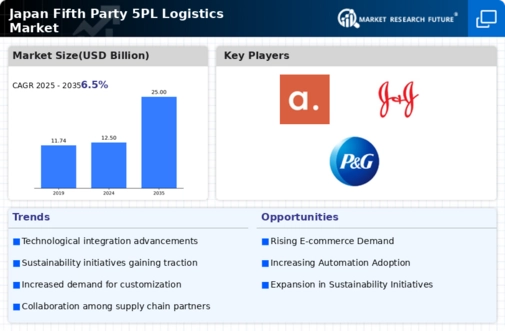
Japan Fifth Party Logistics Market Infographic
Purchase Options

Japan Fifth Party Logistics Market Summary

As per analysis, the Japan fifth party logistics market is projected to grow from USD 0.289 Billion in 2024 to USD 0.544 Billion by 2035, exhibiting a compound annual growth rate (CAGR) of 5.91% during the forecast period (2025 - 2035).

Key Market Trends & Highlights

The Japan fifth party logistics market is poised for growth driven by technological advancements and a focus on sustainability.

  • The transportation segment remains the largest in the Japan fifth party logistics market, reflecting its critical role in supply chain efficiency.
  • Order fulfillment is emerging as the fastest-growing segment, driven by increasing consumer demand for rapid delivery services.
  • In the retail sector, which is the largest, companies are increasingly customizing their logistics solutions to enhance customer satisfaction.
  • Technological advancements and a focus on sustainability are key drivers propelling the growth of the fifth party logistics market.

Market Size & Forecast

2024 Market Size 0.289 (USD Billion)
2035 Market Size 0.544 (USD Billion)
CAGR (2025 - 2035) 5.91%

Major Players

Yusen Logistics (JP), Nippon Express (JP), Kintetsu World Express (JP), SBS Holdings (JP), Hitachi Transport System (JP), Mitsui-Soko Holdings (JP), Seino Holdings (JP), Kawasaki Kisen Kaisha (JP)

Our Impact
Enabled $4.3B Revenue Impact for Fortune 500 and Leading Multinationals
Partnering with 2000+ Global Organizations Each Year
30K+ Citations by Top-Tier Firms in the Industry

Japan Fifth Party Logistics Market Trends

The Japan fifth party logistics market is currently experiencing a transformative phase, characterized by the integration of advanced technologies and a growing emphasis on sustainability. As businesses in Japan increasingly seek to optimize their supply chains, the role of fifth party logistics providers has become more pronounced. These entities not only manage logistics but also offer strategic insights, enabling companies to enhance efficiency and reduce costs. The collaboration between logistics providers and technology firms appears to be fostering innovative solutions that address the unique challenges faced by the Japanese market. Furthermore, the increasing demand for customized logistics services suggests a shift towards more tailored approaches, allowing businesses to meet specific consumer needs effectively. In addition, the regulatory landscape in Japan is evolving, with government initiatives aimed at promoting digitalization and sustainability within the logistics sector. This regulatory support may encourage more companies to adopt fifth party logistics solutions, as they seek to comply with new standards and improve their operational practices. The focus on environmental sustainability is likely to drive further investment in green logistics initiatives, which could reshape the competitive dynamics of the market. Overall, the japan fifth party logistics market is poised for growth, driven by technological advancements and a commitment to sustainable practices.

Technological Integration

The japan fifth party logistics market is witnessing a surge in the adoption of advanced technologies such as artificial intelligence and big data analytics. These innovations enable logistics providers to streamline operations, enhance decision-making, and improve overall service delivery. As companies increasingly rely on data-driven insights, the role of technology in shaping logistics strategies becomes more critical.

Sustainability Focus

There is a growing emphasis on sustainability within the japan fifth party logistics market, as businesses strive to reduce their environmental impact. This trend is reflected in the adoption of eco-friendly practices and the implementation of green logistics solutions. Companies are likely to prioritize sustainable transportation methods and waste reduction strategies to align with consumer expectations and regulatory requirements.

Customization of Services

The demand for customized logistics solutions is on the rise in the japan fifth party logistics market. Businesses are seeking tailored services that cater to their specific needs, which may include specialized handling, unique delivery schedules, and personalized customer support. This trend indicates a shift towards more flexible logistics models that can adapt to the diverse requirements of various industries.

Japan Fifth Party Logistics Market Drivers

E-commerce Growth

The rapid growth of e-commerce in Japan is a pivotal driver for the fifth party logistics market. As consumer preferences shift towards online shopping, logistics providers are compelled to adapt their services to meet the increasing demand for fast and reliable delivery. Recent statistics indicate that e-commerce sales in Japan are expected to reach approximately 20 trillion yen by 2026, creating a substantial opportunity for logistics companies. This surge necessitates the implementation of advanced logistics solutions, including last-mile delivery services and real-time tracking systems. Consequently, the Japan fifth party logistics market is likely to see a significant transformation as companies strive to enhance their capabilities to cater to the evolving e-commerce landscape.

Regulatory Support

The Japan fifth party logistics market benefits from supportive government regulations aimed at enhancing logistics efficiency. The Japanese government has implemented various policies to promote innovation and sustainability within the logistics sector. For example, initiatives such as the Logistics Revolution Strategy encourage the adoption of advanced technologies and sustainable practices. These regulatory frameworks not only facilitate investment in logistics infrastructure but also promote collaboration among stakeholders. As a result, logistics providers are better positioned to optimize their operations and reduce environmental impact. The ongoing support from the government is likely to bolster the growth of the Japan fifth party logistics market, fostering a more competitive and sustainable logistics environment.

Focus on Sustainability

Sustainability has emerged as a critical driver in the Japan fifth party logistics market. With increasing awareness of environmental issues, logistics providers are under pressure to adopt eco-friendly practices. This includes optimizing transportation routes to reduce carbon emissions and implementing green packaging solutions. Recent surveys indicate that over 60% of consumers in Japan prefer companies that demonstrate a commitment to sustainability. As a result, logistics firms are increasingly investing in sustainable technologies and practices to meet consumer expectations and regulatory requirements. This focus on sustainability not only enhances brand reputation but also positions companies favorably within the competitive landscape of the Japan fifth party logistics market.

Customization of Services

The demand for customized logistics solutions is a significant driver in the Japan fifth party logistics market. As businesses seek to differentiate themselves in a competitive marketplace, they require logistics providers that can offer tailored services to meet specific needs. This trend is particularly evident in sectors such as pharmaceuticals and electronics, where precision and reliability are paramount. Logistics companies are responding by developing flexible service offerings that can be adapted to various client requirements. Data suggests that the customization of logistics services is expected to grow by 30% in the coming years, reflecting the increasing importance of personalized solutions in the Japan fifth party logistics market.

Technological Advancements

The Japan fifth party logistics market is experiencing a surge in technological advancements that enhance operational efficiency. Innovations such as artificial intelligence, machine learning, and the Internet of Things are being integrated into logistics processes. For instance, AI-driven analytics are utilized to optimize supply chain management, leading to reduced costs and improved service delivery. According to recent data, the adoption of these technologies is projected to increase by 25% over the next five years, indicating a strong trend towards automation and data-driven decision-making. This technological evolution not only streamlines operations but also enables logistics providers to offer more tailored solutions to clients, thereby enhancing competitiveness in the Japan fifth party logistics market.

Market Segment Insights

By Service Type: Transportation (Largest) vs. Order Fulfillment (Fastest-Growing)

In the Japan fifth party logistics market, the service type segment is significantly influenced by transportation services, which hold the largest market share. This segment benefits from the robust demand for efficient distribution networks and logistics optimization in the region. Conversely, order fulfillment services, while currently representing a smaller share, are rapidly gaining traction due to the surge in e-commerce and consumer expectations for faster delivery. As a result, companies are increasingly focusing on enhancing their fulfillment capabilities to stay competitive. Growth trends in this segment are predominantly driven by the expansion of e-commerce and technological advancements that streamline logistics processes. Warehousing and inventory management are also integral but demonstrate slower growth relative to order fulfillment. The adoption of automation and sophisticated logistics technology is transforming the landscape, enabling more efficient operations and responsive supply chains to meet consumer demands in an ever-changing market environment.

Transportation (Dominant) vs. Inventory Management (Emerging)

Transportation services play a crucial role in the Japan fifth party logistics market, characterized by their capability to deliver goods seamlessly across varying distances, fulfilling the critical need for efficiency in logistics. This segment benefits from a mature infrastructure and advanced logistics networks that enhance operational effectiveness. On the other hand, inventory management is emerging as a vital area of focus for businesses seeking to optimize stock control and minimize costs. As companies increasingly embrace data analytics and inventory optimization techniques, this segment is set to evolve, enabling more accurate forecasting and enhanced supply chain resilience. Effective integration of inventory management with transportation services will be pivotal for firms aiming to achieve comprehensive logistics solutions.

By Industry Vertical: Retail (Largest) vs. Healthcare (Fastest-Growing)

In the Japan fifth party logistics market, the retail sector holds the largest market share, largely due to the demand for efficient distribution channels and the expansion of e-commerce. Retailers require robust logistics solutions to meet consumer expectations for speedy deliveries, driving the sector's significant presence in the logistics domain. Healthcare is witnessing rapid growth, fueled by an increasing demand for medical supplies and pharmaceuticals, necessitating specialized logistics services that adhere to stringent regulatory requirements. This rising demand is reshaping the landscape of logistics services aimed at healthcare providers.

Retail (Dominant) vs. Healthcare (Emerging)

The retail segment is characterized by a well-established network of logistics providers, focusing on agility and reliability to ensure timely supply of goods. As consumers shift towards online shopping, retailers are increasingly investing in advanced logistics technologies to improve their operations. On the other hand, the healthcare sector, while emerging in its logistics capabilities, is rapidly evolving due to the unique challenges it faces, such as temperature-sensitive shipments and compliance with regulations. As more healthcare organizations seek to optimize their supply chains, logistics providers are developing tailored solutions to meet these complex demands, positioning healthcare logistics as a vital area of growth.

By Technology Adoption: Cloud-Based Solutions (Largest) vs. Automation (Fastest-Growing)

In the Japan fifth party logistics market, the technology adoption landscape is significantly shaped by Cloud-Based Solutions, which hold the largest market share among the various technological advancements. These solutions offer flexibility, scalability, and accessibility, making them highly attractive to logistics companies aiming to streamline operations and enhance customer service. On the other hand, Automation is rapidly emerging as a key contributor, capturing the attention of logistics providers looking to reduce operational costs and improve efficiency while meeting growing demand for real-time processing. Growth trends indicate that while Cloud-Based Solutions continue to dominate the landscape, Automation is the fastest-growing segment, driven by advancements in robotic process automation and machine learning technologies. Logistics providers are increasingly investing in these innovations to enhance warehouse operations and transportation management. The push for digital transformation, coupled with the tight labor market and rising consumer expectations, is propelling further investment in Automation, positioning it as a critical component for competitive advantage in the rapidly evolving logistics sector.

Cloud-Based Solutions (Dominant) vs. Automation (Emerging)

Cloud-Based Solutions have established themselves as a dominant force in the Japan fifth party logistics market, primarily due to their capacity to provide integrated, efficient, and scalable solutions that meet the complex needs of modern logistics operations. They empower companies to leverage real-time data and facilitate seamless communication across supply chains. In contrast, Automation represents an emerging trend, characterized by the rapid adoption of technologies such as autonomous vehicles, drones, and robotics in logistics processes. This segment is characterized by its focus on enhancing operational efficiency and reducing human error, thus driving significant improvements in service delivery times and cost savings. Together, these technologies highlight a transformative shift in the logistics landscape, where efficient operational models are being prioritized.

By Customer Type: E-commerce Businesses (Largest) vs. Large Enterprises (Fastest-Growing)

In the Japan fifth party logistics market, the customer type segmentation reveals that E-commerce Businesses dominate the landscape due to their increasing reliance on efficient supply chain solutions to meet rising consumer demands. This segment constitutes a significant portion of the market, reflecting the boom in online shopping. Small and Medium Enterprises (SMEs), while crucial, represent a smaller share, relying on tailored logistics services that meet their specific needs amid competition from larger players.

E-commerce Businesses (Dominant) vs. Large Enterprises (Emerging)

E-commerce Businesses are characterized by their reliance on technology-driven logistics solutions, enabling real-time order tracking and inventory management, which are essential for customer satisfaction in a fast-paced market. They typically seek flexible and scalable logistics options to adapt to fluctuating demand. In contrast, Large Enterprises are emerging strongly, leveraging their extensive resources and established networks to integrate advanced logistics models. These enterprises focus on enhancing operational efficiencies and adopting innovative fulfillment strategies, making them a notable competitor in the evolving market.

Get more detailed insights about Japan Fifth Party Logistics Market

Key Players and Competitive Insights

The fifth party logistics market in Japan is characterized by a dynamic competitive landscape, driven by the increasing demand for integrated logistics solutions and the growing complexity of supply chains. Major players such as Yusen Logistics (Japan), Nippon Express (Japan), and Kintetsu World Express (Japan) are at the forefront, each adopting distinct strategies to enhance their market positioning. Yusen Logistics (Japan) focuses on digital transformation and innovation, leveraging advanced technologies to optimize logistics processes. Meanwhile, Nippon Express (Japan) emphasizes regional expansion and strategic partnerships to enhance its service offerings. Kintetsu World Express (Japan) is also investing in supply chain optimization, aiming to streamline operations and improve efficiency, which collectively shapes a competitive environment that is increasingly reliant on technological advancements and customer-centric solutions.

The business tactics employed by these companies reflect a concerted effort to localize manufacturing and optimize supply chains. The market structure appears moderately fragmented, with several key players exerting influence over various segments. This fragmentation allows for a diverse range of services, catering to different customer needs while fostering competition among the major players. The collective influence of these companies is significant, as they continuously adapt to market demands and technological advancements, thereby shaping the overall landscape of the fifth party logistics market.

In December 2025, Yusen Logistics (Japan) announced a strategic partnership with a leading technology firm to enhance its digital logistics capabilities. This collaboration aims to integrate AI-driven solutions into their supply chain management, which is expected to improve operational efficiency and customer service. The strategic importance of this partnership lies in its potential to position Yusen Logistics as a leader in digital logistics, enabling them to respond more effectively to the evolving needs of their clients.

In November 2025, Nippon Express (Japan) expanded its operations by acquiring a regional logistics provider, thereby enhancing its footprint in the domestic market. This acquisition is strategically significant as it allows Nippon Express to leverage the existing infrastructure of the acquired company, facilitating quicker service delivery and improved logistics solutions. Such moves indicate a trend towards consolidation in the market, as companies seek to enhance their competitive edge through expanded capabilities.

In October 2025, Kintetsu World Express (Japan) launched a new sustainability initiative aimed at reducing carbon emissions across its logistics operations. This initiative includes investments in electric vehicles and renewable energy sources, reflecting a growing trend towards sustainability in the logistics sector. The strategic importance of this initiative is multifaceted; it not only addresses environmental concerns but also aligns with the increasing consumer demand for sustainable practices, potentially enhancing Kintetsu's brand reputation and customer loyalty.

As of January 2026, the competitive trends in the fifth party logistics market are increasingly defined by digitalization, sustainability, and the integration of AI technologies. Strategic alliances are becoming more prevalent, as companies recognize the need to collaborate to enhance their service offerings and operational efficiencies. Looking ahead, competitive differentiation is likely to evolve from traditional price-based competition to a focus on innovation, technology integration, and supply chain reliability. This shift underscores the importance of adaptability and forward-thinking strategies in maintaining a competitive edge in the rapidly changing logistics landscape.


Key Companies in the Japan Fifth Party Logistics Market include

Industry Developments

The Japan Fifth Party 5PL Logistics Market has seen several notable developments recently. Companies such as Yamato Holdings and Nippon Express are expanding their supply chain capabilities to enhance efficiency and meet growing consumer demand. In September 2023, Kintetsu World Express announced a partnership with technology firms to integrate advanced analytics into their logistics operations, reflecting a trend toward digital transformation within the sector.

In August 2023, MitsuiSoko increased its involvement in healthcare logistics, aligning with Japan’s aging population and rising healthcare needs. On the mergers and acquisitions front, Yusen Logistics completed the acquisition of a regional competitor in July 2023 to strengthen its foothold in the domestic market. Additionally, Sagawa Express has been exploring collaborations with local startups to improve last-mile delivery services.

The market valuation for these companies is projected to grow due to the continuous emphasis on e-commerce and technological innovations, with analysts forecasting a compounded annual growth rate of 7% by 2025. Major occurrences in the past few years, including governmental support for logistics technology upgrades and infrastructure advancements, have further shaped the dynamics of Japan's 5PL Logistics Market.

Future Outlook

Japan Fifth Party Logistics Market Future Outlook

The Japan fifth party logistics market is projected to grow at a 5.91% CAGR from 2025 to 2035, driven by technological advancements and increasing demand for integrated logistics solutions.

New opportunities lie in:

  • Development of AI-driven supply chain optimization tools.
  • Expansion of last-mile delivery services using autonomous vehicles.
  • Implementation of blockchain for enhanced supply chain transparency.

By 2035, the market is expected to be robust, characterized by innovation and increased efficiency.

Market Segmentation

Japan Fifth Party Logistics Market Service Type Outlook

  • Transportation
  • Warehousing
  • Inventory Management
  • Order Fulfillment

Japan Fifth Party Logistics Market Customer Type Outlook

  • Small and Medium Enterprises
  • Large Enterprises
  • E-commerce Businesses

Japan Fifth Party Logistics Market Industry Vertical Outlook

  • Retail
  • Manufacturing
  • Healthcare
  • Automotive

Japan Fifth Party Logistics Market Technology Adoption Outlook

  • Cloud-Based Solutions
  • Automation
  • Data Analytics
  • Artificial Intelligence

Report Scope

MARKET SIZE 20240.289(USD Billion)
MARKET SIZE 20250.308(USD Billion)
MARKET SIZE 20350.544(USD Billion)
COMPOUND ANNUAL GROWTH RATE (CAGR)5.91% (2024 - 2035)
REPORT COVERAGERevenue Forecast, Competitive Landscape, Growth Factors, and Trends
BASE YEAR2024
Market Forecast Period2025 - 2035
Historical Data2019 - 2024
Market Forecast UnitsUSD Billion
Key Companies ProfiledYusen Logistics (JP), Nippon Express (JP), Kintetsu World Express (JP), SBS Holdings (JP), Hitachi Transport System (JP), Mitsui-Soko Holdings (JP), Seino Holdings (JP), Kawasaki Kisen Kaisha (JP)
Segments CoveredService Type, Industry Vertical, Technology Adoption, Customer Type
Key Market OpportunitiesIntegration of advanced technologies enhances efficiency in the japan fifth party logistics market.
Key Market DynamicsRising demand for integrated logistics solutions drives innovation in Japan's fifth party logistics market.
Countries CoveredJapan
Leave a Comment

FAQs

What is the current valuation of the Japan fifth party logistics market?

As of 2024, the market valuation was 0.289 USD Billion.

What is the projected market size for the Japan fifth party logistics market by 2035?

The market is expected to reach a valuation of 0.544 USD Billion by 2035.

What is the expected CAGR for the Japan fifth party logistics market during the forecast period?

The market is projected to grow at a CAGR of 5.91% from 2025 to 2035.

Which companies are considered key players in the Japan fifth party logistics market?

Key players include Yusen Logistics, Nippon Express, Kintetsu World Express, and others.

What are the primary service types in the Japan fifth party logistics market?

The main service types include Transportation, Warehousing, Inventory Management, and Order Fulfillment.

How does the market perform in the retail sector within the Japan fifth party logistics market?

In 2024, the retail sector was valued at 0.086 USD Billion, with projections indicating growth to 0.164 USD Billion.

What technological advancements are influencing the Japan fifth party logistics market?

Technologies such as Artificial Intelligence, Cloud-Based Solutions, and Automation are driving market growth.

What is the market outlook for large enterprises in the Japan fifth party logistics sector?

Large enterprises are expected to grow from 0.115 USD Billion in 2024 to 0.221 USD Billion by 2035.

How does the healthcare industry impact the Japan fifth party logistics market?

The healthcare sector was valued at 0.065 USD Billion in 2024, with a projected increase to 0.126 USD Billion.

What role do e-commerce businesses play in the Japan fifth party logistics market?

E-commerce businesses are anticipated to grow from 0.088 USD Billion in 2024 to 0.159 USD Billion by 2035.

Download Free Sample

Kindly complete the form below to receive a free sample of this Report

Compare Licence

×
Features License Type
Single User Multiuser License Enterprise User
Price $4,950 $5,950 $7,250
Maximum User Access Limit 1 User Upto 10 Users Unrestricted Access Throughout the Organization
Free Customization
Direct Access to Analyst
Deliverable Format
Platform Access
Discount on Next Purchase 10% 15% 15%
Printable Versions