×
Request Free Sample ×

Kindly complete the form below to receive a free sample of this Report

* Please use a valid business email

Leading companies partner with us for data-driven Insights

clients tt-cursor
Hero Background

Japan Electronic Pill Market

ID: MRFR/HC/54281-HCR
200 Pages
Rahul Gotadki
February 2026

Japan Electronic Pill Market Research Report: Size, Share, Trend Analysis By Applications (Capsule Endoscopy, Drug Delivery) - Growth Outlook & Industry Forecast 2025 To 2035

Share:
Download PDF ×

We do not share your information with anyone. However, we may send you emails based on your report interest from time to time. You may contact us at any time to opt-out.

Japan Electronic Pill Market Infographic
Purchase Options

Japan Electronic Pill Market Summary

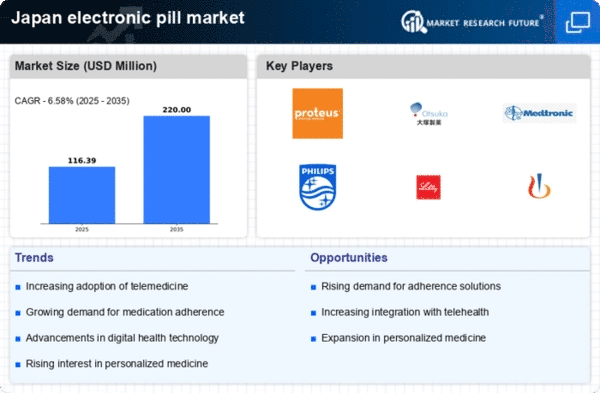
As per Market Research Future analysis, the Japan electronic pill market size was estimated at 109.2 USD Million in 2024. The Japan electronic pill market is projected to grow from 116.39 USD Million in 2025 to 220.0 USD Million by 2035, exhibiting a compound annual growth rate (CAGR) of 6.5% during the forecast period 2025 - 2035

Key Market Trends & Highlights

The Japan electronic pill market is poised for substantial growth driven by technological advancements and increasing consumer acceptance.

  • Technological advancements are enhancing the functionality and effectiveness of electronic pills, making them more appealing to healthcare providers and patients.
  • The regulatory support in Japan is fostering innovation and facilitating the introduction of new electronic pill technologies into the market.
  • The largest segment in the Japan electronic pill market is the chronic disease management segment, while the fastest-growing segment is the preventive healthcare segment.
  • Key market drivers include rising healthcare costs and an aging population, which are pushing for more efficient and patient-centric healthcare solutions.

Market Size & Forecast

2024 Market Size 109.2 (USD Million)
2035 Market Size 220.0 (USD Million)
CAGR (2025 - 2035) 6.58%

Major Players

Proteus Digital Health (US), Otsuka Pharmaceutical (JP), Medtronic (US), Philips (NL), Eli Lilly and Company (US), Novartis (CH), Abbott Laboratories (US), GSK (GB)

Our Impact
Enabled $4.3B Revenue Impact for Fortune 500 and Leading Multinationals
Partnering with 2000+ Global Organizations Each Year
30K+ Citations by Top-Tier Firms in the Industry

Japan Electronic Pill Market Trends

The electronic pill market is currently experiencing notable growth, driven by advancements in technology and increasing demand for innovative healthcare solutions. In Japan, the integration of digital health technologies into traditional medical practices appears to be reshaping patient monitoring and medication adherence. This shift is likely influenced by the aging population, which necessitates more efficient healthcare delivery systems. Furthermore, the emphasis on preventive care and personalized medicine may contribute to the rising acceptance of electronic pills among healthcare providers and patients alike. Moreover, regulatory frameworks in Japan seem to be evolving to accommodate these technological advancements, potentially facilitating the introduction of new products. The collaboration between pharmaceutical companies and tech firms indicates a trend towards developing more sophisticated electronic pills that can provide real-time data on patient health. As the market matures, it may witness increased investment in research and development, aiming to enhance the functionality and reliability of these devices. Overall, the electronic pill market is poised for significant transformation, reflecting broader trends in healthcare innovation and patient-centric approaches.

Technological Advancements

Recent innovations in sensor technology and data analytics are enhancing the capabilities of electronic pills. These advancements allow for improved tracking of medication adherence and patient health metrics, which may lead to better health outcomes.

Regulatory Support

The evolving regulatory landscape in Japan appears to be increasingly supportive of electronic health technologies. This shift may encourage the development and approval of new electronic pill products, fostering market growth.

Consumer Acceptance

There seems to be a growing acceptance of electronic pills among consumers, driven by increased awareness of their benefits. Patients are becoming more open to using technology for health management, which could further propel market expansion.

Japan Electronic Pill Market Drivers

Aging Population

Japan's demographic shift towards an older population is a key driver for the electronic pill market. By 2025, it is estimated that over 30% of the population will be aged 65 and above. This demographic is more likely to require chronic disease management, which necessitates consistent medication adherence. Electronic pills can facilitate this by providing reminders and tracking capabilities, thereby improving compliance rates. The electronic pill market is likely to see increased adoption as healthcare systems adapt to the needs of an aging society, potentially leading to a market growth rate of 15% annually.

Rising Healthcare Costs

The escalating costs associated with healthcare in Japan are driving the demand for innovative solutions within the electronic pill market. As the population ages, the need for efficient medication management becomes increasingly critical. In 2025, healthcare expenditure in Japan is projected to reach approximately $500 billion, prompting healthcare providers to seek cost-effective alternatives. Electronic pills offer a potential solution by enhancing adherence and reducing hospital visits, which can lead to significant savings. The electronic pill market is thus positioned to benefit from this trend, as it aligns with the broader goal of optimizing healthcare resources while improving patient outcomes.

Government Initiatives and Funding

Government initiatives aimed at enhancing healthcare technology are playing a pivotal role in the electronic pill market. In recent years, Japan has allocated substantial funding towards innovative health solutions, including electronic medication management systems. This support is expected to continue, with the government investing approximately $200 million in digital health technologies by 2026. Such initiatives not only foster innovation but also encourage collaboration between tech companies and healthcare providers. The electronic pill market is poised to benefit from this favorable environment, potentially leading to increased market growth and adoption rates.

Increased Focus on Patient-Centric Care

The shift towards patient-centric care in Japan is reshaping the landscape of the electronic pill market. Healthcare providers are increasingly prioritizing patient engagement and satisfaction, which aligns with the functionalities offered by electronic pills. These devices not only ensure medication adherence but also empower patients by providing them with information about their treatment. As the healthcare system evolves, the electronic pill market is likely to experience growth driven by this focus on personalized care, with projections indicating a potential market expansion of 10% annually.

Technological Integration in Healthcare

The integration of advanced technologies in healthcare is significantly influencing the electronic pill market. With the rise of telemedicine and digital health solutions, there is a growing expectation for medication delivery systems to incorporate smart technology. In Japan, the government has been promoting digital health initiatives, which could enhance the acceptance of electronic pills. The electronic pill market stands to gain from this trend, as healthcare providers and patients increasingly seek solutions that offer real-time data and connectivity, potentially increasing market penetration by 20% over the next five years.


Market Segment Insights

By Application: Capsule Endoscopy (Largest) vs. Drug Delivery (Fastest-Growing)

The market share distribution among the segment values in the Japan electronic pill market indicates that Capsule Endoscopy holds the largest share, largely due to its established efficacy in diagnosing gastrointestinal conditions. Drug Delivery, while smaller in market share, is rapidly gaining attention, driven by advancements in microtechnology and the increasing need for efficient drug administration. Patient Monitoring, although crucial, currently occupies a minimal role in the market share hierarchy. Growth trends in the Japan electronic pill market reveal that Capsule Endoscopy continues to benefit from technological innovations and rising patient awareness, solidifying its dominant position. In contrast, Drug Delivery is at the forefront of growth, fueled by healthcare demands for improved medication adherence and remote therapeutic monitoring. The advancement of digital health tools also supports the expansion of Patient Monitoring solutions, although at a slower pace overall.

Capsule Endoscopy (Dominant) vs. Drug Delivery (Emerging)

Capsule Endoscopy is characterized by its ability to provide non-invasive visualization of the gastrointestinal tract, making it a preferred choice for both physicians and patients in the Japan electronic pill market. Its dominance is underpinned by a robust track record in clinical efficacy and patient safety. On the other hand, Drug Delivery is emerging as an innovative solution, utilizing advanced materials and technologies to enhance drug absorption and efficacy. This segment is being driven by a shift towards personalized medicine and the growing trend of home healthcare, positioning it as a transformative force in medication administration. While Capsule Endoscopy remains the market leader, Drug Delivery shows the potential for significant growth and adoption.

By Target area: Esophagus (Largest) vs. Small Intestine (Fastest-Growing)

In the Japan electronic pill market, the Esophagus segment holds the largest market share, reflecting its significance in therapeutic applications. With a growing demand for non-invasive monitoring tools and an increase in the prevalence of esophageal diseases, this segment has established its dominance among the target areas. The Small Intestine segment, while smaller in comparison, is emerging rapidly as innovations in electronic pill technology enhance its capabilities for gastrointestinal health monitoring. Growth trends in this segment are propelled by advancements in technology and rising healthcare awareness. The Small Intestine is forecasted to be the fastest-growing area due to an increasing focus on early diagnosis and patient-friendly methods of monitoring intestinal health. As the population ages, the demand for effective electronic solutions in this area is expected to surge, driving market expansion and encouraging further innovations in the sector.

Esophagus (Dominant) vs. Small Intestine (Emerging)

The Esophagus segment remains dominant in the Japan electronic pill market due to its established applications in monitoring and diagnosing esophageal conditions. Its market position is strengthened by the growing adoption of remote patient monitoring solutions. In contrast, the Small Intestine segment is emerging as a key player, driven by technological advancements that improve diagnosis and monitoring capabilities. As patients and healthcare providers seek less invasive alternatives, the Small Intestine, with its potential for novel electronic pill designs, is poised for rapid growth. Innovations are likely to cater to the rising demand for effective gastrointestinal health management, making it a strong contender in the competitive landscape.

By Parts: Biocompatible capsule encasing microsensors (Largest) vs. Control chip (Fastest-Growing)

The Japan electronic pill market exhibits a diverse distribution of segment values. Among these, biocompatible capsule encasing microsensors hold the largest market share, driven by their essential role in drug delivery and monitoring health parameters. Control chips, while smaller in market size, are gaining momentum and are positioned as the fastest-growing segment due to advances in technology and increased demand for smart healthcare solutions. Growth trends in this segment are being propelled by the rising adoption of electronic pills for chronic disease management and real-time health monitoring. The integration of advanced technologies such as IoT and AI into control chips is expected to enhance their functionality, making them crucial for the future of personalized medicine. As healthcare providers and patients increasingly recognize the benefits of electronic pills, the demand for these components is anticipated to surge significantly.

Control chip (Dominant) vs. Radio transmitter (Emerging)

The control chip segment in the Japan electronic pill market has established itself as a dominant player, providing essential processing capabilities that enable functionalities such as data collection and user interaction. Its integration is vital for the operation of electronic pills, enhancing their clinical usability. The radio transmitter, on the other hand, is classified as an emerging segment, playing a crucial role in ensuring effective communication between the pill and external devices. While it currently represents a smaller share of the market, advancements in wireless technology and the increasing need for real-time data transfer are likely to bolster its growth. As both segments evolve, their collaboration is key in advancing the overall efficacy and adoption of electronic pills.

By End-User: Hospitals (Largest) vs. Medical Centers (Fastest-Growing)

In the Japan electronic pill market, hospitals represent the largest segment, capturing a significant share due to their comprehensive healthcare services and advanced technological integration. They are pivotal in adopting electronic pills for patient monitoring and medication management, which enhances treatment compliance and efficiency. Meanwhile, diagnostic centers also hold a noteworthy position, providing essential services that support hospitals in patient diagnostics and care. The growth trends for this market segment are predominantly driven by the increasing digitization of healthcare practices and a rising demand for innovative solutions that streamline patient care. Emerging technologies and the integration of electronic pills in clinical settings are fueling expansion. Notably, medical centers have emerged as the fastest-growing segment, driven by a growing focus on personalized medicine and preventative care, which leverages electronic pill technologies for real-time health monitoring.

Hospitals (Dominant) vs. Medical Centers (Emerging)

Hospitals serve as the dominant end-user in the market, characterized by vast infrastructure, multidisciplinary teams, and comprehensive patient care capabilities. Their engagement with electronic pills facilitates improved medication adherence, streamlined data management, and enhanced patient outcomes. Conversely, medical centers are seeing rapid growth as they increasingly adopt electronic pill technologies. These centers focus on specialized care and outpatient services, utilizing electronic pills to monitor health metrics and enable personalized healthcare plans. The demand for accuracy in diagnosis and treatment further bolsters their position, making them an integral part of the evolving landscape of the Japan electronic pill market.

Get more detailed insights about Japan Electronic Pill Market

Key Players and Competitive Insights

The electronic pill market in Japan is characterized by a dynamic competitive landscape, driven by technological advancements and increasing demand for patient-centric healthcare solutions. Key players such as Otsuka Pharmaceutical (Japan), Proteus Digital Health (US), and Medtronic (US) are at the forefront, each adopting distinct strategies to enhance their market presence. Otsuka Pharmaceutical (Japan) focuses on integrating digital health solutions with its pharmaceutical offerings, aiming to improve medication adherence through innovative electronic pill technologies. Meanwhile, Proteus Digital Health (US) emphasizes partnerships with healthcare providers to expand its reach, leveraging its expertise in digital medicine to create comprehensive health management systems. Medtronic (US) is also notable for its commitment to innovation, particularly in developing advanced monitoring systems that complement its electronic pill products, thereby enhancing patient outcomes.The business tactics employed by these companies reflect a concerted effort to optimize operations and adapt to local market conditions. Localizing manufacturing and streamlining supply chains are prevalent strategies, allowing firms to respond swiftly to market demands while maintaining cost efficiency. The competitive structure of the market appears moderately fragmented, with several players vying for market share, yet the influence of major companies remains substantial, shaping industry standards and practices.

In September Otsuka Pharmaceutical (Japan) announced a strategic partnership with a leading technology firm to enhance its electronic pill capabilities. This collaboration aims to integrate artificial intelligence (AI) into its medication management systems, potentially revolutionizing how patients interact with their medications. The strategic importance of this move lies in Otsuka's commitment to leveraging cutting-edge technology to improve patient adherence and health outcomes, positioning itself as a leader in digital health innovation.

In August Proteus Digital Health (US) secured a significant investment from a consortium of healthcare investors, enabling the company to accelerate its product development and expand its market footprint. This influx of capital is likely to enhance Proteus's ability to innovate and refine its electronic pill offerings, thereby strengthening its competitive position in a rapidly evolving market. The investment underscores the growing confidence in digital health solutions and the potential for electronic pills to transform patient care.

In October Medtronic (US) launched a new version of its electronic pill, featuring enhanced data analytics capabilities. This product aims to provide healthcare providers with real-time insights into patient adherence and medication effectiveness. The strategic importance of this launch is multifaceted; it not only reinforces Medtronic's commitment to innovation but also addresses the increasing demand for data-driven healthcare solutions, thereby enhancing its competitive edge.

As of November the electronic pill market is witnessing trends that emphasize digitalization, sustainability, and the integration of AI technologies. Strategic alliances among key players are shaping the competitive landscape, fostering innovation and collaboration. The shift from price-based competition to a focus on technological advancement and supply chain reliability is evident, suggesting that future competitive differentiation will hinge on the ability to innovate and deliver superior patient outcomes.

Key Companies in the Japan Electronic Pill Market include

Industry Developments

Recent developments in the Japan Electronic Pill Market have seen significant advancements in technology and healthcare integration. Companies such as Sony and Panasonic are actively pursuing innovations in electronic pill technology, focusing on enhanced patient adherence and real-time monitoring capabilities.

In September 2023, Hitachi announced a collaboration with a leading healthcare provider to expand its electronic pill offerings, aiming to improve chronic disease management. In terms of mergers and acquisitions, Ricoh acquired a smaller tech firm in October 2022, aiming to bolster its electronic health solutions portfolio, which includes electronic pill technology aimed at improving patient outcomes.

The growth trajectory of the Japan Electronic Pill Market is bolstered by an increase in aging population and chronic health conditions, which have driven demand for smart medication delivery systems. Furthermore, Terumo and Omron have recently ramped up Research and Development efforts to develop next-generation electronic pills that could revolutionize patient care.

Over the past two to three years, there has been a noticeable increase in investments directed towards healthcare technology, indicating a strong commitment from key players like Fujifilm and Sharp in advancing the electronic pill landscape within Japan's healthcare system.

Future Outlook

Japan Electronic Pill Market Future Outlook

The Electronic Pill Market in Japan is projected to grow at a 6.58% CAGR from 2025 to 2035, driven by technological advancements and increasing healthcare demands.

New opportunities lie in:

  • Development of integrated telehealth platforms for remote monitoring.
  • Partnerships with pharmaceutical companies for targeted drug delivery systems.
  • Expansion into elder care facilities with tailored medication adherence solutions.

By 2035, the electronic pill market is expected to achieve substantial growth and innovation.

Market Segmentation

Japan Electronic Pill Market Parts Outlook

  • Biocompatible capsule encasing microsensors
  • Control chip
  • Radio transmitter
  • Power source

Japan Electronic Pill Market End-User Outlook

  • Hospitals
  • Diagnostic Centers
  • Clinical Research Organizations
  • Medical Centers

Japan Electronic Pill Market Application Outlook

  • Capsule Endoscopy
  • Drug Delivery
  • Patient Monitoring

Japan Electronic Pill Market Target area Outlook

  • Esophagus
  • Stomach
  • Small Intestine
  • Large Intestine

Report Scope

MARKET SIZE 2024 109.2(USD Million)
MARKET SIZE 2025 116.39(USD Million)
MARKET SIZE 2035 220.0(USD Million)
COMPOUND ANNUAL GROWTH RATE (CAGR) 6.58% (2025 - 2035)
REPORT COVERAGE Revenue Forecast, Competitive Landscape, Growth Factors, and Trends
BASE YEAR 2024
Market Forecast Period 2025 - 2035
Historical Data 2019 - 2024
Market Forecast Units USD Million
Key Companies Profiled Proteus Digital Health (US), Otsuka Pharmaceutical (JP), Medtronic (US), Philips (NL), Eli Lilly and Company (US), Novartis (CH), Abbott Laboratories (US), GSK (GB)
Segments Covered Application, Target area, Parts, End-User
Key Market Opportunities Integration of advanced digital health technologies enhances patient adherence in the electronic pill market.
Key Market Dynamics Rising demand for electronic pills driven by technological advancements and regulatory support in Japan's healthcare sector.
Countries Covered Japan
Leave a Comment

FAQs

What is the expected market size of the Japan Electronic Pill Market in 2024?

The Japan Electronic Pill Market is anticipated to be valued at 163.8 million USD in 2024.

What will the market valuation be by 2035 for the Japan Electronic Pill Market?

By 2035, the Japan Electronic Pill Market is projected to reach a value of 733.8 million USD.

What is the expected CAGR of the Japan Electronic Pill Market from 2025 to 2035?

The projected compound annual growth rate for the Japan Electronic Pill Market from 2025 to 2035 is 14.606%.

Which application segment is expected to dominate the Japan Electronic Pill Market?

The Capsule Endoscopy application segment is expected to hold significant market value, projected to reach 360.0 million USD by 2035.

What is the market size for the Drug Delivery application by 2024?

The Drug Delivery application segment is valued at 83.8 million USD in the year 2024.

Who are the major players in the Japan Electronic Pill Market?

Key players in the Japan Electronic Pill Market include Sony, Ricoh, Mitsubishi Electric, Hitachi, and Canon.

What challenges are the Japan Electronic Pill Market currently facing?

Challenges include technological advancements and increasing competitive pressures within the electronic pill sector.

What growth opportunities exist in the Japan Electronic Pill Market?

The increasing demand for non-invasive diagnostic methods presents growth opportunities in the Japan Electronic Pill Market.

What impact does regionality have on the Japan Electronic Pill Market?

The concentration of key technological companies in Japan enhances the regional growth of the Electronic Pill Market.

What are the expected growth trends for the Japan Electronic Pill Market?

Emerging trends include advancements in drug delivery systems and innovative capsule endoscopic technologies driving market growth.

Download Free Sample

Kindly complete the form below to receive a free sample of this Report

Compare Licence

×
Features License Type
Single User Multiuser License Enterprise User
Price $4,950 $5,950 $7,250
Maximum User Access Limit 1 User Upto 10 Users Unrestricted Access Throughout the Organization
Free Customization
Direct Access to Analyst
Deliverable Format
Platform Access
Discount on Next Purchase 10% 15% 15%
Printable Versions