×
Request Free Sample ×

Kindly complete the form below to receive a free sample of this Report

* Please use a valid business email

Leading companies partner with us for data-driven Insights

clients tt-cursor
Hero Background

Japan Electric Bicycles Market

ID: MRFR/AT/52444-HCR
200 Pages
Sejal Akre
February 2026

Japan Electric Bicycles Market Research Report By Type (Pedal Assist/ Pedelecs, Power on Demand, Pedal Assist with Power on Demand), By Battery Type (Sealed Lead Acid, Li-Ion Battery) and By Motor Type (Hub Motor, Mid Drive Electric) - Growth & Industry Forecast 2025 To 2035

Share:
Download PDF ×

We do not share your information with anyone. However, we may send you emails based on your report interest from time to time. You may contact us at any time to opt-out.

Japan Electric Bicycles Market Infographic
Purchase Options

Japan Electric Bicycles Market Summary

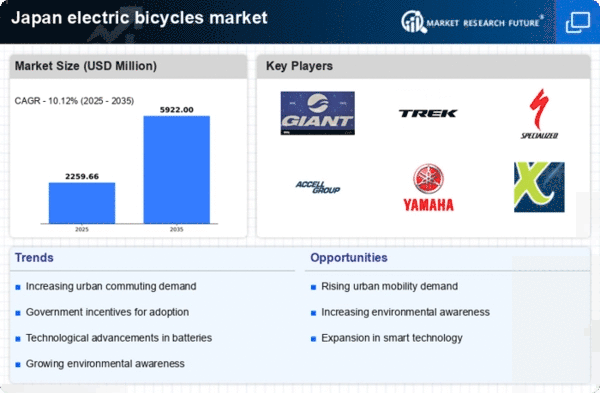
As per Market Research Future analysis, the Japan electric bicycles market size was estimated at 2052.0 USD Million in 2024. The Japan electric bicycles market is projected to grow from 2259.66 USD Million in 2025 to 5922.0 USD Million by 2035, exhibiting a compound annual growth rate (CAGR) of 10.1% during the forecast period 2025 - 2035

Key Market Trends & Highlights

The Japan electric bicycles market is experiencing robust growth driven by technological advancements and increasing environmental awareness.

  • Technological advancements are enhancing the performance and appeal of electric bicycles, making them more attractive to consumers.
  • Government support through subsidies and infrastructure development is fostering a favorable environment for electric bicycle adoption.
  • The health and wellness trend is encouraging more individuals to choose electric bicycles as a sustainable mode of transportation.
  • Urbanization and rising fuel prices are significant drivers propelling the demand for electric bicycles in urban areas.

Market Size & Forecast

2024 Market Size 2052.0 (USD Million)
2035 Market Size 5922.0 (USD Million)
CAGR (2025 - 2035) 10.12%

Major Players

Giant Manufacturing Co. (TW), Trek Bicycle Corporation (US), Specialized Bicycle Components (US), Accell Group (NL), Yamaha Motor Co. (JP), BionX International (CA), Riese & Müller (DE), Pedego Electric Bikes (US), Haibike (DE)

Our Impact
Enabled $4.3B Revenue Impact for Fortune 500 and Leading Multinationals
Partnering with 2000+ Global Organizations Each Year
30K+ Citations by Top-Tier Firms in the Industry

Japan Electric Bicycles Market Trends

The electric bicycles market in Japan is currently experiencing a notable transformation, driven by a combination of technological advancements and shifting consumer preferences. As urban areas become increasingly congested, the demand for efficient and eco-friendly transportation options is on the rise. Electric bicycles offer a practical solution, allowing users to navigate through traffic with ease while reducing their carbon footprint. Furthermore, government initiatives aimed at promoting sustainable mobility are likely to bolster the adoption of electric bicycles, as incentives and subsidies encourage consumers to make the switch from traditional vehicles. In addition to environmental considerations, the electric bicycles market is also influenced by the growing interest in health and fitness. Many individuals are seeking ways to incorporate physical activity into their daily routines, and electric bicycles provide an appealing option that combines exercise with convenience. The integration of smart technology into electric bicycles, such as GPS navigation and fitness tracking, further enhances their appeal. As the market continues to evolve, it appears poised for growth, with innovations and changing societal attitudes playing a crucial role in shaping its future.

Technological Advancements

The electric bicycles market is witnessing rapid technological innovations, including improved battery efficiency and lightweight materials. These advancements enhance performance and extend the range of electric bicycles, making them more appealing to consumers. As manufacturers invest in research and development, the introduction of smart features, such as connectivity and integrated navigation systems, is likely to further attract tech-savvy riders.

Government Support

Government initiatives in Japan are increasingly focused on promoting sustainable transportation solutions. Policies aimed at reducing emissions and encouraging the use of electric bicycles are becoming more prevalent. Subsidies and incentives for consumers purchasing electric bicycles may stimulate market growth, as these measures align with national goals for environmental sustainability.

Health and Wellness Trends

The rising awareness of health and wellness among the population is influencing the electric bicycles market. Many individuals are looking for ways to stay active while commuting or running errands. Electric bicycles offer a unique blend of exercise and convenience, appealing to those who wish to incorporate physical activity into their daily lives without the strain of traditional cycling.

Japan Electric Bicycles Market Drivers

Aging Population

Japan's aging population presents a unique opportunity for the electric bicycles market. As the demographic landscape shifts, older adults are increasingly seeking mobility solutions that accommodate their needs. Electric bicycles offer a user-friendly option for seniors, providing assistance with pedaling and making cycling more accessible. In 2025, it is estimated that over 30% of the population will be aged 65 and older, creating a substantial market segment for electric bicycles. This demographic shift may lead to increased demand for models specifically designed for older riders, emphasizing comfort and ease of use. Consequently, the electric bicycles market is likely to see growth as manufacturers cater to this aging demographic, enhancing their product offerings to meet the needs of older consumers.

Rising Fuel Prices

The escalating fuel prices in Japan are prompting consumers to explore alternative transportation options, thereby benefiting the electric bicycles market. As fuel costs continue to rise, individuals are increasingly seeking cost-effective and efficient means of travel. Electric bicycles present a viable solution, offering lower operational costs compared to traditional vehicles. In 2025, it is anticipated that fuel prices will increase by approximately 15%, further incentivizing consumers to consider electric bicycles as a practical alternative. This economic pressure may lead to a shift in consumer behavior, with more individuals opting for electric bicycles to mitigate transportation expenses. As a result, the electric bicycles market is likely to experience growth as consumers prioritize affordability and sustainability in their commuting choices.

Environmental Awareness

Growing environmental consciousness among Japanese consumers is significantly influencing the electric bicycles market. As awareness of climate change and pollution rises, individuals are increasingly seeking sustainable transportation options. The electric bicycles market aligns with these values, offering a greener alternative to traditional vehicles. In 2025, surveys indicate that over 70% of Japanese consumers prioritize eco-friendly products, which is likely to drive the adoption of electric bicycles. Furthermore, the government has been promoting initiatives to reduce carbon emissions, which may further encourage consumers to transition to electric bicycles. This heightened environmental awareness is expected to create a favorable landscape for the electric bicycles market, as more people recognize the benefits of reducing their carbon footprint.

Technological Integration

The integration of advanced technologies into electric bicycles market is reshaping consumer expectations and experiences. Innovations such as smart connectivity, GPS navigation, and enhanced battery efficiency are becoming increasingly prevalent. In Japan, the market is witnessing a surge in demand for electric bicycles equipped with smart features, which enhance user convenience and safety. By 2025, it is projected that around 40% of electric bicycles sold will incorporate smart technology, appealing to tech-savvy consumers. This trend not only improves the functionality of electric bicycles but also positions them as desirable lifestyle products. As manufacturers continue to innovate, the electric bicycles market is likely to expand, attracting a broader audience seeking modern and efficient transportation solutions.

Urbanization and Commuting Needs

The rapid urbanization in Japan is driving the demand for electric bicycles market. As cities become more congested, commuters seek efficient and eco-friendly transportation alternatives. The electric bicycles market is positioned to benefit from this trend, as these vehicles offer a practical solution for navigating urban environments. In 2025, it is estimated that approximately 80% of the Japanese population will reside in urban areas, further increasing the need for compact and sustainable commuting options. Additionally, the rising costs of public transportation may lead consumers to consider electric bicycles as a cost-effective alternative. This shift in commuting preferences is likely to bolster the electric bicycles market, as more individuals opt for personal mobility solutions that align with their urban lifestyles.


Market Segment Insights

By Type: Pedal Assist (Largest) vs. Power on Demand (Fastest-Growing)

The Japan electric bicycles market shows a varied distribution among its segments, with Pedal Assist leading the way. This segment holds a significant share, appealing to riders who prefer a balance between pedaling and motor assistance. Following closely, Power on Demand is experiencing remarkable growth, captivating consumers who seek immediate assistance with minimal pedaling effort. On the other hand, Pedal Assist with Power on Demand is gaining traction, merging the benefits of both types for enhanced user experience. The growth trends in the market indicate a clear consumer preference leaning towards convenience and flexibility. Rapid urbanization and increasing environmental awareness are driving the demand for electric bicycles. Innovations in battery technology and design are facilitating the growth of the Power on Demand segment, while the traditional Pedal Assist remains popular for its practicality. The diverse features across these segments cater to varying rider preferences, contributing to the dynamic nature of the market.

Pedal Assist (Dominant) vs. Power on Demand (Emerging)

Pedal Assist is the dominant segment in the Japan electric bicycles market, renowned for offering an enhanced cycling experience without compromising on the physical exercise element. Its blend of manual pedaling with powered assistance makes it a preferred choice for daily commuters and recreational users alike. In contrast, Power on Demand is an emerging segment that appeals to consumers desiring instant acceleration without the need for effortful pedaling. This segment is gaining traction among those new to cycling or those who prioritize ease of use, and as urban environments become more congested, the appeal of effortless travel continues to grow.

By Battery Type: Li-Ion Battery (Largest) vs. Sealed Lead Acid (Fastest-Growing)

In the Japan electric bicycles market, the battery type segment is primarily dominated by Li-Ion batteries, which capture a significant share due to their lightweight nature and efficiency. Sealed Lead Acid batteries, while historically prevalent, are gradually being overshadowed by advancements in lithium technologies. The competitive landscape reveals Li-Ion batteries holding the leading position, leveraging high energy density and longer cycle life to satisfy consumer preferences for performance and longevity. Growth trends within the battery type segment indicate a clear shift towards Li-Ion batteries while Sealed Lead Acid batteries are witnessing rapid adoption in specific applications, especially among budget-conscious consumers. The push for environmentally friendly energy solutions and government incentives for electric mobility are contributing to an uptick in demand. Innovations in battery technology, as well as decreasing costs for Li-Ion solutions, are expected to further accelerate this transition, affirming the dominance of Li-Ion and the emergent potential of Sealed Lead Acid alternatives.

Li-Ion Battery (Dominant) vs. Sealed Lead Acid (Emerging)

Li-Ion batteries stand out as the dominant choice in the Japan electric bicycles market, providing superior performance characteristics such as lighter weight, faster charging times, and longer lifespan compared to Sealed Lead Acid batteries. They cater to a growing consumer demand for efficiency and sustainability, making them highly popular among electric bicycle manufacturers. Conversely, Sealed Lead Acid batteries, although considered emerging, are gaining traction for their affordability and ease of use in specific segments. Their robustness and lower initial cost make them appealing for entry-level electric bicycles. As technological advancements continue, these two battery types are positioned to coexist, catering to different market needs and consumer preferences.

By Motor Type: Hub Motor (Largest) vs. Mid Drive Electric (Fastest-Growing)

In the Japan electric bicycles market, the distribution of motor types reveals that hub motors command a significant portion of the market share, appealing to consumers seeking affordability and reliability. This segment's dominance is largely attributed to its simplicity in design, ease of maintenance, and widespread popularity among casual riders and city commuters who prioritize functionality over high-performance metrics. Conversely, mid-drive electric motors have been steadily increasing their share, particularly among enthusiasts and performance-oriented users, capitalizing on their advantages in weight distribution and overall efficiency. The growth trends within this segment highlight a shift towards more performance-driven solutions in the Japan electric bicycles market. Factors such as urbanization, increased environmental awareness, and the demand for sustainable transportation options are propelling the adoption of mid-drive systems. These motors are perceived as cutting-edge technology that enhances the riding experience, encouraging more individuals to transition from traditional bicycles to electric alternatives. With advancements in battery technology and efficient energy management, mid-drive motors are expected to continue their rapid growth, capturing a larger audience and reinforcing their position in the market.

Motor Type: Hub Motor (Dominant) vs. Mid Drive Electric (Emerging)

Hub motors have established themselves as the dominant choice for many riders in the Japan electric bicycles market, primarily due to their straightforward engineering and low manufacturing costs. They are available in a range of power outputs, making them accessible for various user needs from leisure to commuting. Their appeal lies in their ease of use and the lower overall weight of the bike. On the other hand, mid-drive electric motors are emerging strongly, favored for their superior torque and ability to optimize the bike's gear system. These motors are pivotal for those tackling steep inclines and longer distances, effectively responding to the increasing demand for high-performance electric bicycles. As more consumers seek versatility and dynamic riding experiences, mid-drive systems are poised to capture greater market interest, enabling further specialization in the electric bicycle segment.

Get more detailed insights about Japan Electric Bicycles Market

Key Players and Competitive Insights

The electric bicycles market in Japan is characterized by a dynamic competitive landscape, driven by increasing consumer demand for sustainable transportation solutions and advancements in battery technology. Key players such as Yamaha Motor Co. (JP), Giant Manufacturing Co. (TW), and Trek Bicycle Corporation (US) are actively shaping the market through innovation and strategic partnerships. Yamaha Motor Co. (JP) focuses on integrating advanced technology into their products, enhancing user experience and performance. Meanwhile, Giant Manufacturing Co. (TW) emphasizes regional expansion and local manufacturing to cater to the growing demand in urban areas. Trek Bicycle Corporation (US) is leveraging digital transformation to enhance customer engagement and streamline operations, indicating a collective shift towards a more integrated and responsive market environment. In terms of business tactics, companies are increasingly localizing manufacturing and optimizing supply chains to reduce costs and improve efficiency. The market appears moderately fragmented, with several key players exerting influence over their respective segments. This competitive structure allows for a diverse range of products and innovations, fostering a healthy environment for growth and competition among established brands and new entrants alike. In October 2025, Yamaha Motor Co. (JP) announced a partnership with a leading battery manufacturer to develop next-generation lithium-ion batteries aimed at increasing the range and efficiency of their electric bicycles. This strategic move is likely to enhance Yamaha's competitive edge by addressing one of the primary concerns of consumers—battery life—thus potentially increasing market share in a rapidly evolving sector. In September 2025, Giant Manufacturing Co. (TW) launched a new line of electric bicycles featuring smart connectivity options, allowing users to track performance metrics via a mobile app. This innovation not only caters to the tech-savvy consumer but also positions Giant as a leader in integrating digital solutions into traditional cycling, which may attract a broader customer base and enhance brand loyalty. In August 2025, Trek Bicycle Corporation (US) expanded its operations in Japan by opening a new flagship store in Tokyo, showcasing its latest electric bicycle models. This move signifies Trek's commitment to the Japanese market and its strategy to enhance brand visibility and customer interaction. By establishing a physical presence, Trek aims to foster community engagement and provide personalized customer experiences, which could lead to increased sales and brand recognition. As of November 2025, current trends in the electric bicycles market include a strong emphasis on digitalization, sustainability, and the integration of artificial intelligence in product development. Strategic alliances among key players are increasingly shaping the competitive landscape, facilitating knowledge sharing and resource optimization. The shift from price-based competition to a focus on innovation, technology, and supply chain reliability is evident, suggesting that companies that prioritize these aspects will likely emerge as leaders in the evolving market.

Key Companies in the Japan Electric Bicycles Market include

Industry Developments

In Japan's electric bicycles market, significant developments have been observed in recent months. Honda has introduced a new electric bike model aimed at urban commuters, while Panasonic continues to expand its offerings in the e-bike segment, leveraging its advanced battery technology. Yamaha has also launched new models featuring enhanced torque control and adaptability for diverse terrains, catering to increasing consumer demand for versatile e-bikes. 

Specialized Bicycle Components and Trek Bicycle Corporation are focusing on sustainability, adopting eco-friendly practices in manufacturing to appeal to environmentally conscious consumers. In the realm of mergers and acquisitions, there have been no significant publicly announced deals involving prominent players like Brompton Bicycle or Ducati reported in recent months. 

However, news from early 2022 highlighted Giant Manufacturing Co's strategic investments in electric bike technology, further solidifying its competitive stance in the market. The Japan electric bicycle market is anticipated to see robust growth, driven by increasing health consciousness, government initiatives promoting green transportation, and rising fuel prices, encouraging consumers to adopt electric bicycles as a viable mode of transport.


Future Outlook

Japan Electric Bicycles Market Future Outlook

The Electric bicycles Market in Japan is projected to grow at a 10.12% CAGR from 2025 to 2035, driven by urbanization, environmental concerns, and technological advancements.

New opportunities lie in:

  • Development of subscription-based e-bike services for urban commuters. Integration of smart technology for enhanced user experience and safety. Expansion of charging infrastructure to support e-bike adoption in rural areas.

By 2035, the electric bicycles market is expected to be robust, reflecting substantial growth and innovation.

Market Segmentation

Japan Electric Bicycles Market Type Outlook

  • Pedal Assist/ Pedelecs
  • Power on Demand
  • Pedal Assist with Power on Demand

Japan Electric Bicycles Market Motor Type Outlook

  • Hub Motor
  • Mid Drive Electric

Japan Electric Bicycles Market Battery Type Outlook

  • Sealed Lead Acid
  • Li-Ion Battery

Report Scope

MARKET SIZE 2024 2052.0(USD Million)
MARKET SIZE 2025 2259.66(USD Million)
MARKET SIZE 2035 5922.0(USD Million)
COMPOUND ANNUAL GROWTH RATE (CAGR) 10.12% (2025 - 2035)
REPORT COVERAGE Revenue Forecast, Competitive Landscape, Growth Factors, and Trends
BASE YEAR 2024
Market Forecast Period 2025 - 2035
Historical Data 2019 - 2024
Market Forecast Units USD Million
Key Companies Profiled Giant Manufacturing Co. (TW), Trek Bicycle Corporation (US), Specialized Bicycle Components (US), Accell Group (NL), Yamaha Motor Co. (JP), BionX International (CA), Riese & Müller (DE), Pedego Electric Bikes (US), Haibike (DE)
Segments Covered Type, Battery Type, Motor Type
Key Market Opportunities Growing demand for eco-friendly transportation solutions drives innovation in the electric bicycles market.
Key Market Dynamics Rising consumer demand for eco-friendly transportation drives innovation and competition in the electric bicycles market.
Countries Covered Japan
Leave a Comment

FAQs

What is the expected market size of the Japan Electric Bicycles Market in 2024?

The Japan Electric Bicycles Market is expected to be valued at 2.56 USD Billion in 2024.

What will be the projected market size of the Japan Electric Bicycles Market by 2035?

By 2035, the market is anticipated to reach a value of 7.2 USD Billion.

What is the expected compound annual growth rate (CAGR) for the Japan Electric Bicycles Market from 2025 to 2035?

The expected CAGR for the Japan Electric Bicycles Market from 2025 to 2035 is 9.837%.

Which segment of the market is expected to dominate in 2024?

The Pedal Assist/Pedelecs segment is projected to dominate the market with a value of 1.28 USD Billion in 2024.

What are the key players in the Japan Electric Bicycles Market?

Major players in the market include Honda, Panasonic, Yamaha, and Trek Bicycle Corporation among others.

What is the market size for the Power on Demand segment in 2024?

The Power on Demand segment is expected to be valued at 0.84 USD Billion in 2024.

What is the projected market value for Pedal Assist with Power on Demand by 2035?

The Pedal Assist with Power on Demand segment is forecasted to reach a market value of 1.2 USD Billion by 2035.

What are the major growth drivers for the Japan Electric Bicycles Market?

Key growth drivers include increasing environmental awareness, urbanization, and advancements in battery technology.

How does the Japan Electric Bicycles Market growth rate compare across different segments?

The market is experiencing significant growth across all segments, with Pedal Assist seeing notable demand.

What challenges does the Japan Electric Bicycles Market currently face?

Challenges include regulatory hurdles and competition from traditional bicycles and alternative transportation methods.

Download Free Sample

Kindly complete the form below to receive a free sample of this Report

Compare Licence

×
Features License Type
Single User Multiuser License Enterprise User
Price $4,950 $5,950 $7,250
Maximum User Access Limit 1 User Upto 10 Users Unrestricted Access Throughout the Organization
Free Customization
Direct Access to Analyst
Deliverable Format
Platform Access
Discount on Next Purchase 10% 15% 15%
Printable Versions