×
Request Free Sample ×

Kindly complete the form below to receive a free sample of this Report

* Please use a valid business email

Leading companies partner with us for data-driven Insights

clients tt-cursor
Hero Background

Japan Edge Ai Hardware Market

ID: MRFR/SEM/45137-HCR
200 Pages
Aarti Dhapte
February 2026

Japan Edge-AI Hardware Market Size, Share and Research Report By Component (CPU, GPU, ASIC, FPGA), By Device (Smartphone, Camera, Robot, Automobile, Smart Speaker, Wearables, Smart Mirror, Others), By Power Consumption (0-5 W, 6-10 W, More Than 10 W), By Process (Training, Inference) and By Vertical (Consumer Electronics, Smart Home, Automotive Transportation, Healthcare, Aerospace Defense, Government, Construction, Others) - Industry Forecast Till 2035

Share:
Download PDF ×

We do not share your information with anyone. However, we may send you emails based on your report interest from time to time. You may contact us at any time to opt-out.

Japan Edge Ai Hardware Market Infographic
Purchase Options

Japan Edge Ai Hardware Market Summary

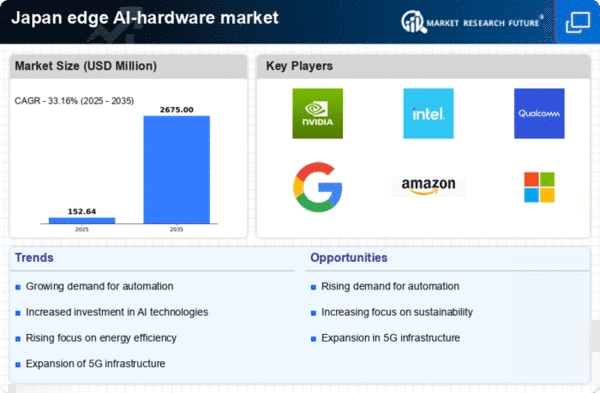
As per Market Research Future analysis, the Japan edge AI-hardware market size was estimated at 114.63 USD Million in 2024. The Japan edge ai-hardware market is projected to grow from 152.64 USD Million in 2025 to 2675.0 USD Million by 2035, exhibiting a compound annual growth rate (CAGR) of 33.1% during the forecast period 2025 - 2035

Key Market Trends & Highlights

The Japan edge AI-hardware market is experiencing robust growth driven by technological advancements and increasing demand for real-time data processing.

  • The manufacturing sector represents the largest segment, showcasing a notable increase in edge AI-hardware adoption.
  • Smart cities emerge as the fastest-growing segment, reflecting a shift towards integrated urban solutions.
  • Energy efficiency remains a critical focus, as stakeholders seek sustainable technology implementations.
  • Key market drivers include rising demand for real-time data processing and government initiatives supporting AI development.

Market Size & Forecast

2024 Market Size 114.63 (USD Million)
2035 Market Size 2675.0 (USD Million)
CAGR (2025 - 2035) 33.16%

Major Players

NVIDIA (US), Intel (US), Qualcomm (US), Google (US), Amazon (US), Microsoft (US), IBM (US), Xilinx (US), Arm (GB)

Our Impact
Enabled $4.3B Revenue Impact for Fortune 500 and Leading Multinationals
Partnering with 2000+ Global Organizations Each Year
30K+ Citations by Top-Tier Firms in the Industry

Japan Edge Ai Hardware Market Trends

the edge AI-hardware market is experiencing notable growth, driven by advancements in artificial intelligence and the increasing demand for real-time data processing. In Japan, the integration of edge computing with AI technologies is becoming more prevalent across various sectors, including manufacturing, healthcare, and transportation. This trend is largely influenced by the need for enhanced efficiency and reduced latency in data handling. As organizations seek to leverage AI capabilities at the edge, investments in specialized hardware are expected to rise, fostering innovation and competitive advantages. Moreover, the regulatory environment in Japan appears to be supportive of technological advancements, encouraging the adoption of edge ai-hardware solutions. Government initiatives aimed at promoting digital transformation and smart city projects are likely to further stimulate market growth. The focus on sustainability and energy efficiency is also shaping the development of edge ai-hardware, as companies strive to minimize their environmental impact while maximizing performance. Overall, the edge ai-hardware market is poised for continued expansion, with various factors contributing to its evolution and adoption across industries.

Increased Adoption in Manufacturing

The edge ai-hardware market is witnessing a surge in adoption within the manufacturing sector. Companies are increasingly utilizing AI-driven solutions to enhance operational efficiency, optimize supply chains, and improve predictive maintenance. This trend is likely to lead to a greater demand for specialized hardware that can process data locally, reducing reliance on centralized systems.

Focus on Smart Cities

The development of smart cities in Japan is significantly influencing the edge ai-hardware market. As urban areas seek to integrate technology for improved infrastructure and services, the need for edge computing solutions becomes apparent. This trend suggests a growing market for hardware that supports real-time data analysis and decision-making in urban environments.

Emphasis on Energy Efficiency

Sustainability is becoming a key consideration in the edge ai-hardware market. Companies are increasingly prioritizing energy-efficient solutions that not only reduce operational costs but also align with environmental goals. This emphasis on energy efficiency may drive innovation in hardware design and functionality, catering to the evolving demands of eco-conscious consumers.

Japan Edge Ai Hardware Market Drivers

Integration of AI in IoT Devices

The integration of artificial intelligence (AI) into Internet of Things (IoT) devices is a significant driver for the edge ai-hardware market in Japan. As IoT applications proliferate across various sectors, the need for intelligent edge devices that can analyze data locally becomes paramount. This integration allows for enhanced functionality, such as predictive maintenance and automated responses, which are essential for industries like healthcare and transportation. The market is expected to witness a growth rate of around 20% as more companies adopt AI-enabled IoT solutions. This trend not only improves operational efficiency but also fosters innovation, making the edge ai-hardware market a focal point for technological advancement in Japan.

Advancements in Semiconductor Technology

Advancements in semiconductor technology are significantly influencing the edge ai-hardware market in Japan. The development of more efficient and powerful chips enables edge devices to perform complex AI computations locally, reducing reliance on cloud infrastructure. This technological evolution is crucial for applications requiring low latency and high processing power, such as autonomous vehicles and smart manufacturing systems. The market is projected to grow by approximately 16% as semiconductor manufacturers continue to innovate and produce specialized chips tailored for edge computing. These advancements not only enhance performance but also contribute to energy efficiency, making edge ai-hardware solutions more attractive to businesses across various sectors.

Growing Focus on Data Privacy and Security

In the context of the edge ai-hardware market, the growing focus on data privacy and security is becoming increasingly relevant in Japan. With the rise of data breaches and cyber threats, organizations are prioritizing the implementation of secure edge devices that can protect sensitive information. This trend is particularly pronounced in sectors such as finance and healthcare, where data integrity is paramount. As a result, the demand for edge ai-hardware that incorporates advanced security features is expected to rise. The market may see a growth rate of around 12% as companies seek to comply with stringent regulations and safeguard their data assets, thereby enhancing the overall trust in edge computing solutions.

Rising Demand for Real-Time Data Processing

The edge ai-hardware market in Japan experiences a notable surge in demand for real-time data processing capabilities. Industries such as manufacturing and logistics are increasingly reliant on instantaneous data analysis to enhance operational efficiency. This trend is driven by the need for timely decision-making, which is critical in competitive environments. As a result, the market for edge ai-hardware is projected to grow at a CAGR of approximately 15% over the next five years. Companies are investing in advanced edge devices that can process data locally, reducing latency and bandwidth costs. This shift towards real-time analytics is likely to propel the edge ai-hardware market forward, as organizations seek to leverage data for improved performance and innovation.

Government Initiatives Supporting AI Development

Government initiatives in Japan aimed at promoting AI development play a crucial role in driving the edge ai-hardware market. The Japanese government has launched various programs to support research and development in AI technologies, which includes funding for startups and established companies. These initiatives are designed to enhance Japan's competitiveness in the global AI landscape. As a result, the edge ai-hardware market is likely to benefit from increased investment and collaboration between public and private sectors. The government’s commitment to fostering a robust AI ecosystem is expected to lead to a market growth of approximately 18% over the next few years, positioning Japan as a leader in edge computing technologies.


Market Segment Insights

By Component: GPU (Largest) vs. ASIC (Fastest-Growing)

In the Japan edge ai-hardware market, the component segment showcases a dynamic distribution of market share. The GPU category emerges as the largest segment, owing to its versatility and efficiency in handling AI workloads. CPUs follow, providing robust performance for a variety of applications. Meanwhile, FPGAs and ASICs, although smaller in share, play crucial roles in specific, high-performance scenarios, with ASICs gaining traction due to their effectiveness in specialized tasks. The growth trends within the component segment are driven by increasing demand for AI applications across industries, enhanced processing capabilities of GPUs, and the emergence of ASICs for optimized performance. As companies focus on powering real-time data analytics and machine learning, the demand for these components is projected to grow significantly. Technological advancements and an evolving ecosystem are also contributing to the rising adoption rates of these components.

GPU (Dominant) vs. ASIC (Emerging)

The GPU segment stands out as the dominant player in the component landscape, primarily due to its adaptability in various AI applications, offering high parallel processing capabilities that are essential for deep learning tasks. This dominance translates to widespread adoption across sectors such as gaming, healthcare, and automation. On the other hand, the ASIC segment is emerging rapidly, specifically tailored for specific applications which require high efficiency and lower energy consumption. ASICs are optimized for speed and resource utilization, making them ideal for industries focusing on processing large datasets quickly and cost-effectively. The competition between these components drives innovation, pushing the boundaries of what is feasible in edge AI solutions.

By Device: Smartphone (Largest) vs. Camera (Fastest-Growing)

In the Japan edge ai-hardware market, the device segment showcases a diverse range of technology applications, with smartphones dominating the landscape. They are pivotal in AI deployment due to their extensive usage and integration with daily activities. Notably, the camera segment is rapidly gaining traction, driven by advancements in imaging AI technology and its application in various sectors including surveillance and media. The growth trends in this segment are influenced by the continuous innovation in AI capabilities, encouraging manufacturers to explore enhanced functionalities. Factors such as increasing consumer demand for smart devices and the integration of AI in autonomous technologies within robots and automobiles further bolster this segment. The rising adoption of wearables and smart speakers also indicates a significant shift towards more interconnected device ecosystems within the market.

Smartphone: Dominant vs. Camera: Emerging

Smartphones remain the dominant force in the device segment, with their versatility and pervasive adoption across various demographics. These devices serve as essential platforms for deploying advanced edge AI capabilities, including voice recognition and augmented reality applications. Conversely, the camera segment, recognized as an emerging player, is experiencing rapid growth due to improvements in machine learning algorithms that enhance image processing and recognition. The increasing demand for smart surveillance solutions and AI-driven photography is propelling camera technology into new markets. This combination of evolving software capabilities and the need for high-quality imaging solutions positions cameras as a critical component in the edge AI landscape, complementing the widespread use of smartphones.

By Power Consumption: 6-10 W (Largest) vs. More Than 10 W (Fastest-Growing)

In the Japan edge ai-hardware market, the power consumption segment is segmented into three key categories: 0-5 W, 6-10 W, and More Than 10 W. Among these, the 6-10 W category holds the largest market share, driven by its balanced efficiency and capabilities. Conversely, the More Than 10 W category is gaining traction rapidly, appealing to performance-driven applications that require robust processing power, while the 0-5 W segment remains the smallest due to its limited application scope in high-performance tasks. The growth trends in this segment indicate a shift towards higher power consumptions, with More Than 10 W expected to see the steepest growth. This trend is fuelled by advancements in AI technologies and an increasing demand for edge computing solutions that require greater processing capabilities. Factors contributing to this expansion include the rise of complex AI applications, the need for real-time data processing, and the push for smarter devices in various industries, including healthcare, automotive, and smart cities.

6-10 W (Dominant) vs. More Than 10 W (Emerging)

The 6-10 W segment is characterized by a versatile range of edge AI hardware that offers an optimal mix of power and efficiency, making it the preferred choice for many applications such as smart cameras and IoT devices. This dominance is largely due to its ability to meet the needs of moderate processing tasks while ensuring lower energy consumption. In contrast, the More Than 10 W segment is emerging rapidly as a result of increasing demands for powerful AI solutions, capable of handling intensive computations. This higher power consumption supports advanced functionalities like deep learning and complex analytics, making it essential for industries aiming to leverage AI technology. Companies investing in high-performance hardware are likely to thrive in this segment, thus contributing to its growth.

By Vertical: Consumer Electronics (Largest) vs. Healthcare (Fastest-Growing)

In the Japan edge ai-hardware market, the distribution of market share reveals that Consumer Electronics holds the largest segment. This sector has been significantly bolstered by the increasing adoption of smart technologies and connected devices among consumers. Following closely, the Healthcare segment is rapidly expanding, driven by technological advancements such as AI-powered diagnostic tools and telehealth applications. These trends indicate a shift towards integrating AI solutions in everyday life and critical sectors. Growth trends in the Japan edge ai-hardware market demonstrate a robust upward trajectory, particularly for the Healthcare segment, which is the fastest-growing due to an aging population and rising demand for efficient medical solutions. Additionally, Consumer Electronics continues to thrive as innovations in smart devices fuel market expansion. The increasing investment in R&D and supportive government initiatives also serve as major drivers for growth in these segments, indicating a promising future for edge AI applications.

Consumer Electronics: Dominant vs. Healthcare: Emerging

Consumer Electronics is established as the dominant force in the Japan edge ai-hardware market, characterized by a wide array of products that integrate AI technologies, including smart TVs, wearables, and other connected devices. This segment benefits from a large consumer base that values innovation and connectivity, ensuring consistent demand. In contrast, the Healthcare sector, while emerging, shows immense potential due to ongoing advancements in AI that enhance patient care, diagnostics, and operational efficiency. As healthcare providers increasingly adopt AI solutions to streamline processes and improve outcomes, this segment is likely to see accelerated growth, positioning itself as a critical player in the overall market landscape.

Get more detailed insights about Japan Edge Ai Hardware Market

Key Players and Competitive Insights

The edge ai-hardware market in Japan is characterized by a dynamic competitive landscape, driven by rapid technological advancements and increasing demand for localized processing capabilities. Major players such as NVIDIA (US), Intel (US), and Qualcomm (US) are strategically positioned to leverage their extensive R&D capabilities and established market presence. NVIDIA (US) focuses on innovation in AI-driven graphics processing units (GPUs), while Intel (US) emphasizes its transition towards edge computing solutions, enhancing its portfolio with specialized hardware. Qualcomm (US) is actively expanding its offerings in 5G-enabled edge devices, indicating a strong commitment to integrating connectivity with AI functionalities. Collectively, these strategies foster a competitive environment that prioritizes technological superiority and market responsiveness.
Key business tactics within this market include localizing manufacturing and optimizing supply chains to enhance efficiency and reduce costs. The competitive structure appears moderately fragmented, with several key players vying for market share while also collaborating on various initiatives. This fragmentation allows for a diverse range of products and services, catering to the unique needs of different sectors, including automotive, healthcare, and smart cities.
In October 2025, NVIDIA (US) announced the launch of its latest AI accelerator specifically designed for edge applications, which is expected to significantly enhance processing speeds while reducing power consumption. This strategic move underscores NVIDIA's commitment to maintaining its leadership in AI hardware by addressing the growing demand for efficient edge computing solutions. The introduction of this accelerator is likely to strengthen its competitive position against rivals by offering superior performance metrics.
In September 2025, Intel (US) unveiled a new line of edge AI chips aimed at the industrial automation sector. This initiative reflects Intel's strategy to penetrate niche markets by providing tailored solutions that meet specific industry requirements. The focus on industrial applications suggests a shift towards more specialized offerings, which may enhance Intel's market share in the edge AI segment.
In August 2025, Qualcomm (US) entered into a partnership with a leading telecommunications provider to develop 5G-enabled edge AI solutions for smart cities. This collaboration is indicative of Qualcomm's strategy to integrate its advanced connectivity technologies with AI capabilities, thereby creating a comprehensive ecosystem for urban development. Such partnerships are likely to enhance Qualcomm's competitive edge by positioning it as a key player in the rapidly evolving smart city landscape.
As of November 2025, current trends in the edge ai-hardware market are heavily influenced by digitalization, sustainability, and the integration of AI technologies. Strategic alliances among key players are shaping the competitive landscape, fostering innovation and collaboration. The shift from price-based competition to a focus on technological advancement and supply chain reliability is becoming increasingly evident. Moving forward, competitive differentiation will likely hinge on the ability to innovate and adapt to emerging market demands, with a strong emphasis on sustainable practices and cutting-edge technology.

Key Companies in the Japan Edge Ai Hardware Market include

Industry Developments

Recent developments in the Japan Edge-AI Hardware Market have shown significant growth, with companies like Fujitsu and Sony advancing their technology in this sector. In October 2023, Fujitsu announced innovative initiatives aimed at bolstering its capabilities in edge computing and artificial intelligence, focusing on improving efficiency in various industries. Meanwhile, NVIDIA has strengthened its partnerships with local tech firms, fostering a collaborative ecosystem for AI development tailored to Japan's unique market needs. Notably, in September 2023, Arm announced its collaboration with Omron to integrate AI capabilities into automation solutions, enhancing productivity in manufacturing environments.

Additionally, the overall market valuation for edge AI hardware is projected to rise significantly, fueled by increasing demand for intelligent IoT devices. In the past couple of years, major events included Intel's strategic investments in local startups to expand its footprint within the Japanese edge computing landscape, along with Texas Instruments launching new edge-AI products aimed specifically at the automotive sector. As these companies innovate and expand their offerings, Japan's edge-AI hardware market is rapidly evolving, creating a landscape that promises enhanced capabilities across multiple sectors.

Future Outlook

Japan Edge Ai Hardware Market Future Outlook

The edge AI-hardware market in Japan is poised for growth at a remarkable 33.16% CAGR from 2025 to 2035, driven by advancements in AI algorithms, IoT integration, and demand for real-time data processing.

New opportunities lie in:

  • Development of AI-optimized edge computing chips for industrial automation.
  • Integration of edge AI solutions in smart city infrastructure projects.
  • Launch of subscription-based AI hardware maintenance services for enterprises.

By 2035, the edge AI-hardware market is expected to achieve substantial growth, solidifying its strategic importance.

Market Segmentation

Japan Edge Ai Hardware Market Device Outlook

  • Smartphone
  • Camera
  • Robot
  • Automobile
  • Smart Speaker
  • Wearables
  • Smart Mirror
  • Others

Japan Edge Ai Hardware Market Vertical Outlook

  • Consumer Electronics
  • Smart Home
  • Automotive & Transportation
  • Healthcare
  • Aerospace & Defense
  • Government
  • Construction
  • Others

Japan Edge Ai Hardware Market Component Outlook

  • CPU
  • GPU
  • ASIC
  • FPGA

Japan Edge Ai Hardware Market Power Consumption Outlook

  • 0-5 W
  • 6-10 W
  • More Than 10 W

Report Scope

MARKET SIZE 2024 114.63(USD Million)
MARKET SIZE 2025 152.64(USD Million)
MARKET SIZE 2035 2675.0(USD Million)
COMPOUND ANNUAL GROWTH RATE (CAGR) 33.16% (2025 - 2035)
REPORT COVERAGE Revenue Forecast, Competitive Landscape, Growth Factors, and Trends
BASE YEAR 2024
Market Forecast Period 2025 - 2035
Historical Data 2019 - 2024
Market Forecast Units USD Million
Key Companies Profiled NVIDIA (US), Intel (US), Qualcomm (US), Google (US), Amazon (US), Microsoft (US), IBM (US), Xilinx (US), Arm (GB)
Segments Covered Component, Device, Power Consumption, Vertical
Key Market Opportunities Integration of advanced machine learning algorithms in edge ai-hardware enhances real-time data processing capabilities.
Key Market Dynamics Rising demand for localized processing drives innovation in edge AI-hardware solutions across various industries.
Countries Covered Japan
Leave a Comment

FAQs

What is the expected market size of the Japan Edge-AI Hardware Market in 2024?

The Japan Edge-AI Hardware Market is expected to be valued at 91.84 USD Million in 2024.

What will be the market value of the Japan Edge-AI Hardware Market by 2035?

By 2035, the market is projected to reach a value of 250.0 USD Million.

What is the expected compound annual growth rate (CAGR) for the Japan Edge-AI Hardware Market from 2025 to 2035?

The market is anticipated to grow at a CAGR of 9.531% from 2025 to 2035.

Which component will dominate the Japan Edge-AI Hardware Market in terms of value in 2024?

The CPU segment is expected to dominate with a market value of 30.5 USD Million in 2024.

What is the market value for the GPU component in the Japan Edge-AI Hardware Market in 2035?

The market value for the GPU component is projected to be 62.0 USD Million by 2035.

What are the key players in the Japan Edge-AI Hardware Market?

Major players include Fujitsu, Sony, Nvidia, and Intel among others.

What will be the market size of the ASIC component in the Japan Edge-AI Hardware Market in 2024?

The ASIC component is expected to be valued at 20.0 USD Million in 2024.

What is the anticipated market value for the FPGA segment in 2035?

The FPGA segment is projected to reach a market value of 56.0 USD Million by 2035.

What current trends are influencing the Japan Edge-AI Hardware Market?

Emerging trends include increased demand for efficient data processing and AI integration.

How do market dynamics affect growth in the Japan Edge-AI Hardware Market?

Growth drivers include advancements in AI technologies and rising applications across industries.

Download Free Sample

Kindly complete the form below to receive a free sample of this Report

Compare Licence

×
Features License Type
Single User Multiuser License Enterprise User
Price $4,950 $5,950 $7,250
Maximum User Access Limit 1 User Upto 10 Users Unrestricted Access Throughout the Organization
Free Customization
Direct Access to Analyst
Deliverable Format
Platform Access
Discount on Next Purchase 10% 15% 15%
Printable Versions