×
Request Free Sample ×

Kindly complete the form below to receive a free sample of this Report

* Please use a valid business email

Leading companies partner with us for data-driven Insights

clients tt-cursor
Hero Background

Japan Ductile Iron Pipes Market

ID: MRFR/PCM/54996-HCR
200 Pages
Snehal Singh
February 2026

Japan Ductile Iron Pipes Market Research Report: By Diameter (DN 80-300, DN 350-600, DN 700-1000, DN 1200-2000, DN2000 & above) andBy Application (Water & Wastewater, Irrigation)- Forecast to 2035

Share:
Download PDF ×

We do not share your information with anyone. However, we may send you emails based on your report interest from time to time. You may contact us at any time to opt-out.

Japan Ductile Iron Pipes Market Infographic
Purchase Options

Japan Ductile Iron Pipes Market Summary

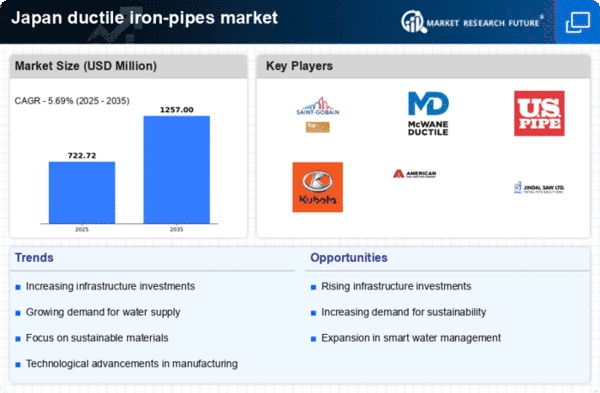
As per Market Research Future analysis, the Japan Ductile Iron Pipes Market size was estimated at 683.81 $ Million in 2024. The Ductile Iron-pipes market is projected to grow from 722.72 $ Million in 2025 to 1257.0 $ Million by 2035, exhibiting a compound annual growth rate (CAGR) of 5.6% during the forecast period 2025 - 2035

Key Market Trends & Highlights

The Japan ductile iron-pipes market is experiencing a positive trajectory driven by sustainability and infrastructure needs.

  • Sustainability initiatives are increasingly shaping the demand for ductile iron pipes in Japan.
  • Technological advancements are enhancing the manufacturing processes, leading to improved product quality and efficiency.
  • The largest segment in the market is driven by increased investment in water infrastructure, while the fastest-growing segment focuses on sustainable solutions.
  • Key market drivers include growing urbanization and regulatory support for quality standards, which are crucial for market expansion.

Market Size & Forecast

2024 Market Size 683.81 (USD Million)
2035 Market Size 1257.0 (USD Million)
CAGR (2025 - 2035) 5.69%

Major Players

Saint-Gobain (FR), McWane (US), U.S. Pipe (US), Kubota (JP), AMERICAN Cast Iron Pipe Company (US), Jindal Saw (IN), Ductile Iron Pipe Company (US), Hunan Valin Steel Tube (CN)

Our Impact
Enabled $4.3B Revenue Impact for Fortune 500 and Leading Multinationals
Partnering with 2000+ Global Organizations Each Year
30K+ Citations by Top-Tier Firms in the Industry

Japan Ductile Iron Pipes Market Trends

The Japan Ductile Iron Pipes Market is currently experiencing a notable transformation. This change is driven by various factors, including infrastructure development and environmental considerations. In Japan, The demand for durable and corrosion-resistant piping solutions is on the rise. Municipalities and private sectors are prioritizing long-lasting materials for water supply and sewage systems. This shift is largely influenced by the need to replace aging infrastructure and enhance the efficiency of water distribution networks. Furthermore, The emphasis on sustainability is prompting stakeholders to adopt materials that minimize environmental impact. This shift fosters a more resilient infrastructure framework. In addition, technological advancements in manufacturing processes are contributing to the growth of the ductile iron-pipes market. Innovations in production techniques are enhancing the quality and performance of these pipes, making them more appealing to end-users. The integration of smart technologies into piping systems is gaining traction. This integration allows for better monitoring and management of water resources. As Japan continues to invest in modernizing its infrastructure, The ductile iron-pipes market is poised for sustained growth. This growth reflects a broader trend towards improved resource management and environmental stewardship.

Sustainability Initiatives

Sustainability initiatives are increasingly influencing the ductile iron-pipes market. Stakeholders are focusing on eco-friendly materials and practices, aligning with Japan's commitment to environmental conservation. This trend is likely to drive demand for products that not only meet performance standards but also contribute to reducing carbon footprints.

Technological Advancements

Technological advancements are reshaping the ductile iron-pipes market. Innovations in manufacturing processes enhance the durability and efficiency of pipes. Additionally, the integration of smart technologies allows for improved monitoring and management of water systems, making these products more attractive to consumers.

Infrastructure Investment

Investment in infrastructure is a key driver for the ductile iron-pipes market. As Japan prioritizes the modernization of its water supply and sewage systems, the demand for reliable and long-lasting piping solutions is expected to grow. This trend reflects a broader commitment to enhancing public utilities and ensuring efficient resource management.

Japan Ductile Iron Pipes Market Drivers

Growing Urbanization

Rapid urbanization in Japan is a crucial driver for the ductile iron-pipes market. As cities expand, the demand for robust and reliable water supply and sewage systems increases. Urban areas require extensive infrastructure to support their growing populations, leading to a heightened need for durable piping solutions. Ductile iron pipes, known for their strength and longevity, are increasingly favored in urban projects. According to recent data, urban areas in Japan are projected to grow by approximately 10% by 2030, which could significantly boost the ductile iron-pipes market. This trend indicates a shift towards modern infrastructure, where ductile iron pipes play a vital role in ensuring efficient water management and waste disposal systems.

Rising Demand for Sustainable Solutions

Growing awareness of environmental sustainability is influencing the ductile iron-pipes market in Japan. As industries and municipalities seek to reduce their carbon footprints, the demand for sustainable materials and practices is on the rise. Ductile iron pipes, with their recyclability and durability, align well with these sustainability goals. The market is likely to see an increase in demand as more projects prioritize eco-friendly materials. Additionally, the potential for reduced maintenance costs and longer service life associated with ductile iron pipes further supports their appeal in sustainable infrastructure projects. This trend indicates a shift towards responsible resource management in the ductile iron-pipes market.

Regulatory Support for Quality Standards

Japan's stringent regulatory framework regarding water quality and infrastructure safety is a significant driver for the ductile iron-pipes market. The Japanese government has implemented various standards to ensure that water supply systems are both safe and efficient. These regulations often favor the use of high-quality materials, such as ductile iron, which is recognized for its resistance to corrosion and mechanical stress. The emphasis on maintaining high standards in public health and safety is likely to increase the demand for ductile iron pipes. As municipalities strive to comply with these regulations, investments in ductile iron-pipes market are expected to rise, reflecting a commitment to sustainable and reliable infrastructure.

Technological Innovations in Manufacturing

Technological advancements in the manufacturing processes of ductile iron pipes are driving growth in the market. Innovations such as improved casting techniques and enhanced alloy compositions have led to the production of pipes that are not only stronger but also lighter and more cost-effective. These advancements allow for easier installation and reduced transportation costs, making ductile iron pipes more appealing to contractors and municipalities. The ductile iron-pipes market is likely to benefit from these innovations, enhancing the overall performance and longevity of the pipes. Furthermore, the integration of smart technologies in monitoring and maintenance could further elevate the market's potential, aligning with Japan's focus on smart city initiatives.

Increased Investment in Water Infrastructure

The commitment of the Japanese government to upgrading and maintaining water infrastructure is a pivotal driver for the ductile iron-pipes market. With aging infrastructure posing challenges, there is a concerted effort to invest in modern solutions that ensure reliable water supply and waste management. Recent reports indicate that public spending on water infrastructure is expected to increase by 15% over the next five years, which could significantly impact the ductile iron-pipes market. This investment trend reflects a broader recognition of the need for sustainable and resilient infrastructure, where ductile iron pipes are likely to play a central role in future projects.


Market Segment Insights

By Diameter: DN 80-300 (Largest) vs. DN 700-1000 (Fastest-Growing)

In the Japan ductile iron-pipes market, the segment distribution shows that DN 80-300 holds the largest market share, primarily due to its widespread application in various infrastructure projects. Meanwhile, the DN 700-1000 segment has emerged as a key player, reflecting growing demand as it accommodates larger infrastructure needs in urban developments. The diverse uses across sectors such as water supply and sewage systems further bolster their market presence, Growth trends within this segment indicate a significant increase in demand for both DN 700-1000 and DN 1200-2000 sizes as municipalities expand water treatment facilities and upgrade aging infrastructure. The push for sustainable and efficient systems emphasizes larger pipe diameters capable of handling increased flow rates, with projects initiated under government policies focusing on improving water quality and efficiency driving this growth.

DN 80-300 (Dominant) vs. DN 700-1000 (Emerging)

The DN 80-300 segment, characterized by its versatility, is primarily used in residential and commercial applications, reflecting its dominant position in the market. Its size facilitates easier installation and maintenance, an advantage that resonates well with project managers. On the other hand, the DN 700-1000 segment is garnering attention as an emerging choice for larger industrial and urban developments, driven by increasing urbanization and infrastructure projects. This segment is essential for high-capacity applications, making it increasingly vital for future expansions. As demand for robust and efficient systems rises, the shift towards using larger diameter pipes signifies evolving market needs that cater to modern infrastructure requirements.

By Type: Water & Wastewater (Largest) vs. Irrigation (Fastest-Growing)

In the Japan ductile iron-pipes market, the water & wastewater segment commands the largest share, benefiting from the ongoing investments in infrastructural upgrades and the maintenance of existing water systems. This segment remains critical due to its central role in water supply and sewage systems, thus demanding robust and durable piping solutions. Moreover, the importance of reliable infrastructure in urban and rural areas further solidifies the position of this segment in the market. On the other hand, the irrigation segment is observed to be the fastest-growing segment, driven by the increasing focus on agricultural efficiency and sustainable water management practices. The rise in agricultural technologies and a substantial push towards enhancing crop yield through effective irrigation methods signify a shift in market dynamics. As farmers seek to optimize water usage, the demand for ductile iron pipes tailored for irrigation applications is set to increase significantly.

Water & Wastewater (Dominant) vs. Irrigation (Emerging)

The water & wastewater segment is established as the dominant force in the Japan ductile iron-pipes market, characterized by substantial utilization in municipal water systems and wastewater treatment facilities. This segment's strength lies in its reliability, long lifespan, and excellent corrosion resistance, making it a preferred choice for critical infrastructure. Conversely, the irrigation segment is emerging, with increasing adoption driven by technological advancements in agricultural practices. This segment caters to a growing need for efficient water distribution in farming, making ductile iron pipes an appealing solution due to their durability and ability to withstand varying environmental conditions. As both segments evolve, they reflect distinct yet complementary aspects of the market's overall growth strategy.

Get more detailed insights about Japan Ductile Iron Pipes Market

Key Players and Competitive Insights

The ductile iron-pipes market in Japan is characterized by a competitive landscape that is increasingly shaped by innovation, sustainability, and strategic partnerships. Key players such as Kubota (JP), Saint-Gobain (FR), and McWane (US) are actively pursuing strategies that emphasize technological advancements and regional expansion. Kubota (JP), for instance, has focused on enhancing its product offerings through research and development, aiming to meet the growing demand for durable and environmentally friendly piping solutions. Meanwhile, Saint-Gobain (FR) has been investing in digital transformation initiatives to streamline operations and improve customer engagement, thereby positioning itself as a leader in the market. Collectively, these strategies contribute to a dynamic competitive environment where companies are not only vying for market share but also striving to set industry standards.In terms of business tactics, localizing manufacturing and optimizing supply chains have emerged as critical strategies for success. The market structure appears moderately fragmented, with several key players exerting influence over various segments. This fragmentation allows for a diverse range of products and services, catering to different customer needs. However, the presence of major companies like U.S. Pipe (US) and AMERICAN Cast Iron Pipe Company (US) indicates a concentration of market power that can shape pricing and availability, ultimately impacting smaller competitors.

In October Kubota (JP) announced a strategic partnership with a leading technology firm to develop smart piping solutions that integrate IoT capabilities. This move is significant as it aligns with the growing trend towards digitalization in the construction and infrastructure sectors. By leveraging advanced technologies, Kubota (JP) aims to enhance the functionality and efficiency of its products, potentially setting a new benchmark in the industry.

In September Saint-Gobain (FR) launched a new line of eco-friendly ductile iron pipes designed to reduce carbon emissions during production. This initiative reflects the company's commitment to sustainability and positions it favorably in a market increasingly driven by environmental considerations. The introduction of these products may not only attract environmentally conscious customers but also comply with stricter regulations on emissions, thereby enhancing Saint-Gobain's competitive edge.

In August McWane (US) expanded its manufacturing capabilities by opening a new facility in Japan, aimed at increasing production capacity and reducing lead times. This strategic expansion is likely to bolster McWane's market presence and improve its ability to respond to local demand. By investing in local manufacturing, the company may also mitigate supply chain disruptions and enhance its overall operational efficiency.

As of November the competitive trends in the ductile iron-pipes market are increasingly defined by digitalization, sustainability, and the integration of advanced technologies such as AI. Strategic alliances are becoming more prevalent, allowing companies to pool resources and expertise to innovate and meet evolving market demands. The shift from price-based competition to a focus on innovation and supply chain reliability is evident, suggesting that future competitive differentiation will hinge on the ability to deliver high-quality, technologically advanced products that align with sustainability goals.

Key Companies in the Japan Ductile Iron Pipes Market include

Industry Developments

The Japan Ductile Iron Pipes Market has recently seen notable developments, driven by increasing demand in the water supply and sewage sectors. Nippon Steel Corporation and Japan Cast Iron Pipes have been focusing on enhancing their production capabilities to meet the growing needs. In June 2023, Sumitomo Metal Industries announced plans for capacity expansion to cater to new infrastructure projects, reflecting a broader trend across the industry. Current affairs indicate a strong push towards sustainability, with companies like Kubota investing in eco-friendly ductile iron pipe technologies.

In terms of mergers and acquisitions, as of March 2023, Daido Steel acquired a minority stake in a regional manufacturer, indicating consolidation efforts within the market. Growth in market valuation for companies like Hitachi Metals further emphasizes the robust nature of the sector, as the Japanese government’s infrastructure spending plans boost the market. Over the past few years, investments in water infrastructure have intensified, particularly since 2021, supporting the upward trend in ductile iron pipe demand and creating a competitive landscape among major players such as Toyo Seikan and Mitsubishi Materials.

Future Outlook

Japan Ductile Iron Pipes Market Future Outlook

The ductile iron-pipes market in Japan is projected to grow at a 5.69% CAGR from 2025 to 2035, driven by infrastructure development, urbanization, and technological advancements.

New opportunities lie in:

  • Expansion into smart water management systems
  • Development of corrosion-resistant coatings for enhanced durability
  • Partnerships with construction firms for integrated supply solutions

By 2035, the ductile iron-pipes market is expected to achieve robust growth and increased market share.

Market Segmentation

Japan Ductile Iron Pipes Market Type Outlook

  • Water & Wastewater
  • Irrigation

Japan Ductile Iron Pipes Market Diameter Outlook

  • D.N. 80-300
  • DN 350-600
  • DN 700-1000
  • DN 1200-2000
  • DN 2000 & above

Report Scope

MARKET SIZE 2024 683.81(USD Million)
MARKET SIZE 2025 722.72(USD Million)
MARKET SIZE 2035 1257.0(USD Million)
COMPOUND ANNUAL GROWTH RATE (CAGR) 5.69% (2025 - 2035)
REPORT COVERAGE Revenue Forecast, Competitive Landscape, Growth Factors, and Trends
BASE YEAR 2024
Market Forecast Period 2025 - 2035
Historical Data 2019 - 2024
Market Forecast Units USD Million
Key Companies Profiled Saint-Gobain (FR), McWane (US), U.S. Pipe (US), Kubota (JP), AMERICAN Cast Iron Pipe Company (US), Jindal Saw (IN), Ductile Iron Pipe Company (US), Hunan Valin Steel Tube (CN)
Segments Covered Diameter, Type
Key Market Opportunities Increasing demand for sustainable infrastructure solutions drives growth in the ductile iron-pipes market.
Key Market Dynamics Rising demand for sustainable infrastructure drives innovation and competition in the ductile iron-pipes market.
Countries Covered Japan
Leave a Comment

FAQs

What is the expected market size of the Japan Ductile Iron Pipes Market in 2024?

The Japan Ductile Iron Pipes Market is expected to be valued at 683.81 million USD in 2024.

What is the projected market size for the Japan Ductile Iron Pipes Market by 2035?

By 2035, the Japan Ductile Iron Pipes Market is anticipated to reach a value of 1,082.0 million USD.

What is the expected CAGR for the Japan Ductile Iron Pipes Market between 2025 and 2035?

The market is expected to grow at a compound annual growth rate of 4.26% from 2025 to 2035.

Who are the major players in the Japan Ductile Iron Pipes Market?

Key players in the market include Nippon Steel Corporation, Japan Cast Iron Pipes, and Sumitomo Metal Industries among others.

What is the market value for DN 80-300 diameter pipes in 2024?

In 2024, the market value for DN 80-300 diameter pipes is anticipated to be 180.0 million USD.

What will be the market size for DN 350-600 diameter pipes in 2035?

The market size for DN 350-600 diameter pipes is expected to be 225.0 million USD by 2035.

How is the market expected to grow in terms of applications?

The market is expected to see growth driven by applications in infrastructure development and utilities management.

What is the projected market value for DN 2000 and above pipes in 2024?

The projected market value for DN 2000 and above pipes in 2024 is 83.81 million USD.

What opportunities exist in the Japan Ductile Iron Pipes Market until 2035?

Opportunities in the market include increasing demand for durable materials and advancements in manufacturing technologies.

What is the expected value of the DN 1200-2000 diameter pipes in 2035?

The expected value of the DN 1200-2000 diameter pipes in 2035 is projected to be 225.0 million USD.

Download Free Sample

Kindly complete the form below to receive a free sample of this Report

Compare Licence

×
Features License Type
Single User Multiuser License Enterprise User
Price $4,950 $5,950 $7,250
Maximum User Access Limit 1 User Upto 10 Users Unrestricted Access Throughout the Organization
Free Customization
Direct Access to Analyst
Deliverable Format
Platform Access
Discount on Next Purchase 10% 15% 15%
Printable Versions