×
Request Free Sample ×

Kindly complete the form below to receive a free sample of this Report

* Please use a valid business email

Leading companies partner with us for data-driven Insights

clients tt-cursor
Hero Background

Japan Downstream Processing Market

ID: MRFR/MED/49881-HCR
200 Pages
Rahul Gotadki
February 2026

Japan Downstream Processing Market Research Report: Size, Share, Trend Analysis By Applications (Biopharmaceuticals, Food and Beverage, Water and Wastewater Treatment, Biofuels, Cosmetics), By Technique (Chromatography, Filtration, Ultrafiltration, Centrifugation, Precipitation), By Product (Reagents, Equipment, Consumables, Membranes, Filters) andBy End Use (Pharmaceutical, Biotechnology, Food Industry, Environmental, Cosmetic Industry) - Growth Outlook & Industry Forecast 2025 To 2035

Share:
Download PDF ×

We do not share your information with anyone. However, we may send you emails based on your report interest from time to time. You may contact us at any time to opt-out.

Japan Downstream Processing Market Infographic
Purchase Options

Japan Downstream Processing Market Summary

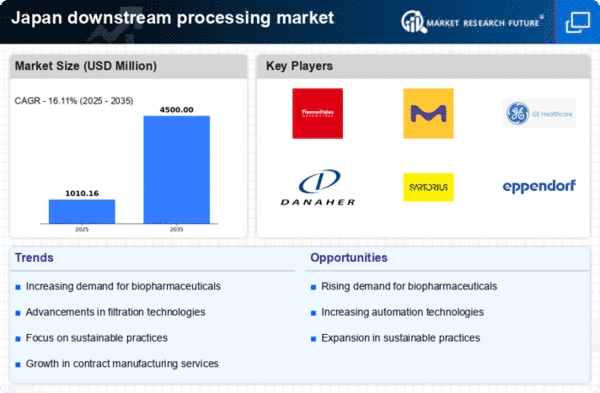
As per Market Research Future analysis, the Japan downstream processing market Size was estimated at 870.0 USD Million in 2024. The Japan downstream processing market is projected to grow from 1010.16 USD Million in 2025 to 4500.0 USD Million by 2035, exhibiting a compound annual growth rate (CAGR) of 16.1% during the forecast period 2025 - 2035

Key Market Trends & Highlights

The Japan downstream processing market is poised for growth driven by technological advancements and sustainability initiatives.

  • Technological advancements are enhancing efficiency and reducing costs in downstream processing.
  • Sustainability initiatives are increasingly influencing operational practices across the market.
  • Collaborative partnerships are emerging as a key strategy for innovation and market expansion.
  • Rising demand for biopharmaceuticals and regulatory compliance are major drivers shaping the market landscape.

Market Size & Forecast

2024 Market Size 870.0 (USD Million)
2035 Market Size 4500.0 (USD Million)
CAGR (2025 - 2035) 16.11%

Major Players

Thermo Fisher Scientific (US), Merck KGaA (DE), GE Healthcare (US), Danaher Corporation (US), Sartorius AG (DE), Eppendorf AG (DE), Pall Corporation (US), Boehringer Ingelheim (DE)

Our Impact
Enabled $4.3B Revenue Impact for Fortune 500 and Leading Multinationals
Partnering with 2000+ Global Organizations Each Year
30K+ Citations by Top-Tier Firms in the Industry

Japan Downstream Processing Market Trends

The downstream processing market in Japan is currently experiencing notable developments, driven by advancements in technology and increasing demand for efficient processing solutions. The market appears to be influenced by the growing emphasis on sustainability and environmental considerations, prompting companies to adopt innovative methods that minimize waste and enhance productivity. Furthermore, the integration of automation and digital technologies seems to be reshaping operational frameworks, allowing for improved efficiency and reduced operational costs. As industries strive to meet stringent regulatory requirements, the downstream processing market is likely to witness a shift towards more sophisticated and compliant processing techniques. In addition, the competitive landscape of the downstream processing market is evolving, with a focus on strategic partnerships and collaborations among key players. This trend indicates a collective effort to leverage shared resources and expertise, ultimately enhancing service offerings and market reach. The increasing complexity of processing requirements necessitates a collaborative approach, which may lead to the development of tailored solutions that cater to specific industry needs. Overall, the downstream processing market in Japan is poised for growth, driven by innovation, collaboration, and a commitment to sustainability.

Technological Advancements

The downstream processing market is witnessing a surge in technological innovations, particularly in automation and digitalization. These advancements are enhancing operational efficiency and enabling real-time monitoring of processes, which may lead to improved product quality and reduced waste.

Sustainability Initiatives

There is a growing trend towards sustainability within the downstream processing market, as companies increasingly prioritize eco-friendly practices. This shift is likely driven by regulatory pressures and consumer demand for greener solutions, prompting firms to adopt more sustainable processing methods.

Collaborative Partnerships

Strategic collaborations among industry players are becoming more prevalent in the downstream processing market. These partnerships may facilitate knowledge sharing and resource optimization, ultimately leading to the development of innovative solutions tailored to meet specific market demands.

Japan Downstream Processing Market Drivers

Rising Demand for Biopharmaceuticals

The increasing demand for biopharmaceuticals in Japan is a key driver for the downstream processing market. As the healthcare sector evolves, the need for effective and efficient biopharmaceutical production processes becomes paramount. In 2025, the biopharmaceutical market in Japan is projected to reach approximately $20 billion, indicating a robust growth trajectory. This surge necessitates advanced downstream processing techniques to ensure high purity and yield of therapeutic proteins. Consequently, companies are investing in innovative technologies to enhance their downstream processing capabilities, thereby driving market growth. The downstream processing market is likely to benefit from this trend as manufacturers seek to optimize their production processes to meet the rising demand for biopharmaceuticals.

Technological Integration in Manufacturing

The integration of advanced technologies in manufacturing processes is transforming the downstream processing market in Japan. Automation, artificial intelligence, and data analytics are increasingly being adopted to streamline operations and improve efficiency. In 2025, it is anticipated that around 60% of downstream processing market players will implement automated systems to enhance productivity. This technological shift allows for real-time monitoring and optimization of production processes, leading to reduced operational costs and improved product quality. As manufacturers embrace these innovations, the downstream processing market is likely to experience significant growth, driven by the need for more efficient and cost-effective production methods.

Regulatory Compliance and Quality Standards

Stringent regulatory requirements in Japan significantly influence the downstream processing market. The pharmaceutical and biopharmaceutical sectors are subject to rigorous quality standards set by authorities such as the Pharmaceuticals and Medical Devices Agency (PMDA). Compliance with these regulations is essential for market players to ensure product safety and efficacy. In 2025, it is estimated that around 70% of companies in the downstream processing market will invest in technologies that facilitate compliance with these regulations. This focus on quality assurance not only enhances the credibility of products but also drives innovation in processing techniques. As a result, the downstream processing market is expected to expand as companies prioritize adherence to regulatory standards.

Growing Investment in Research and Development

Investment in research and development (R&D) is a crucial driver for the downstream processing market in Japan. As companies strive to innovate and develop new biopharmaceutical products, R&D expenditures are expected to rise significantly. In 2025, it is projected that R&D spending in the biopharmaceutical sector will exceed $5 billion, reflecting a commitment to advancing downstream processing technologies. This investment not only fosters innovation but also enhances the capabilities of the downstream processing market to meet evolving market demands. By focusing on R&D, companies can develop more efficient processing methods, thereby improving yield and reducing costs, which is essential for maintaining competitiveness in the market.

Increased Focus on Environmental Sustainability

The growing emphasis on environmental sustainability is reshaping the downstream processing market in Japan. Companies are increasingly adopting eco-friendly practices and technologies to minimize their environmental impact. In 2025, it is estimated that around 50% of players in the downstream processing market will implement sustainable practices in their operations. This shift is driven by both regulatory pressures and consumer demand for greener products. By investing in sustainable downstream processing methods, companies can not only enhance their market position but also contribute to broader environmental goals. This focus on sustainability is likely to propel the downstream processing market forward as businesses seek to align with global sustainability trends.


Market Segment Insights

By Application: Biopharmaceuticals (Largest) vs. Food and Beverage (Fastest-Growing)

In the Japan downstream processing market, the application segment is primarily dominated by biopharmaceuticals, which holds the largest market share. This sector has established a strong foothold due to the increasing demand for biologics and a robust pipeline of innovative therapies. The food and beverage sector follows closely, showcasing significant contributions as well, reflecting the region's rich culinary heritage and consumer preferences for processed products. Looking towards the future, the food and beverage application is poised for rapid growth, driven by rising health consciousness and demand for functional foods. Concurrently, biopharmaceuticals continue to thrive, propelled by advancements in drug development and regulatory support. The increasing focus on biotechnology and the need for efficient processing technologies will further enhance the opportunities in these segments, thereby shaping the landscape of the Japan downstream processing market.

Biopharmaceuticals: Dominant vs. Food and Beverage: Emerging

Biopharmaceuticals stand as the dominant application within the Japan downstream processing market, characterized by a strong emphasis on research and development, leading to the production of high-quality biologics. This sector benefits from significant investment in innovative technologies, which enhance the efficacy and safety of therapeutic products. In contrast, the food and beverage sector is emerging rapidly, driven by evolving consumer trends that favor health-oriented and artisan products. This segment's growth is supported by innovative processing techniques that improve product quality and shelf-life, catering to the diverse preferences of the population. Both segments complement each other, as advances in processing technology often filter between biopharmaceuticals and food applications, creating a dynamic and integrated market environment.

By Technique: Chromatography (Largest) vs. Filtration (Fastest-Growing)

The Japan downstream processing market exhibits a dynamic landscape in its technique segment, with chromatography holding the largest market share. This technique is widely adopted due to its efficiency in separating and purifying complex mixtures, making it a favorite among companies seeking high-resolution results. Filtration, although smaller in market share, is rapidly gaining traction as a preferred method for various applications, driven by advancements in technology and the demand for higher product purity. Growth trends in the downstream processing techniques are fueled by the increasing needs of the pharmaceutical and biotechnology sectors. Factors such as the rise in biopharmaceutical production, stringent regulatory requirements, and innovations in processing technologies are propelling the growth of these techniques. In particular, filtration's emerging role in critical processes highlights its potential to dominate future market developments, alongside the well-established chromatography technique.

Chromatography: Dominant vs. Filtration: Emerging

Chromatography, as the dominant technique in the Japan downstream processing market, is known for its reliability and effectiveness in separating components based on their chemical properties. Its applications span across various industries, including pharmaceuticals, where precision is paramount. Early adoption of high-performance liquid chromatography (HPLC) systems has significantly improved analytical capabilities. On the other hand, filtration is emerging as a crucial technique due to its versatility and ability to meet increasing purity requirements. Advanced filtration technologies, including microfiltration and ultrafiltration, are being integrated into many processes, making them essential for ensuring product quality and compliance with regulatory standards. The combination of efficiency and adaptability allows filtration to carve out a substantial niche next to its dominant counterpart.

By Product: Reagents (Largest) vs. Equipment (Fastest-Growing)

In the Japan downstream processing market, the product segment is primarily composed of reagents, equipment, consumables, membranes, and filters. Among these, reagents hold the largest market share due to their essential role in various processing applications. Equipment is gaining traction as the fastest-growing segment, driven by technological advancements and increasing demand for efficient processing solutions. The market distribution reflects a balanced need for these diverse product types, with reagents dominating due to their vital contributions to performance and productivity. Growth trends in this segment are significantly influenced by the ongoing innovations in processing technologies. The increasing adoption of automation and digitalization in processing operations is driving the equipment segment upwards. Additionally, the rise in biopharmaceutical manufacturing is propelling demand for high-quality reagents and consumables. As manufacturers seek to enhance their efficiency and reduce costs, the market for membranes and filters is also seeing consistent growth, indicating a robust overall outlook for product offerings in this sector.

Reagents (Dominant) vs. Equipment (Emerging)

Reagents are the dominant force in the Japan downstream processing market, characterized by their critical role in enhancing processing efficiency and effectiveness. This segment offers a wide range of chemical substances used to drive various downstream processes, ensuring product quality and compliance. On the other hand, equipment is emerging rapidly, distinguished by advanced technological features that promote automation and efficiency. Manufacturers are increasingly investing in state-of-the-art equipment solutions, which not only optimize workflows but also reduce operational costs. As both segments continue to evolve, the collaboration between reagent suppliers and equipment manufacturers will play a pivotal role in delivering innovative solutions tailored to meet market demands.

By End Use: Pharmaceutical (Largest) vs. Biotechnology (Fastest-Growing)

In the Japan downstream processing market, the end use segments are characterized by a diverse distribution of market share. The pharmaceutical sector leads significantly, owing to the established presence of major players and advanced research and development initiatives. Following it closely is the biotechnology segment, which is rapidly growing as innovations in biopharmaceuticals gain momentum. The food industry and environmental applications also contribute notably, though they hold smaller shares compared to the front-runners. The growth trends in the Japan downstream processing market are driven by increasing investments in pharmaceutical innovations and biotechnology advancements. The demand for sustainable and effective processing solutions has led to a surge in biotechnological applications across various industries, particularly in pharmaceuticals and cosmetics. Rising health consciousness and environmental regulations are also propelling growth in the food and environmental sectors, thus enhancing the overall market landscape.

Pharmaceutical: Dominant vs. Biotechnology: Emerging

The pharmaceutical segment stands as the dominant force within the Japan downstream processing market, showcasing robust investments in research and development, extensive regulatory compliance, and a strong pipeline of innovative drugs. It benefits from a mature infrastructure and a well-established distribution network, which enhances its market stability. In contrast, the biotechnology sector is emerging rapidly, fueled by advancements in genetic engineering and bioprocessing technologies. This sector is characterized by a focus on novel therapeutics and personalized medicine, which appeals significantly to investors. Both segments play crucial roles, with the pharmaceutical industry solidifying its dominance while biotechnology increasingly captures market interest through innovative solutions.

Get more detailed insights about Japan Downstream Processing Market

Key Players and Competitive Insights

The downstream processing market in Japan is characterized by a dynamic competitive landscape, driven by innovation, technological advancements, and strategic partnerships. Key players such as Thermo Fisher Scientific (US), Merck KGaA (DE), and Sartorius AG (DE) are at the forefront, each adopting distinct strategies to enhance their market presence. Thermo Fisher Scientific (US) focuses on expanding its product portfolio through continuous innovation, while Merck KGaA (DE) emphasizes strategic acquisitions to bolster its capabilities in bioprocessing. Sartorius AG (DE) is increasingly investing in digital transformation initiatives, which collectively shape a competitive environment that prioritizes technological leadership and operational efficiency.
In terms of business tactics, companies are localizing manufacturing to better serve the Japanese market, optimizing supply chains to enhance responsiveness, and leveraging advanced technologies to streamline operations. The market structure appears moderately fragmented, with several key players exerting influence through their established reputations and innovative offerings. This fragmentation allows for a diverse range of solutions, catering to various customer needs while fostering healthy competition among the major players.
In October 2025, Thermo Fisher Scientific (US) announced the launch of a new line of bioprocessing equipment designed to enhance efficiency in cell culture processes. This strategic move is significant as it aligns with the growing demand for advanced bioprocessing solutions in Japan, positioning the company to capture a larger market share amidst increasing competition. The introduction of this equipment is likely to bolster Thermo Fisher's reputation as a leader in innovation within the sector.
In September 2025, Merck KGaA (DE) completed the acquisition of a local biopharmaceutical company, which is expected to enhance its capabilities in downstream processing. This acquisition not only expands Merck's operational footprint in Japan but also strengthens its portfolio of bioprocessing technologies. The strategic importance of this move lies in its potential to accelerate product development timelines and improve service delivery to clients in the region.
In August 2025, Sartorius AG (DE) unveiled a new digital platform aimed at optimizing bioprocessing workflows. This platform integrates AI-driven analytics to provide real-time insights, thereby enhancing decision-making processes for biopharmaceutical manufacturers. The introduction of this technology reflects Sartorius's commitment to digitalization, which is increasingly becoming a critical factor in maintaining competitive advantage in the downstream processing market.
As of November 2025, current trends in the downstream processing market include a pronounced shift towards digitalization, sustainability, and the integration of AI technologies. Strategic alliances among key players are shaping the competitive landscape, fostering innovation and collaboration. Looking ahead, competitive differentiation is likely to evolve from traditional price-based competition to a focus on technological innovation, supply chain reliability, and sustainable practices. This shift underscores the importance of adaptability and forward-thinking strategies in navigating the complexities of the market.

Key Companies in the Japan Downstream Processing Market include

Industry Developments

In the Japan Downstream Processing Market, recent developments have highlighted a progressive trend among key players such as Chemours, BASF, and Mitsubishi Chemical Corporation. There has been a notable focus on sustainability, with many companies increasing investments in environmentally friendly processes and products. For instance, the pace of innovation in chemical recycling technologies is gaining traction, driven by companies like Nippon Shokubai Co. Ltd. and Daicel Corporation, aiming to enhance sustainability and reduce carbon footprints.

In terms of mergers and acquisitions, Chemours has announced plans to expand its downstream processing capabilities; however, the specifics remain unconfirmed in terms of timing and partners. Meanwhile, Sumitomo Chemical Company has introduced initiatives to collaborate with industry peers on sustainable raw material sourcing, indicating a cooperative approach in the market.Recent evaluations suggest that the market valuation for the downstream processing sector is improving, attributed to rising demands in end-user industries such as automotive and electronics.

The Japanese government has also been supportive, establishing policies that encourage innovation and investment in advanced chemical processing, fostering a robust environment for market growth.

Future Outlook

Japan Downstream Processing Market Future Outlook

The Downstream Processing Market in Japan is projected to grow at a 16.11% CAGR from 2025 to 2035, driven by technological advancements and increasing demand for biopharmaceuticals.

New opportunities lie in:

  • Investment in automated downstream processing technologies to enhance efficiency.
  • Development of eco-friendly solvents for purification processes.
  • Expansion of contract manufacturing services for biopharmaceutical companies.

By 2035, the downstream processing market is expected to achieve substantial growth and innovation.

Market Segmentation

Japan Downstream Processing Market End Use Outlook

  • Pharmaceutical
  • Biotechnology
  • Food Industry
  • Environmental
  • Cosmetic Industry

Japan Downstream Processing Market Product Outlook

  • Reagents
  • Equipment
  • Consumables
  • Membranes
  • Filters

Japan Downstream Processing Market Technique Outlook

  • Chromatography
  • Filtration
  • Ultrafiltration
  • Centrifugation
  • Precipitation

Japan Downstream Processing Market Application Outlook

  • Biopharmaceuticals
  • Food and Beverage
  • Water and Wastewater Treatment
  • Biofuels
  • Cosmetics

Report Scope

MARKET SIZE 2024 870.0(USD Million)
MARKET SIZE 2025 1010.16(USD Million)
MARKET SIZE 2035 4500.0(USD Million)
COMPOUND ANNUAL GROWTH RATE (CAGR) 16.11% (2025 - 2035)
REPORT COVERAGE Revenue Forecast, Competitive Landscape, Growth Factors, and Trends
BASE YEAR 2024
Market Forecast Period 2025 - 2035
Historical Data 2019 - 2024
Market Forecast Units USD Million
Key Companies Profiled Thermo Fisher Scientific (US), Merck KGaA (DE), GE Healthcare (US), Danaher Corporation (US), Sartorius AG (DE), Eppendorf AG (DE), Pall Corporation (US), Boehringer Ingelheim (DE)
Segments Covered Application, Technique, Product, End Use
Key Market Opportunities Adoption of advanced bioprocessing technologies enhances efficiency in the downstream processing market.
Key Market Dynamics Technological advancements and regulatory changes drive innovation in the downstream processing market, enhancing efficiency and sustainability.
Countries Covered Japan
Leave a Comment

FAQs

What is the expected market size of the Japan Downstream Processing Market in 2024?

The Japan Downstream Processing Market is expected to be valued at 261.0 million USD in 2024.

What is the projected market value for the Japan Downstream Processing Market by 2035?

By 2035, the Japan Downstream Processing Market is projected to be valued at 585.0 million USD.

What is the expected compound annual growth rate for the Japan Downstream Processing Market from 2025 to 2035?

The expected CAGR for the Japan Downstream Processing Market from 2025 to 2035 is 7.613%.

Which application segment holds the largest market share in the Japan Downstream Processing Market?

The Biopharmaceuticals application segment holds the largest share, with a value of 100.5 million USD in 2024.

What is the market size forecast for the Food and Beverage application in 2035?

The Food and Beverage application is forecasted to reach a market size of 162.0 million USD by 2035.

Who are the key players in the Japan Downstream Processing Market?

Major players include Chemours, BASF, DIC Corporation, and Sumitomo Chemical Company, among others.

What is the 2035 market value for Water and Wastewater Treatment in this market?

The market value for Water and Wastewater Treatment is anticipated to reach 90.5 million USD by 2035.

How much is the Biofuels segment valued at in 2024 within the Japan Downstream Processing Market?

The Biofuels segment is valued at 25.0 million USD in 2024.

What are the growth drivers influencing the Japan Downstream Processing Market?

Factors include technological advancements, increasing demand in the biopharmaceutical sector, and environmental regulations.

What challenges could impact the growth of the Japan Downstream Processing Market?

Challenges may include regulatory hurdles and competition from alternative processing technologies.

Download Free Sample

Kindly complete the form below to receive a free sample of this Report

Compare Licence

×
Features License Type
Single User Multiuser License Enterprise User
Price $4,950 $5,950 $7,250
Maximum User Access Limit 1 User Upto 10 Users Unrestricted Access Throughout the Organization
Free Customization
Direct Access to Analyst
Deliverable Format
Platform Access
Discount on Next Purchase 10% 15% 15%
Printable Versions