×
Request Free Sample ×

Kindly complete the form below to receive a free sample of this Report

* Please use a valid business email

Leading companies partner with us for data-driven Insights

clients tt-cursor
Hero Background

Japan Digital Credential Management Software Market

ID: MRFR/ICT/57703-HCR
200 Pages
Garvit Vyas
February 2026

Japan Digital Credential Management Software Market Size, Share and Trends Analysis Report By Type (On Premises, Cloud-based) and By Application (Large Companies, Small and Medium-Sized Companies)- Forecast to 2035

Share:
Download PDF ×

We do not share your information with anyone. However, we may send you emails based on your report interest from time to time. You may contact us at any time to opt-out.

Japan Digital Credential Management Software Market Infographic
Purchase Options

Japan Digital Credential Management Software Market Summary

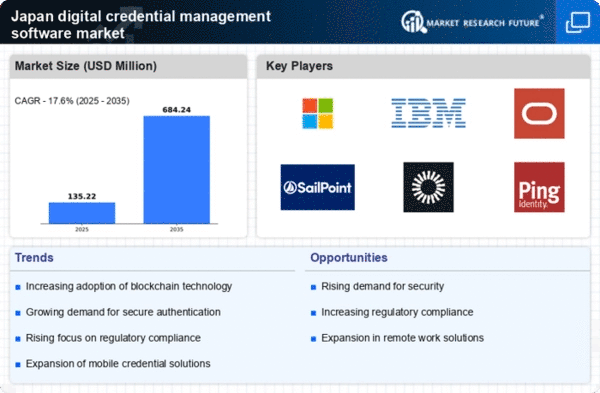
As per Market Research Future analysis, the Japan Digital Credential Management Software Market size was estimated at 114.98 USD Million in 2024. The Digital Credential-management-software market is projected to grow from 135.22 USD Million in 2025 to 684.24 USD Million by 2035, exhibiting a compound annual growth rate (CAGR) of 17% during the forecast period 2025 - 2035

Key Market Trends & Highlights

The Japan The digital credential management software market in Japan is experiencing robust growth, driven by security needs and technological advancements.

  • The market is witnessing an increased focus on security measures to protect digital identities.
  • Integration with emerging technologies such as blockchain is becoming prevalent in credential management solutions.
  • Regulatory compliance and standardization are shaping the market landscape, particularly in the financial services sector.
  • Rising demand for digital identity solutions and growing cybersecurity concerns are key drivers of market expansion.

Market Size & Forecast

2024 Market Size 114.98 (USD Million)
2035 Market Size 684.24 (USD Million)
CAGR (2025 - 2035) 17.6%

Major Players

Microsoft (US), IBM (US), Oracle (US), SailPoint Technologies (US), Okta (US), Ping Identity (US), Duo Security (US), OneLogin (US)

Our Impact
Enabled $4.3B Revenue Impact for Fortune 500 and Leading Multinationals
Partnering with 2000+ Global Organizations Each Year
30K+ Citations by Top-Tier Firms in the Industry

Japan Digital Credential Management Software Market Trends

The Japan Digital Credential Management Software Market is currently experiencing notable growth, driven by the increasing need for secure and efficient identity verification solutions. Organizations across various sectors are recognizing the importance of managing digital credentials to enhance security and streamline operations. This trend is particularly evident in industries such as finance, healthcare, and education, where the protection of sensitive information is paramount. As technology evolves, the demand for innovative solutions that facilitate seamless credential management continues to rise, suggesting a robust future for this market. Moreover, the regulatory landscape in Japan is evolving, with government initiatives aimed at promoting digital transformation. These initiatives encourage businesses to adopt advanced technologies, including digital credential-management software, to improve operational efficiency and security. The emphasis on compliance with data protection regulations further propels the adoption of these solutions. As organizations seek to navigate the complexities of digital identity management, the digital credential-management-software market is poised for sustained growth, reflecting a broader trend towards digitalization in Japan's economy.

Increased Focus on Security

The The digital credential management software market is witnessing a heightened emphasis on security measures. Organizations are prioritizing solutions that offer robust encryption and multi-factor authentication to safeguard sensitive data. This trend is driven by the rising number of cyber threats and data breaches, prompting businesses to invest in advanced security technologies.

Integration with Emerging Technologies

There is a growing trend towards integrating digital credential-management software with emerging technologies such as blockchain and artificial intelligence. These integrations enhance the functionality and reliability of credential management systems, providing organizations with innovative tools to streamline processes and improve user experiences.

Regulatory Compliance and Standardization

The The digital credential management software market is increasingly influenced by regulatory compliance requirements. Organizations are adopting solutions that align with national and international standards to ensure data protection and privacy. This trend reflects a broader movement towards standardization in credential management practices, fostering trust and accountability.

Japan Digital Credential Management Software Market Drivers

Growing Cybersecurity Concerns

The digital credential-management-software market in Japan is being propelled by escalating concerns regarding cybersecurity threats. With the rise in cyberattacks targeting sensitive information, organizations are increasingly prioritizing the protection of digital identities. This heightened awareness has led to a greater emphasis on implementing robust credential management systems that can mitigate risks associated with data breaches. According to industry reports, nearly 60% of Japanese companies have reported experiencing some form of cyber incident in the past year. This alarming statistic underscores the urgent need for effective digital credential management solutions. As businesses strive to safeguard their assets and maintain customer trust, the demand for advanced software solutions in this market is expected to grow, reflecting a proactive approach to cybersecurity.

Emergence of Blockchain Technology

The emergence of blockchain technology is poised to have a transformative impact on the digital credential-management-software market in Japan. Blockchain offers a decentralized and secure method for managing digital identities, which aligns with the growing demand for transparency and trust in digital transactions. As organizations explore innovative ways to enhance their credential management processes, the integration of blockchain technology appears to be a promising avenue. This technology not only enhances security but also streamlines verification processes, potentially reducing operational costs. Market Research Future suggest that the adoption of blockchain-based solutions could lead to a significant shift in how digital credentials are managed, thereby driving growth in the digital credential-management-software market.

Government Initiatives and Support

Government initiatives in Japan are significantly influencing the digital credential-management-software market. The Japanese government has been actively promoting digital transformation across various sectors, which includes the implementation of digital identity systems. Initiatives such as the My Number system, which aims to streamline administrative processes and enhance citizen services, are indicative of this trend. The government's commitment to fostering a digital economy is likely to bolster the adoption of credential management solutions. Furthermore, funding and support for technology startups in this domain are expected to stimulate innovation and competition. As a result, the digital credential-management-software market is anticipated to benefit from these supportive measures, potentially leading to an increase in market penetration and user adoption.

Rising Demand for Digital Identity Solutions

The digital credential-management-software market in Japan is experiencing a notable surge in demand for digital identity solutions. This trend is largely driven by the increasing need for secure and efficient identity verification processes across various sectors, including finance, healthcare, and education. As organizations seek to enhance their security measures, the adoption of digital credential management systems is becoming essential. According to recent data, the market is projected to grow at a CAGR of approximately 15% over the next five years. This growth is indicative of a broader shift towards digitalization, where traditional methods of identity verification are being replaced by more advanced, technology-driven solutions. Consequently, the digital credential-management-software market is positioned to play a pivotal role in shaping the future of identity management in Japan.

Shift Towards Remote Work and Digital Services

The digital credential-management-software market is witnessing a transformation driven by the shift towards remote work and the increasing reliance on digital services. As organizations adapt to new work environments, the need for secure access to digital resources has become paramount. This shift has prompted businesses to invest in credential management solutions that facilitate secure remote access while ensuring compliance with security protocols. Data indicates that approximately 70% of Japanese companies have adopted remote work policies, further emphasizing the necessity for effective digital identity management. Consequently, the digital credential-management-software market is likely to expand as organizations seek to enhance their operational efficiency and security in a predominantly digital landscape.


Market Segment Insights

By Type: Cloud-based (Largest) vs. On-Premises (Fastest-Growing)

The Japan digital credential-management-software market shows a significant distribution in its type segmentation, where cloud-based solutions dominate the landscape. With organizations increasingly adopting digital services, cloud-based software has taken a considerable share of the market, reflecting the growing preference for flexible, scalable, and accessible solutions. On-premises solutions, while still important, are being outpaced as the majority of enterprises explore digital transformation strategies. Growth trends indicate that the shift towards cloud-based offerings will continue, driven by factors such as the need for remote access, enhanced security features, and reduced IT overhead costs. Meanwhile, on-premises software is emerging as a vital solution for sectors requiring stringent data control and compliance, attracting a niche segment of users that prioritize security and customization. As such, both segments are expected to evolve to meet the changing demands of the Japan digital credential-management-software market.

Cloud-based (Dominant) vs. On-Premises (Emerging)

Cloud-based solutions are characterized by their ability to provide users with real-time access to credential-management tools from any location, significantly enhancing operational flexibility. Their dominance stems from the growing trend of digital transformation across industries, where businesses seek efficient and cost-effective methods to manage credentials. On the other hand, on-premises solutions are emerging, targeting organizations that have stringent data privacy, security, and compliance requirements. These solutions offer greater control over data but come with higher initial costs and maintenance challenges, making them suitable for sectors such as finance and healthcare where data security is paramount. The growing demand for regulatory compliance is also contributing to the emergence of on-premises technologies.

By Application: Large Companies (Largest) vs. Small and Medium-Sized Companies (Fastest-Growing)

In the Japan digital credential-management-software market, large companies dominate the application segment, holding the majority share due to their extensive needs for secure credential management. These organizations prioritize advanced solutions to safeguard sensitive data and ensure compliance with regulatory standards, thus driving significant market demand. Conversely, small and medium-sized companies are increasingly adopting these technologies, capitalizing on the affordability and scalability of digital credential solutions, which allows them to improve security and operational efficiency. Growth in this segment is heavily influenced by the rising emphasis on cybersecurity and digital transformation across businesses of all sizes. Large companies are investing in comprehensive credential management systems to protect against data breaches, while small and medium-sized companies seek to harness technological advancements at lower costs. As awareness of security threats grows, both segments are expected to expand, although the small and medium-sized companies segment is projected to be the fastest-growing as they embrace these solutions to stay competitive in the market.

Large Companies: Dominant vs. Small and Medium-Sized Companies: Emerging

Large companies in the Japan digital credential-management-software market are characterized by their robust investments in sophisticated authentication technologies, driven by the need for stringent security measures and governance compliance. They leverage advanced features such as identity verification, access control, and integration with existing IT infrastructures to streamline operations. In contrast, small and medium-sized companies, while emerging, are rapidly catching up due to increasing recognition of the importance of secure credential management. Their market position is shifting as they adopt user-friendly, cost-effective solutions that meet their requirements without compromising security. This evolution reflects a broader trend of digital transformation, where even smaller players are realizing the necessity of implementing secure identity management solutions to thrive in today's competitive landscape.

Get more detailed insights about Japan Digital Credential Management Software Market

Key Players and Competitive Insights

The digital credential-management-software market in Japan is characterized by a dynamic competitive landscape, driven by the increasing demand for secure identity verification and access management solutions. Key players such as Microsoft (US), IBM (US), and Okta (US) are strategically positioned to leverage their technological expertise and extensive resources. Microsoft (US) focuses on integrating its credential management solutions with its cloud services, enhancing user experience and security. IBM (US) emphasizes innovation through its AI-driven identity management systems, while Okta (US) is known for its user-friendly interface and strong partnerships with various enterprises, which collectively shape a competitive environment that prioritizes security and user accessibility.The market structure appears moderately fragmented, with several players vying for market share. Key business tactics include localizing software solutions to meet regional compliance requirements and optimizing supply chains to enhance service delivery. The collective influence of these major players fosters a competitive atmosphere where innovation and customer-centric solutions are paramount, allowing them to adapt to the evolving needs of businesses in Japan.

In October Microsoft (US) announced the launch of its new Azure Active Directory features, aimed at enhancing security protocols for enterprise clients. This strategic move is significant as it not only strengthens Microsoft's position in the market but also addresses the growing concerns regarding data breaches and identity theft, thereby reinforcing customer trust and loyalty.

In September IBM (US) unveiled its latest AI-powered identity verification tool, which utilizes machine learning algorithms to streamline the authentication process. This development is crucial as it positions IBM at the forefront of technological advancement in credential management, potentially attracting a broader client base seeking cutting-edge solutions.

In August Okta (US) expanded its partnership with a leading telecommunications provider in Japan, enhancing its service offerings in the region. This collaboration is likely to bolster Okta's market presence and facilitate the integration of its solutions into a wider array of business applications, thereby increasing its competitive edge.

As of November current trends in the digital credential-management-software market include a pronounced shift towards digitalization, sustainability, and the integration of AI technologies. Strategic alliances among key players are shaping the landscape, fostering innovation and enhancing service delivery. The competitive differentiation is expected to evolve, moving away from price-based competition towards a focus on technological innovation, reliability, and the ability to meet complex regulatory requirements. This shift indicates a future where companies that prioritize advanced technology and customer-centric solutions will likely lead the market.

Key Companies in the Japan Digital Credential Management Software Market include

Industry Developments

Recent developments in the Japan Digital Credential Management Software Market indicate a steady growth trajectory, driven by increasing demands for secure identity verification and access management. Microsoft enabled a dedicated Japan region for Entra ID in October 2022, which enables the storage and processing of identity data locally. This support is necessary for compliance with stringent privacy and residency regulations in sectors such as finance and healthcare.

Microsoft rebranded Azure AD as Microsoft Entra ID in July 2023 and began implementing advanced features in the Japan region in August 2023. These features include API-driven provisioning, enhanced privilege identity management, conditional access controls for external users, and support for FIDO2 passkeys, thereby enhancing secure credential management.

Future Outlook

Japan Digital Credential Management Software Market Future Outlook

The Digital Credential Management Software Market in Japan is projected to grow at a 17.6% CAGR from 2025 to 2035, driven by increasing security needs and digital transformation initiatives.

New opportunities lie in:

  • Integration of AI-driven analytics for enhanced user verification processes.
  • Development of mobile credentialing solutions for on-the-go access.
  • Partnerships with educational institutions for streamlined credential issuance.

By 2035, the market is expected to achieve substantial growth, reflecting evolving security demands.

Market Segmentation

Japan Digital Credential Management Software Market Type Outlook

  • On-Premises
  • Cloud-based

Japan Digital Credential Management Software Market Application Outlook

  • Large Companies
  • Small and Medium-Sized Companies

Report Scope

MARKET SIZE 2024 114.98(USD Million)
MARKET SIZE 2025 135.22(USD Million)
MARKET SIZE 2035 684.24(USD Million)
COMPOUND ANNUAL GROWTH RATE (CAGR) 17.6% (2025 - 2035)
REPORT COVERAGE Revenue Forecast, Competitive Landscape, Growth Factors, and Trends
BASE YEAR 2024
Market Forecast Period 2025 - 2035
Historical Data 2019 - 2024
Market Forecast Units USD Million
Key Companies Profiled Microsoft (US), IBM (US), Oracle (US), SailPoint Technologies (US), Okta (US), Ping Identity (US), Duo Security (US), OneLogin (US)
Segments Covered Type, Application
Key Market Opportunities Integration of advanced security features in digital credential-management-software market enhances user trust and compliance.
Key Market Dynamics Rising demand for secure digital identity solutions drives innovation in the digital credential-management-software market.
Countries Covered Japan
Leave a Comment

FAQs

What is the expected market size of the Japan Digital Credential Management Software Market in 2024?

The Japan Digital Credential Management Software Market is expected to be valued at 114.66 USD Million in 2024.

What is the projected market size of the Japan Digital Credential Management Software Market by 2035?

By 2035, the market is projected to reach a valuation of 577.71 USD Million.

What is the expected compound annual growth rate (CAGR) for the Japan Digital Credential Management Software Market between 2025 and 2035?

The expected CAGR for the Japan Digital Credential Management Software Market from 2025 to 2035 is 15.836%.

Which segment is projected to have higher market value in 2035, On-Premises or Cloud-based Digital Credential Management Software?

The Cloud-based segment is projected to have a higher market value of 366.86 USD Million in 2035 compared to the On-Premises segment which is expected to reach 210.85 USD Million.

Who are the key players in the Japan Digital Credential Management Software Market?

Major players in the market include OneLogin, DigiCert, Okta, CA Technologies, Salesforce, AWS, Ping Identity, Symantec, Microsoft, Auth0, Gemalto, Fujitsu, IBM, IDnow, and Thales Group.

What is the market value of the On-Premises segment for the Japan Digital Credential Management Software Market in 2024?

The On-Premises segment is valued at 42.2 USD Million in 2024.

What are the major growth drivers for the Japan Digital Credential Management Software Market?

Increased demand for secure digital identity verification and rapid cloud adoption are major growth drivers.

What challenges does the Japan Digital Credential Management Software Market face?

Data privacy concerns and the complexity of integration with existing systems pose challenges for the market.

What is the projected growth for the Cloud-based segment from 2024 to 2035?

The Cloud-based segment is expected to grow significantly, from 72.46 USD Million in 2024 to 366.86 USD Million by 2035.

How does regional demand compare in the Japan Digital Credential Management Software Market?

The demand in Japan is primarily driven by technology advancement and government initiatives on digital transformation.

Download Free Sample

Kindly complete the form below to receive a free sample of this Report

Compare Licence

×
Features License Type
Single User Multiuser License Enterprise User
Price $4,950 $5,950 $7,250
Maximum User Access Limit 1 User Upto 10 Users Unrestricted Access Throughout the Organization
Free Customization
Direct Access to Analyst
Deliverable Format
Platform Access
Discount on Next Purchase 10% 15% 15%
Printable Versions