×
Request Free Sample ×

Kindly complete the form below to receive a free sample of this Report

* Please use a valid business email

Leading companies partner with us for data-driven Insights

clients tt-cursor
Hero Background

Japan Conversational Computing Platform Market

ID: MRFR/ICT/60913-HCR
200 Pages
Aarti Dhapte
February 2026

Japan Conversational Computing Platform Market Research Report By Application (Customer Support, Virtual Assistants, Chatbots, Voice Interfaces, Speech Recognition), By Deployment Type (Cloud-Based, On-Premise, Hybrid), By End User (Retail, Healthcare, Education, Telecommunications, Banking and Financial Services) and By Technology (Natural Language Processing, Machine Learning, Speech Synthesis, Text-to-Speech, Voice Recognition)- Forecast to 2035

Share:
Download PDF ×

We do not share your information with anyone. However, we may send you emails based on your report interest from time to time. You may contact us at any time to opt-out.

Japan Conversational Computing Platform Market Infographic
Purchase Options

Japan Conversational Computing Platform Market Summary

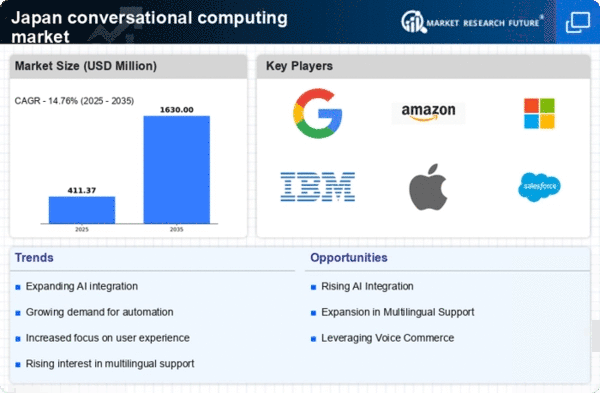
As per Market Research Future analysis, the Japan conversational computing-platform market size was estimated at 358.46 USD Million in 2024. The Japan conversational computing-platform market is projected to grow from 411.37 USD Million in 2025 to 1630.0 USD Million by 2035, exhibiting a compound annual growth rate (CAGR) of 14.7% during the forecast period 2025 - 2035

Key Market Trends & Highlights

The Japan conversational computing-platform market is experiencing robust growth driven by technological advancements and evolving consumer needs.

  • The market is witnessing a rise of AI-driven solutions that enhance user interaction and engagement.
  • Integration with IoT devices is becoming increasingly prevalent, facilitating seamless communication across platforms.
  • Multilingual capabilities are gaining traction, catering to Japan's diverse linguistic landscape and global business needs.
  • Key market drivers include the growing demand for customer engagement and advancements in natural language processing.

Market Size & Forecast

2024 Market Size 358.46 (USD Million)
2035 Market Size 1630.0 (USD Million)
CAGR (2025 - 2035) 14.76%

Major Players

Google (US), Amazon (US), Microsoft (US), IBM (US), Apple (US), Salesforce (US), Nuance Communications (US), SAP (DE), Baidu (CN)

Our Impact
Enabled $4.3B Revenue Impact for Fortune 500 and Leading Multinationals
Partnering with 2000+ Global Organizations Each Year
30K+ Citations by Top-Tier Firms in the Industry

Japan Conversational Computing Platform Market Trends

The conversational computing-platform market is experiencing notable growth. This growth is driven by advancements in artificial intelligence and natural language processing technologies. In Japan, the increasing adoption of smart devices and the rising demand for automated customer service solutions are shaping the landscape. Companies are investing in developing sophisticated chatbots and virtual assistants to enhance user experience and streamline operations. This trend is further supported by the growing emphasis on digital transformation across various sectors, including retail, finance, and healthcare. As organizations seek to improve efficiency and customer engagement, the integration of conversational interfaces is becoming a strategic priority. Moreover, the cultural inclination towards technology in Japan is fostering a conducive environment for the expansion of the conversational computing-platform market. Consumers are increasingly comfortable interacting with AI-driven systems, which encourages businesses to innovate and implement these solutions. The focus on personalization and contextual understanding in conversations is likely to drive further advancements in the field. As the market evolves, it appears that collaboration between technology providers and enterprises will be crucial in addressing the unique needs of Japanese consumers, ultimately leading to enhanced service delivery and customer satisfaction.

Rise of AI-Driven Solutions

The conversational computing-platform market is witnessing a surge in AI-driven solutions, particularly in customer service applications. Businesses are leveraging machine learning algorithms to create more intuitive and responsive chatbots, which can handle complex queries and provide personalized assistance. This trend indicates a shift towards more human-like interactions, enhancing user satisfaction.

Integration with IoT Devices

There is a growing trend of integrating conversational computing platforms with Internet of Things (IoT) devices. This integration allows users to control smart home appliances and other connected devices through voice commands, creating a seamless user experience. Such advancements suggest a future where voice interaction becomes the primary mode of communication with technology.

Focus on Multilingual Capabilities

The demand for multilingual capabilities in conversational computing platforms is increasing, particularly in a diverse market like Japan. Companies are recognizing the importance of catering to various language speakers, which enhances accessibility and user engagement. This trend highlights the need for platforms to evolve and support multiple languages effectively.

Japan Conversational Computing Platform Market Drivers

Focus on Enhanced Security and Privacy

As concerns regarding data security and privacy continue to escalate, the conversational computing-platform market in Japan is witnessing a heightened focus on these issues. Organizations are increasingly aware of the need to protect sensitive customer information, leading to the implementation of robust security measures within conversational platforms. This trend is particularly relevant in sectors such as finance and healthcare, where data breaches can have severe consequences. Companies are investing in technologies that ensure compliance with stringent regulations, such as the Personal Information Protection Act (PIPA) in Japan. The emphasis on security not only helps in building consumer trust but also enhances the overall credibility of conversational computing solutions. As businesses prioritize security and privacy, the market is likely to see innovations aimed at addressing these challenges, thereby fostering a safer environment for user interactions.

Growing Demand for Customer Engagement

the conversational computing-platform market in Japan experienced a notable surge in demand for enhanced customer engagement solutions. Businesses are increasingly recognizing the importance of real-time communication with customers, leading to a projected growth rate of approximately 15% annually. This trend is driven by the need for personalized interactions, which are facilitated by advanced conversational platforms. Companies are investing in these technologies to improve customer satisfaction and retention, thereby enhancing their competitive edge. The integration of AI and machine learning into these platforms allows for more intuitive and responsive customer service, which is becoming a critical factor in the success of businesses across various sectors. As organizations strive to meet the evolving expectations of consumers, the focus on customer engagement through conversational computing is likely to intensify, further propelling the market forward.

Rising Adoption of Mobile Applications

The proliferation of mobile applications in Japan is significantly influencing the conversational computing-platform market. With over 80% of the population using smartphones, businesses are increasingly leveraging mobile platforms to engage with customers. This trend is driving the development of conversational interfaces that are optimized for mobile use, allowing for more accessible and convenient interactions. As consumers become accustomed to using apps for various services, the expectation for conversational capabilities within these applications is rising. Companies are investing in conversational computing technologies to enhance user experiences and streamline customer support through mobile channels. The integration of chatbots and voice assistants into mobile applications is becoming a standard practice, reflecting the growing importance of mobile-first strategies in the market. This shift is likely to continue, further propelling the growth of the conversational computing-platform market in Japan.

Advancements in Natural Language Processing

Natural Language Processing (NLP) technologies are rapidly evolving, significantly impacting the conversational computing-platform market in Japan. The ability of these platforms to understand and process human language is improving, with accuracy rates reaching over 90% in certain applications. This advancement enables businesses to deploy more sophisticated chatbots and virtual assistants that can handle complex queries and provide relevant responses. As a result, organizations are increasingly adopting these solutions to streamline operations and enhance user experiences. The growing reliance on NLP is indicative of a broader trend towards automation and efficiency in customer interactions. Furthermore, the Japanese market is witnessing a shift towards voice-activated systems, which are becoming integral to the conversational computing landscape. This evolution in NLP capabilities is expected to drive further investment and innovation within the market, as companies seek to leverage these technologies for competitive advantage.

Increased Investment in Digital Transformation

The ongoing digital transformation across various industries in Japan is a significant driver for the conversational computing-platform market. Organizations are allocating substantial budgets towards digital initiatives, with estimates suggesting that spending could reach ¥10 trillion by 2025. This investment is aimed at enhancing operational efficiency and improving customer interactions through advanced technologies. As businesses transition to digital-first strategies, the demand for conversational platforms that facilitate seamless communication is likely to grow. Companies are recognizing that integrating these platforms into their digital ecosystems can lead to improved customer insights and more effective marketing strategies. The push for digital transformation is not only reshaping how businesses operate but also creating a fertile ground for the conversational computing-platform market to thrive, as organizations seek innovative solutions to meet their evolving needs.


Market Segment Insights

By Application: Customer Support (Largest) vs. Chatbots (Fastest-Growing)

In the Japan conversational computing-platform market, the application segment showcases a competitive distribution among its components. Customer support has established itself as the largest segment, benefiting from the demands for efficient client interaction. Virtual assistants and voice interfaces follow closely, displaying significant market interest. Meanwhile, chatbots have emerged prominently, showing a rapid increase in adoption as businesses seek to enhance user experience and streamline operations. Growth trends in this market are fueled by the increasing reliance on digital solutions for customer engagement. The rise of artificial intelligence and machine learning technologies is driving features such as advanced speech recognition and personalized virtual assistants. Innovations are expected to continue boosting chatbots, making them an essential tool in various industries. Furthermore, consumer preferences for instant and responsive support are shaping the evolution of conversational platforms.

Customer Support: Dominant vs. Chatbots: Emerging

Customer support remains a dominant force in the Japan conversational computing-platform market, characterized by its integration into customer service strategies across various industries. This segment focuses on providing immediate assistance and resolutions, leading to enhanced customer satisfaction. In contrast, chatbots are becoming an emerging component, utilizing AI to automate responses and engage users in real-time. The flexibility and scalability of chatbots make them attractive for businesses looking to optimize costs while improving response times. Both segments play crucial roles, with customer support setting the standard for service excellence and chatbots revolutionizing how interactions are managed, catering to the growing need for automation and efficiency.

By Deployment Type: Cloud-Based (Largest) vs. On-Premise (Fastest-Growing)

In the Japan conversational computing-platform market, the distribution of market share among the deployment types reveals that cloud-based solutions dominate the landscape. Their flexibility, scalability, and reduced maintenance costs make them highly appealing to businesses looking to enhance their operational efficiency. On-premise solutions, while currently holding a smaller share, are gaining traction due to increasing data privacy concerns and the need for enhanced control over proprietary data. Growth trends indicate a strong upward trajectory for the hybrid deployment model, which merges the benefits of both cloud and on-premise systems. This trend is driven by organizations seeking tailored solutions that allow for both scalability and security. Additionally, the surge in remote work has accelerated the adoption of cloud-based solutions, making them integral to the future of the market.

Cloud-Based (Dominant) vs. On-Premise (Emerging)

Cloud-based solutions are characterized by their capacity to deliver services over the internet, allowing users to access applications and data from any location. This deployment type is favored by many organizations for its cost-effectiveness and ability to scale rapidly according to business needs. In contrast, on-premise deployment offers greater control and security, making it suitable for businesses that handle sensitive information. While cloud solutions lead the market, on-premise deployments are emerging as organizations increasingly focus on compliance and data sovereignty. The hybrid model stands out as it effectively combines the strengths of both deployment types, catering to diverse business needs while mitigating the limitations inherent in standalone systems.

By End User: Retail (Largest) vs. Healthcare (Fastest-Growing)

In the Japan conversational computing-platform market, the retail sector holds the largest share due to its extensive adoption of digital solutions for enhancing customer interactions and personalizing shopping experiences. Following closely, the healthcare sector is emerging as a significant player, driven by the increasing need for virtual consultations and patient engagement tools that leverage conversational AI technology. Growth in these sectors is driven by evolving consumer expectations and technological advancements. The retail sector benefits from streamlined operations and improved customer engagement, while the healthcare sector is rapidly adopting conversational platforms to facilitate remote patient consultation and management. As these trends continue, both sectors are expected to experience robust growth, albeit at different paces and scales.

Retail: Dominant vs. Healthcare: Emerging

The retail sector is characterized by its advanced use of conversational computing platforms, making it a dominant force in the market. Retailers leverage these platforms to deliver personalized shopping experiences, improve customer service, and optimize logistics. This sector has integrated AI-driven chatbots and virtual assistants effectively, enhancing customer interaction and satisfaction. In contrast, the healthcare sector is regarded as an emerging player, utilizing conversational technology to address patient needs through telehealth solutions and automated chat interfaces. This sector is experiencing rapid adoption due to the demand for efficient patient management systems, driven by a growing emphasis on healthcare accessibility and innovation.

By Technology: Natural Language Processing (Largest) vs. Machine Learning (Fastest-Growing)

In the Japan conversational computing-platform market, Natural Language Processing holds the largest market share among the technology segment values, driven by its significant applications in customer support and user interaction. Machine Learning, while comparatively smaller, is rapidly gaining traction as organizations increasingly adopt data-driven approaches to enhance user experiences. This trend showcases the competitive landscape within the segment values, where each technology plays a unique role in defining market dynamics. Growth trends in the segment are propelled by advancements in AI technologies and increasing adoption of conversational agents across various sectors, including retail, healthcare, and finance. Factors such as the rising demand for automated customer service solutions and improvements in algorithmic efficiency contribute to Machine Learning’s rapid growth. As companies seek to leverage these technologies for better engagement and operational efficiency, the competition between Natural Language Processing and Machine Learning intensifies, positioning both as critical players in the market's future.

Technology: Natural Language Processing (Dominant) vs. Machine Learning (Emerging)

Natural Language Processing (NLP) is the dominant force in the technology segment of the Japan conversational computing-platform market, characterized by its ability to understand and process human language effectively. Its applications span across various domains such as chatbots, virtual assistants, and sentiment analysis, making it invaluable for businesses aiming to improve user engagement. NLP not only enhances communication but also adds significant value by providing insights into customer preferences. On the other hand, Machine Learning is emerging as a key player, focusing on developing algorithms that improve with experience. This technology facilitates more personalized user interactions and automates substantial processes, appealing to a broad range of industries. As both technologies advance, their integration is expected to foster innovative solutions that enhance overall performance in conversational computing.

Get more detailed insights about Japan Conversational Computing Platform Market

Key Players and Competitive Insights

The conversational computing-platform market in Japan is characterized by a dynamic competitive landscape, driven by rapid technological advancements and increasing consumer demand for AI-driven solutions. Major players such as Google (US), Amazon (US), and Microsoft (US) are at the forefront, each adopting distinct strategies to enhance their market presence. Google (US) focuses on continuous innovation in natural language processing, while Amazon (US) emphasizes its integration of voice technology into various consumer products. Microsoft (US) leverages its cloud infrastructure to provide scalable conversational solutions, indicating a trend towards cloud-based platforms that enhance operational efficiency and user experience.The market structure appears moderately fragmented, with a mix of established giants and emerging players. Key tactics employed by these companies include localizing their offerings to cater to Japanese consumers, optimizing supply chains for efficiency, and forming strategic partnerships to enhance technological capabilities. This collective approach not only strengthens their competitive positioning but also fosters a collaborative environment that encourages innovation across the sector.

In September Google (US) announced the launch of a new AI-driven conversational platform tailored specifically for the Japanese market. This strategic move is significant as it underscores Google's commitment to understanding local consumer behavior and preferences, potentially enhancing user engagement and satisfaction. By leveraging advanced machine learning algorithms, Google aims to provide a more personalized experience, which could lead to increased market share in a highly competitive environment.

In October Amazon (US) expanded its Alexa capabilities by integrating advanced multilingual support, including Japanese dialects. This initiative is crucial as it not only broadens the accessibility of its services but also positions Amazon as a leader in catering to diverse linguistic needs. Such enhancements are likely to attract a wider user base, thereby solidifying Amazon's foothold in the conversational computing landscape.

In August Microsoft (US) entered into a partnership with a leading Japanese telecommunications company to develop a new suite of conversational AI tools aimed at enhancing customer service operations. This collaboration is indicative of a broader trend where technology firms align with local businesses to create tailored solutions that address specific market challenges. By combining resources and expertise, Microsoft is poised to deliver innovative solutions that resonate with Japanese consumers, further enhancing its competitive edge.

As of November the competitive trends in the conversational computing-platform market are increasingly defined by digitalization, sustainability, and the integration of AI technologies. Strategic alliances among key players are shaping the landscape, fostering innovation and enhancing service delivery. The shift from price-based competition to a focus on technological advancement and supply chain reliability is evident, suggesting that future differentiation will hinge on the ability to innovate and adapt to evolving consumer needs.

Key Companies in the Japan Conversational Computing Platform Market include

Industry Developments

In recent months, the Japan Conversational Computing Platform Market has experienced notable developments, particularly with companies like Oracle, NTT Data, Google, and LINE Corporation leading innovations and enhancements. As of September 2023, LINE Corporation announced advancements in its AI-driven chatbots, improving customer interaction capabilities, which aligns with the growing demand for natural language processing technologies in Japan. Similarly, Fujitsu and SoftBank have been partnering with local enterprises to increase the deployment of conversational AI solutions across various industries. 

In terms of mergers and acquisitions, there were significant movements in August 2023 when NTT Data acquired a startup specializing in AI technologies aimed at enhancing its conversational systems. The market has seen an upward trend, fueled by the increasing adoption of AI technologies, with a valuation projection suggesting a growth of approximately 15% annually for the next few years. The Japanese government is also encouraging the expansion of AI infrastructure and education in technology, further energizing the market.

Recent ventures in research and development by major players like IBM and Amazon are also creating competitive advantages, thus influencing the landscape of conversational computing platforms in Japan.

Future Outlook

Japan Conversational Computing Platform Market Future Outlook

The Conversational Computing Platform Market in Japan is projected to grow at a 14.76% CAGR from 2025 to 2035, driven by advancements in AI, increased automation, and consumer demand for seamless interactions.

New opportunities lie in:

  • Integration of AI-driven chatbots in e-commerce platforms
  • Development of multilingual support systems for diverse user bases
  • Partnerships with telecom providers for enhanced connectivity solutions

By 2035, the market is expected to achieve substantial growth, positioning itself as a leader in technological innovation.

Market Segmentation

Japan Conversational Computing Platform Market End User Outlook

  • Retail
  • Healthcare
  • Education
  • Telecommunications
  • Banking and Financial Services

Japan Conversational Computing Platform Market Technology Outlook

  • Natural Language Processing
  • Machine Learning
  • Speech Synthesis
  • Text-to-Speech
  • Voice Recognition

Japan Conversational Computing Platform Market Application Outlook

  • Customer Support
  • Virtual Assistants
  • Chatbots
  • Voice Interfaces
  • Speech Recognition

Japan Conversational Computing Platform Market Deployment Type Outlook

  • Cloud-Based
  • On-Premise
  • Hybrid

Report Scope

MARKET SIZE 2024 358.46(USD Million)
MARKET SIZE 2025 411.37(USD Million)
MARKET SIZE 2035 1630.0(USD Million)
COMPOUND ANNUAL GROWTH RATE (CAGR) 14.76% (2025 - 2035)
REPORT COVERAGE Revenue Forecast, Competitive Landscape, Growth Factors, and Trends
BASE YEAR 2024
Market Forecast Period 2025 - 2035
Historical Data 2019 - 2024
Market Forecast Units USD Million
Key Companies Profiled Google (US), Amazon (US), Microsoft (US), IBM (US), Apple (US), Salesforce (US), Nuance Communications (US), SAP (DE), Baidu (CN)
Segments Covered Application, Deployment Type, End User, Technology
Key Market Opportunities Integration of artificial intelligence in conversational computing-platforms enhances user engagement and personalization.
Key Market Dynamics Rising demand for AI-driven solutions fuels competition in the conversational computing-platform market.
Countries Covered Japan
Leave a Comment

FAQs

What is the projected market size of the Japan Conversational Computing Platform Market in 2024?

The market is expected to be valued at 417.38 million USD in 2024.

What is the expected market size for the Japan Conversational Computing Platform Market by 2035?

By 2035, the market is projected to grow to 1240.0 million USD.

What is the expected CAGR for the Japan Conversational Computing Platform Market from 2025 to 2035?

The expected CAGR for the market during this period is 10.405%.

Which application segment is projected to have the largest market share in 2035?

The Customer Support segment is expected to hold the largest market share with an estimated value of 300.0 million USD in 2035.

What is the market value of the Virtual Assistants segment in 2024?

The Virtual Assistants segment is valued at 90.0 million USD in 2024.

How is the Chatbots application projected to grow by 2035?

The Chatbots segment is forecasted to increase to 240.0 million USD by 2035.

What is the projected market value for Voice Interfaces in 2035?

The Voice Interfaces application is expected to reach 200.0 million USD by 2035.

Who are some key players in the Japan Conversational Computing Platform Market?

Major players in the market include Oracle, NEC, NTT Data, Google, and OpenAI.

What is the market value for Speech Recognition in 2024?

The Speech Recognition application segment is valued at 77.38 million USD in 2024.

What challenges might impact the growth of the Japan Conversational Computing Platform Market?

Challenges such as technological advancements and competitive pressure are expected to shape market dynamics.

Download Free Sample

Kindly complete the form below to receive a free sample of this Report

Compare Licence

×
Features License Type
Single User Multiuser License Enterprise User
Price $4,950 $5,950 $7,250
Maximum User Access Limit 1 User Upto 10 Users Unrestricted Access Throughout the Organization
Free Customization
Direct Access to Analyst
Deliverable Format
Platform Access
Discount on Next Purchase 10% 15% 15%
Printable Versions