×
Request Free Sample ×

Kindly complete the form below to receive a free sample of this Report

* Please use a valid business email

Leading companies partner with us for data-driven Insights

clients tt-cursor
Hero Background

Japan Cognitive Services Platform Market

ID: MRFR/ICT/59950-HCR
200 Pages
Aarti Dhapte
February 2026

Japan Cognitive Services Platform Market Research Report By Application (Natural Language Processing, Computer Vision, Speech Recognition, Emotion Recognition, Predictive Analytics), By Deployment Type (Cloud-Based, On-Premises, Hybrid), By Industry (Healthcare, Retail, Finance, Education, Manufacturing) and By User Type (Small and Medium Enterprises, Large Enterprises, Government Organizations)- Forecast to 2035

Share:
Download PDF ×

We do not share your information with anyone. However, we may send you emails based on your report interest from time to time. You may contact us at any time to opt-out.

Japan Cognitive Services Platform Market Infographic
Purchase Options

Japan Cognitive Services Platform Market Summary

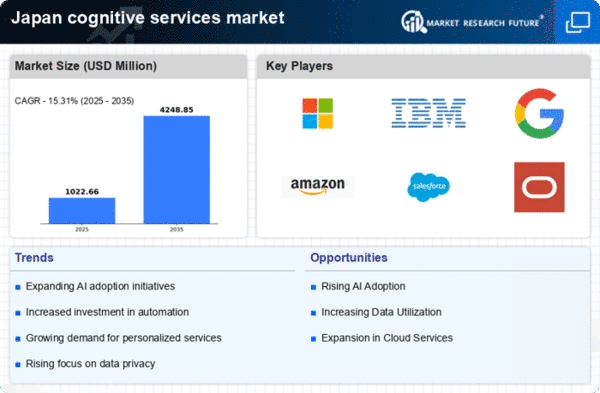
As per Market Research Future analysis, the Japan cognitive services market size was estimated at 886.88 USD Million in 2024. The Japan cognitive services-platform market is projected to grow from 1022.66 USD Million in 2025 to 4248.85 USD Million by 2035, exhibiting a compound annual growth rate (CAGR) of 15.3% during the forecast period 2025 - 2035

Key Market Trends & Highlights

The Japan cognitive services market is experiencing robust growth driven by technological advancements and increasing demand for automation.

  • The market is witnessing increased adoption of AI technologies across various sectors, enhancing operational efficiency.
  • Customer experience enhancement remains a focal point, with businesses leveraging cognitive services to improve engagement.
  • The government is actively supporting digital transformation initiatives, fostering a conducive environment for market growth.
  • Rising demand for automation solutions and growing investment in AI research and development are key drivers propelling the market forward.

Market Size & Forecast

2024 Market Size 886.88 (USD Million)
2035 Market Size 4248.85 (USD Million)
CAGR (2025 - 2035) 15.31%

Major Players

Microsoft (US), IBM (US), Google (US), Amazon (US), Salesforce (US), Oracle (US), SAP (DE), Alibaba (CN), NVIDIA (US)

Our Impact
Enabled $4.3B Revenue Impact for Fortune 500 and Leading Multinationals
Partnering with 2000+ Global Organizations Each Year
30K+ Citations by Top-Tier Firms in the Industry

Japan Cognitive Services Platform Market Trends

The cognitive services market in Japan is experiencing notable growth, driven by advancements in artificial intelligence and machine learning technologies. Organizations across various sectors are increasingly adopting these platforms to enhance operational efficiency and improve customer engagement. The integration of cognitive services into business processes appears to facilitate data-driven decision-making, thereby fostering innovation and competitiveness. Furthermore, the Japanese government is actively promoting digital transformation initiatives, which may further accelerate the adoption of cognitive services. This trend suggests a robust future for the market as businesses seek to leverage intelligent solutions to address complex challenges. In addition, the demand for personalized customer experiences is rising, prompting companies to invest in cognitive services that can analyze consumer behavior and preferences. This shift towards customer-centric strategies indicates a potential for growth in the cognitive services-platform market. As organizations continue to explore the capabilities of these platforms, the landscape is likely to evolve, presenting new opportunities for service providers and technology developers. The emphasis on data privacy and security also remains a critical consideration, influencing the development and deployment of cognitive solutions in Japan.

Increased Adoption of AI Technologies

The cognitive services-platform market is witnessing a surge in the adoption of artificial intelligence technologies. Businesses are increasingly utilizing these platforms to automate processes and enhance decision-making capabilities. This trend is likely to continue as organizations recognize the value of AI in driving efficiency and innovation.

Focus on Customer Experience Enhancement

There is a growing emphasis on improving customer experiences through cognitive services. Companies are leveraging these platforms to gain insights into consumer behavior, enabling them to tailor offerings and services. This focus on personalization is expected to shape the future of the market.

Government Support for Digital Transformation

The Japanese government is actively supporting digital transformation initiatives, which may positively impact the cognitive services-platform market. Policies aimed at fostering innovation and technology adoption are likely to encourage businesses to invest in cognitive solutions, thereby driving market growth.

Japan Cognitive Services Platform Market Drivers

Emphasis on Enhanced Security Measures

In the context of the cognitive services-platform market, the emphasis on enhanced security measures is becoming increasingly critical in Japan. As organizations adopt cognitive technologies, concerns regarding data privacy and cybersecurity are paramount. Recent reports indicate that cyber threats have escalated, prompting businesses to invest in robust security frameworks. This trend is reflected in the allocation of approximately 30% of IT budgets towards security solutions. Consequently, cognitive services that incorporate advanced security features are in high demand, as organizations seek to protect sensitive information while leveraging cognitive capabilities. This focus on security is likely to shape the development and adoption of cognitive services in the market.

Rising Demand for Automation Solutions

The cognitive services market in Japan is experiencing a notable surge in demand for automation solutions across various sectors. Industries such as manufacturing, finance, and healthcare are increasingly adopting cognitive technologies to streamline operations and enhance productivity. According to recent data, the automation market in Japan is projected to grow at a CAGR of approximately 15% over the next five years. This trend indicates a strong inclination towards integrating cognitive services to reduce manual intervention and improve efficiency. As organizations seek to optimize their processes, the cognitive services-platform market is likely to benefit significantly from this shift towards automation, positioning itself as a critical enabler of operational excellence.

Expansion of Cloud Computing Infrastructure

The expansion of cloud computing infrastructure in Japan is a pivotal factor driving the cognitive services-platform market. With the increasing adoption of cloud technologies, businesses are gaining access to scalable and flexible cognitive services that can be deployed rapidly. Recent statistics suggest that the cloud services market in Japan is expected to reach $20 billion by 2026, indicating a strong trend towards cloud-based solutions. This shift allows organizations to leverage cognitive services without the burden of extensive on-premises infrastructure. As cloud adoption continues to rise, the cognitive services-platform market is likely to flourish, providing businesses with innovative tools to enhance their operations.

Increased Focus on Data-Driven Decision Making

In Japan, there is a marked shift towards data-driven decision making, which is significantly influencing the cognitive services-platform market. Organizations are increasingly recognizing the value of leveraging data analytics and cognitive insights to inform strategic choices. This trend is reflected in a survey indicating that over 70% of Japanese companies prioritize data analytics in their operational strategies. Consequently, the demand for cognitive services that facilitate data interpretation and actionable insights is on the rise. As businesses strive to enhance their competitive edge, the cognitive services-platform market is likely to see robust growth, driven by the need for sophisticated analytical tools and platforms.

Growing Investment in AI Research and Development

Investment in artificial intelligence (AI) research and development is a key driver for the cognitive services market in Japan. The government and private sector are channeling substantial resources into AI initiatives, with funding reaching approximately $1 billion in recent years. This financial commitment is aimed at fostering innovation and enhancing the capabilities of cognitive services. As a result, the cognitive services-platform market is poised to expand, driven by advancements in machine learning, natural language processing, and computer vision. The emphasis on R&D not only supports the development of cutting-edge technologies but also encourages collaboration between academia and industry, further propelling market growth.


Market Segment Insights

By Application: Natural Language Processing (Largest) vs. Emotion Recognition (Fastest-Growing)

In the Japan cognitive services-platform market, Natural Language Processing (NLP) holds the largest market share among application segments, driven by its wide adoption across industries for tasks such as sentiment analysis and customer service automation. Following NLP, Computer Vision and Speech Recognition have significant shares, highlighting their relevance in sectors like healthcare and communication. Emotion Recognition, although currently smaller, indicates a rapid rise as businesses increasingly adopt it for enhancing user experiences. The growth trends in the Japan cognitive services-platform market show that Emotion Recognition is expected to expand at the fastest rate, influenced by advancements in AI and machine learning technologies. Companies are leveraging NLP not only for operational efficiency but also in developing sophisticated interfaces that improve human-computer interactions. As digital transformation accelerates, predictive analytics is also gaining traction, assisting organizations in making informed decisions by analyzing large data sets effectively.

NLP (Dominant) vs. Emotion Recognition (Emerging)

Natural Language Processing (NLP) continues to dominate the applications within the Japan cognitive services-platform market, characterized by its robust capabilities in analyzing and generating human language. This widespread adoption enables organizations to enhance customer engagement and streamline workflows. On the other hand, Emotion Recognition is emerging as a key player, tapping into the growing need for understanding user emotions in real-time. This segment leverages facial recognition and sentiment detection technologies to create more personalized customer experiences. The contrast between these segments illustrates a market balancing established technologies with innovative, cutting-edge applications that cater to evolving consumer demands.

By Deployment Type: Cloud-Based (Largest) vs. On-Premises (Fastest-Growing)

In the Japan cognitive services-platform market, the deployment type is segmented into Cloud-Based, On-Premises, and Hybrid solutions. Cloud-Based services hold the largest market share, driven by their scalability and accessibility. Meanwhile, On-Premises solutions are witnessing increased adoption due to rising security concerns among enterprises, making them a strong contender in this segment. This distribution reflects the varying preferences of businesses regarding operational flexibility and data sovereignty. The growth trends in the Japan cognitive services-platform market indicate a significant shift towards On-Premises solutions, which are expected to grow rapidly over the next few years. Factors contributing to this trend include enhanced data protection regulations and the growing emphasis on compliance. Conversely, Cloud-Based solutions maintain their dominance owing to their ease of integration and cost-effectiveness, appealing to a broad range of businesses looking to leverage cognitive capabilities without extensive infrastructure investments.

Cloud-Based (Dominant) vs. On-Premises (Emerging)

Cloud-Based solutions dominate the Japan cognitive services-platform market by offering unmatched flexibility and lower upfront costs, making them particularly appealing to small and medium enterprises. These services enable organizations to leverage advanced cognitive technologies without the burden of heavy infrastructure. On the other hand, On-Premises solutions are emerging as a preferred choice for large enterprises that prioritize strict data control and customization capabilities. These solutions allow businesses to retain greater oversight of their operations and compliance with local data governance policies, which is increasingly important amid evolving regulatory landscapes. As businesses continue to evaluate their cognitive service needs, the contrast between the flexibility of Cloud-Based services and the security of On-Premises options is shaping the competitive landscape.

By Industry: Healthcare (Largest) vs. Retail (Fastest-Growing)

The Japan cognitive services-platform market exhibits a diverse distribution of market share across various industries. Healthcare is currently the largest segment, significantly benefiting from advancements in AI-driven diagnostics and patient care solutions. Retail, while smaller in comparison, is rapidly gaining traction as businesses integrate cognitive services to enhance customer experiences and optimize operations. This dynamic between the two segments illustrates the evolving landscape and competitive nature of the market. In terms of growth trends, the healthcare industry is led by the rising adoption of AI for medical imaging and predictive analytics. Retail is experiencing the fastest growth, driven by the need for personalized customer interactions and the integration of chatbots and virtual assistants. Enhancements in data analytics capabilities further fuel retail's expansion, reflecting a broader trend toward leveraging cognitive technologies across various sectors in the market.

Healthcare (Dominant) vs. Retail (Emerging)

Healthcare serves as the dominant force in the cognitive services-platform market, characterized by its ability to streamline medical procedures and improve patient outcomes through innovative AI applications. This sector is marked by significant investments in health tech and research, leading to breakthroughs in diagnostics, treatment planning, and patient management systems. On the other hand, retail is emerging as a competitive segment, fueled by a robust demand for personalized shopping experiences and efficient inventory management systems. Companies within this sector are increasingly adopting cognitive services to analyze consumer behavior and preferences, often utilizing machine learning algorithms for better decision-making, thereby enhancing their market position and adaptability in an ever-changing consumer landscape.

By User Type: Large Enterprises (Largest) vs. Small and Medium Enterprises (Fastest-Growing)

In the Japan cognitive services-platform market, Large Enterprises command a significant market share, benefiting from vast resources and extensive adoption of advanced technologies. Their established infrastructure enables them to implement cognitive solutions efficiently, resulting in a major portion of the market being dominated by these players. Conversely, Small and Medium Enterprises (SMEs) are gradually increasing their share by leveraging cloud-based services, which allow more agile and cost-effective access to cognitive capabilities, thus narrowing the gap. The growth trajectory for Small and Medium Enterprises is particularly noteworthy, with SMEs emerging as the fastest-growing segment in this market. This growth is driven by increasing digital transformation initiatives and an expanding focus on AI-driven solutions to enhance operational efficiency. As technology becomes more accessible, SMEs are finding innovative ways to integrate cognitive services into their operations, leading to rapid adoption and a significant uptick in their market presence over time.

Large Enterprises (Dominant) vs. Small and Medium Enterprises (Emerging)

Large Enterprises in the cognitive services-platform segment are characterized by their robust financial capabilities, allowing for significant investments in technology and talent. These entities typically have established customer bases and a broad operational reach, which contribute to their market dominance. In contrast, Small and Medium Enterprises are emerging as key players in the market, driven by their agility and ability to quickly adopt new technologies. SMEs often rely on cost-effective cloud solutions, enabling them to compete effectively with larger counterparts. The increasing focus on digital transformation and the need for more tailored cognitive solutions have empowered SMEs to carve out a significant niche, showing remarkable growth potential and innovation within the Japan cognitive services-platform market.

Get more detailed insights about Japan Cognitive Services Platform Market

Key Players and Competitive Insights

The cognitive services market in Japan is characterized by a dynamic competitive landscape, driven by rapid advancements in artificial intelligence (AI) and increasing demand for automation across various sectors. Major players such as Microsoft (US), IBM (US), and Google (US) are strategically positioned to leverage their technological prowess and extensive resources. Microsoft (US) focuses on integrating AI capabilities into its Azure cloud platform, enhancing its service offerings. IBM (US) emphasizes its hybrid cloud solutions, aiming to provide businesses with flexible and scalable cognitive services. Google (US) continues to innovate with its AI-driven tools, particularly in natural language processing and machine learning, which are pivotal for businesses seeking to enhance customer engagement and operational efficiency. Collectively, these strategies foster a competitive environment that prioritizes innovation and technological advancement.Key business tactics within this market include localizing services to meet regional demands and optimizing supply chains to enhance service delivery. The competitive structure appears moderately fragmented, with several key players vying for market share. This fragmentation is indicative of a landscape where both established corporations and emerging startups contribute to a diverse array of cognitive services, thereby intensifying competition and driving innovation.

In October Microsoft (US) announced the launch of a new AI-driven analytics tool designed specifically for the Japanese market. This strategic move is significant as it not only caters to local business needs but also reinforces Microsoft's commitment to enhancing its presence in Asia. By tailoring its offerings, Microsoft (US) aims to capture a larger share of the growing demand for data-driven decision-making tools among Japanese enterprises.

In September IBM (US) expanded its partnership with a leading Japanese telecommunications company to co-develop AI solutions for smart cities. This collaboration is crucial as it aligns with Japan's ongoing initiatives to enhance urban infrastructure through technology. By leveraging IBM's expertise in AI and the telecommunications partner's local market knowledge, this partnership is poised to deliver innovative solutions that address urban challenges, thereby solidifying IBM's position in the cognitive services landscape.

In August Google (US) unveiled a new suite of AI tools aimed at improving customer service operations for Japanese businesses. This initiative is particularly relevant as it addresses the increasing demand for enhanced customer engagement strategies. By providing advanced AI capabilities, Google (US) not only strengthens its competitive edge but also supports local businesses in navigating the complexities of customer interactions in a digital-first environment.

As of November current trends in the cognitive services-platform market are heavily influenced by digitalization, sustainability, and the integration of AI technologies. Strategic alliances among key players are shaping the competitive landscape, fostering innovation and collaboration. The shift from price-based competition to a focus on technological differentiation and supply chain reliability is evident. Moving forward, companies that prioritize innovation and adaptability are likely to emerge as leaders in this evolving market.

Key Companies in the Japan Cognitive Services Platform Market include

Industry Developments

Microsoft committed US$2.9 billion over the course of two years in April 2024 to the substantial expansion of its cloud and AI infrastructure in Japan. This encompasses the deployment of AI semiconductors in current data centers, the establishment of a Microsoft Research Asia facility in Tokyo, and the training of three million Japanese professionals in AI by 2027.

This will establish the foundation for Azure Cognitive Services across sectors.Oracle announced in April 2024 a US$8 billion investment plan in Japan over the next decade to expand its cloud footprint, develop sovereign-cloud capabilities, and support AI infrastructure for classified workloads in government and enterprise settings.Accenture, in partnership with NVIDIA, established the AI Refinery Engineering Hub in Tokyo in late 2023 and early 2024. 

This hub is a component of a global network that is dedicated to the development of agentic AI systems for Japanese enterprises, utilizing NVIDIA NeMo, NIM microservices, and AI Enterprise software.In November 2024, SoftBank initiated the construction of Japan's most powerful AI supercomputer using NVIDIA Blackwell with the assistance of NVIDIA. Additionally, SoftBank piloted a combined AI-5G telecom solution ("AITRAS") to meet the demand for sovereign AI computation.OpenAI opened its inaugural Asia office in Tokyo in April 2024.

The company collaborated with prominent Japanese companies, including Toyota and Daikin, to provide a Japanese-optimized LLM and to promote the adoption of enterprise AI in Japan.

Future Outlook

Japan Cognitive Services Platform Market Future Outlook

The cognitive services market in Japan is projected to grow at a 15.31% CAGR from 2025 to 2035, driven by advancements in AI, increased automation, and demand for data analytics.

New opportunities lie in:

  • Development of AI-driven customer support chatbots for retail sectors.
  • Integration of cognitive services in healthcare diagnostics and patient management.
  • Creation of personalized marketing solutions leveraging machine learning algorithms.

By 2035, the market is expected to achieve substantial growth, positioning itself as a leader in technological innovation.

Market Segmentation

Japan Cognitive Services Platform Market Industry Outlook

  • Healthcare
  • Retail
  • Finance
  • Education
  • Manufacturing

Japan Cognitive Services Platform Market User Type Outlook

  • Small and Medium Enterprises
  • Large Enterprises
  • Government Organizations

Japan Cognitive Services Platform Market Application Outlook

  • Natural Language Processing
  • Computer Vision
  • Speech Recognition
  • Emotion Recognition
  • Predictive Analytics

Japan Cognitive Services Platform Market Deployment Type Outlook

  • Cloud-Based
  • On-Premises
  • Hybrid

Report Scope

MARKET SIZE 2024 886.88(USD Million)
MARKET SIZE 2025 1022.66(USD Million)
MARKET SIZE 2035 4248.85(USD Million)
COMPOUND ANNUAL GROWTH RATE (CAGR) 15.31% (2025 - 2035)
REPORT COVERAGE Revenue Forecast, Competitive Landscape, Growth Factors, and Trends
BASE YEAR 2024
Market Forecast Period 2025 - 2035
Historical Data 2019 - 2024
Market Forecast Units USD Million
Key Companies Profiled Microsoft (US), IBM (US), Google (US), Amazon (US), Salesforce (US), Oracle (US), SAP (DE), Alibaba (CN), NVIDIA (US)
Segments Covered Application, Deployment Type, Industry, User Type
Key Market Opportunities Integration of advanced artificial intelligence in cognitive services-platform market enhances user experience and operational efficiency.
Key Market Dynamics Rising demand for AI-driven solutions fuels competition among cognitive services-platform providers in Japan.
Countries Covered Japan
Leave a Comment

FAQs

What is the expected market size of the Japan Cognitive Services Platform Market in 2024?

The Japan Cognitive Services Platform Market is expected to be valued at 888.38 USD Million in 2024.

What will be the projected market value by 2035?

By 2035, the Japan Cognitive Services Platform Market is projected to reach a value of 4024.0 USD Million.

What is the expected compound annual growth rate for the market from 2025 to 2035?

The expected CAGR for the Japan Cognitive Services Platform Market from 2025 to 2035 is 14.721%.

Which application segment is projected to be the largest in 2035?

The Computer Vision application segment is projected to grow to 910.0 USD Million by 2035, making it one of the largest segments.

What is the market size for Natural Language Processing in 2024 and its projected size in 2035?

Natural Language Processing is valued at 150.0 USD Million in 2024 and is projected to reach 685.0 USD Million in 2035.

Who are the major players in the Japan Cognitive Services Platform Market?

Key players in the market include Oracle, Microsoft, Amazon Web Services, IBM, and Google among others.

What is the projected market size for Speech Recognition by 2035?

The Speech Recognition application segment is expected to reach a market size of 800.0 USD Million by 2035.

What growth opportunities exist within the Japan Cognitive Services Platform Market?

The market offers growth opportunities in predictive analytics and advancements in natural language processing technologies.

How much is the Emotion Recognition segment expected to grow by 2035?

The Emotion Recognition segment is expected to grow to 540.0 USD Million by 2035.

What is the market size for Predictive Analytics in 2024 and its forecast for 2035?

Predictive Analytics is valued at 238.38 USD Million in 2024 and is projected to grow to 1089.0 USD Million by 2035.

Download Free Sample

Kindly complete the form below to receive a free sample of this Report

Compare Licence

×
Features License Type
Single User Multiuser License Enterprise User
Price $4,950 $5,950 $7,250
Maximum User Access Limit 1 User Upto 10 Users Unrestricted Access Throughout the Organization
Free Customization
Direct Access to Analyst
Deliverable Format
Platform Access
Discount on Next Purchase 10% 15% 15%
Printable Versions