×
Request Free Sample ×

Kindly complete the form below to receive a free sample of this Report

* Please use a valid business email

Leading companies partner with us for data-driven Insights

clients tt-cursor
Hero Background

Japan Cloud AI Market

ID: MRFR/ICT/57426-HCR
200 Pages
Garvit Vyas
February 2026

Japan Cloud AI Market Size, Share and Research Report: By Application (Natural Language Processing, Machine Learning, Computer Vision, Speech Recognition, Predictive Analytics), By Deployment Model (Public Cloud, Private Cloud, Hybrid Cloud), By End Use Industry (Healthcare, Retail, Banking, Manufacturing, Telecommunications) andBy Service Type (Infrastructure as a Service, Platform as a Service, Software as a Service)- Industry Forecast to 2035

Share:
Download PDF ×

We do not share your information with anyone. However, we may send you emails based on your report interest from time to time. You may contact us at any time to opt-out.

Japan Cloud AI Market Infographic
Purchase Options

Japan Cloud AI Market Summary

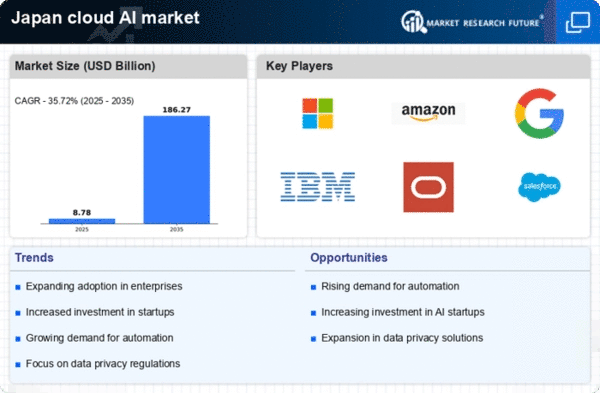
As per Market Research Future analysis, the Japan cloud AI market size was estimated at 6.47 USD Billion in 2024. The Japan The market is projected to grow from 8.78 USD Billion in 2025 to 186.27 USD Billion by 2035, exhibiting a compound annual growth rate (CAGR) of 35.7% during the forecast period 2025 - 2035

Key Market Trends & Highlights

The Japan The cloud AI market is experiencing robust growth driven by technological advancements and increasing demand for automation.

  • The market is witnessing increased adoption of AI solutions across various industries, particularly in the healthcare and finance sectors.
  • Data security and compliance are becoming paramount as organizations integrate AI technologies into their operations.
  • AI-driven applications are emerging rapidly, with significant growth observed in the retail and manufacturing segments.
  • Key market drivers include rising demand for automation and substantial investment in AI research and development.

Market Size & Forecast

2024 Market Size 6.47 (USD Billion)
2035 Market Size 186.27 (USD Billion)
CAGR (2025 - 2035) 35.72%

Major Players

Microsoft (US), Amazon (US), Google (US), IBM (US), Oracle (US), Salesforce (US), Alibaba (CN), Tencent (CN), SAP (DE)

Our Impact
Enabled $4.3B Revenue Impact for Fortune 500 and Leading Multinationals
Partnering with 2000+ Global Organizations Each Year
30K+ Citations by Top-Tier Firms in the Industry

Japan Cloud AI Market Trends

The cloud ai market is experiencing notable growth, driven by advancements in technology and increasing demand for automation across various sectors. Organizations are increasingly adopting cloud-based artificial intelligence solutions to enhance operational efficiency and improve decision-making processes. This trend is particularly evident in industries such as finance, healthcare, and manufacturing, where data-driven insights are becoming essential for competitive advantage. Furthermore, the integration of machine learning and natural language processing into cloud platforms is enabling businesses to leverage vast amounts of data more effectively, leading to innovative applications and services. In addition, the regulatory environment in Japan is evolving to support the expansion of the cloud ai market. Government initiatives aimed at promoting digital transformation and innovation are fostering a conducive atmosphere for investment in artificial intelligence technologies. As companies seek to comply with new regulations and standards, the demand for cloud-based solutions that offer scalability and flexibility is likely to increase. This shift not only enhances the capabilities of businesses but also contributes to the overall economic growth of the region, positioning Japan as a key player in the cloud ai landscape.

Increased Adoption of AI Solutions

Organizations are increasingly integrating artificial intelligence into their operations, utilizing cloud platforms to streamline processes and enhance productivity. This trend reflects a broader shift towards automation, where businesses seek to optimize workflows and reduce operational costs.

Focus on Data Security and Compliance

As the cloud ai market expands, there is a heightened emphasis on data security and regulatory compliance. Companies are prioritizing solutions that ensure the protection of sensitive information while adhering to local laws and international standards.

Emergence of AI-Driven Applications

The development of innovative applications powered by artificial intelligence is on the rise. These applications are designed to address specific industry challenges, offering tailored solutions that enhance customer experiences and drive business growth.

Japan Cloud AI Market Drivers

Rising Demand for Automation

The cloud ai market in Japan experiences a notable surge in demand for automation solutions across various sectors. Industries such as manufacturing, finance, and healthcare are increasingly adopting AI technologies to streamline operations and enhance productivity. According to recent data, the automation market in Japan is projected to grow at a CAGR of approximately 15% over the next five years. This trend indicates a strong inclination towards integrating AI-driven automation tools, which are expected to significantly reduce operational costs and improve efficiency. As organizations seek to remain competitive, the The cloud AI market is likely to benefit from this growing demand for automation. This positions it as a critical enabler of business transformation.

Expansion of Cloud Infrastructure

The expansion of cloud infrastructure in Japan is a pivotal driver for the cloud ai market. With the increasing availability of high-speed internet and advancements in cloud computing technologies, businesses are more inclined to adopt cloud-based AI solutions. The Japanese government has been actively promoting the development of cloud infrastructure, which is expected to reach a market size of ¥2 trillion by 2026. This growth facilitates easier access to AI tools and resources, enabling organizations to harness the power of AI without significant upfront investments. As cloud infrastructure continues to evolve, the cloud ai market is poised for substantial growth, providing businesses with scalable and flexible AI solutions.

Growing Focus on Customer Experience

In the competitive landscape of Japan, businesses are increasingly prioritizing customer experience, which is driving the adoption of AI technologies. The cloud ai market is witnessing a shift as companies leverage AI to analyze customer data and personalize interactions. This trend is particularly evident in the retail and service sectors, where organizations are utilizing AI-driven insights to enhance customer engagement. Reports indicate that companies implementing AI solutions for customer experience improvements have seen a 20% increase in customer satisfaction scores. As businesses strive to meet evolving consumer expectations, the cloud ai market is likely to expand, providing innovative solutions that enhance customer interactions.

Regulatory Support for AI Integration

The regulatory environment in Japan is becoming increasingly supportive of AI integration across various sectors. The government has introduced policies aimed at fostering the growth of the cloud ai market while ensuring ethical standards and compliance. These regulations are designed to encourage innovation while addressing concerns related to data privacy and security. As a result, businesses are more likely to invest in AI technologies, knowing that there is a framework in place to guide their implementation. This supportive regulatory landscape is expected to enhance the attractiveness of the cloud ai market, driving further adoption and integration of AI solutions in diverse industries.

Investment in AI Research and Development

Japan's commitment to advancing technology is reflected in its substantial investment in AI research and development. The government has allocated significant funding to promote innovation in the cloud ai market, aiming to position the country as a leader in AI technology. In 2025, public and private sector investments in AI are expected to exceed ¥1 trillion, fostering an environment conducive to breakthroughs in AI applications. This influx of capital is likely to accelerate the development of new cloud-based AI solutions, enhancing the capabilities of businesses across various industries. Consequently, the cloud ai market stands to gain from this robust investment landscape, driving growth and innovation.


Market Segment Insights

By Application: Natural Language Processing (Largest) vs. Machine Learning (Fastest-Growing)

The Japan cloud ai market showcases a diverse application landscape, with Natural Language Processing (NLP) leading the charge as the largest segment. This segment's dominance stems from its extensive utilization across industries, enhancing customer interactions and automating tasks. Following closely is the Machine Learning segment, which is experiencing rapid growth due to its increasing applications in predictive analytics and data processing, making it a critical driver of innovation within the market. Growth trends indicate a significant shift towards incorporating advanced AI capabilities, particularly in sectors like finance and healthcare. The rising demand for personalized solutions and data-driven decision-making drives Machine Learning's rapid expansion. Moreover, advancements in technology and increasing investments in AI research are propelling the evolution of NLP, solidifying its position while Machine Learning emerges as a vital player moving forward.

Natural Language Processing (Dominant) vs. Machine Learning (Emerging)

Natural Language Processing (NLP) stands as the dominant force in the Japan cloud ai market, characterized by its ability to facilitate human-computer interaction through language understanding. Its applications range from chatbots to language translation, making it invaluable in enhancing customer experiences across various sectors. On the other hand, Machine Learning, while emerging, is rapidly gaining traction due to its capabilities in automating data analysis and supporting decision-making processes. As organizations increasingly rely on data-driven insights, Machine Learning is expected to grow at an accelerated pace, leveraging big data and optimizing operational efficiencies, thus establishing itself as a key component in the competitive landscape.

By Deployment Model: Public Cloud (Largest) vs. Hybrid Cloud (Fastest-Growing)

In the Japan cloud ai market, the Public Cloud segment holds the largest market share, driven by widespread adoption among various industries seeking cost-effective and scalable solutions. This model offers flexibility and easy access to computing resources, making it highly appealing for businesses aiming to enhance their operational efficiency. On the other hand, the Hybrid Cloud segment is emerging as the fastest-growing segment due to its unique ability to combine the benefits of both Public and Private Cloud models. Organizations are increasingly opting for Hybrid solutions to achieve a balanced approach that addresses security concerns while still leveraging the scalability of public services, thereby driving growth in this area.

Public Cloud (Dominant) vs. Hybrid Cloud (Emerging)

The Public Cloud segment in the Japan cloud ai market is characterized by its extensive user base and significant reliance on third-party service providers. It facilitates quick deployment of applications and services without the need for substantial upfront infrastructure investments, attracting small to large enterprises alike. In contrast, the Hybrid Cloud is gaining traction as an emerging choice, especially among enterprises with specific regulatory and data security requirements. This model enables businesses to maintain sensitive operations on Private Clouds while utilizing Public Clouds for less critical applications, thus offering enhanced control and compliance, which is essential in Japan's data-sensitive environment.

By End Use Industry: Healthcare (Largest) vs. Retail (Fastest-Growing)

In the Japan cloud ai market, the healthcare sector holds the largest market share, leveraging advanced AI solutions for predictive analytics, patient management, and operational efficiency. Retail, meanwhile, is rapidly catching up with increasing adoption of AI for personalized customer experiences, supply chain optimization, and data-driven sales strategies. This competitive landscape indicates the dynamic nature of these key segments as they continuously evolve to meet market demands. The growth trends in these segments reflect a shift towards digital transformation, with healthcare prioritizing patient-centric AI applications. Retail is emerging as the fastest-growing sector due to the rise of e-commerce, where AI plays a pivotal role in enhancing user engagement and automating inventory management. Other sectors, such as banking and telecommunications, are also important players, but the focus remains heavily on these two for innovation and growth.

Healthcare: Dominant vs. Retail: Emerging

Healthcare stands out as a dominant force in the Japan cloud ai market, driven by its integration of AI in clinical settings, telemedicine, and administrative processes. This segment benefits from a substantial investment in technology to improve patient outcomes and streamline operations. Conversely, retail is an emerging segment, rapidly harnessing cloud AI to reshape the shopping experience through personalization and efficiency. Retailers are utilizing AI for customer insights, demand forecasting, and tailored marketing strategies, allowing them to compete more effectively in a digital-first landscape. As both segments evolve, their interplay will shape the future trajectory of AI applications in various industries.

By Service Type: Software as a Service (Largest) vs. Infrastructure as a Service (Fastest-Growing)

The Japan cloud ai market shows a diverse distribution in service type segments, with Software as a Service (SaaS) leading the landscape. This segment has captured a significant share owing to its wide adoption for business applications and operational efficiency. Infrastructure as a Service (IaaS) and Platform as a Service (PaaS) follow, showcasing substantial interest, particularly among businesses seeking cost-effective solutions for infrastructure management. Growth trends in the Japan cloud ai market indicate that IaaS is the fastest-growing service type, driven by increasing demand for scalable computing resources and the integration of AI technologies into cloud environments. SaaS continues to thrive as enterprises emphasize digital transformation, while PaaS supports rapid application development, fostering innovation and agility in various sectors.

Software as a Service (Dominant) vs. Infrastructure as a Service (Emerging)

In the Japan cloud ai market, Software as a Service (SaaS) dominates due to its capacity to deliver software solutions over the internet, allowing businesses to reduce IT costs and increase efficiency. This segment is particularly favored in sectors such as finance and retail, where quick access to applications is essential. Conversely, Infrastructure as a Service (IaaS) is emerging rapidly, appealing to businesses needing flexible computing resources without the overhead of physical infrastructure. As organizations increasingly adopt AI-driven applications, IaaS is positioned to experience significant growth, bolstered by the rising trend of hybrid cloud environments that leverage both public and private infrastructure.

Get more detailed insights about Japan Cloud AI Market

Key Players and Competitive Insights

The cloud AI market in Japan is characterized by a dynamic competitive landscape, driven by rapid technological advancements and increasing demand for AI-driven solutions across various sectors. Major players such as Microsoft (US), Amazon (US), and Alibaba (CN) are strategically positioned to leverage their extensive cloud infrastructures and AI capabilities. Microsoft (US) focuses on innovation through its Azure platform, emphasizing AI integration and partnerships with local enterprises to enhance digital transformation. Amazon (US) continues to expand its AWS offerings, prioritizing scalability and flexibility, while Alibaba (CN) aims to penetrate the market further by localizing its services and enhancing its AI capabilities to cater to Japanese businesses.
The business tactics employed by these companies reflect a competitive structure that is moderately fragmented, with a mix of global giants and regional players. Localizing services and optimizing supply chains are critical strategies that enhance their market presence. The collective influence of these key players shapes the competitive environment, as they continuously adapt to the evolving needs of Japanese consumers and businesses.
In October 2025, Microsoft (US) announced a strategic partnership with a leading Japanese telecommunications company to enhance AI-driven cloud services tailored for the local market. This collaboration is expected to bolster Microsoft’s position in Japan by providing customized solutions that address specific industry challenges, thereby reinforcing its commitment to regional expansion and innovation.

In September 2025, Amazon (US) unveiled a new AI service aimed at improving operational efficiency for Japanese SMEs. This initiative not only demonstrates Amazon's focus on local market needs but also highlights its strategy to capture a larger share of the growing SME sector in Japan, which is increasingly adopting cloud solutions to enhance productivity.
In August 2025, Alibaba (CN) launched a new AI-powered analytics tool specifically designed for the Japanese retail sector. This move signifies Alibaba's intent to deepen its engagement with local businesses, providing them with advanced tools to optimize their operations and customer experiences. Such initiatives are indicative of Alibaba's broader strategy to establish a strong foothold in Japan's competitive landscape.
As of November 2025, current trends in the cloud AI market are heavily influenced by digitalization, sustainability, and the integration of AI technologies. Strategic alliances among key players are reshaping the competitive landscape, fostering innovation and collaboration. The shift from price-based competition to a focus on technological advancement and supply chain reliability is evident, suggesting that future competitive differentiation will hinge on the ability to innovate and deliver tailored solutions that meet the unique demands of the Japanese market.

Key Companies in the Japan Cloud AI Market include

Industry Developments

The Japan Cloud AI Market has seen significant developments, with major companies like Microsoft and Amazon expanding their cloud infrastructure to meet the growing demand for AI services. In July 2023, Microsoft announced a significant investment to enhance its Azure cloud solutions, targeting local businesses requiring advanced AI capabilities. Likewise, Amazon Web Services launched new AI tools in September 2023 tailored for Japanese enterprises, signaling a strong push towards digital transformation in the region.

Notably, in August 2023, NTT Data acquired a minority stake in a promising AI startup focused on health care solutions, highlighting an ongoing trend of partnerships and acquisitions to leverage technological innovation.

Additionally, NEC and Fujitsu have been collaborating on AI developments, focusing on public sector applications, which underscores the government’s push for AI integration in various sectors. The market's growth potential is further supported by Japan's increasing expenditure on digital technologies, projected to exceed trillions of yen over the next five years, as the country aims to strengthen its competitive edge in the global AI landscape.

Future Outlook

Japan Cloud AI Market Future Outlook

The cloud AI market in Japan is projected to grow at a 35.72% CAGR from 2025 to 2035, driven by advancements in machine learning, data analytics, and increased cloud adoption.

New opportunities lie in:

  • Development of AI-driven predictive maintenance solutions for manufacturing sectors.
  • Creation of tailored AI platforms for small and medium enterprises.
  • Expansion of AI-enhanced cybersecurity services to protect cloud infrastructures.

By 2035, the cloud AI market is expected to achieve substantial growth, solidifying its critical role in various industries.

Market Segmentation

Japan Cloud AI Market Application Outlook

  • Natural Language Processing
  • Machine Learning
  • Computer Vision
  • Speech Recognition
  • Predictive Analytics

Japan Cloud AI Market Service Type Outlook

  • Infrastructure as a Service
  • Platform as a Service
  • Software as a Service

Japan Cloud AI Market Deployment Model Outlook

  • Public Cloud
  • Private Cloud
  • Hybrid Cloud

Japan Cloud AI Market End Use Industry Outlook

  • Healthcare
  • Retail
  • Banking
  • Manufacturing
  • Telecommunications

Report Scope

MARKET SIZE 2024 6.47(USD Billion)
MARKET SIZE 2025 8.78(USD Billion)
MARKET SIZE 2035 186.27(USD Billion)
COMPOUND ANNUAL GROWTH RATE (CAGR) 35.72% (2025 - 2035)
REPORT COVERAGE Revenue Forecast, Competitive Landscape, Growth Factors, and Trends
BASE YEAR 2024
Market Forecast Period 2025 - 2035
Historical Data 2019 - 2024
Market Forecast Units USD Billion
Key Companies Profiled Microsoft (US), Amazon (US), Google (US), IBM (US), Oracle (US), Salesforce (US), Alibaba (CN), Tencent (CN), SAP (DE)
Segments Covered Application, Deployment Model, End Use Industry, Service Type
Key Market Opportunities Integration of advanced machine learning capabilities into cloud services enhances operational efficiency and customer engagement.
Key Market Dynamics Rising demand for cloud AI solutions drives innovation and competition among local and global providers in Japan.
Countries Covered Japan
Leave a Comment

FAQs

What is the projected market size of the Japan Cloud AI Market in 2024?

The Japan Cloud AI Market is expected to be valued at 1.5 billion USD in 2024.

What will be the market size of the Japan Cloud AI Market by 2035?

By 2035, the Japan Cloud AI Market is projected to reach a valuation of 10.0 billion USD.

What is the expected compound annual growth rate (CAGR) of the Japan Cloud AI Market from 2025 to 2035?

The expected CAGR for the Japan Cloud AI Market from 2025 to 2035 is 18.823%.

Which application segment of the Japan Cloud AI Market is projected to grow the most by 2035?

The Natural Language Processing segment is projected to grow to 2.8 billion USD by 2035.

How much is the Machine Learning application segment worth in 2024?

The Machine Learning application segment is valued at 0.5 billion USD in 2024.

Which companies are considered major players in the Japan Cloud AI Market?

Major players in the Japan Cloud AI Market include SAP, Oracle, and Google among others.

What is the projected market value for the Computer Vision segment in 2035?

The Computer Vision segment is expected to reach a market value of 2.0 billion USD by 2035.

What value is the Predictive Analytics segment expected to hold in 2035?

The Predictive Analytics segment is projected to hold a value of 0.8 billion USD in 2035.

What challenges might the Japan Cloud AI Market face in the coming years?

The market may face challenges related to data privacy regulations and technological advancements.

How has the competitive landscape evolved in the Japan Cloud AI Market recently?

The competitive landscape has seen increased investments from major technology firms aiming to enhance their offerings.

Download Free Sample

Kindly complete the form below to receive a free sample of this Report

Compare Licence

×
Features License Type
Single User Multiuser License Enterprise User
Price $4,950 $5,950 $7,250
Maximum User Access Limit 1 User Upto 10 Users Unrestricted Access Throughout the Organization
Free Customization
Direct Access to Analyst
Deliverable Format
Platform Access
Discount on Next Purchase 10% 15% 15%
Printable Versions