×
Request Free Sample ×

Kindly complete the form below to receive a free sample of this Report

* Please use a valid business email

Leading companies partner with us for data-driven Insights

clients tt-cursor
Hero Background

Japan Cardiac Biomarkers Market

ID: MRFR/HC/51426-HCR
200 Pages
Rahul Gotadki
February 2026

Japan Cardiac Biomarkers Market Research Report: Size, Share, Trend Analysis By Types (Creatine Kinase (CK-MB), Troponins T, Imyoglobin, BNPs, IMA, Others), By Location of Testing (Point of Care, Laboratory Testing) and By Applications (Myocardial Infarction, Congestive Heart Failure, Acute Coronary Syndrome, Atherosclerosis) - Growth Outlook & Industry Forecast 2025 To 2035

Share:
Download PDF ×

We do not share your information with anyone. However, we may send you emails based on your report interest from time to time. You may contact us at any time to opt-out.

Japan Cardiac Biomarkers Market Infographic
Purchase Options

Japan Cardiac Biomarkers Market Summary

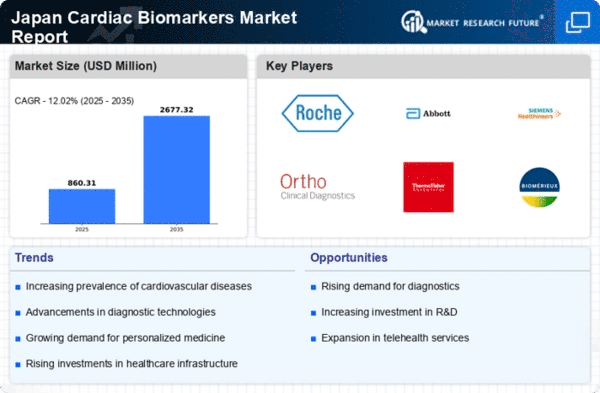
As per Market Research Future analysis, the Japan cardiac biomarkers market size was estimated at 768.0 USD Million in 2024. The Japan cardiac biomarkers market is projected to grow from 860.31 USD Million in 2025 to 2677.32 USD Million by 2035, exhibiting a compound annual growth rate (CAGR) of 12.0% during the forecast period 2025 - 2035

Key Market Trends & Highlights

The Japan cardiac biomarkers market is poised for growth driven by technological advancements and increasing healthcare expenditure.

  • Technological advancements in biomarkers are enhancing diagnostic accuracy and patient outcomes.
  • The largest segment in the market is the cardiac troponin segment, while the fastest-growing segment is the natriuretic peptide segment.
  • Regulatory support for innovation is fostering the development of new biomarkers and diagnostic tools.
  • Rising incidence of cardiovascular diseases and increased healthcare expenditure are key drivers propelling market growth.

Market Size & Forecast

2024 Market Size 768.0 (USD Million)
2035 Market Size 2677.32 (USD Million)
CAGR (2025 - 2035) 12.02%

Major Players

Roche Diagnostics (CH), Abbott Laboratories (US), Siemens Healthineers (DE), Ortho Clinical Diagnostics (US), Thermo Fisher Scientific (US), bioMérieux (FR), QuidelOrtho Corporation (US), Boehringer Ingelheim (DE)

Our Impact
Enabled $4.3B Revenue Impact for Fortune 500 and Leading Multinationals
Partnering with 2000+ Global Organizations Each Year
30K+ Citations by Top-Tier Firms in the Industry

Japan Cardiac Biomarkers Market Trends

The cardiac biomarkers market in Japan is currently experiencing notable growth, driven by an increasing prevalence of cardiovascular diseases and a rising aging population. The demand for early diagnosis and effective monitoring of heart conditions is propelling advancements in biomarker technologies. Furthermore, the integration of innovative diagnostic tools and point-of-care testing is enhancing the accessibility and efficiency of cardiac care. This trend is likely to continue as healthcare providers seek to improve patient outcomes through timely interventions and personalized treatment plans. In addition, the regulatory landscape in Japan is evolving to support the development and approval of new cardiac biomarkers. The Ministry of Health, Labour and Welfare is actively promoting research and development initiatives, which may lead to the introduction of novel biomarkers in clinical practice. As a result, stakeholders in the cardiac biomarkers market are increasingly focusing on collaborations with research institutions and healthcare providers to facilitate the translation of scientific discoveries into practical applications. This collaborative approach could potentially accelerate the pace of innovation and improve the overall quality of cardiac care in Japan.

Technological Advancements in Biomarkers

The cardiac biomarkers market is witnessing rapid technological advancements, particularly in the development of high-sensitivity assays and point-of-care testing devices. These innovations are enhancing the accuracy and speed of diagnostics, allowing for quicker decision-making in clinical settings. As a result, healthcare professionals can provide timely interventions, which is crucial for improving patient outcomes.

Regulatory Support for Innovation

Regulatory bodies in Japan are increasingly supportive of innovations in the cardiac biomarkers market. Initiatives aimed at streamlining the approval process for new diagnostic tools are being implemented. This regulatory environment encourages research and development, fostering the introduction of novel biomarkers that can significantly enhance patient care.

Growing Focus on Preventive Healthcare

There is a growing emphasis on preventive healthcare within the cardiac biomarkers market. As awareness of cardiovascular diseases rises, healthcare providers are prioritizing early detection and risk assessment. This shift towards preventive measures is likely to drive demand for advanced biomarkers that can identify individuals at risk, ultimately leading to better management of heart health.

Japan Cardiac Biomarkers Market Drivers

Increased Healthcare Expenditure

Japan's rising healthcare expenditure is a significant factor influencing the cardiac biomarkers market. With a focus on improving healthcare infrastructure and access to advanced medical technologies, the government is investing heavily in healthcare initiatives. This financial commitment is likely to enhance the availability of cardiac biomarker tests, making them more accessible to patients. As healthcare spending is projected to grow by around 5% annually, the cardiac biomarkers market is expected to benefit from increased funding for research, development, and implementation of innovative diagnostic solutions. This trend underscores the importance of cardiac biomarkers in the broader context of healthcare improvement.

Growing Awareness of Heart Health

There is a notable increase in public awareness regarding heart health in Japan, which is driving the cardiac biomarkers market. Educational campaigns and health initiatives aimed at promoting cardiovascular health are encouraging individuals to seek preventive care and regular screenings. This heightened awareness is leading to a greater demand for cardiac biomarker tests, as patients and healthcare providers recognize their value in early detection and management of heart diseases. As a result, the market is likely to experience sustained growth, with estimates suggesting an increase in demand for cardiac biomarkers by approximately 10% over the next few years.

Advancements in Diagnostic Technologies

Technological innovations in diagnostic tools are transforming the cardiac biomarkers market. The introduction of high-sensitivity assays and point-of-care testing devices enhances the accuracy and speed of cardiac biomarker detection. These advancements facilitate timely diagnosis and treatment, which is crucial in managing cardiovascular diseases. In Japan, the market for cardiac biomarkers is projected to reach approximately $1.5 billion by 2027, reflecting a growing investment in research and development. The integration of artificial intelligence and machine learning in diagnostic processes further augments the capabilities of cardiac biomarkers, making them indispensable in modern healthcare settings.

Rising Incidence of Cardiovascular Diseases

The increasing prevalence of cardiovascular diseases in Japan is a primary driver for the cardiac biomarkers market. According to recent health statistics, cardiovascular diseases account for a significant portion of mortality rates, prompting healthcare providers to seek effective diagnostic tools. The demand for early detection and monitoring of heart conditions is escalating, leading to a greater reliance on cardiac biomarkers. This trend is expected to continue, with projections indicating that the market could grow at a CAGR of approximately 8% over the next few years. As healthcare systems prioritize patient outcomes, to improve cardiovascular health.

Regulatory Support for Biomarker Development

Regulatory bodies in Japan are increasingly supportive of the development and approval of cardiac biomarkers, which is positively impacting the market. Streamlined approval processes and guidelines for biomarker validation are encouraging innovation and facilitating the introduction of new diagnostic tests. This regulatory environment fosters collaboration between researchers, healthcare providers, and industry stakeholders, ultimately enhancing the cardiac biomarkers market. As more biomarkers receive regulatory approval, the market is expected to expand, with a projected growth rate of around 7% annually, reflecting the importance of regulatory frameworks in advancing cardiac health diagnostics.


Market Segment Insights

By Type: Troponins T and I (Largest) vs. Myoglobin (Fastest-Growing)

The Japan cardiac biomarkers market reveals a distinctive distribution of market share across its various segments, with Troponins T and I commanding the largest share due to their critical role in diagnosing myocardial infarction. This particular segment's robustness is complemented by the growing demand for rapid and accurate diagnostic tools in clinical settings. Other segments like Creatine Kinase (CK-MB) and BNPs contribute to the market, albeit at a lesser extent, highlighting the importance of comprehensive cardiac assessment. In terms of growth trends, Myoglobin is emerging as the fastest-growing segment, driven by its rising utilization in acute cardiac event detection. The increasing prevalence of cardiovascular diseases in Japan has fueled demand for effective biomarkers, and advancements in technology are expected to enhance accuracy and speed in biomarker tests. This shift towards personalized medicine and timely diagnosis further emphasizes the positive growth trajectory for the Myoglobin segment, complementing the established dominance of Troponins T and I.

Troponins T and I (Dominant) vs. Myoglobin (Emerging)

Troponins T and I are pivotal in the Japan cardiac biomarkers market, recognized for their specificity and sensitivity in diagnosing heart attacks. Their established presence in clinical protocols ensures they remain the dominant segment, significantly influencing treatment decisions and patient outcomes. In contrast, Myoglobin, while historically less emphasized, is rapidly gaining recognition as an emerging biomarker due to its ability to provide early diagnosis in acute coronary syndromes. Its rapid release into the bloodstream post-injury positions it as a valuable tool for emergency settings, complementing the use of traditional markers. As the market evolves, both segments will play crucial roles in enhancing the accuracy of cardiovascular diagnoses.

By Location of Testing: Point of Care (Largest) vs. Laboratory Testing (Fastest-Growing)

In the Japan cardiac biomarkers market, the distribution of market share among location of testing segments is notably varied. Point of Care testing holds the largest share, driven by the increasing demand for quick and reliable diagnostic solutions that cater to immediate patient care. Conversely, Laboratory Testing is emerging with rapid growth, fueled by advancements in technology and an expanding infrastructure that enhances laboratory capabilities for cardiac biomarker analysis. The growth trends indicate a shift towards Point of Care testing, primarily due to its convenience and immediate results which significantly improve patient management. However, Laboratory Testing is not far behind, showcasing the fastest growth, largely attributed to heightened investments in laboratory research and the increasing prevalence of cardiac diseases, prompting a need for more extensive diagnostic methods. Both segments are pivotal in responding to the evolving healthcare landscape in Japan.

Point of Care (Dominant) vs. Laboratory Testing (Emerging)

Point of Care testing is recognized as the dominant segment in the Japan cardiac biomarkers market, characterized by its ability to deliver quick and accurate results directly at the site of patient care, which is crucial for timely decision-making. Its convenience has led to its widespread adoption in various healthcare settings. On the other hand, Laboratory Testing is viewed as an emerging segment that is rapidly gaining traction. With ongoing innovations in laboratory diagnostics and an expanding number of accredited laboratories, this segment is becoming increasingly vital for comprehensive cardiac evaluations. Both segments serve complementary roles, with Point of Care addressing immediate patient needs while Laboratory Testing provides in-depth analytical capabilities.

By Application: Myocardial Infarction (Largest) vs. Congestive Heart Failure (Fastest-Growing)

In the Japan cardiac biomarkers market, the application segment is primarily driven by Myocardial Infarction, which holds the largest share due to the high prevalence and awareness surrounding heart attacks. Congestive Heart Failure follows as a significant segment as well, reflecting growing concerns over heart diseases while showcasing rapid growth driven by increasing aging population and lifestyle changes that lead to various heart conditions. The growth trends indicate a marked interest in biomarkers that can detect and diagnose Myocardial Infarction efficiently, ensuring timely treatment. In addition, the fast-growing Congestive Heart Failure segment is fueled by advancements in biomarker technologies and heightened healthcare initiatives. Thus, the application as a whole is evolving, supported by continuous research and growing demand for specific and sensitive diagnostic tools.

Myocardial Infarction (Dominant) vs. Acute Coronary Syndrome (Emerging)

Myocardial Infarction stands out as the dominant application in the Japan cardiac biomarkers market, attributed to its critical role in emergency settings and the necessity for rapid diagnosis to improve patient outcomes. The elevated focus on prevention and treatment of heart attacks has led to increased investments in research for innovative biomarkers. Conversely, Acute Coronary Syndrome is emerging as a vital segment due to its broad spectrum of conditions and the urgent need for effective diagnostic tools. This growing segment is characterized by a diverse range of biomarkers that aid in timely identification, enhancing the management of patients, and aligning with the overall trend towards personalized medicine in cardiovascular care.

Get more detailed insights about Japan Cardiac Biomarkers Market

Key Players and Competitive Insights

The cardiac biomarkers market in Japan is characterized by a dynamic competitive landscape, driven by technological advancements and an increasing prevalence of cardiovascular diseases. Key players such as Roche Diagnostics (CH), Abbott Laboratories (US), and Siemens Healthineers (DE) are at the forefront, leveraging innovation and strategic partnerships to enhance their market presence. Roche Diagnostics (CH) focuses on developing cutting-edge diagnostic solutions, while Abbott Laboratories (US) emphasizes expanding its product portfolio through acquisitions and collaborations. Siemens Healthineers (DE) is investing in digital transformation initiatives, which collectively shape a competitive environment that prioritizes innovation and responsiveness to market needs.In terms of business tactics, companies are increasingly localizing manufacturing and optimizing supply chains to enhance efficiency and reduce costs. The market structure appears moderately fragmented, with several players vying for market share. However, the collective influence of major companies like bioMérieux (FR) and Thermo Fisher Scientific (US) is notable, as they contribute to a competitive atmosphere that encourages continuous improvement and innovation.

In October Abbott Laboratories (US) announced a strategic partnership with a leading Japanese healthcare provider to enhance the distribution of its cardiac biomarker products. This collaboration is expected to significantly improve access to advanced diagnostic tools in the region, thereby strengthening Abbott's market position. The partnership underscores the importance of local alliances in navigating the complexities of the Japanese healthcare landscape.

In September Roche Diagnostics (CH) launched a new cardiac biomarker assay that utilizes advanced AI algorithms to improve diagnostic accuracy. This innovation not only enhances patient outcomes but also positions Roche as a leader in the integration of AI within diagnostic processes. The introduction of this assay reflects a broader trend towards the incorporation of technology in healthcare, which is likely to redefine competitive dynamics in the market.

In August Siemens Healthineers (DE) expanded its product offerings by acquiring a startup specializing in point-of-care testing for cardiac biomarkers. This acquisition is strategically significant as it allows Siemens to diversify its portfolio and tap into the growing demand for rapid diagnostic solutions. The move indicates a shift towards more agile and responsive product development strategies in the market.

As of November current trends in the cardiac biomarkers market include a strong emphasis on digitalization, sustainability, and the integration of AI technologies. Strategic alliances are increasingly shaping the competitive landscape, enabling companies to pool resources and expertise. Looking ahead, it appears that competitive differentiation will evolve from traditional price-based competition to a focus on innovation, technological advancements, and supply chain reliability. This shift may redefine how companies position themselves in the market, emphasizing the need for agility and responsiveness to emerging healthcare challenges.

Key Companies in the Japan Cardiac Biomarkers Market include

Industry Developments

The Japan Cardiac Biomarkers Market has recently seen significant developments, particularly in growth opportunities and advancements in technology. The ongoing expansion of cardiac biomarker testing has resulted from increasing cardiovascular disease rates and the demand for early diagnostic tools. Companies such as Siemens Healthineers, Abbott Laboratories, and Roche have been at the forefront, enhancing their product offerings and improving testing accuracy and efficiency. Notably, in June 2023, Mitsubishi Chemical announced plans to collaborate with bioMerieux to enhance diagnostic technologies for cardiovascular diseases, aiming to leverage their respective strengths in biotechnology and healthcare.

Additionally, FujiFilm has entered a strategic partnership with Guardian Health to co-develop innovative cardiac biomarker assays, reflecting a trend towards collaboration for further innovation. The overall market valuation is projected to grow significantly, impacting the availability and use of advanced cardiac biomarkers across Japan. Moreover, the regulatory environment is adapting to accommodate rapid technological advancements, ensuring companies maintain rigorous quality standards. Noteworthy, in October 2022, Thermo Fisher Scientific expanded its operational facilities in Japan, boosting its capacity to meet the rising demand for cardiac biomarker testing and diagnostics, exemplifying the sector's robust growth trajectory amidst evolving healthcare needs.

Future Outlook

Japan Cardiac Biomarkers Market Future Outlook

The Cardiac Biomarkers Market is projected to grow at a 12.02% CAGR from 2025 to 2035, driven by technological advancements, increasing prevalence of cardiovascular diseases, and rising demand for rapid diagnostics.

New opportunities lie in:

  • Development of point-of-care testing devices for rapid biomarker analysis.
  • Integration of AI-driven analytics for personalized treatment plans.
  • Expansion of telehealth services for remote biomarker monitoring.

By 2035, the cardiac biomarkers market is expected to achieve substantial growth and innovation.

Market Segmentation

Japan Cardiac Biomarkers Market Type Outlook

  • Creatine Kinase (CK-MB)
  • Troponins T and I
  • Myoglobin
  • BNPs
  • IMA
  • Others

Japan Cardiac Biomarkers Market Application Outlook

  • Myocardial Infarction
  • Congestive Heart Failure
  • Acute Coronary Syndrome
  • Atherosclerosis

Japan Cardiac Biomarkers Market Location of Testing Outlook

  • Point of Care
  • Laboratory Testing

Report Scope

MARKET SIZE 2024 768.0(USD Million)
MARKET SIZE 2025 860.31(USD Million)
MARKET SIZE 2035 2677.32(USD Million)
COMPOUND ANNUAL GROWTH RATE (CAGR) 12.02% (2025 - 2035)
REPORT COVERAGE Revenue Forecast, Competitive Landscape, Growth Factors, and Trends
BASE YEAR 2024
Market Forecast Period 2025 - 2035
Historical Data 2019 - 2024
Market Forecast Units USD Million
Key Companies Profiled Roche Diagnostics (CH), Abbott Laboratories (US), Siemens Healthineers (DE), Ortho Clinical Diagnostics (US), Thermo Fisher Scientific (US), bioMérieux (FR), QuidelOrtho Corporation (US), Boehringer Ingelheim (DE)
Segments Covered Type, Location of Testing, Application
Key Market Opportunities Integration of advanced digital health technologies enhances cardiac biomarkers market potential in Japan.
Key Market Dynamics Rising demand for innovative cardiac biomarkers driven by regulatory advancements and technological innovations in Japan.
Countries Covered Japan
Leave a Comment

FAQs

What is the projected market size of the Japan Cardiac Biomarkers Market in 2024?

The Japan Cardiac Biomarkers Market is expected to be valued at 768.0 million USD in 2024.

What will be the market size of the Japan Cardiac Biomarkers Market by 2035?

By 2035, the Japan Cardiac Biomarkers Market is anticipated to reach 3070.0 million USD.

What is the expected CAGR for the Japan Cardiac Biomarkers Market from 2025 to 2035?

The expected CAGR for the Japan Cardiac Biomarkers Market from 2025 to 2035 is 13.425 percent.

Which type of cardiac biomarker is expected to dominate the market in 2024?

Troponins T is expected to dominate the market with a value of 250.0 million USD in 2024.

What market value is projected for Troponins T by 2035?

The market value for Troponins T is projected to reach 1100.0 million USD by 2035.

Which companies are the key players in the Japan Cardiac Biomarkers Market?

Major players include Siemens Healthineers, Abbott Laboratories, and Roche, among others.

What will be the anticipated market value for Creatine Kinase (CK-MB) in 2035?

The anticipated market value for Creatine Kinase (CK-MB) is 600.0 million USD in 2035.

What are the expected market values for BNPs and IMA in 2024?

BNPs is valued at 180.0 million USD and IMA at 88.0 million USD in 2024.

How will the market demand for cardiac biomarkers grow in Japan?

There is a significant growth opportunity within the Japan Cardiac Biomarkers Market driven by increasing cardiac health concerns.

What is the market value expected for Imyoglobin in 2035?

The market value for Imyoglobin is expected to reach 400.0 million USD by 2035.

Download Free Sample

Kindly complete the form below to receive a free sample of this Report

Compare Licence

×
Features License Type
Single User Multiuser License Enterprise User
Price $4,950 $5,950 $7,250
Maximum User Access Limit 1 User Upto 10 Users Unrestricted Access Throughout the Organization
Free Customization
Direct Access to Analyst
Deliverable Format
Platform Access
Discount on Next Purchase 10% 15% 15%
Printable Versions