×
Request Free Sample ×

Kindly complete the form below to receive a free sample of this Report

* Please use a valid business email

Leading companies partner with us for data-driven Insights

clients tt-cursor
Hero Background

Japan Breast Pumps Market

ID: MRFR/MED/50464-HCR
200 Pages
Rahul Gotadki
February 2026

Japan Breast Pumps Market Research Report: Size, Share, Trend Analysis By Technology (Manual Pumps, Battery Powered Pumps, Electric Pumps), By Product (Open System, Closed System), and By Applications (Personal Use, Hospital Grade) - Growth Outlook & Industry Forecast 2025 To 2035

Share:
Download PDF ×

We do not share your information with anyone. However, we may send you emails based on your report interest from time to time. You may contact us at any time to opt-out.

Japan Breast Pumps Market Infographic
Purchase Options

Japan Breast Pumps Market Summary

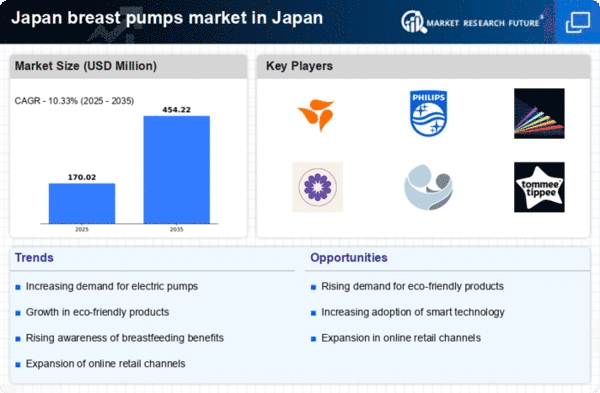
As per Market Research Future analysis, the Japan breast pumps market Size was estimated at 154.1 USD Million in 2024. The Japan breast pumps market is projected to grow from 170.02 USD Million in 2025 to 454.22 USD Million by 2035, exhibiting a compound annual growth rate (CAGR) of 10.3% during the forecast period 2025 - 2035

Key Market Trends & Highlights

The Japan breast pumps market is experiencing notable growth driven by technological advancements and changing consumer preferences.

  • Technological advancements are enhancing the efficiency and user-friendliness of breast pumps, appealing to modern parents.
  • The largest segment in the market is the electric breast pumps, while manual breast pumps are currently the fastest-growing segment.
  • Increased awareness and support for breastfeeding practices are contributing to a rise in demand for breast pumps across various demographics.
  • Rising birth rates and government initiatives and support are key drivers propelling the growth of the breast pumps market in Japan.

Market Size & Forecast

2024 Market Size 154.1 (USD Million)
2035 Market Size 454.22 (USD Million)
CAGR (2025 - 2035) 10.33%

Major Players

Medela (CH), Philips (NL), Spectra (KR), Lansinoh (US), Ameda (US), Tommee Tippee (GB), Chicco (IT), Pigeon (JP)

Our Impact
Enabled $4.3B Revenue Impact for Fortune 500 and Leading Multinationals
Partnering with 2000+ Global Organizations Each Year
30K+ Citations by Top-Tier Firms in the Industry

Japan Breast Pumps Market Trends

The breast pumps market in Japan is currently experiencing notable growth, driven by a combination of factors including increasing awareness of breastfeeding benefits and a rising number of working mothers. The cultural shift towards supporting breastfeeding, alongside advancements in technology, has led to the development of more efficient and user-friendly devices. Manufacturers are focusing on creating products that cater to the needs of modern mothers, emphasizing portability, ease of use, and comfort. This trend appears to be fostering a more favorable environment for breastfeeding, as mothers seek solutions that align with their busy lifestyles. Moreover, the regulatory landscape in Japan is evolving, with government initiatives aimed at promoting breastfeeding practices. These initiatives may include educational programs and support systems for new mothers, which could further enhance the demand for breast pumps. As the market continues to adapt to the changing needs of consumers, it seems likely that innovation will play a crucial role in shaping future offerings. The emphasis on sustainability and eco-friendly materials is also gaining traction, reflecting broader societal trends towards environmental consciousness. Overall, the breast pumps market is poised for continued expansion, driven by both consumer demand and supportive policies.

Technological Advancements

Recent innovations in the breast pumps market focus on enhancing user experience through improved efficiency and convenience. Manufacturers are integrating smart technology, allowing for features such as app connectivity and customizable settings. These advancements cater to the needs of modern mothers, making the pumping process more manageable and less time-consuming.

Increased Awareness and Support

There is a growing recognition of the importance of breastfeeding, leading to increased support for mothers. Educational campaigns and community programs are being implemented to promote breastfeeding practices. This heightened awareness is likely to drive demand for breast pumps, as more mothers seek to balance their professional and personal lives.

Sustainability Trends

The breast pumps market is witnessing a shift towards sustainable practices, with manufacturers exploring eco-friendly materials and production methods. This trend reflects a broader societal movement towards environmental responsibility, appealing to consumers who prioritize sustainability in their purchasing decisions.

Japan Breast Pumps Market Drivers

Rising Birth Rates

The increasing birth rates in Japan have a direct impact on the breast pumps market. As more families choose to have children, the demand for breastfeeding products, including breast pumps, is likely to rise. Recent statistics indicate that the birth rate in Japan has shown a slight increase, which may lead to a higher number of breastfeeding mothers seeking efficient solutions for milk expression. This trend suggests a growing market potential for breast pumps, as new mothers often prioritize convenience and effectiveness in their breastfeeding journey. The breast pumps market is poised to benefit from this demographic shift, as manufacturers may introduce innovative products tailored to the needs of new mothers.

Technological Innovations

Technological innovations in the breast pumps market are transforming the way mothers express milk. Advances in design, efficiency, and user-friendliness are making breast pumps more appealing to consumers. Features such as smart technology, portability, and quieter operation are becoming increasingly important to modern mothers. The breast pumps market is witnessing a surge in demand for electric and hands-free models, which offer convenience and flexibility. As manufacturers continue to invest in research and development, the introduction of new technologies may further enhance the appeal of breast pumps, potentially leading to increased sales and market growth.

Increased Health Awareness

Increased health awareness among Japanese consumers is contributing to the growth of the breast pumps market. As more individuals recognize the health benefits of breastfeeding for both mothers and infants, the demand for breast pumps is likely to rise. Educational campaigns and resources promoting breastfeeding are becoming more prevalent, which may lead to a greater acceptance of breast pumps as essential tools for nursing mothers. The breast pumps market stands to gain from this heightened awareness, as it encourages mothers to invest in quality products that support their breastfeeding goals. This trend suggests a positive outlook for the market as health-conscious consumers seek effective solutions.

Changing Consumer Preferences

Changing consumer preferences are shaping the breast pumps market in Japan. As more mothers prioritize convenience and flexibility, there is a noticeable shift towards electric and portable breast pumps. This trend indicates that consumers are seeking products that fit seamlessly into their busy lifestyles. The breast pumps market is adapting to these preferences by offering a wider range of options that cater to the needs of modern mothers. Additionally, the rise of online shopping has made it easier for consumers to access various breast pump models, further driving market growth. Understanding these evolving preferences is crucial for manufacturers aiming to capture a larger share of the market.

Government Initiatives and Support

Government initiatives aimed at promoting breastfeeding are likely to bolster the breast pumps market in Japan. Various programs and campaigns encourage mothers to breastfeed, which in turn increases the demand for breast pumps. The Japanese government has implemented policies that support maternal health and breastfeeding practices, potentially leading to a rise in the number of mothers utilizing breast pumps. This supportive environment may enhance the breast pumps market, as it encourages manufacturers to develop products that align with government guidelines and consumer needs. The collaboration between public health initiatives and the breast pumps market could result in increased awareness and accessibility of breastfeeding solutions.


Market Segment Insights

By Technology: Electric Pumps (Largest) vs. Manual Pumps (Fastest-Growing)

In the Japan breast pumps market, Electric Pumps hold the largest market share, reflecting consumer preference for efficiency and convenience. Meanwhile, Manual Pumps, while smaller in share, are experiencing significant growth as they appeal to budget-conscious consumers seeking flexibility and simplicity in use. The growth of Manual Pumps is driven by increasing awareness of breastfeeding benefits among new mothers and the desire for portable options. Electric Pumps continue to dominate due to advancements in technology and features that cater to modern parent's needs, such as quiet operation and ease of use, further solidifying their position in the market.

Technology: Electric Pumps (Dominant) vs. Manual Pumps (Emerging)

Electric Pumps are characterized by their efficiency and user-friendly design, making them a preferred choice for many new mothers in the Japan breast pumps market. These devices utilize advanced technology to provide consistent suction and reduce the time spent on pumping. In contrast, Manual Pumps offer a more traditional, hands-on approach that appeals to a growing segment of parents interested in cost-effective solutions. These pumps are lightweight and portable, making them increasingly popular among those looking for convenience without compromising on quality. Together, these segments illustrate the diverse preferences of consumers, accommodating various lifestyles and budgets.

By Product: Closed System (Largest) vs. Open System (Fastest-Growing)

In the Japan breast pumps market, the Closed System segment is the largest, commanding a significant share due to its hygienic design and effectiveness in preventing milk contamination. This system appeals to many mothers who prioritize safety and convenience for their infants, making it a preferred choice. On the other hand, the Open System segment is experiencing rapid growth as more consumers are drawn to its user-friendly features and lower initial costs, contributing to a dynamic market landscape. Growth trends indicate that as the awareness of breastfeeding benefits increases, more mothers are seeking efficient and safe breast pumping solutions. The innovation in technology and design is propelling the growth of the Open System, making it an attractive option for new mothers. Companies are focusing on enhancing the functionality and portability of breast pumps, further driving the market. Moreover, the support from healthcare professionals for breastfeeding is likely to bolster demand for both segment values.

Closed System (Dominant) vs. Open System (Emerging)

The Closed System breast pumps are recognized for their superior hygiene standards, preventing the backflow of milk and offering mothers peace of mind. These pumps are engineered with a barrier that keeps milk from coming into contact with the pump's motor and other components, ensuring a safe pumping experience. Their reliability and efficiency in maintaining milk quality appeal strongly to health-conscious mothers. In contrast, Open System breast pumps are becoming increasingly popular among mothers seeking affordability and ease of use. While they may not offer the same level of hygiene protection as Closed Systems, their lightweight design and user-friendly features cater to a growing segment of consumers looking for convenient solutions for on-the-go pumping.

By Application: Personal Use (Largest) vs. Hospital Grade (Fastest-Growing)

In the Japan breast pumps market, the distribution between personal use and hospital-grade pumps highlights the significant majority held by personal use devices. This segment caters primarily to individual mothers seeking convenience and efficiency, accounting for a notable share of market demand. Hospital-grade pumps, while smaller in proportion, are quickly gaining traction due to their superior technology and performance needed for medical settings. Growth trends indicate that the hospital-grade segment is becoming increasingly relevant as healthcare facilities focus on providing advanced solutions for breastfeeding support. The rise in awareness around breastfeeding benefits and the increasing adoption of hospital-grade pumps in medical institutions are driving this growth. Concurrently, personal use devices continue to thrive as more mothers prioritize ease of use and flexibility in their breastfeeding journeys.

Personal Use (Dominant) vs. Hospital Grade (Emerging)

In the Japan breast pumps market, the personal use segment remains dominant due to its alignment with the needs of everyday consumers who prioritize convenience and effectiveness. These pumps are typically designed for portability and ease of use, allowing mothers to express milk at home or on-the-go effortlessly. Features such as adjustable suction levels, portability, and user-friendly designs make them a preferred choice for many. On the other hand, the hospital-grade segment is emerging with advanced technology that caters to medical facilities. These pumps are engineered for high efficiency and frequency of use, often used in hospitals and clinics to support mothers with medical conditions or those who face challenges with breastfeeding. Their growing presence indicates a shift towards more specialized solutions in the market.

Get more detailed insights about Japan Breast Pumps Market

Key Players and Competitive Insights

The breast pumps market in Japan exhibits a dynamic competitive landscape characterized by innovation and strategic partnerships. Key players such as Medela (CH), Philips (NL), and Spectra (KR) are at the forefront, each employing distinct strategies to enhance their market presence. Medela (CH) focuses on product innovation, particularly in developing smart breast pumps that integrate with mobile applications, thereby appealing to tech-savvy consumers. Philips (NL) emphasizes sustainability in its product lines, aligning with growing consumer preferences for eco-friendly solutions. Meanwhile, Spectra (KR) leverages its strong distribution network to penetrate rural markets, ensuring accessibility for a broader demographic.The competitive structure of the market appears moderately fragmented, with several players vying for market share. Companies are increasingly localizing manufacturing to reduce costs and optimize supply chains, which may enhance their competitive edge. This localized approach allows for quicker response times to market demands and fosters a more resilient supply chain, particularly in the face of global uncertainties.

In October Medela (CH) announced a partnership with a leading Japanese tech firm to develop an AI-driven breast pump that personalizes pumping schedules based on user data. This strategic move not only positions Medela as a pioneer in smart technology but also aligns with the increasing consumer demand for personalized healthcare solutions. The collaboration is likely to enhance user experience and could lead to increased market share in the tech-savvy segment of the population.

In September Philips (NL) launched a new line of eco-friendly breast pumps made from recycled materials, reinforcing its commitment to sustainability. This initiative is significant as it responds to the rising consumer awareness regarding environmental issues. By prioritizing sustainable practices, Philips may strengthen its brand loyalty among environmentally conscious consumers, potentially leading to a competitive advantage in the market.

In August Spectra (KR) expanded its distribution channels by partnering with local retailers across Japan, aiming to increase product availability in underserved areas. This strategic expansion is crucial as it not only enhances brand visibility but also addresses the accessibility challenges faced by new mothers in rural regions. Such initiatives may contribute to a more inclusive market presence and foster brand loyalty among diverse consumer segments.

As of November the breast pumps market is increasingly influenced by trends such as digitalization, sustainability, and AI integration. Strategic alliances among companies are shaping the competitive landscape, fostering innovation and enhancing product offerings. The shift from price-based competition to a focus on technological advancement and supply chain reliability is evident. Companies that prioritize innovation and sustainability are likely to differentiate themselves in this evolving market, suggesting a future where competitive advantage hinges on the ability to adapt to consumer preferences and technological advancements.

Key Companies in the Japan Breast Pumps Market include

Industry Developments

The Japan Breast Pumps Market has recently seen several notable developments. In September 2023, Medela announced a new line of innovative breast pumps designed to enhance user experience and efficiency for mothers.

This follows a trend in which key players, such as Pigeon and Philips, have been emphasizing technological advancements in their breast pump offerings, integrating smart technology for real-time monitoring.

Since 2021, the market has experienced steady growth, driven by an increase in awareness surrounding breastfeeding and maternal health, alongside supportive government policies promoting breastfeeding. Furthermore, in July 2023, Munchkin entered into a collaboration with local retailers to expand its market reach, highlighting the importance of strategic partnerships in capturing consumer attention.

In terms of mergers and acquisitions, there have been no publicly known significant transactions involving the listed companies in the last six months; however, the competitive landscape remains dynamic.

The overall market valuation has improved substantially, with estimates indicating a projected growth rate contributing positively to both local manufacturers and international brands, such as Chicco and Lansinoh, reinforcing their market positions in Japan.

Future Outlook

Japan Breast Pumps Market Future Outlook

The Breast Pumps Market in Japan is projected to grow at a 10.33% CAGR from 2025 to 2035, driven by technological advancements, increasing awareness, and changing consumer preferences.

New opportunities lie in:

  • Development of smart breast pumps with mobile app integration
  • Expansion of rental services for high-end breast pumps
  • Partnerships with hospitals for exclusive product offerings

By 2035, the market is expected to achieve substantial growth and innovation.

Market Segmentation

Japan Breast Pumps Market Product Outlook

  • Open System
  • Closed System

Japan Breast Pumps Market Technology Outlook

  • Manual Pumps
  • Battery Powered Pumps
  • Electric Pumps

Japan Breast Pumps Market Application Outlook

  • Personal Use
  • Hospital Grade

Report Scope

MARKET SIZE 2024154.1(USD Million)
MARKET SIZE 2025170.02(USD Million)
MARKET SIZE 2035454.22(USD Million)
COMPOUND ANNUAL GROWTH RATE (CAGR)10.33% (2025 - 2035)
REPORT COVERAGERevenue Forecast, Competitive Landscape, Growth Factors, and Trends
BASE YEAR2024
Market Forecast Period2025 - 2035
Historical Data2019 - 2024
Market Forecast UnitsUSD Million
Key Companies ProfiledMedela (CH), Philips (NL), Spectra (KR), Lansinoh (US), Ameda (US), Tommee Tippee (GB), Chicco (IT), Pigeon (JP)
Segments CoveredTechnology, Product, Application
Key Market OpportunitiesIntegration of smart technology in breast pumps enhances user experience and meets evolving consumer demands.
Key Market DynamicsRising consumer preference for electric breast pumps drives innovation and competition in Japan's breast pumps market.
Countries CoveredJapan
Leave a Comment

FAQs

What is the expected market size of the Japan Breast Pumps Market in 2024?

The Japan Breast Pumps Market is expected to be valued at 184.8 million USD in 2024.

What is the projected market size for the Japan Breast Pumps Market by 2035?

In 2035, the Japan Breast Pumps Market is anticipated to reach a valuation of 488.5 million USD.

What is the estimated compound annual growth rate (CAGR) for the Japan Breast Pumps Market from 2025 to 2035?

The estimated CAGR for the Japan Breast Pumps Market from 2025 to 2035 is 9.239 percent.

Which technology segment holds the largest market value in 2024 within the Japan Breast Pumps Market?

The Electric Pumps segment holds the largest market value at 94.8 million USD in 2024.

What is the market value of Manual Pumps in the Japan Breast Pumps Market in 2035?

The market value for Manual Pumps is projected to be 125.0 million USD in 2035.

Who are the key players in the Japan Breast Pumps Market?

Key players in the market include Munchkin, Tommee Tippee, Chicco, Bebek, Pigeon, Medela, Philips, Lansinoh, Spectra, Bellababy, Ameda, and Nuk.

What is the market size of Battery Powered Pumps in 2024 in Japan?

Battery Powered Pumps are valued at 40.0 million USD in the Japan Breast Pumps Market in 2024.

What growth factors are contributing to the expansion of the Japan Breast Pumps Market?

Growing awareness regarding breastfeeding benefits and technological advancements are key growth drivers in the market.

What challenges could affect the Japan Breast Pumps Market's growth by 2035?

Challenges may include competition from alternative feeding methods and regulatory hurdles affecting product development.

What is the market value of Electric Pumps expected to be in 2035?

The market value for Electric Pumps is expected to reach 263.5 million USD in 2035.

Download Free Sample

Kindly complete the form below to receive a free sample of this Report

Compare Licence

×
Features License Type
Single User Multiuser License Enterprise User
Price $4,950 $5,950 $7,250
Maximum User Access Limit 1 User Upto 10 Users Unrestricted Access Throughout the Organization
Free Customization
Direct Access to Analyst
Deliverable Format
Platform Access
Discount on Next Purchase 10% 15% 15%
Printable Versions