×
Request Free Sample ×

Kindly complete the form below to receive a free sample of this Report

* Please use a valid business email

Leading companies partner with us for data-driven Insights

clients tt-cursor
Hero Background

Japan Bottled Water Market

ID: MRFR/CG/44921-HCR
128 Pages
Tejas Chaudhary
February 2026

Japan Bottled Water Market Size, Share, Industry Trend & Analysis Research Report By Type (Water, Carbonated Water, Flavored Water, Functional Water), By Packaging (Plastic Bottle) and By Application (Filter Bottle Washers, Filler Capper, Blow Molder, Shrink Wrapper) - Forecast to 2035

Share:
Download PDF ×

We do not share your information with anyone. However, we may send you emails based on your report interest from time to time. You may contact us at any time to opt-out.

Japan Bottled Water Market Infographic
Purchase Options

Japan Bottled Water Market Summary

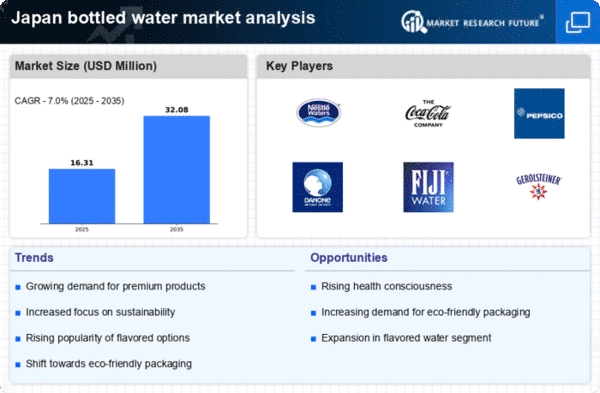
As per Market Research Future analysis, the Japan bottled water market Size was estimated at 15.24 USD Million in 2024. The Japan bottled water market is projected to grow from 16.31 USD Million in 2025 to 32.08 USD Million by 2035, exhibiting a compound annual growth rate (CAGR) of 7% during the forecast period 2025 - 2035

Key Market Trends & Highlights

The Japan bottled water market is experiencing a robust shift towards health-conscious and premium offerings.

  • The largest segment in the Japan bottled water market is still the still water category, while sparkling water is the fastest-growing segment.
  • Health and wellness trends are driving consumers towards bottled water as a healthier alternative to sugary beverages.
  • Sustainability initiatives are becoming increasingly important, with brands focusing on eco-friendly packaging solutions.
  • Rising health consciousness and the demand for convenience are key drivers propelling the market forward.

Market Size & Forecast

2024 Market Size 15.24 (USD Million)
2035 Market Size 32.08 (USD Million)
CAGR (2025 - 2035) 7.0%

Major Players

Nestle Waters (CH), Coca-Cola (US), PepsiCo (US), Danone (FR), Fiji Water (US), Gerolsteiner (DE), Evian (FR), Voss Water (NO), San Pellegrino (IT)

Our Impact
Enabled $4.3B Revenue Impact for Fortune 500 and Leading Multinationals
Partnering with 2000+ Global Organizations Each Year
30K+ Citations by Top-Tier Firms in the Industry

Japan Bottled Water Market Trends

The bottled water market in Japan exhibits a dynamic landscape characterized by evolving consumer preferences and increasing health consciousness. As individuals become more aware of hydration's role in overall well-being, the demand for bottled water continues to rise. This trend is further fueled by the growing inclination towards convenience, as consumers seek easily accessible hydration options. Additionally, the market is witnessing a shift towards premium products, with consumers willing to pay a premium for high-quality, mineral-rich waters. This inclination towards premiumization suggests a potential for brands to differentiate themselves through unique sourcing and packaging strategies. Moreover, sustainability has emerged as a pivotal factor influencing purchasing decisions within the bottled water market. Consumers are increasingly concerned about environmental impacts, prompting brands to adopt eco-friendly practices. This includes utilizing recyclable materials and implementing sustainable sourcing methods. The emphasis on sustainability not only aligns with consumer values but also enhances brand loyalty. As the market evolves, companies that prioritize environmental responsibility may find themselves better positioned to capture the attention of discerning consumers. Overall, the bottled water market in Japan is poised for continued growth, driven by health trends, premiumization, and sustainability initiatives.

Health and Wellness Focus

The bottled water market is increasingly influenced by a growing emphasis on health and wellness. Consumers are more aware of the importance of hydration and its benefits, leading to a rise in demand for bottled water as a healthier alternative to sugary beverages.

Premiumization Trend

There is a noticeable shift towards premium bottled water products. Consumers are willing to invest in high-quality options that offer unique mineral compositions or distinctive sourcing, indicating a desire for enhanced drinking experiences.

Sustainability Initiatives

Sustainability has become a critical consideration for consumers in the bottled water market. Brands are responding by adopting eco-friendly practices, such as using recyclable packaging and promoting responsible sourcing, which resonates with environmentally conscious buyers.

Japan Bottled Water Market Drivers

Diverse Flavor Offerings

The bottled water market in Japan is diversifying its product offerings to include flavored and enhanced waters, catering to a wider range of consumer preferences. This trend reflects a growing interest in unique taste experiences among Japanese consumers, who are increasingly willing to explore new flavors. Data shows that flavored bottled water has seen a growth rate of approximately 15% in recent years, indicating a strong market potential. By expanding their product lines to include various flavors and functional ingredients, companies in the bottled water market can attract new customers and retain existing ones, thereby enhancing their competitive edge.

Rising Health Consciousness

The increasing awareness of health and wellness among consumers in Japan appears to be a primary driver for the bottled water market. As individuals prioritize hydration and seek healthier beverage options, the demand for bottled water has surged. Recent data indicates that the bottled water market in Japan has experienced a growth rate of approximately 8% annually. This trend is likely to continue as consumers become more discerning about their beverage choices, favoring products that promote health benefits. The bottled water market is thus positioned to capitalize on this shift, offering a variety of options that cater to health-conscious consumers, including mineral-rich and functional waters.

Innovative Packaging Solutions

The bottled water market in Japan is witnessing a shift towards innovative packaging solutions that appeal to environmentally conscious consumers. Companies are increasingly adopting eco-friendly materials and designs, which not only enhance the product's appeal but also address sustainability concerns. Recent statistics indicate that around 30% of consumers prefer brands that utilize recyclable or biodegradable packaging. This trend suggests that the bottled water market is evolving to meet consumer expectations for sustainability, potentially leading to increased market share for brands that prioritize eco-friendly practices. As the industry adapts to these preferences, it may also attract a broader customer base.

Convenience and On-the-Go Consumption

The fast-paced lifestyle of urban dwellers in Japan has led to a significant increase in the demand for convenient beverage options. Bottled water, being portable and easy to consume, aligns perfectly with the needs of busy consumers. The bottled water market benefits from this trend, as sales in convenience stores and vending machines have risen sharply. Data suggests that over 60% of bottled water sales occur through these channels, highlighting the importance of accessibility. As more consumers seek hydration solutions that fit their on-the-go lifestyles, the bottled water market is likely to see sustained growth, driven by the need for convenience.

Increased Focus on Hydration Education

The bottled water market in Japan is benefiting from a heightened focus on hydration education among consumers. As health organizations and brands promote the importance of adequate water intake, awareness of the benefits of hydration is growing. This educational push appears to be influencing consumer behavior, leading to increased bottled water consumption. Recent surveys indicate that nearly 70% of consumers recognize the importance of staying hydrated, which bodes well for the bottled water market. As educational initiatives continue to evolve, they may further drive demand, positioning the bottled water market for sustained growth in the coming years.


Market Segment Insights

By Product Type: Water (Largest) vs. Carbonated Water (Fastest-Growing)

In the Japan bottled water market, the segment distribution showcases Water as the largest contributor, holding a significant share among consumers. Carbonated Water has emerged strongly, capturing the attention of health-conscious customers seeking alternatives to sugary beverages. Flavored Water and Functional Water, while smaller in comparison, also cater to niche markets, demonstrating steady interest and demand among various demographics. Growth trends indicate that Carbonated Water is becoming the fastest-growing segment, driven by innovation and marketing that emphasizes healthier, sparkling options. The shift in consumer preferences toward flavored and functional alternatives reflects a broader trend of wellness and lifestyle choices, positioning these segments for potential expansion. Continued product diversification and the introduction of unique flavors are expected to further propel demand in the coming years.

Water (Dominant) vs. Functional Water (Emerging)

Water remains the dominant segment in the Japan bottled water market, preferred for its purity and health benefits. It serves a wide consumer base, with availability in various formats, enhancing its appeal. On the other hand, Functional Water is categorized as an emerging segment, targeting consumers who prioritize enhanced hydration, electrolytes, and additional nutrients. This segment appeals primarily to fitness enthusiasts and those pursuing active lifestyles, creating a growing niche market. As the trend towards health continues, both segments are positioned strategically to cater to evolving consumer preferences, with Water maintaining its stronghold while Functional Water captures the interest of a more discerning audience.

By Packaging: Plastic Bottle (Largest) vs. Others (Fastest-Growing)

In the Japan bottled water market, the distribution of market share among packaging options indicates a strong preference for plastic bottles, which dominate the segment with the largest share. Other packaging types, while significantly smaller in terms of market share, are gradually gaining traction among consumers who seek alternatives, driven by environmental concerns and changing preferences. Growth trends within the packaging segment reveal an increase in demand for sustainable and eco-friendly options. The fastest-growing segment, labeled as 'Others', is benefiting from innovative packaging solutions that cater to environmentally-conscious consumers. The rise in health awareness and fitness trends has also played a role in the overall growth, as consumers are increasingly choosing premium bottled water options that often utilize these emerging packaging types.

Plastic Bottle (Dominant) vs. Others (Emerging)

Plastic bottles remain the dominant packaging choice in the Japan bottled water market due to their convenience, affordability, and lightweight nature, making them ideal for on-the-go consumption. The extensive infrastructure and distribution networks in place support the widespread availability of plastic bottled water. On the other hand, the segment labeled as 'Others' is emerging, primarily consisting of glass bottles and biodegradable options. Brands utilizing these alternative packaging solutions are tapping into a niche market focused on sustainability, which is appealing to a growing demographic of eco-aware consumers. Although currently smaller in market share, the innovations and marketing efforts directed towards 'Others' suggest a potential for significant growth in the coming years.

By Application: Fillers & Cappers (Largest) vs. Filter Bottle Washers (Fastest-Growing)

In the Japan bottled water market, the application segment showcases a diverse distribution among key players. Fillers & Cappers hold a considerable share due to their essential role in ensuring efficient bottling processes. Meanwhile, Filter Bottle Washers, although currently smaller in market share, are emerging rapidly as consumer demand increases for sustainable and hygienic bottle cleaning solutions, indicating a shift towards efficiency and cleanliness. Growth trends within this segment are stimulated by advancements in technology and heightened consumer awareness regarding health and sustainability. The rise in environmental regulations drives investment in innovative solutions like Filter Bottle Washers, while Fillers & Cappers benefit from consistent demand in an expanding market. This transition reflects a broader trend towards automation and sustainable practices in the industry, setting the stage for significant developments ahead.

Fillers & Cappers (Dominant) vs. Filter Bottle Washers (Emerging)

Fillers & Cappers are the dominant force in the application segment of the Japan bottled water market, primarily due to their crucial function in the production line, ensuring efficient bottling and sealing processes. Their widespread adoption stems from the growing demand for bottled water, necessitating reliable machinery to meet high volume requirements. In contrast, Filter Bottle Washers represent an emerging segment, gaining traction as hygiene and sustainability take precedence. Their innovative designs and eco-friendly features cater to a market increasingly focused on reducing water waste and enhancing product safety. This dynamic juxtaposition highlights the ongoing transformation within the application landscape, where traditional methods coexist with novel concepts aimed at improving operational efficiency and environmental stewardship.

Get more detailed insights about Japan Bottled Water Market

Key Players and Competitive Insights

The bottled water market in Japan exhibits a dynamic competitive landscape characterized by a blend of established global players and local brands. Key growth drivers include increasing health consciousness among consumers, a shift towards premium bottled water, and a rising demand for sustainable packaging solutions. Major companies such as Nestle Waters (CH), Coca-Cola (US), and Danone (FR) are strategically positioned to leverage these trends. Nestle Waters (CH) focuses on innovation in product offerings, particularly in the premium segment, while Coca-Cola (US) emphasizes regional expansion and sustainability initiatives. Danone (FR) is actively pursuing partnerships to enhance its distribution network, thereby shaping a competitive environment that is increasingly focused on differentiation through quality and sustainability.In terms of business tactics, companies are localizing manufacturing to reduce costs and optimize supply chains, which is particularly relevant in a market that is moderately fragmented. This fragmentation allows for a diverse range of products, catering to varying consumer preferences. The collective influence of key players is significant, as they not only drive market trends but also set benchmarks for quality and sustainability that smaller brands strive to meet.

In October Coca-Cola (US) announced a partnership with a local Japanese company to develop a new line of eco-friendly bottled water, utilizing biodegradable materials. This strategic move underscores Coca-Cola's commitment to sustainability and aligns with the growing consumer demand for environmentally responsible products. By leveraging local expertise, Coca-Cola (US) aims to enhance its market presence while addressing environmental concerns, which could potentially strengthen its competitive position.

In September Danone (FR) launched a new marketing campaign focused on the health benefits of its bottled water products, targeting health-conscious consumers. This initiative not only aims to boost brand awareness but also positions Danone (FR) as a leader in promoting wellness through hydration. The campaign's success may hinge on its ability to resonate with consumers increasingly prioritizing health in their purchasing decisions.

In August Nestle Waters (CH) expanded its product line to include flavored bottled water, catering to the growing trend of flavored beverages among younger consumers. This strategic diversification could enhance Nestle's appeal in a competitive market, potentially attracting a demographic that seeks variety in their hydration options. The introduction of flavored options may also serve to differentiate Nestle Waters (CH) from its competitors, who primarily focus on traditional bottled water offerings.

As of November current competitive trends in the bottled water market are heavily influenced by digitalization, sustainability, and the integration of AI technologies. Companies are increasingly forming strategic alliances to enhance their operational capabilities and market reach. The shift from price-based competition to a focus on innovation, technology, and supply chain reliability is evident. As consumer preferences evolve, companies that prioritize these aspects are likely to gain a competitive edge, ensuring their relevance in a rapidly changing market.

Key Companies in the Japan Bottled Water Market include

Industry Developments

Recent developments in the Japan Bottled Water Market indicate a growing trend towards health-oriented products, with consumers increasingly favoring mineral-rich water and functional beverages. Companies like Kirin Brewery Company and CocaCola Bottlers Japan are innovating their product lines to cater to this demand. Notably, in October 2023, Oita Prefectural Water announced an expansion of its distribution channels, aiming to enhance its market presence in urban areas. In the mergers and acquisitions sphere, Asahi Group Holdings announced its acquisition of a local bottled water brand in September 2023, which aligns with its strategy to expand its health-focused beverage offerings.

Another significant development includes Suntory Beverage and Food, which has implemented a new sustainability initiative aimed at reducing plastic waste in packaging, enhancing its reputation among environmentally conscious consumers. Over the past two years, the market has seen steady valuation growth attributed to an increase in health awareness among consumers and the rising demand for high-quality water products. This has positively impacted the operations of major players, including Ibusuki Water Source and Mizuno Corporation. The Japan Bottled Water Market continues to adapt and evolve, driven by consumer preferences and sustainability initiatives.

Future Outlook

Japan Bottled Water Market Future Outlook

The Bottled Water Market in Japan is projected to grow at a 7.0% CAGR from 2025 to 2035, driven by health trends, convenience, and sustainability initiatives.

New opportunities lie in:

  • Expansion of eco-friendly packaging solutions
  • Development of premium bottled water brands
  • Implementation of direct-to-consumer online sales channels

By 2035, the market is expected to be robust, reflecting evolving consumer preferences and innovative strategies.

Market Segmentation

Japan Bottled Water Market Packaging Outlook

  • Plastic Bottle
  • Others

Japan Bottled Water Market Application Outlook

  • Filter Bottle Washers
  • Fillers & Cappers
  • Blow Molders
  • Shrink Wrappers

Japan Bottled Water Market Product Type Outlook

  • Water
  • Carbonated Water
  • Flavored Water
  • Functional Water

Report Scope

MARKET SIZE 2024 15.24(USD Million)
MARKET SIZE 2025 16.31(USD Million)
MARKET SIZE 2035 32.08(USD Million)
COMPOUND ANNUAL GROWTH RATE (CAGR) 7.0% (2025 - 2035)
REPORT COVERAGE Revenue Forecast, Competitive Landscape, Growth Factors, and Trends
BASE YEAR 2024
Market Forecast Period 2025 - 2035
Historical Data 2019 - 2024
Market Forecast Units USD Million
Key Companies Profiled Nestle Waters (CH), Coca-Cola (US), PepsiCo (US), Danone (FR), Fiji Water (US), Gerolsteiner (DE), Evian (FR), Voss Water (NO), San Pellegrino (IT)
Segments Covered Product Type, Packaging, Application
Key Market Opportunities Growing demand for eco-friendly packaging solutions in the bottled water market presents significant opportunities.
Key Market Dynamics Rising consumer preference for eco-friendly packaging drives innovation in the bottled water market.
Countries Covered Japan
Leave a Comment

FAQs

What was the projected market size of the Japan Bottled Water Market in 2024?

The Japan Bottled Water Market was projected to be valued at 10.89 million USD in 2024.

How much is the Japan Bottled Water Market expected to grow by 2035?

By 2035, the Japan Bottled Water Market is expected to reach a valuation of 20.38 million USD.

What is the expected CAGR for the Japan Bottled Water Market from 2025 to 2035?

The expected CAGR for the Japan Bottled Water Market from 2025 to 2035 is 5.863 percent.

Which segment of the Japan Bottled Water Market leads in terms of market share?

The 'Water' segment is expected to dominate the market, valued at 4.34 million USD in 2024.

What was the market valuation for the Carbonated Water segment in 2024?

The Carbonated Water segment was valued at 2.18 million USD in 2024.

How much is the Flavored Water segment expected to generate by 2035?

The Flavored Water segment is expected to reach a valuation of 4.69 million USD by 2035.

Who are the major players in the Japan Bottled Water Market?

Major players include Asahi Group Holdings, CocaCola Bottlers Japan, and Nestle Waters.

What was the market valuation of the Functional Water segment in 2024?

The Functional Water segment was valued at 1.83 million USD in 2024.

What growth trends can be observed in the Japan Bottled Water Market?

Emerging trends include increased demand for flavored and functional water.

What challenges might affect the Japan Bottled Water Market in the coming years?

Challenges may include competition from alternative beverage options and environmental concerns.

Download Free Sample

Kindly complete the form below to receive a free sample of this Report

Compare Licence

×
Features License Type
Single User Multiuser License Enterprise User
Price $4,950 $5,950 $7,250
Maximum User Access Limit 1 User Upto 10 Users Unrestricted Access Throughout the Organization
Free Customization
Direct Access to Analyst
Deliverable Format
Platform Access
Discount on Next Purchase 10% 15% 15%
Printable Versions