×
Request Free Sample ×

Kindly complete the form below to receive a free sample of this Report

* Please use a valid business email

Leading companies partner with us for data-driven Insights

clients tt-cursor
Hero Background

Japan Audit Software Market

ID: MRFR/ICT/56604-HCR
200 Pages
Aarti Dhapte
February 2026

Japan Audit Software Market Size, Share and Trends Analysis Report By Component (Solution, Service), By Organization Size (Large Enterprises, Small & Medium Enterprises), By Deployment Model (On-Premise, Cloud) and By Vertical (BFSI, Energy & Utility, Manufacturing, Food & Beverage, Accounting/CPA Firms, Non-Profit Organizations)- Forecast to 2035

Share:
Download PDF ×

We do not share your information with anyone. However, we may send you emails based on your report interest from time to time. You may contact us at any time to opt-out.

Japan Audit Software Market Infographic
Purchase Options

Japan Audit Software Market Summary

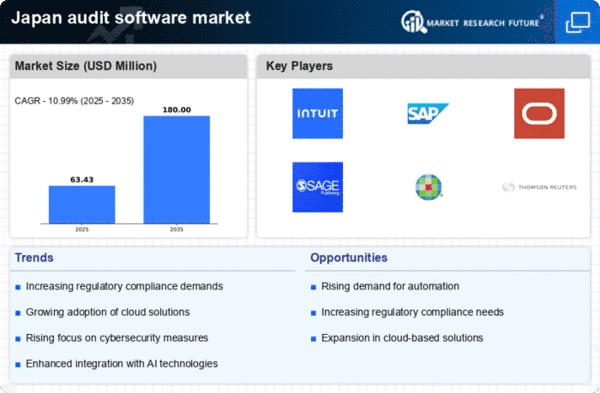
As per Market Research Future analysis, the Japan audit software market size was estimated at 57.15 USD Million in 2024. The Japan audit software market is projected to grow from 63.43 USD Million in 2025 to 180.0 USD Million by 2035, exhibiting a compound annual growth rate (CAGR) of 10.9% during the forecast period 2025 - 2035

Key Market Trends & Highlights

The Japan audit software market is experiencing a transformative shift driven by technological advancements and evolving regulatory landscapes.

  • The integration of AI and automation is reshaping the audit software landscape, enhancing efficiency and accuracy.
  • Data security remains a paramount concern, prompting software providers to prioritize robust security measures.
  • Regulatory compliance adaptability is increasingly vital, as businesses seek solutions that can swiftly adjust to changing regulations.
  • The rising demand for real-time analytics and the shift towards cloud-based solutions are key drivers propelling market growth.

Market Size & Forecast

2024 Market Size 57.15 (USD Million)
2035 Market Size 180.0 (USD Million)
CAGR (2025 - 2035) 10.99%

Major Players

Intuit (US), SAP (DE), Oracle (US), Sage (GB), Wolters Kluwer (NL), Thomson Reuters (CA), CCH Tagetik (IT), BlackLine (US)

Our Impact
Enabled $4.3B Revenue Impact for Fortune 500 and Leading Multinationals
Partnering with 2000+ Global Organizations Each Year
30K+ Citations by Top-Tier Firms in the Industry

Japan Audit Software Market Trends

The audit software market is currently experiencing a notable transformation, driven by advancements in technology and increasing regulatory requirements. Organizations are increasingly adopting sophisticated software solutions to enhance their auditing processes, ensuring compliance and improving operational efficiency. The integration of artificial intelligence and machine learning into audit software is particularly noteworthy, as these technologies facilitate real-time data analysis and risk assessment. This shift not only streamlines workflows but also empowers auditors to focus on strategic decision-making rather than routine tasks. Moreover, the growing emphasis on data security and privacy is shaping the landscape of the audit software market. Companies are prioritizing solutions that offer robust security features to protect sensitive information. As regulatory frameworks evolve, businesses are compelled to invest in software that not only meets compliance standards but also adapts to changing legal requirements. This trend indicates a shift towards more flexible and scalable solutions that can accommodate the dynamic nature of the auditing environment. Overall, the audit software market is poised for continued growth as organizations seek to leverage technology for enhanced audit practices.

Integration of AI and Automation

The incorporation of artificial intelligence and automation technologies is revolutionizing the audit software market. These innovations enable auditors to conduct more thorough analyses with greater speed and accuracy, reducing the time spent on manual tasks. As a result, firms are likely to enhance their audit quality and efficiency, leading to improved client satisfaction.

Focus on Data Security

With the increasing importance of data protection, audit software solutions are evolving to prioritize security features. Organizations are seeking software that not only complies with regulations but also safeguards sensitive information from breaches. This trend reflects a broader commitment to maintaining trust and integrity in the auditing process.

Regulatory Compliance Adaptability

The audit software market is witnessing a trend towards solutions that can quickly adapt to changing regulatory requirements. As laws and standards evolve, businesses require software that can seamlessly integrate updates, ensuring ongoing compliance. This adaptability is crucial for organizations aiming to mitigate risks associated with non-compliance.

Japan Audit Software Market Drivers

Increased Focus on Cost Efficiency

Cost efficiency remains a critical driver for the audit software market. As organizations strive to optimize their operational expenditures, they are increasingly turning to audit software solutions that promise to streamline processes and reduce manual workloads. The potential for significant cost savings is evident, with studies indicating that companies can reduce audit-related costs by up to 30% through the implementation of automated audit solutions. This financial incentive is compelling, particularly for small and medium-sized enterprises (SMEs) that may have limited resources. Consequently, the audit software market is likely to see a surge in adoption as businesses seek to leverage technology to enhance their financial oversight while minimizing costs. The emphasis on cost efficiency is expected to drive innovation and competition among software providers, further enriching the market landscape.

Shift Towards Cloud-Based Solutions

The transition to cloud-based solutions is a significant driver for the audit software market in Japan. Organizations are increasingly adopting cloud technologies to enhance flexibility, scalability, and accessibility of their audit processes. This shift is particularly appealing to businesses that require remote access to audit data and collaboration among geographically dispersed teams. Recent statistics indicate that cloud-based audit solutions are projected to capture over 50% of the market share by 2026. The advantages of cloud computing, such as reduced IT infrastructure costs and automatic updates, are compelling factors that encourage firms to migrate to these platforms. As more organizations recognize the benefits of cloud-based audit software, the market is likely to expand, fostering innovation and competition among providers.

Emphasis on Enhanced User Experience

The audit software market in Japan is witnessing a growing emphasis on enhanced user experience. As organizations seek to improve the efficiency of their audit processes, the usability of software solutions has become a focal point. Companies are increasingly prioritizing intuitive interfaces and user-friendly features that facilitate ease of use for auditors and finance professionals. Research suggests that software solutions with superior user experience can lead to a 25% increase in productivity among audit teams. This focus on user experience is likely to drive the development of more sophisticated and accessible audit software, catering to the diverse needs of users. As firms continue to invest in technologies that enhance user satisfaction, the audit software market is expected to evolve, with a greater emphasis on design and functionality.

Growing Importance of Data Integrity

Data integrity is becoming increasingly paramount in the audit software market in Japan. As organizations face mounting pressure to ensure the accuracy and reliability of their financial data, the demand for robust audit solutions that can guarantee data integrity is on the rise. This trend is underscored by the fact that approximately 70% of Japanese firms have reported instances of data discrepancies in their financial records, highlighting the critical need for reliable audit software. Solutions that incorporate advanced validation and verification processes are likely to gain traction, as they provide organizations with the assurance that their data is accurate and trustworthy. The focus on data integrity not only enhances compliance with regulatory standards but also fosters greater stakeholder confidence, thereby driving the growth of the audit software market.

Rising Demand for Real-Time Analytics

The audit software market is experiencing a notable increase in demand for real-time analytics capabilities. Organizations are increasingly recognizing the value of immediate insights into their financial and operational data. This trend is driven by the need for timely decision-making and enhanced transparency in financial reporting. According to recent data, approximately 65% of Japanese companies are prioritizing real-time data access to improve their audit processes. This shift towards real-time analytics is likely to propel the growth of the audit software market, as firms seek solutions that can provide instant feedback and facilitate proactive risk management. The integration of advanced analytics tools within audit software is expected to enhance the overall efficiency and effectiveness of audits, thereby attracting more businesses to invest in these technologies.


Market Segment Insights

By Component: Solution (Largest) vs. Service (Fastest-Growing)

In the Japan audit software market, the distribution of market share indicates that the Solution segment holds the largest portion, catering to a significant demand within various business sectors. Businesses are increasingly adopting comprehensive solutions that offer advanced features for automating audits, ensuring compliance, and maintaining accuracy. Conversely, the Service segment, while currently smaller, demonstrates noteworthy potential as more firms seek specialized consulting and support services to enhance their internal auditing capabilities. Growth trends in the Japan audit software market reveal that while the Solution segment maintains dominance, the Service segment is rapidly gaining traction. This growth is driven by factors such as evolving regulatory requirements, increasing digitalization of audit processes, and a heightened focus on risk management. Companies are keen on leveraging service offerings to bridge gaps in their internal audit functions, fostering a collaborative approach to compliance and efficiency.

Solution (Dominant) vs. Service (Emerging)

The Solution segment in the Japan audit software market is characterized by its broad application across various industry verticals, providing robust tools for managing complex audit processes. Solutions are designed to enhance efficiency, accuracy, and compliance, making them essential for organizations aiming to streamline their audit functions. Meanwhile, the Service segment is emerging as a critical counterpart, offering tailored support, training, and advisory services that complement software solutions. This segment appeals to businesses seeking personalized engagement and expertise in navigating auditing challenges, thereby fostering a hybrid approach that integrates technology with professional guidance.

By Deployment Model: Cloud (Largest) vs. On-Premise (Fastest-Growing)

In the Japan audit software market, the deployment model landscape is characterized by a significant shift towards cloud-based solutions. The cloud segment commands the largest share, attributed to its scalability, accessibility, and cost-effectiveness, appealing to a broad range of organizations. As businesses increasingly embrace digital transformation, the demand for cloud solutions continues to outpace that of traditional on-premise models, which are gradually losing market prominence. Growth trends indicate a robust acceleration in the adoption of cloud-based audit software, driven by factors such as remote work, enhanced data security measures, and the rising need for real-time compliance monitoring. Meanwhile, the on-premise segment is recognized as the fastest-growing, primarily among sectors with stringent regulatory requirements that favor localized data control. This duality reflects the diverse needs of users in the market, balancing traditional and modern deployment strategies.

Cloud (Dominant) vs. On-Premise (Emerging)

The cloud deployment model in the Japan audit software market is recognized as the dominant force, offering numerous advantages like flexibility, scalability, and lower upfront costs, making it attractive for businesses of all sizes. Its capacity to accommodate remote work scenarios seamlessly has accelerated its uptake. Conversely, the on-premise model maintains an emerging status, appealing particularly to organizations with stringent data privacy concerns and a preference for keeping their data and audit processes entirely in-house. As compliance and regulatory frameworks evolve, on-premise solutions are experiencing growth due to their perceived security benefits. Together, these deployment models represent a critical balance in the market, catering to different organizational needs.

By Organization Size: Large Enterprises (Largest) vs. Small & Medium Enterprises (Fastest-Growing)

In the Japan audit software market, the distribution of market share reveals that large enterprises hold a significant portion, benefitting from complex compliance requirements and large operational needs. This segment's established relationships with software providers allow for robust integration and support, which solidifies its leading position. Conversely, small and medium enterprises are rapidly gaining traction, driven by a rising need for budget-friendly options and flexible tools to manage audits effectively. The growth trends indicate that while large enterprises continue to dominate, small and medium enterprises are emerging as the fastest-growing segment. This shift is primarily attributed to increasing digitization, which encourages smaller firms to adopt audit software that suits their specific needs. As more SMEs embrace technology, the demand for tailored solutions is anticipated to surge, reflecting a changing landscape in the Japan audit software market.

Large Enterprises (Dominant) vs. Small & Medium Enterprises (Emerging)

Large enterprises in the Japan audit software market are characterized by their extensive resources and established technology infrastructure. Their audit requirements are often complex, leading to a preference for comprehensive solutions that can handle multifaceted regulations. These organizations typically benefit from long-term partnerships with software vendors, which ensures tailored services and continuous support. In contrast, small and medium enterprises are increasingly recognizing the value of audit software. They often seek solutions that are cost-effective and easy to implement, making them more agile in compliance and audit processes. The emerging demand for simple, efficient tools reflects a shift toward user-friendly solutions that cater specifically to the unique challenges faced by SMEs.

By Vertical: BFSI (Largest) vs. Manufacturing (Fastest-Growing)

The Japan audit software market exhibits a diverse landscape with significant shares distributed across various sectors. The BFSI segment is the largest, driven by stringent regulatory requirements and a need for enhanced compliance measures. Meanwhile, sectors like Manufacturing are witnessing considerable adoption rates as companies seek to streamline operations and increase transparency within their audit processes. Growth trends indicate that the Manufacturing sector is the fastest-growing in the Japan audit software market, fueled by technological advancements and digitization initiatives. Besides, the BFSI sector continues to thrive, supported by continuous innovations and the need for robust risk management solutions. The shift towards automated auditing processes is reshaping the dynamics of these segments, driving demand for specialized software solutions.

BFSI (Dominant) vs. Manufacturing (Emerging)

In the Japan audit software market, the BFSI segment is positioned as the dominant player, characterized by high demand for compliance and regulatory solutions. Organizations in this sector prioritize accuracy and efficiency, translating to a preference for sophisticated software tools. On the other hand, the Manufacturing sector is an emerging force, where companies increasingly realize the importance of audit processes in enhancing operational efficiency. As manufacturers adopt smarter technologies and automated systems, the demand for tailored audit solutions is expected to rise. This dynamic highlights a shift towards integrating audit capabilities within broader operational frameworks, suggesting that while BFSI remains the leader, Manufacturing is rapidly becoming a vital segment to monitor.

Get more detailed insights about Japan Audit Software Market

Key Players and Competitive Insights

The audit software market is characterized by a dynamic competitive landscape, driven by technological advancements and increasing regulatory requirements. Major players such as Intuit (US), SAP (DE), and Oracle (US) are actively shaping the market through strategic initiatives focused on innovation and digital transformation. Intuit (US) has positioned itself as a leader in user-friendly solutions, emphasizing cloud-based offerings that cater to small and medium-sized enterprises. Meanwhile, SAP (DE) leverages its extensive enterprise resource planning (ERP) capabilities to integrate audit functionalities, thereby enhancing operational efficiency for larger corporations. Oracle (US) continues to invest in artificial intelligence (AI) and machine learning (ML) to automate audit processes, which not only streamlines operations but also reduces compliance risks. Collectively, these strategies foster a competitive environment that prioritizes technological integration and customer-centric solutions.
In terms of business tactics, companies are increasingly localizing their offerings to better meet the specific needs of Japanese clients. This localization often involves adapting software features to comply with local regulations and cultural preferences. The market structure appears moderately fragmented, with a mix of established players and emerging startups. The influence of key players is substantial, as they set benchmarks for quality and innovation, compelling smaller firms to either innovate rapidly or seek partnerships to remain competitive.
In October 2025, SAP (DE) announced a strategic partnership with a leading Japanese fintech firm to enhance its audit software capabilities. This collaboration aims to integrate advanced analytics and AI-driven insights into SAP's existing solutions, thereby providing clients with more robust tools for risk management and compliance. The strategic importance of this partnership lies in its potential to significantly improve SAP's market penetration in Japan, allowing it to offer tailored solutions that resonate with local businesses.
In September 2025, Intuit (US) launched a new version of its audit software specifically designed for the Japanese market, incorporating features that address local tax regulations and compliance requirements. This move is indicative of Intuit's commitment to understanding and meeting the unique needs of Japanese customers. By enhancing its product offerings, Intuit not only strengthens its competitive position but also fosters customer loyalty in a market that values localized solutions.
In August 2025, Oracle (US) unveiled a new AI-driven module within its audit software suite, aimed at automating data analysis and reporting processes. This innovation is particularly significant as it addresses the growing demand for efficiency in audit practices. By reducing the time and resources required for audits, Oracle positions itself as a forward-thinking leader in the market, appealing to organizations seeking to optimize their audit functions.
As of November 2025, the competitive trends in the audit software market are increasingly defined by digitalization, sustainability, and the integration of AI technologies. Strategic alliances are becoming more prevalent, as companies recognize the value of collaboration in enhancing their service offerings. Looking ahead, competitive differentiation is likely to evolve from traditional price-based strategies to a focus on innovation, technological advancements, and supply chain reliability. This shift underscores the importance of agility and responsiveness in a rapidly changing market landscape.

Key Companies in the Japan Audit Software Market include

Industry Developments

The Japan Audit Software Market has seen significant activity recently, particularly in terms of product innovation and investment. Companies like Microsoft and Oracle have expanded their offerings to include advanced analytics tools, enhancing decision-making capabilities for audit professionals. The transition to cloud-based solutions is also gaining momentum, with software providers such as Xero and Zoho integrating more artificial intelligence features to streamline auditing processes. 

In terms of valuations, the market is projected to experience robust growth, driven by increased demand for data security and regulatory compliance, resulting in a strong competitive landscape for firms including and SAP. Furthermore, notable acquisitions are taking place, such as Intuit's acquisition of a smaller player in the market for an undisclosed amount in September 2023, which aims to enhance its audit functionalities. 

Over the past couple of years, increased regulatory scrutiny in Japan has prompted businesses to invest more in comprehensive auditing tools, with major events including the rollout of stricter compliance guidelines in April 2022. Overall, ongoing technological advancements and strategic partnerships are redefining the auditing landscape in Japan.


Future Outlook

Japan Audit Software Market Future Outlook

The audit software market is projected to grow at a 10.99% CAGR from 2025 to 2035, driven by technological advancements and regulatory compliance needs.

New opportunities lie in:

  • Integration of AI-driven analytics for real-time auditing insights.
  • Development of cloud-based solutions for remote audit capabilities.
  • Expansion into niche markets such as environmental and sustainability audits.

By 2035, the audit software market is expected to achieve substantial growth and innovation.

Market Segmentation

Japan Audit Software Market Vertical Outlook

  • BFSI
  • Energy & Utility
  • Manufacturing
  • Food & Beverage
  • Accounting/CPA Firms
  • Non-Profit Organizations

Japan Audit Software Market Component Outlook

  • Solution
  • Service

Japan Audit Software Market Deployment Model Outlook

  • On-Premise
  • Cloud

Japan Audit Software Market Organization Size Outlook

  • Large Enterprises
  • Small & Medium Enterprises

Report Scope

MARKET SIZE 2024 57.15(USD Million)
MARKET SIZE 2025 63.43(USD Million)
MARKET SIZE 2035 180.0(USD Million)
COMPOUND ANNUAL GROWTH RATE (CAGR) 10.99% (2025 - 2035)
REPORT COVERAGE Revenue Forecast, Competitive Landscape, Growth Factors, and Trends
BASE YEAR 2024
Market Forecast Period 2025 - 2035
Historical Data 2019 - 2024
Market Forecast Units USD Million
Key Companies Profiled Intuit (US), SAP (DE), Oracle (US), Sage (GB), Wolters Kluwer (NL), Thomson Reuters (CA), CCH Tagetik (IT), BlackLine (US)
Segments Covered Component, Deployment Model, Organization Size, Vertical
Key Market Opportunities Integration of artificial intelligence enhances efficiency and accuracy in the audit software market.
Key Market Dynamics Rising demand for compliance-driven audit software amid evolving regulatory frameworks in Japan's financial sector.
Countries Covered Japan
Leave a Comment

FAQs

What is the expected market size of the Japan Audit Software Market in 2024?

The Japan Audit Software Market is expected to be valued at 38.1 million USD in 2024.

What is the projected market size for the Japan Audit Software Market by 2035?

By 2035, the Japan Audit Software Market is projected to reach a valuation of 114.3 million USD.

What is the expected CAGR for the Japan Audit Software Market from 2025 to 2035?

The expected compound annual growth rate for the Japan Audit Software Market from 2025 to 2035 is 10.503%.

What are the major components of the Japan Audit Software Market?

The Japan Audit Software Market is segmented into two key components: Solution and Service.

How much is the Solution segment expected to be valued at in 2024?

In 2024, the Solution segment of the Japan Audit Software Market is expected to be valued at 20.0 million USD.

What is the expected value of the Service segment in 2035?

The Service segment of the Japan Audit Software Market is expected to reach a value of 54.3 million USD by 2035.

Who are the key players in the Japan Audit Software Market?

Some major players in the Japan Audit Software Market include Microsoft, Intuit, Oracle, and IBM.

What are the key trends driving the growth of the Japan Audit Software Market?

Key trends driving growth include increasing demand for automation and enhanced compliance processes in auditing.

What challenges does the Japan Audit Software Market currently face?

The market faces challenges such as rapid technological changes and the need for regulatory compliance.

How does the global economic situation impact the Japan Audit Software Market?

The global economic situation can influence investment in technologies, thereby impacting the Japan Audit Software Market growth.

Download Free Sample

Kindly complete the form below to receive a free sample of this Report

Compare Licence

×
Features License Type
Single User Multiuser License Enterprise User
Price $4,950 $5,950 $7,250
Maximum User Access Limit 1 User Upto 10 Users Unrestricted Access Throughout the Organization
Free Customization
Direct Access to Analyst
Deliverable Format
Platform Access
Discount on Next Purchase 10% 15% 15%
Printable Versions