×
Request Free Sample ×

Kindly complete the form below to receive a free sample of this Report

* Please use a valid business email

Leading companies partner with us for data-driven Insights

clients tt-cursor
Hero Background

Japan Application Modernization Services Market

ID: MRFR/ICT/57084-HCR
200 Pages
Aarti Dhapte
February 2026

Japan Application Modernization Services Market Size, Share and Trends Analysis Report By Vertical (Healthcare, IT, Telecommunications, Energy and utilities, Manufacturing, Consumer goods and retail), By Deployment Type (Hybrid cloud, Private cloud, Public cloud) and By Application (Post modernization, Application portfolio assignment, UI modernization, Cloud application mitigation, Application integration, Application re-platforming)- Forecast to 2035

Share:
Download PDF ×

We do not share your information with anyone. However, we may send you emails based on your report interest from time to time. You may contact us at any time to opt-out.

Japan Application Modernization Services Market Infographic
Purchase Options

Japan Application Modernization Services Market Summary

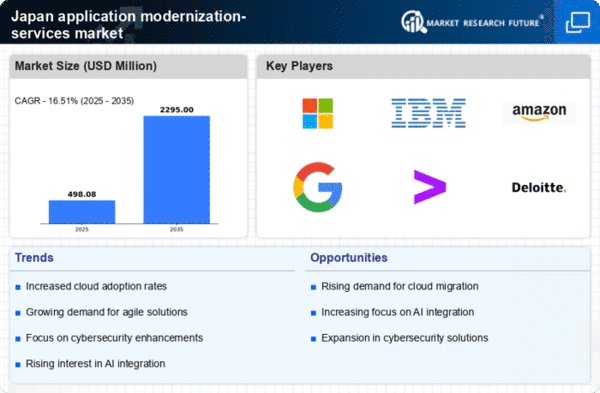
As per Market Research Future analysis, the Japan application modernization-services market Size was estimated at 427.5 USD Million in 2024. The Japan application modernization-services market industry is projected to grow from 498.08 USD Million in 2025 to 2295.0 USD Million by 2035, exhibiting a compound annual growth rate (CAGR) of 16.5% during the forecast period 2025 - 2035

Key Market Trends & Highlights

The Japan application modernization-services market is experiencing robust growth driven by digital transformation and technological advancements.

  • Cloud adoption and migration are accelerating as organizations seek to enhance operational efficiency.
  • There is a heightened focus on security and compliance to protect sensitive data and meet regulatory requirements.
  • The integration of advanced technologies, such as AI and automation, is reshaping service delivery models.
  • Rising demand for digital transformation and government initiatives are key drivers propelling market expansion.

Market Size & Forecast

2024 Market Size 427.5 (USD Million)
2035 Market Size 2295.0 (USD Million)
CAGR (2025 - 2035) 16.51%

Major Players

Microsoft (US), IBM (US), Amazon (US), Google (US), Accenture (IE), Deloitte (US), Capgemini (FR), Cognizant (US), TCS (IN), HCL Technologies (IN)

Our Impact
Enabled $4.3B Revenue Impact for Fortune 500 and Leading Multinationals
Partnering with 2000+ Global Organizations Each Year
30K+ Citations by Top-Tier Firms in the Industry

Japan Application Modernization Services Market Trends

The application modernization-services market is currently experiencing a transformative phase, driven by the increasing need for organizations to enhance operational efficiency and adapt to evolving technological landscapes. As businesses in Japan strive to remain competitive, they are increasingly investing in modernizing legacy systems, which often hinder agility and innovation. This shift is characterized by a growing emphasis on cloud migration, microservices architecture, and the integration of advanced technologies such as artificial intelligence and machine learning. The focus on improving user experience and ensuring data security is paramount, as organizations seek to leverage modernization efforts to meet customer expectations and regulatory requirements. Moreover, the landscape of the application modernization-services market is shaped by a diverse range of stakeholders, including IT service providers, software vendors, and consulting firms. Collaboration among these entities is essential to deliver comprehensive solutions that address the unique challenges faced by businesses in Japan. The ongoing digital transformation initiatives, supported by government policies promoting innovation and technology adoption, further bolster the market's growth potential. As organizations continue to prioritize modernization strategies, the application modernization-services market is poised for sustained expansion, reflecting the dynamic nature of the technology ecosystem in Japan.

Cloud Adoption and Migration

The trend towards cloud adoption is gaining momentum, as organizations recognize the benefits of scalability, flexibility, and cost-effectiveness. Many businesses are migrating their applications to cloud platforms, which allows for improved resource management and enhanced collaboration. This shift not only modernizes infrastructure but also facilitates the integration of innovative technologies.

Focus on Security and Compliance

As digital threats become more sophisticated, there is an increasing emphasis on security and compliance within the application modernization-services market. Organizations are prioritizing the implementation of robust security measures to protect sensitive data and ensure compliance with regulations. This focus is crucial for maintaining customer trust and safeguarding business operations.

Integration of Advanced Technologies

The integration of advanced technologies such as artificial intelligence, machine learning, and automation is transforming the application modernization-services market. These technologies enable organizations to enhance operational efficiency, improve decision-making processes, and deliver personalized customer experiences. The adoption of such innovations is likely to drive competitive advantage in the market.

Japan Application Modernization Services Market Drivers

Government Initiatives and Support

The Japanese government is actively promoting initiatives aimed at enhancing the digital landscape, which significantly impacts the application modernization-services market. With policies encouraging the adoption of advanced technologies, the government aims to boost productivity and innovation. For instance, the Digital Agency of Japan has launched various programs to support businesses in their modernization efforts. This governmental backing is expected to catalyze investments in application modernization services, as companies seek to align with national objectives. The application modernization-services market is likely to benefit from these initiatives, as they provide a conducive environment for technological advancements and modernization efforts across multiple sectors.

Increased Focus on Customer Experience

In Japan, there is a growing emphasis on improving customer experience, which is driving the application modernization-services market. Businesses are increasingly aware that outdated applications can hinder customer satisfaction and loyalty. As a result, many organizations are investing in modernizing their applications to provide seamless and personalized experiences. Recent surveys indicate that over 60% of Japanese consumers prefer businesses that utilize modern technology for service delivery. This shift in consumer expectations compels companies to prioritize application modernization, thereby fueling market growth. The application modernization-services market is likely to expand as businesses strive to meet these evolving customer demands.

Competitive Pressure and Market Dynamics

The competitive landscape in Japan is intensifying, prompting organizations to modernize their applications to remain relevant. As new entrants and innovative startups emerge, established companies are compelled to enhance their technological capabilities. This competitive pressure is a significant driver for the application modernization-services market, as businesses seek to leverage modern applications for improved agility and responsiveness. Data suggests that companies that invest in modernization are 50% more likely to outperform their competitors. Consequently, the application modernization-services market is expected to thrive as organizations prioritize modernization to maintain their market position and drive growth.

Rising Demand for Digital Transformation

The application modernization-services market in Japan is experiencing a notable surge in demand driven by the need for digital transformation across various sectors. Organizations are increasingly recognizing the necessity to modernize legacy systems to enhance operational efficiency and customer engagement. According to recent data, approximately 70% of Japanese enterprises are prioritizing digital initiatives, which directly influences the growth of the application modernization-services market. This trend is particularly evident in industries such as finance and retail, where the integration of modern applications is essential for maintaining competitive advantage. As businesses strive to adapt to changing consumer behaviors and technological advancements, the application modernization-services market is poised for substantial growth.

Integration of Artificial Intelligence and Automation

The integration of artificial intelligence (AI) and automation technologies is reshaping the application modernization-services market in Japan. Organizations are increasingly adopting AI-driven solutions to enhance operational efficiency and decision-making processes. This trend is evident in sectors such as manufacturing and logistics, where automation is becoming essential for optimizing workflows. The application modernization-services market is likely to benefit from this integration, as businesses seek to modernize their applications to incorporate AI capabilities. Reports indicate that companies leveraging AI in their operations can achieve up to 30% cost savings, further incentivizing investments in application modernization services.


Market Segment Insights

By Vertical: Healthcare (Largest) vs. IT (Fastest-Growing)

The Japan application modernization-services market exhibits a diverse distribution among its verticals, with the healthcare sector holding the largest share. This segment benefits from increased investments in digital health initiatives and the adoption of advanced technologies. Following closely are the IT and telecommunications sectors, which are also experiencing significant traction as organizations shift towards modernization to stay competitive. Consumer goods and retail are growing steadily, reflecting shifts in consumer behavior and e-commerce growth. Growth trends are being driven by several factors, including the demand for digital transformation and efficiency improvements across industries. The healthcare segment is evolving rapidly, focusing on telemedicine and electronic health records, while IT leads in adopting cloud services and agile methodologies. Telecommunications are expanding due to 5G rollout, and the manufacturing sector is increasingly looking at IoT solutions. All these trends indicate a dynamic market responding to both technological advancements and changing consumer needs.

Healthcare: Dominant vs. IT: Emerging

In the Japan application modernization-services market, the healthcare segment stands out as a dominant force, leveraging advanced technologies to enhance patient care and streamline operations. This vertical is characterized by its significant investments in digital health tools, which include telehealth platforms and data analytics. On the other hand, the IT sector is emerging rapidly, driven by the need for businesses to adopt modern solutions such as cloud computing and AI. This segment is gaining traction as companies implement agile practices to improve efficiency and reduce operational costs. Together, these segments highlight a transformation, where healthcare leads in current adoption while IT positions itself as a vital player for future growth.

By Deployment Mode: Hybrid Cloud (Largest) vs. Private Cloud (Fastest-Growing)

In the Japan application modernization-services market, the deployment mode segment showcases notable market share dynamics. Hybrid cloud solutions have emerged as the dominant choice among enterprises, widely adopted for their flexibility and scalability. This mode enables organizations to leverage both on-premises and cloud resources effectively. Meanwhile, private cloud solutions, though smaller in share, are rapidly gaining traction due to increasing demand for enhanced security and compliance. Growth trends in this segment indicate a shift towards hybrid cloud as businesses strive to optimize operational efficiency. The rising need for digital transformation and robust IT infrastructure is propelling investments in cloud technologies. Private cloud is witnessing accelerated growth, driven by enterprises prioritizing data security and regulatory compliance in their modernization strategies. Such trends reflect the evolving preferences of companies seeking tailored cloud solutions.

Hybrid Cloud: Dominant vs. Private Cloud: Emerging

Hybrid cloud stands out as the dominant deployment mode in the Japan application modernization-services market, offering organizations the dual advantage of public and private cloud capabilities. This approach allows businesses to maintain control over sensitive data while accessing the scalability of public cloud services, thereby enhancing operational efficiency. In contrast, private cloud is an emerging segment showing rapid growth, appealing to companies with strict data privacy requirements. Organizations are increasingly investing in private cloud solutions to meet compliance regulations and enhance security measures. As the market evolves, both deployment modes are expected to play pivotal roles, with hybrid cloud leading in adoption while private cloud carves a niche for highly regulated industries.

By Application: Application Integration (Largest) vs. UI Modernization (Fastest-Growing)

In the Japan application modernization-services market, Application Integration holds the largest share, driven by the increasing need for businesses to streamline operations and enhance communication across various applications. Following closely is UI Modernization, which has quickly become a significant contributor, appealing to organizations seeking to enhance user experience and engagement through aesthetic and functional upgrades. The growth trends within the application segment show a strong emphasis on digital transformation initiatives. The demand for Application Integration is primarily influenced by the ongoing shift toward a more interconnected software ecosystem, while UI Modernization is being propelled by consumer expectations for intuitive and visually appealing interfaces. Businesses are prioritizing these areas to maintain competitiveness and adapt to evolving market dynamics.

Application Integration (Dominant) vs. UI Modernization (Emerging)

Application Integration is characterized by its ability to connect disparate systems and facilitate seamless data exchange, proving essential for organizations aiming to optimize workflows and reduce operational silos. As a dominant player in the segment, it enables businesses to leverage existing infrastructure while adopting new technologies. In contrast, UI Modernization is emerging as a critical focus for many firms, as the demand for enhanced user interfaces and experiences intensifies. This segment addresses the need for applications to be visually appealing and user-friendly, which is crucial in an increasingly competitive landscape where customer satisfaction plays a pivotal role in business success.

Get more detailed insights about Japan Application Modernization Services Market

Key Players and Competitive Insights

The application modernization-services market in Japan is characterized by a dynamic competitive landscape, driven by the increasing demand for digital transformation and cloud adoption. Major players such as Microsoft (US), IBM (US), and Accenture (IE) are strategically positioned to leverage their technological expertise and extensive service portfolios. Microsoft (US) focuses on enhancing its Azure cloud platform, which serves as a backbone for modernization initiatives, while IBM (US) emphasizes hybrid cloud solutions and AI integration to streamline operations. Accenture (IE) is actively pursuing partnerships with local firms to bolster its market presence, indicating a trend towards localized service delivery that resonates with Japanese enterprises.The market structure appears moderately fragmented, with a mix of The application modernization-services market share. Key tactics employed by these companies include localizing service offerings and optimizing supply chains to enhance responsiveness to client needs. This competitive environment is shaped by the collective influence of these major players, who are increasingly collaborating to address the complexities of modernization projects.

In October Microsoft (US) announced a strategic partnership with a leading Japanese telecommunications company to enhance cloud services tailored for local businesses. This collaboration is expected to facilitate smoother transitions for enterprises looking to modernize their applications, thereby reinforcing Microsoft's commitment to regional adaptation and customer-centric solutions. The partnership underscores the importance of aligning The application modernization-services market demands.

In September IBM (US) launched a new suite of AI-driven tools aimed at accelerating application modernization for financial services in Japan. This initiative is particularly significant as it addresses the unique regulatory and operational challenges faced by the sector. By integrating AI into modernization efforts, IBM (US) positions itself as a leader in providing innovative solutions that enhance efficiency and compliance, potentially reshaping the competitive dynamics within the financial services landscape.

In August Accenture (IE) expanded its operations in Japan by acquiring a local consulting firm specializing in digital transformation. This acquisition is likely to enhance Accenture's capabilities in delivering tailored modernization services, reflecting a broader trend of consolidation within the market. By integrating local expertise, Accenture (IE) aims to strengthen its competitive edge and better serve the evolving needs of Japanese enterprises.

As of November the competitive trends in the application modernization-services market are increasingly defined by digitalization, sustainability, and AI integration. Strategic alliances are becoming pivotal in shaping the landscape, as companies recognize the need for collaborative approaches to tackle complex modernization challenges. Looking ahead, competitive differentiation is expected to evolve, with a shift from price-based competition towards innovation, technology, and supply chain reliability. This transition suggests that companies that prioritize these elements will likely emerge as leaders in the market.

Key Companies in the Japan Application Modernization Services Market include

Industry Developments

The Japan Application Modernization Services Market has recently seen various developments within major companies. Cognizant announced extensive investment in cloud services to enhance modernization capabilities, aiming to support Japanese enterprises in digital transformation as of August 2023. Oracle also reported growth in their cloud adoption services, promising robust support for application modernizations since July 2023. Noteworthy, in June 2023, Accenture expanded its partnership with NTT Data, focusing on providing integrated services tailored for the local market. 

Amidst these advancements, IBM secured several contracts for application modernization initiatives with significant local clients in May 2023, bolstering its presence in Japan. In terms of mergers and acquisitions, Capgemini acquired a minority stake in a local tech firm in September 2023, further enhancing its capabilities in application modernization specific to the Japanese landscape. 

Market valuation growth reflects the increased demand for modernization services, with Japanese companies recognizing the necessity for agile and efficient IT solutions. The collective efforts by these companies highlight a key progression within Japan's drive towards a digital economy, aligning with government initiatives to enhance technology integration across various sectors.

Future Outlook

Japan Application Modernization Services Market Future Outlook

The Application Modernization Services Market is projected to grow at 16.51% CAGR from 2025 to 2035, driven by digital transformation, cloud adoption, and evolving customer demands.

New opportunities lie in:

  • Development of AI-driven modernization tools for legacy systems.
  • Expansion of cloud-native application services to enhance scalability.
  • Creation of industry-specific modernization frameworks to address unique business needs.

By 2035, the market is expected to achieve substantial growth, reflecting robust demand for modernization services.

Market Segmentation

Japan Application Modernization Services Market Vertical Outlook

  • Healthcare
  • IT
  • Telecommunications
  • Energy and utilities
  • Manufacturing
  • Consumer goods and retail

Japan Application Modernization Services Market Application Outlook

  • Post modernization
  • Application portfolio assignment
  • UI modernization
  • Cloud application mitigation
  • Application integration
  • Application re-platforming

Japan Application Modernization Services Market Deployment Mode Outlook

  • Hybrid cloud
  • Private cloud
  • Public cloud

Report Scope

MARKET SIZE 2024 427.5(USD Million)
MARKET SIZE 2025 498.08(USD Million)
MARKET SIZE 2035 2295.0(USD Million)
COMPOUND ANNUAL GROWTH RATE (CAGR) 16.51% (2025 - 2035)
REPORT COVERAGE Revenue Forecast, Competitive Landscape, Growth Factors, and Trends
BASE YEAR 2024
Market Forecast Period 2025 - 2035
Historical Data 2019 - 2024
Market Forecast Units USD Million
Key Companies Profiled Microsoft (US), IBM (US), Amazon (US), Google (US), Accenture (IE), Deloitte (US), Capgemini (FR), Cognizant (US), TCS (IN), HCL Technologies (IN)
Segments Covered Vertical, Deployment Mode, Application
Key Market Opportunities Integration of cloud-native solutions enhances agility in the application modernization-services market.
Key Market Dynamics Rising demand for cloud-native solutions drives competitive innovation in Japan's application modernization-services market.
Countries Covered Japan
Leave a Comment

FAQs

What is the projected market size of the Japan Application Modernization Services Market in 2024?

The Japan Application Modernization Services Market is expected to be valued at 427.5 million USD in 2024.

What will be the market value of the Japan Application Modernization Services Market in 2035?

By 2035, the market is projected to reach a value of 2047.5 million USD.

What is the expected compound annual growth rate (CAGR) for the Japan Application Modernization Services Market from 2025 to 2035?

The expected CAGR for the market from 2025 to 2035 is 15.304 percent.

Which vertical is expected to hold the largest market share in the Japan Application Modernization Services Market by 2035?

By 2035, the IT vertical is expected to hold the largest market share with a value of 520.0 million USD.

What was the market value for the Healthcare segment in 2024 and what is it anticipated to be in 2035?

The Healthcare segment was valued at 75.0 million USD in 2024 and is anticipated to grow to 360.0 million USD by 2035.

Who are the key players in the Japan Application Modernization Services Market?

Major players in the market include Cognizant, SAP, Oracle, Capgemini, and Accenture among others.

What is the anticipated market size for the Telecommunications segment in 2035?

The Telecommunications segment is anticipated to reach a market size of 330.0 million USD by 2035.

How much is the Energy and Utilities segment valued at in 2024?

The Energy and Utilities segment is valued at 50.0 million USD in 2024.

What growth opportunities exist in the Japan Application Modernization Services Market?

There are significant growth opportunities driven by increased digital transformation initiatives across various sectors.

What challenges might impact the Japan Application Modernization Services Market during the forecast period?

Potential challenges include rapid technological advancements and the need for skilled professionals in the industry.

Download Free Sample

Kindly complete the form below to receive a free sample of this Report

Compare Licence

×
Features License Type
Single User Multiuser License Enterprise User
Price $4,950 $5,950 $7,250
Maximum User Access Limit 1 User Upto 10 Users Unrestricted Access Throughout the Organization
Free Customization
Direct Access to Analyst
Deliverable Format
Platform Access
Discount on Next Purchase 10% 15% 15%
Printable Versions