×
Request Free Sample ×

Kindly complete the form below to receive a free sample of this Report

* Please use a valid business email

Leading companies partner with us for data-driven Insights

clients tt-cursor
Hero Background

Japan AI in Transportation Market

ID: MRFR/ICT/57097-HCR
200 Pages
Aarti Dhapte
February 2026

Japan AI in Transportation Market Size, Share and Trends Analysis Report By Offering (Hardware, Services, Software), By IoT Communication Technology (Cellular, LPWAN, LoRaWAN, Z-Wave, Zigbee, NFC, Bluetooth, Others), By Application (Autonomous Truck, Semi-autonomous Truck, Truck Platooning, Human-Machine Interface (HMI), Predictive Maintenance, Precision & Mapping, Traffic Detection, Computer Vision-Powered Parking Management, Road Condition Monitoring, Automatic Traffic Incident Detection, Driver Monitoring, Others), andBy Machine Learning Technology (Deep Learning, Computer Vision, Natural Language Processing, Context Awareness)- Forecast to 2035

Share:
Download PDF ×

We do not share your information with anyone. However, we may send you emails based on your report interest from time to time. You may contact us at any time to opt-out.

Japan AI in Transportation Market Infographic
Purchase Options

Japan AI in Transportation Market Summary

As per Market Research Future analysis, the Japan AI in Transportation Market size was estimated at 123.55 USD Million in 2024. The AI in Transportation Market is projected to grow from 136.57 USD Million in 2025 to 372.09 USD Million by 2035, exhibiting a compound annual growth rate (CAGR) of 10.5% during the forecast period 2025 - 2035

Key Market Trends & Highlights

The Japan AI in-transportation market is poised for substantial growth driven by technological advancements and urbanization.

  • Enhanced traffic management systems are being increasingly adopted to optimize urban mobility.
  • The development of autonomous vehicles is gaining momentum, positioning Japan as a leader in this segment.
  • Smart public transportation systems are evolving rapidly, catering to the needs of densely populated urban areas.
  • Government initiatives and rising demand for smart logistics solutions are key drivers propelling market expansion.

Market Size & Forecast

2024 Market Size 123.55 (USD Million)
2035 Market Size 372.09 (USD Million)
CAGR (2025 - 2035) 10.54%

Major Players

Tesla (US), Waymo (US), Cruise (US), Aurora (US), Baidu (CN), Nuro (US), Mobileye (IL), Zoox (US), Pony.ai (CN)

Our Impact
Enabled $4.3B Revenue Impact for Fortune 500 and Leading Multinationals
Partnering with 2000+ Global Organizations Each Year
30K+ Citations by Top-Tier Firms in the Industry

Japan AI in Transportation Market Trends

The Japan AI in Transportation Market is experiencing notable advancements, particularly in Japan, where technological innovation is at the forefront. The integration of artificial intelligence into transportation systems is reshaping how goods and people move. This transformation is driven by a combination of government initiatives, private sector investments, and a growing demand for efficiency and safety. As urban areas become increasingly congested, the need for smart transportation solutions is more pressing than ever. AI technologies are being employed to optimize traffic management, enhance public transportation systems, and improve logistics operations. Moreover, the focus on sustainability is influencing the AI in Transportation Market. Japan is actively pursuing eco-friendly transportation solutions, which are being supported by AI applications. These technologies are not only aimed at reducing emissions but also at promoting the use of electric and autonomous vehicles. The collaboration between various stakeholders, including government bodies, technology firms, and automotive manufacturers, is fostering an environment conducive to innovation. As a result, the AI in Transportation Market is poised for significant growth, with the potential to revolutionize the transportation landscape in Japan.

Enhanced Traffic Management

AI technologies are being utilized to improve traffic flow and reduce congestion in urban areas. By analyzing real-time data, these systems can optimize traffic signals and provide drivers with timely information, leading to more efficient travel.

Autonomous Vehicle Development

The push for autonomous vehicles is gaining momentum, with AI playing a crucial role in their development. Japanese companies are investing heavily in research and development to create safe and reliable self-driving technologies.

Smart Public Transportation Systems

AI is transforming public transportation by enabling smarter scheduling and routing. This enhances the user experience and increases the efficiency of transit systems, making them more attractive to commuters.

Japan AI in Transportation Market Drivers

Technological Advancements in AI

Rapid advancements in AI technologies, including machine learning and data analytics, are significantly impacting the transportation sector in Japan. These innovations enable the development of sophisticated algorithms that enhance vehicle automation and improve safety features. The ai in-transportation market is benefiting from these technological breakthroughs, as companies invest in AI solutions to stay competitive. For instance, the integration of AI in vehicle-to-everything (V2X) communication systems is expected to enhance real-time decision-making capabilities. This trend suggests a promising future for the ai in-transportation market, as technology continues to evolve.

Environmental Sustainability Goals

Japan is increasingly prioritizing environmental sustainability, which is influencing the transportation sector's shift towards greener solutions. The ai in-transportation market is aligning with these goals by developing AI technologies that optimize fuel consumption and reduce emissions. The government aims to achieve a 26% reduction in greenhouse gas emissions by 2030, which necessitates the adoption of innovative transportation solutions. AI-driven systems that enhance energy efficiency in public transport and logistics are likely to play a pivotal role in meeting these targets. This alignment with sustainability objectives may drive further growth in the ai in-transportation market.

Government Initiatives and Support

The Japanese government actively promotes the adoption of AI technologies in the transportation sector, recognizing their potential to enhance efficiency and safety. Initiatives such as the 'Next-Generation Mobility Strategy' aim to integrate AI into various transportation systems. This strategy includes funding for research and development, which is expected to reach approximately $1 billion by 2026. Furthermore, the government has established regulatory frameworks to facilitate the testing and deployment of AI-driven solutions. These efforts are likely to stimulate growth in the AI in Transportation Market, as they create a conducive environment for innovation and investment.

Urbanization and Population Density

Japan's urban areas are experiencing significant population density, leading to increased traffic congestion and a pressing need for innovative transportation solutions. The ai in-transportation market is poised to address these challenges by implementing AI technologies that improve traffic flow and reduce travel times. With over 37 million people residing in the Greater Tokyo Area, the demand for efficient transportation systems is paramount. AI applications, such as predictive analytics for traffic management, are becoming essential tools for urban planners. This trend indicates a robust growth trajectory for the ai in-transportation market as cities seek to enhance mobility.

Rising Demand for Smart Logistics Solutions

As e-commerce continues to expand in Japan, there is a growing need for efficient logistics solutions. The ai in-transportation market is responding to this demand by developing AI-driven logistics systems that optimize delivery routes and reduce operational costs. According to recent estimates, the logistics sector in Japan is projected to grow by 5% annually, with AI technologies playing a crucial role in this transformation. Companies are increasingly adopting AI to enhance supply chain visibility and improve customer satisfaction, which is likely to drive further investment in the ai in-transportation market.


Market Segment Insights

By Offering: Software (Largest) vs. Services (Fastest-Growing)

In the Japan AI in Transportation Market, Software holds the largest market share among offerings, demonstrating robust adoption rates across various transportation sectors. Following closely, Services account for a significant portion of the market, showcasing a growing preference for integrated solutions that enhance operational efficiency and customer satisfaction. The growth trends in this segment are primarily driven by increasing investments in technology and innovation. As businesses seek to optimize their operations, the demand for Software solutions continues to rise. Conversely, Services are emerging rapidly, fueled by the need for ongoing support, customization, and real-time analytics, making them crucial for modern transportation systems.

Software: Hardware (Dominant) vs. Services (Emerging)

Software has established itself as the dominant force in the offering segment, characterized by its versatility and ability to scale across various transportation applications. In contrast, Hardware, while significant, is becoming overshadowed by Software's capabilities. Services, however, are emerging as a vital component in this market, with companies increasingly seeking tailored solutions to meet specific operational needs. The combined advantages of physical devices and intelligent software create a synergy that boosts overall performance. This trend reflects a shift towards more holistic, service-oriented approaches in the industry, where data-driven insights enable better decision-making and enhanced efficiency.

By IoT Communication Technology: Cellular (Largest) vs. LPWAN (Fastest-Growing)

In the Japan AI in Transportation Market, the IoT communication technology segment exhibits a diverse distribution among its key technologies. Cellular technology holds the largest market share, driven by its established infrastructure and broad application in various transportation systems. Meanwhile, segments like LPWAN are gaining traction due to their low power consumption and extensive range, making them ideal for IoT applications in smart transportation solutions. Growth trends within this segment indicate a significant rise in demand for connectivity solutions that support real-time data exchange and monitoring in transportation. The proliferation of smart devices and increasing investments in infrastructure projects are major drivers. Moreover, innovations in LPWAN technologies are rapidly creating new opportunities, positioning them as a crucial component in the evolving landscape of IoT communication technologies.

Cellular (Dominant) vs. LPWAN (Emerging)

Cellular technology stands as the dominant player in the Japan ai in-transportation market, leveraging its established networks and high reliability for critical transportation applications. It offers robust connectivity that supports a myriad of IoT devices and facilitates seamless communication. In contrast, LPWAN emerges as a promising alternative due to its ability to connect a vast number of low-power devices over long distances, making it particularly suited for applications that require infrequent data transmission. While Cellular technology is well-regarded for its speed and bandwidth, LPWAN continues to attract attention as an emerging technology that prioritizes energy efficiency and cost-effectiveness. The coexistence of these technologies illustrates the dynamic nature of the market, catering to varying needs within the transportation industry.

By Application: Predictive Maintenance (Largest) vs. Autonomous Truck (Fastest-Growing)

In the Japan AI in Transportation Market, the application segment is witnessing a dynamic distribution of market share among various technologies. Predictive Maintenance holds a significant market share, underpinned by its ability to enhance operational efficiency and reduce downtime. This is closely followed by other applications like Semi-autonomous Truck and Traffic Detection, which are also gaining traction, yet they do not match the dominance of Predictive Maintenance. The fragmentation of the market indicates a rich landscape of innovation and competition, particularly among emerging technologies. Growth trends within this segment are driven by the increasing demand for automation and safety in transportation. Autonomous Truck technology, in particular, is becoming a focal point of investment as stakeholders recognize its potential for redefining logistics operations. Additionally, advancements in computer vision and sensor technology are propelling the capabilities of applications such as Road Condition Monitoring and Driver Monitoring, signaling robust growth prospects as the Japan ai in-transportation market evolves.

Predictive Maintenance (Dominant) vs. Autonomous Truck (Emerging)

Predictive Maintenance stands out as a dominant application within the Japan ai in-transportation market, providing companies with tools to anticipate vehicle maintenance needs and avoid costly breakdowns. Its ability to leverage data analytics and real-time monitoring has made it essential for operators looking to maximize uptime and efficiency. Conversely, Autonomous Truck technology, while still emerging, has captured significant attention due to its transformative impact on logistics and delivery systems. With advancements in AI and machine learning, Autonomous Trucks are expected to play a critical role in the future of transportation, minimizing human error and optimizing route planning. Both segments are integral to the sector's evolution, with Predictive Maintenance focusing on reliability and Autonomous Trucks emphasizing innovation.

By Machine Learning Technology: Deep Learning (Largest) vs. Computer Vision (Fastest-Growing)

In the Japan AI in Transportation Market, the segmentation of machine learning technology reveals a notable distribution of market shares among deep learning, computer vision, natural language processing, and context awareness. Deep learning has established itself as the largest segment, driven by its extensive applications in autonomous driving and predictive analytics. Meanwhile, computer vision is emerging as a fast-growing segment, leveraging advancements in image processing and visual data interpretation, which are increasingly being integrated into transportation systems to enhance safety and efficiency. The growth trends within these segments are significantly influenced by technological advancements and evolving industry needs. Deep learning continues to benefit from large data availability, algorithms improvement, and increased investment in AI research. Conversely, computer vision's rapid expansion is attributed to the rising demand for real-time data analysis and the integration of AI with IoT devices in transportation, solidifying its position as a driver of innovation in the sector.

Deep Learning (Dominant) vs. Natural Language Processing (Emerging)

Deep learning stands as the dominant technology in the Japan ai in-transportation market, owing to its robust performance in complex problem-solving and ability to learn from vast datasets, making it ideal for applications requiring high accuracy, such as traffic prediction and navigation optimization. On the other hand, natural language processing is positioned as an emerging technology, gaining traction for its ability to facilitate human-machine interaction through voice commands and chatbots. This emerging segment is driving the development of more intuitive transportation systems, enabling users to engage with technology through natural language, thus enhancing user experience and accessibility.

Get more detailed insights about Japan AI in Transportation Market

Key Players and Competitive Insights

The ai in-transportation market is currently characterized by a dynamic competitive landscape, driven by rapid technological advancements and increasing demand for autonomous solutions. Major players such as Tesla (US), Waymo (US), and Baidu (CN) are at the forefront, each adopting distinct strategies to enhance their market positioning. Tesla (US) continues to innovate with its Full Self-Driving (FSD) technology, focusing on software improvements and user experience, while Waymo (US) emphasizes partnerships with local municipalities to expand its autonomous ride-hailing services. Baidu (CN), leveraging its strong AI capabilities, is actively developing its Apollo platform, which aims to integrate various transportation modes, thereby enhancing operational efficiency and user accessibility. Collectively, these strategies contribute to a competitive environment that is increasingly focused on technological differentiation and strategic collaborations.In terms of business tactics, companies are localizing manufacturing and optimizing supply chains to enhance operational efficiency. The market appears moderately fragmented, with a mix of established players and emerging startups vying for market share. This competitive structure is influenced by the collective actions of key players, who are increasingly focusing on regional expansion and technological innovation to capture consumer interest and meet regulatory requirements.

In October Tesla (US) announced a partnership with a leading Japanese automotive manufacturer to co-develop next-generation autonomous vehicle technologies. This collaboration is expected to enhance Tesla's capabilities in the Japanese market, allowing for localized adaptations of its FSD technology. The strategic importance of this partnership lies in its potential to accelerate Tesla's market penetration and strengthen its competitive edge in a region that is increasingly prioritizing autonomous solutions.

In September Waymo (US) expanded its autonomous ride-hailing services to additional cities in Japan, marking a significant step in its international growth strategy. This expansion not only diversifies Waymo's operational footprint but also positions the company to leverage Japan's advanced infrastructure and tech-savvy consumer base. The strategic importance of this move is underscored by the potential for increased market share and enhanced brand recognition in a competitive landscape.

In August Baidu (CN) launched a new initiative aimed at integrating its Apollo platform with public transportation systems in major Japanese cities. This initiative is designed to create a seamless transportation experience for users, potentially increasing the adoption of autonomous vehicles in urban settings. The strategic significance of this initiative lies in its ability to foster collaboration with local governments and enhance Baidu's reputation as a leader in smart transportation solutions.

As of November current trends in the ai in-transportation market are heavily influenced by digitalization, sustainability, and the integration of AI technologies. Strategic alliances are increasingly shaping the competitive landscape, as companies recognize the value of collaboration in driving innovation and enhancing service offerings. Looking ahead, competitive differentiation is likely to evolve from traditional price-based competition to a focus on technological innovation, supply chain reliability, and the ability to deliver sustainable solutions. This shift indicates a growing emphasis on creating value through advanced technologies and strategic partnerships.

Key Companies in the Japan AI in Transportation Market include

Industry Developments

The AI Pilot autonomous bus system from TIER IV obtained its first-ever Level 4 certification in October 2024, allowing for driverless public operation in Nagano Prefecture. In collaboration with NTT, the U.S. company May Mobility expanded Japan's urban mobility capabilities by demonstrating autonomous shuttles in Tokyo and Nagoya by March 2025.

Utilising a suite of cameras, radars, and LiDAR, Nissan advanced its driverless van trials in Yokohama in April 2025 in anticipation of Level 4 deployment by 2029–2030. Concurrently, Wayve, a UK autonomous technology firm, established a development centre in Yokohama and signed a software integration contract with Nissan for use in production vehicles starting in 2027.

The upcoming "conveyor belt road" between Tokyo and Osaka, a completely automated transport corridor expected to begin trials by 2027–2028, will alleviate the scarcity of delivery drivers and complement vehicle advancements.Further illustrating Japan's strategic direction towards AI-enhanced transportation ecosystems are AI-enabled smart city and mobility projects like Toyota-NTT's AI mobility platform and autonomous bus services in Fukuoka.

Future Outlook

Japan AI in Transportation Market Future Outlook

The AI in Transportation Market in Japan is poised for growth at 10.54% CAGR from 2025 to 2035, driven by advancements in automation, data analytics, and infrastructure investment.

New opportunities lie in:

  • Development of AI-driven traffic management systems for urban areas.
  • Integration of autonomous delivery vehicles in logistics networks.
  • Creation of predictive maintenance solutions for transportation fleets.

By 2035, the market is expected to achieve substantial growth, driven by innovative technologies and strategic investments.

Market Segmentation

Japan AI in Transportation Market Offering Outlook

  • Hardware
  • Services
  • Software

Japan AI in Transportation Market Application Outlook

  • Autonomous Truck
  • Semi-autonomous Truck
  • Truck Platooning
  • Human-Machine Interface (HMI)
  • Predictive Maintenance
  • Precision & Mapping
  • Traffic Detection
  • Computer Vision-Powered Parking Management
  • Road Condition Monitoring
  • Automatic Traffic Incident Detection
  • Driver Monitoring
  • Others

Japan AI in Transportation Market Machine Learning Technology Outlook

  • Deep Learning
  • Computer Vision
  • Natural Language Processing
  • Context Awareness

Japan AI in Transportation Market IoT Communication Technology Outlook

  • Cellular
  • LPWAN
  • LoRaWAN
  • Z-Wave
  • Zigbee
  • NFC
  • Bluetooth
  • Others

Report Scope

MARKET SIZE 2024 123.55(USD Million)
MARKET SIZE 2025 136.57(USD Million)
MARKET SIZE 2035 372.09(USD Million)
COMPOUND ANNUAL GROWTH RATE (CAGR) 10.54% (2025 - 2035)
REPORT COVERAGE Revenue Forecast, Competitive Landscape, Growth Factors, and Trends
BASE YEAR 2024
Market Forecast Period 2025 - 2035
Historical Data 2019 - 2024
Market Forecast Units USD Million
Key Companies Profiled Tesla (US), Waymo (US), Cruise (US), Aurora (US), Baidu (CN), Nuro (US), Mobileye (IL), Zoox (US), Pony.ai (CN)
Segments Covered Offering, IoT Communication Technology, Application, Machine Learning Technology
Key Market Opportunities Integration of advanced AI algorithms for optimizing traffic management and enhancing autonomous vehicle safety.
Key Market Dynamics Rapid advancements in autonomous vehicle technology drive competitive dynamics in the ai in-transportation market.

Countries Covered Japan
Leave a Comment

FAQs

What is the market size of the Japan AI in Transportation Market in 2024?

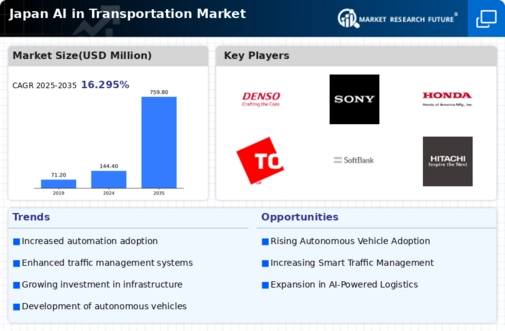
The Japan AI in Transportation Market is expected to be valued at 144.38 million USD in 2024.

What is the projected market size of the Japan AI in Transportation Market by 2035?

By 2035, the Japan AI in Transportation Market is projected to reach a value of 759.75 million USD.

What is the expected CAGR for the Japan AI in Transportation Market during the forecast period?

The expected compound annual growth rate (CAGR) for the Japan AI in Transportation Market from 2025 to 2035 is 16.295%.

What will be the market value of hardware offerings in the Japan AI in Transportation Market by 2035?

The market value of hardware offerings in the Japan AI in Transportation Market is expected to be 190.0 million USD by 2035.

What is the projected market value for services in the Japan AI in Transportation Market in 2035?

The projected market value for services in the Japan AI in Transportation Market is anticipated to be 260.0 million USD by 2035.

How much is the software segment expected to be valued in the Japan AI in Transportation Market by 2035?

The software segment of the Japan AI in Transportation Market is expected to be valued at 309.75 million USD by 2035.

Who are some of the key players in the Japan AI in Transportation Market?

Major players in the Japan AI in Transportation Market include Denso, Sony, Honda, and Toshiba among others.

What are the growth drivers for the Japan AI in Transportation Market?

Key growth drivers for the Japan AI in Transportation Market include advancements in technology and increasing demand for automation.

What are some emerging trends in the Japan AI in Transportation Market?

Emerging trends in the Japan AI in Transportation Market include the integration of AI with smart transportation systems and autonomous vehicles.

How does the Japan AI in Transportation Market compare to other regions?

While specific regional comparisons may vary, the Japan AI in Transportation Market is recognized for its significant innovation and investment in AI technology.

Download Free Sample

Kindly complete the form below to receive a free sample of this Report

Compare Licence

×
Features License Type
Single User Multiuser License Enterprise User
Price $4,950 $5,950 $7,250
Maximum User Access Limit 1 User Upto 10 Users Unrestricted Access Throughout the Organization
Free Customization
Direct Access to Analyst
Deliverable Format
Platform Access
Discount on Next Purchase 10% 15% 15%
Printable Versions