×
Request Free Sample ×

Kindly complete the form below to receive a free sample of this Report

* Please use a valid business email

Leading companies partner with us for data-driven Insights

clients tt-cursor
Hero Background

Japan 5G Smart Farming Market

ID: MRFR/ICT/56930-HCR
200 Pages
Aarti Dhapte
February 2026

Japan 5G Smart Farming Market Size, Share and Trends Analysis Report By Component (Hardware, Software, Services), By Application (Precision Farming, Irrigation and Water Management, Plant Health, Soil Moisture, Water Supply Control, Smart Greenhouse), and By Farm Size (Large Farms, Small & Medium Farms)-Forecast to 2035

Share:
Download PDF ×

We do not share your information with anyone. However, we may send you emails based on your report interest from time to time. You may contact us at any time to opt-out.

Japan 5G Smart Farming Market Infographic
Purchase Options

Japan 5G Smart Farming Market Summary

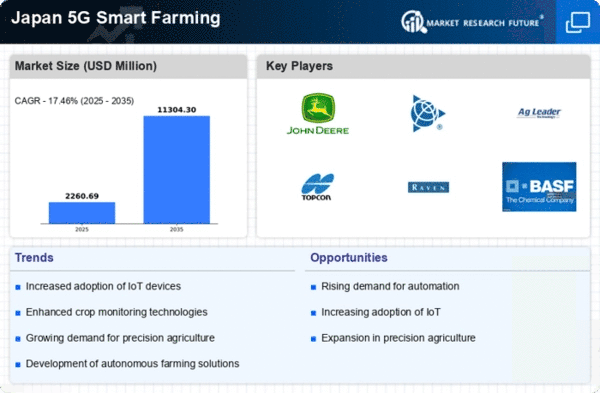
As per Market Research Future analysis, the Japan 5G Smart Farming Market Size was estimated at 1924.65 USD Million in 2024. The Japan 5g smart-farming market is projected to grow from 2260.69 USD Million in 2025 to 11304.3 USD Million by 2035, exhibiting a compound annual growth rate (CAGR) of 17.4% during the forecast period 2025 - 2035

Key Market Trends & Highlights

The Japan 5G Smart Farming Market is poised for substantial growth driven by technological advancements and increasing agricultural demands.

  • The largest segment in the Japan 5G smart-farming market is precision agriculture, while the fastest-growing segment is IoT-enabled farming solutions.
  • There is a notable increase in the adoption of IoT devices, enhancing connectivity and operational efficiency in agriculture.
  • Government support and initiatives are fostering innovation and investment in smart farming technologies across the region.
  • Rising demand for sustainable agriculture and advancements in precision agriculture are key drivers propelling market growth.

Market Size & Forecast

2024 Market Size 1924.65 (USD Million)
2035 Market Size 11304.3 (USD Million)
CAGR (2025 - 2035) 17.46%

Major Players

Deere & Company (US), Trimble Inc. (US), AG Leader Technology (US), Topcon Positioning Systems (US), Raven Industries (US), BASF SE (DE), CNH Industrial N.V. (GB), Yara International ASA (NO), Trelleborg AB (SE)

Our Impact
Enabled $4.3B Revenue Impact for Fortune 500 and Leading Multinationals
Partnering with 2000+ Global Organizations Each Year
30K+ Citations by Top-Tier Firms in the Industry

Japan 5G Smart Farming Market Trends

The 5g smart-farming market is currently experiencing a transformative phase, driven by advancements in technology and the increasing need for efficient agricultural practices. In Japan, the integration of 5g technology into farming operations appears to enhance connectivity, enabling real-time data exchange and improved decision-making processes. This shift is likely to lead to optimized resource management, increased crop yields, and reduced environmental impact. Furthermore, the Japanese government is actively promoting initiatives that support the adoption of smart farming technologies, which may further accelerate growth in this sector. Moreover, the emphasis on sustainability and food security in Japan suggests a strong alignment between governmental policies and the objectives of the 5g smart-farming market. As farmers increasingly adopt precision agriculture techniques, the demand for high-speed connectivity is expected to rise. This trend indicates a potential for innovative solutions that leverage 5g capabilities, such as autonomous machinery and advanced monitoring systems. Overall, the future of the 5g smart-farming market in Japan appears promising, with significant opportunities for growth and development in the coming years.

Increased Adoption of IoT Devices

The integration of Internet of Things (IoT) devices in the 5g smart-farming market is becoming more prevalent. These devices facilitate real-time monitoring of soil conditions, crop health, and weather patterns. As farmers in Japan embrace IoT technology, they are likely to enhance operational efficiency and make informed decisions based on accurate data.

Enhanced Data Analytics Capabilities

The 5g smart-farming market is witnessing advancements in data analytics, allowing for better interpretation of agricultural data. With the high-speed connectivity provided by 5g, farmers can analyze large datasets quickly, leading to improved crop management strategies and optimized resource allocation.

Government Support and Initiatives

The Japanese government is actively promoting the adoption of smart farming technologies through various initiatives. This support may include funding, research grants, and policy frameworks aimed at encouraging innovation in the 5g smart-farming market. Such efforts are likely to foster a conducive environment for growth and development.

Japan 5G Smart Farming Market Drivers

Advancements in Precision Agriculture

Precision agriculture is becoming a cornerstone of the 5g smart-farming market in Japan. The ability to utilize high-speed data transmission allows farmers to implement precise farming techniques, such as variable rate application of fertilizers and pesticides. This not only enhances crop yields but also minimizes resource wastage. According to recent estimates, precision agriculture can increase productivity by up to 20% while reducing input costs by approximately 15%. As farmers seek to maximize efficiency and profitability, the adoption of 5g-enabled precision agriculture solutions is likely to surge, driving growth in the market.

Integration of AI and Machine Learning

The integration of artificial intelligence (AI) and machine learning into the 5g smart-farming market is transforming agricultural practices in Japan. These technologies enable predictive analytics, which can forecast crop yields and identify potential issues before they escalate. By leveraging 5g connectivity, farmers can access vast amounts of data in real-time, allowing for more informed decision-making. This trend is particularly relevant as Japan faces labor shortages in agriculture, with the workforce declining by 20% over the past decade. AI-driven solutions can help mitigate these challenges, suggesting that the market for smart farming technologies will likely expand as farmers seek innovative ways to enhance productivity.

Rising Demand for Sustainable Agriculture

The 5g smart-farming market in Japan is experiencing a notable shift towards sustainable agricultural practices. As consumers increasingly prioritize eco-friendly products, farmers are compelled to adopt technologies that minimize environmental impact. The integration of 5g technology facilitates real-time monitoring of soil health, crop conditions, and resource usage, enabling farmers to optimize inputs and reduce waste. This trend aligns with Japan's commitment to sustainability, as the government aims to reduce greenhouse gas emissions by 26% by 2030. Consequently, the demand for smart farming solutions that leverage 5g connectivity is expected to grow, potentially increasing market value significantly.

Increased Investment in Agricultural Technology

Investment in agricultural technology is a significant driver of the 5g smart-farming market in Japan. With the government and private sector recognizing the potential of advanced technologies, funding for research and development is on the rise. In 2025, it is projected that investments in agri-tech could reach ¥500 billion, reflecting a growing commitment to modernizing the agricultural sector. This influx of capital is likely to accelerate the development and deployment of 5g solutions, enabling farmers to adopt cutting-edge technologies that improve efficiency and sustainability. As a result, the market is poised for substantial growth.

Growing Consumer Awareness and Demand for Traceability

Consumer awareness regarding food safety and traceability is increasingly influencing the 5g smart-farming market in Japan. As consumers demand transparency about the origins of their food, farmers are adopting technologies that provide detailed tracking of agricultural products from farm to table. 5g technology facilitates the collection and sharing of data related to food production, ensuring that consumers can access information about farming practices and product quality. This trend is likely to drive the adoption of smart farming solutions, as farmers seek to meet consumer expectations and enhance their market competitiveness.


Market Segment Insights

By Component: Hardware (Largest) vs. Software (Fastest-Growing)

In the Japan 5g smart-farming market, the component segment is primarily dominated by hardware, which captures the largest share due to its essential role in 5G infrastructure. Hardware components, including sensors, drones, and IoT devices, account for a significant portion of the market. On the other hand, the software segment, while smaller, is experiencing rapid growth as farmers increasingly leverage data analytics and AI-driven solutions for enhanced decision-making. The growth trends within the Japan 5g smart-farming market are strongly influenced by advancements in technology and increasing adoption of smart farming practices. The demand for efficient agricultural solutions is pushing the software segment to be the fastest-growing area, driven by innovations in agri-tech that enhance productivity and resource management. Moreover, government initiatives supporting sustainable agriculture reinforce the market's evolution, leading to a more integrated approach to farming that combines hardware and software solutions.

Hardware: Dominant vs. Software: Emerging

The hardware segment is characterized by its robust market position, offering essential tools such as precision agriculture equipment, drones, and advanced sensors that facilitate real-time monitoring and data collection. This segment is critical for establishing an effective 5G framework and is heavily relied upon by farmers to maximize crop yields and minimize waste. In contrast, the software segment is emerging, focused on providing innovative solutions for data management and analysis. This segment is gaining traction due to the growing importance of big data and AI in agriculture, enabling farmers to optimize their operations. As both segments continue to evolve, their interplay will likely enhance overall efficiency and sustainability in farming practices.

By Application: Precision Farming (Largest) vs. Irrigation and Water Management (Fastest-Growing)

In the Japan 5g smart-farming market, Precision Farming holds the largest share among the various applications, reflecting the increasing reliance on data-driven farming techniques. Meanwhile, Irrigation and Water Management is demonstrating remarkable growth, driven by advancements in technology and rising demand for efficient resource management. These applications are essential in optimizing agricultural productivity and sustainability. Growth trends indicate a significant shift towards smart technologies in farming practices, with both Precision Farming and Irrigation and Water Management leading the charge. Factors such as the need for improved crop yields, water conservation efforts, and the integration of IoT solutions are propelling these segments forward. As farmers increasingly adopt tech-driven methodologies, the potential for growth remains substantial in the coming years.

Precision Farming (Dominant) vs. Irrigation and Water Management (Emerging)

Precision Farming is characterized by its focus on accuracy and efficiency in agricultural practices, utilizing advanced technologies such as GPS, sensors, and data analytics to enhance crop management. This segment has established itself as the dominant force in the market, driven by its proven ability to increase yields and reduce costs. On the other hand, Irrigation and Water Management, while currently an emerging segment, is rapidly gaining traction due to its critical role in optimizing water use. As climate concerns rise, farmers are increasingly exploring innovative irrigation solutions, such as smart irrigation systems and soil moisture sensors, to adapt to changing environmental conditions. Both segments play complementary roles in shaping the future of farming.

By Farm Size: Large Farms (Largest) vs. Small & Medium Farms (Fastest-Growing)

In the Japan 5g smart-farming market, the distribution of market share between large farms and small & medium farms reveals a significant divide. Large farms dominate the segment, benefitting from their larger operational scale, access to advanced technologies, and greater investment capabilities. On the other hand, small & medium farms are gradually gaining traction, supported by increasing demand for sustainable practices and precision farming, making them key players in the evolving landscape. The growth trends in this segment point towards a substantial shift in how both large and small & medium farms are utilizing smart technologies. The rapid adoption of 5g solutions is primarily driven by large farms focusing on enhancing operational efficiency and crop yields. Conversely, small & medium farms are emerging as the fastest-growing segment, motivated by the necessity to innovate and remain competitive, thus creating a robust ecosystem of smart-farming practices that cater to diverse agricultural needs.

Large Farms (Dominant) vs. Small & Medium Farms (Emerging)

Large farms in the Japan 5g smart-farming market represent the dominant force, characterized by their sophisticated infrastructure and substantial investments in cutting-edge technology. They leverage 5g connectivity to optimize their operational processes, manage vast agricultural lands, and enhance productivity significantly. In contrast, small & medium farms are emerging as pivotal players, focusing on leveraging 5g technologies to adopt precision farming techniques. These farms are increasingly utilizing data-driven insights to improve crop management, addressing sustainability, and enhancing yield efficiency. This juxtaposition demonstrates the diverse approaches within the segment, highlighting how both categories are adapting to technological advancements in the agriculture sector.

Get more detailed insights about Japan 5G Smart Farming Market

Key Players and Competitive Insights

The competitive dynamics within the 5g smart-farming market in Japan are characterized by rapid technological advancements and a growing emphasis on sustainability. Key growth drivers include the increasing demand for precision agriculture, which leverages data analytics and IoT technologies to enhance crop yields and reduce resource consumption. Major players such as Deere & Company (US), Trimble Inc. (US), and BASF SE (DE) are strategically positioned to capitalize on these trends. Deere & Company (US) focuses on innovation through the integration of AI and machine learning into its agricultural machinery, while Trimble Inc. (US) emphasizes partnerships with local tech firms to enhance its service offerings. BASF SE (DE) is actively pursuing sustainability initiatives, aligning its product development with environmental goals, which collectively shapes a competitive environment that prioritizes technological advancement and ecological responsibility.
In terms of business tactics, companies are increasingly localizing manufacturing to reduce supply chain vulnerabilities and optimize operational efficiency. The market structure appears moderately fragmented, with several key players exerting influence through strategic collaborations and technological innovations. This fragmentation allows for a diverse range of solutions tailored to specific agricultural needs, fostering a competitive landscape that encourages continuous improvement and adaptation.
In October 2025, Deere & Company (US) announced a partnership with a leading Japanese tech firm to develop advanced drone technology for crop monitoring. This strategic move is likely to enhance Deere's capabilities in precision agriculture, allowing farmers to utilize real-time data for better decision-making. The integration of drone technology into their existing product line could significantly improve operational efficiency and yield outcomes, positioning Deere as a leader in the smart-farming sector.
In September 2025, Trimble Inc. (US) launched a new suite of software solutions designed to optimize farm management through enhanced data analytics. This initiative reflects Trimble's commitment to digital transformation, enabling farmers to make data-driven decisions that improve productivity and sustainability. The introduction of these tools may strengthen Trimble's market position by providing comprehensive solutions that address the evolving needs of modern agriculture.
In August 2025, BASF SE (DE) unveiled a new line of bio-based fertilizers aimed at reducing environmental impact while maintaining crop productivity. This development underscores BASF's strategic focus on sustainability and innovation, aligning with global trends towards eco-friendly agricultural practices. By offering products that meet both performance and environmental standards, BASF is likely to attract a growing segment of environmentally conscious farmers.
As of November 2025, current competitive trends in the 5g smart-farming market are heavily influenced by digitalization, sustainability, and the integration of AI technologies. Strategic alliances among key players are shaping the landscape, fostering innovation and collaboration. The shift from price-based competition to a focus on technological differentiation and supply chain reliability is evident. Companies that prioritize innovation and sustainable practices are likely to gain a competitive edge, suggesting that the future of the market will hinge on the ability to adapt to these evolving trends.

Key Companies in the Japan 5G Smart Farming Market include

Industry Developments

NTT Docomo and Kubota announced in October 2023 that they would work together to introduce a 5G smart agricultural project in Japan that would use AI analytics, sensor-based monitoring, and autonomous tractors to focus on precision farming.

Through smooth communication and real-time data interchange between farms and equipment, the program seeks to optimize planting, fertilizing, and harvesting. SoftBank launched its 5G Smart Farm service in rural Hokkaido and Kyushu in December 2023.

It uses AI-enhanced sensors and IoT platforms to enable precision irrigation and pest detection. In the meantime, Rakuten Mobile and Sharp Corporation announced in March 2024 that they would be integrating 5G-enabled agricultural robots that use computer vision and low-latency communication for precise planting and harvesting.

The 5G Smart Agriculture Lab, which focuses on climate-adaptive agricultural practices and uses AI-powered data analytics to maximize crop production, was unveiled by NEC Corporation in Chiba, Japan, in May 2024.

These developments are in line with government initiatives to address the aging farmer demographics, lower operating costs, and preserve sustainable agricultural production. They also show a strong trend toward completely automated and intelligent farming throughout Japan.

Future Outlook

Japan 5G Smart Farming Market Future Outlook

The 5G smart-farming market in Japan is poised for growth at a 17.46% CAGR from 2025 to 2035, driven by technological advancements and increased demand for efficiency.

New opportunities lie in:

  • Development of precision agriculture tools utilizing 5G connectivity
  • Integration of IoT sensors for real-time crop monitoring
  • Creation of data analytics platforms for predictive farming insights

By 2035, the market is expected to achieve substantial growth and innovation.

Market Segmentation

Japan 5G Smart Farming Market Component Outlook

  • Hardware
  • Software
  • Services

Japan 5G Smart Farming Market Farm Size Outlook

  • Large Farms
  • Small & Medium Farms

Japan 5G Smart Farming Market Application Outlook

  • Precision Farming
  • Irrigation and Water Management
  • Plant Health
  • Soil Moisture
  • Water Supply Control
  • Smart Greenhouse

Report Scope

MARKET SIZE 2024 1924.65(USD Million)
MARKET SIZE 2025 2260.69(USD Million)
MARKET SIZE 2035 11304.3(USD Million)
COMPOUND ANNUAL GROWTH RATE (CAGR) 17.46% (2025 - 2035)
REPORT COVERAGE Revenue Forecast, Competitive Landscape, Growth Factors, and Trends
BASE YEAR 2024
Market Forecast Period 2025 - 2035
Historical Data 2019 - 2024
Market Forecast Units USD Million
Key Companies Profiled Deere & Company (US), Trimble Inc. (US), AG Leader Technology (US), Topcon Positioning Systems (US), Raven Industries (US), BASF SE (DE), CNH Industrial N.V. (GB), Yara International ASA (NO), Trelleborg AB (SE)
Segments Covered Component, Application, Farm Size
Key Market Opportunities Integration of advanced sensors and automation enhances productivity in the 5g smart-farming market.
Key Market Dynamics Rapid technological advancements in connectivity enhance efficiency and productivity in the 5G smart-farming market.
Countries Covered Japan
Leave a Comment

FAQs

What is the projected market size of the Japan 5G Smart Farming Market in 2024?

The Japan 5G Smart Farming Market is expected to be valued at 2.5 USD Billion in 2024.

What is the estimated market size for the Japan 5G Smart Farming Market by 2035?

The overall market is projected to reach 15.0 USD Billion by 2035.

What is the expected compound annual growth rate (CAGR) for the Japan 5G Smart Farming Market from 2025 to 2035?

The market is expected to grow at a CAGR of 17.69% during the period from 2025 to 2035.

Which company is anticipated to hold a significant market share in the Japan 5G Smart Farming Market?

Fujitsu is among the major players expected to have a significant market share in the Japan 5G Smart Farming Market.

What will be the market value of the hardware segment in the Japan 5G Smart Farming Market by 2035?

The hardware segment is projected to be valued at 6.0 USD Billion by 2035.

How much is the services segment of the Japan 5G Smart Farming Market expected to grow by 2035?

The services segment is anticipated to reach a value of 4.5 USD Billion by 2035.

What is the expected market size for the software segment of the Japan 5G Smart Farming Market by 2035?

The software segment is projected to be valued at 4.5 USD Billion by 2035.

What key trends are driving the growth of the Japan 5G Smart Farming Market?

Emerging technologies and the need for enhanced efficiency in farming practices are key trends driving market growth.

What challenges may affect the Japan 5G Smart Farming Market in the coming years?

Challenges include the high initial investment costs and the need for technological adaptation in traditional farming.

What impact do regional factors have on the growth of the Japan 5G Smart Farming Market?

Regional factors such as technological infrastructure and agricultural practices significantly influence the market's growth rate.

Download Free Sample

Kindly complete the form below to receive a free sample of this Report

Compare Licence

×
Features License Type
Single User Multiuser License Enterprise User
Price $4,950 $5,950 $7,250
Maximum User Access Limit 1 User Upto 10 Users Unrestricted Access Throughout the Organization
Free Customization
Direct Access to Analyst
Deliverable Format
Platform Access
Discount on Next Purchase 10% 15% 15%
Printable Versions