×
Request Free Sample ×

Kindly complete the form below to receive a free sample of this Report

* Please use a valid business email

Leading companies partner with us for data-driven Insights

clients tt-cursor
Hero Background

Japan 5G IoT Market

ID: MRFR/ICT/56780-HCR
200 Pages
Aarti Dhapte
February 2026

Japan 5G IoT Market Size, Share and Trends Analysis Report By Service (Enhanced Mobile Broadband, Ultra-Reliable Low Latency Communications, Massive Machine Type Communications), By Technology (5G New Radio Standalone Architecture, 5G New Radio Non-Standalone Architecture), By Type (Short-Range IoT Devices, Wide-Range IoT Devices) and By Vertical (Consumer Electronics, Automotive, Railway, Mining, Utilities, Healthcare, Agriculture, Manufacturing)-Forecast to 2035

Share:
Download PDF ×

We do not share your information with anyone. However, we may send you emails based on your report interest from time to time. You may contact us at any time to opt-out.

Japan 5G IoT Market Infographic
Purchase Options

Japan 5G IoT Market Summary

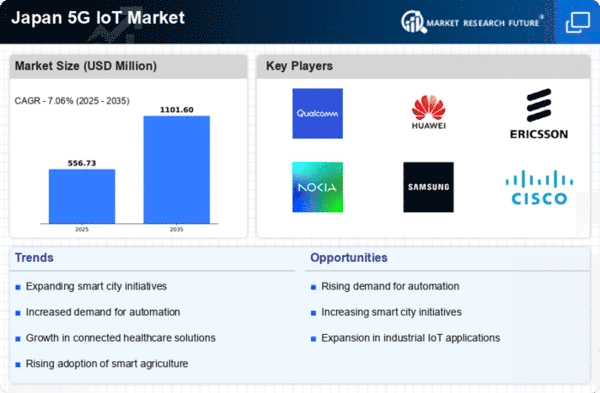
As per Market Research Future analysis, the Japan 5G IoT Market size was estimated at 520.02 USD Million in 2024. The 5G Iot market is projected to grow from 556.73 USD Million in 2025 to 1101.6 USD Million by 2035, exhibiting a compound annual growth rate (CAGR) of 7.0% during the forecast period 2025 - 2035

Key Market Trends & Highlights

The Japan 5G IoT Market is poised for substantial growth driven by technological advancements and strategic investments.

  • The market is witnessing increased investment in infrastructure to support 5G deployment.
  • Smart city initiatives are gaining traction, indicating a shift towards urban digitalization.
  • Industrial IoT applications are advancing rapidly, positioning this segment as a key growth area.
  • Rising demand for enhanced connectivity and government support for technological advancement are major drivers of market growth.

Market Size & Forecast

2024 Market Size 520.02 (USD Million)
2035 Market Size 1101.6 (USD Million)
CAGR (2025 - 2035) 7.06%

Major Players

Qualcomm (US), Huawei (CN), Ericsson (SE), Nokia (FI), Samsung (KR), Cisco (US), Intel (US), ZTE (CN), AT&T (US)

Our Impact
Enabled $4.3B Revenue Impact for Fortune 500 and Leading Multinationals
Partnering with 2000+ Global Organizations Each Year
30K+ Citations by Top-Tier Firms in the Industry

Japan 5G IoT Market Trends

The Japan 5G IoT Market is currently experiencing a transformative phase, driven by advancements in connectivity and the increasing demand for smart devices. In Japan, the integration of 5g technology into various sectors is fostering innovation and enhancing operational efficiency. Industries such as manufacturing, healthcare, and transportation are leveraging this technology to optimize processes and improve service delivery. The government is actively promoting initiatives to support the development of smart cities, which further propels the adoption of 5g solutions. As a result, businesses are increasingly investing in 5g infrastructure to remain competitive in a rapidly evolving landscape. Moreover, the emphasis on sustainability and energy efficiency is shaping the trajectory of the 5g iot market. Companies are exploring ways to utilize 5g technology to reduce their carbon footprint and enhance resource management. The collaboration between public and private sectors is crucial in driving research and development efforts, ensuring that Japan remains at the forefront of technological advancements. This collaborative approach is likely to yield innovative solutions that address both economic and environmental challenges, positioning the nation as a leader in the 5g iot space.

Increased Investment in Infrastructure

There is a noticeable trend towards heightened investment in 5g infrastructure across various sectors. Companies are allocating resources to enhance network capabilities, ensuring robust connectivity for IoT devices. This investment is essential for supporting the growing number of connected devices and applications.

Focus on Smart City Initiatives

The push for smart city initiatives is gaining momentum, with local governments prioritizing the integration of 5g technology. These initiatives aim to improve urban living through enhanced connectivity, efficient public services, and sustainable resource management.

Advancements in Industrial IoT Applications

The industrial sector is witnessing significant advancements in IoT applications powered by 5g technology. This trend is characterized by the adoption of automation, real-time monitoring, and predictive maintenance, which collectively enhance operational efficiency and productivity.

Japan 5G IoT Market Drivers

Adoption of Smart City Technologies

The 5g iot market in Japan is significantly influenced by the adoption of smart city technologies. Urban areas are increasingly integrating IoT solutions to enhance public services, improve traffic management, and promote sustainability. The deployment of 5g networks enables seamless communication between various city infrastructure components, such as smart lighting, waste management systems, and public transportation. This integration is expected to lead to improved quality of life for residents and increased operational efficiency for city administrations. Reports suggest that investments in smart city initiatives could exceed $50 billion by 2030, indicating a substantial opportunity for growth within the 5g iot market. The alignment of technological advancements with urban development strategies is likely to drive further innovation.

Increased Focus on Security Solutions

As the 5g iot market expands, the need for robust security solutions becomes increasingly critical. With the proliferation of connected devices, vulnerabilities to cyber threats are heightened, prompting businesses to prioritize security measures. In Japan, companies are investing in advanced cybersecurity frameworks to protect their IoT ecosystems. This focus on security is likely to drive innovation within the 5g iot market, as firms seek to develop secure communication protocols and data encryption methods. The market for IoT security solutions is expected to grow significantly, with projections indicating a compound annual growth rate (CAGR) of over 20% through 2027. This trend highlights the importance of security in fostering trust and adoption of 5g technologies.

Rising Demand for Enhanced Connectivity

The 5g iot market in Japan is experiencing a notable surge in demand for enhanced connectivity solutions. As industries increasingly rely on real-time data transmission, the need for high-speed, low-latency communication becomes paramount. This demand is driven by sectors such as manufacturing, healthcare, and transportation, which are integrating IoT devices to optimize operations. According to recent data, the number of connected devices in Japan is projected to reach 1 billion by 2025, indicating a robust growth trajectory. The 5g iot market is thus positioned to benefit from this trend, as businesses seek to leverage advanced connectivity to improve efficiency and productivity.

Emergence of Smart Manufacturing Solutions

The 5g iot market is witnessing a transformative shift towards smart manufacturing solutions in Japan. As industries adopt IoT technologies, the integration of 5g networks facilitates real-time monitoring and automation of production processes. This shift is particularly relevant in Japan's manufacturing sector, which is known for its emphasis on precision and efficiency. The implementation of 5g-enabled IoT devices allows for predictive maintenance, reducing downtime and operational costs. Reports indicate that smart manufacturing could enhance productivity by up to 30% in the coming years, thereby driving growth in the 5g iot market. This trend reflects a broader movement towards Industry 4.0, where connectivity and data analytics play crucial roles.

Government Support for Technological Advancement

The Japanese government is actively promoting the development of the 5g iot market through various initiatives and funding programs. This support is evident in the allocation of substantial budgets aimed at enhancing digital infrastructure and fostering innovation. For instance, the government has set ambitious targets for 5g deployment, aiming for nationwide coverage by 2025. Such initiatives not only stimulate investment in the 5g iot market but also encourage collaboration between public and private sectors. The potential for economic growth is significant, with estimates suggesting that the 5g iot market could contribute over $100 billion to Japan's GDP by 2030, underscoring the importance of government involvement in this sector.


Market Segment Insights

By Service: Ultra-Reliable Low Latency Communications (Largest) vs. Massive Machine Type Communications (Fastest-Growing)

In the Japan 5g iot market, Ultra-Reliable Low Latency Communications (URLLC) holds the largest share, reflecting its critical role in applications requiring instantaneous data transmission such as remote surgeries and smart manufacturing. Enhanced Mobile Broadband (EMBB) follows, catering to high-bandwidth applications, while Massive Machine Type Communications (MMTC) accounts for a smaller yet rapidly expanding portion of the market, driven by the proliferation of IoT devices across various sectors. Growth trends within this segment indicate a robust demand for URLLC as industries increasingly rely on real-time data processing. The acceleration of digital transformation in sectors like healthcare, automotive, and smart cities fuels investments in EMBB, allowing businesses to enhance connectivity. MMTC, being the fastest-growing, is benefiting from advancements in sensor technology and the need for efficient wireless communication for millions of devices, leading to a surge in IoT deployments within the Japan 5g iot market.

Ultra-Reliable Low Latency Communications (Dominant) vs. Massive Machine Type Communications (Emerging)

Ultra-Reliable Low Latency Communications (URLLC) stands out as the dominant service segment in the current landscape, characterized by its ability to provide reliable, fast, and robust connectivity essential for mission-critical applications. The low latency offered by URLLC makes it ideal for industries like healthcare, autonomous driving, and industrial automation. On the other hand, Massive Machine Type Communications (MMTC) is recognized as the emerging segment, focused on connecting a vast number of low-power devices. While URLLC maintains a strong position in established markets, MMTC is rapidly gaining traction as wireless standards evolve, enabling the seamless integration of thousands of devices into networks, thus driving the next wave of IoT expansion.

By Technology: 5G NR Standalone (Largest) vs. 5G NR Non-Standalone (Fastest-Growing)

In the Japan 5g iot market, the distribution of market share among the technology segment values highlights the prominence of 5G New Radio (NR) Standalone Architecture, which is recognized as the largest segment. This architecture allows for a complete utilization of 5G capabilities without relying on any previous generation networks, offering significant advantages in data capacity and low latency. Conversely, 5G New Radio (NR) Non-Standalone Architecture, while presently smaller, is witnessing rapid adoption due to its integration with existing 4G infrastructure, making it an accessible option for many users. The growth trends in this segment are driven by escalating demand for high-speed connectivity and the proliferation of IoT devices across various industries in Japan. As businesses strive for digital transformation, the capabilities provided by 5G technology are becoming increasingly crucial. Additionally, government initiatives to bolster 5G infrastructure and investments from telecom operators are fostering an environment conducive to the growth of both architectures, especially the Non-Standalone variant, which is regarded as the fastest-growing segment due to its quicker rollout and fewer initial investment barriers.

Technology: 5G NR Standalone (Dominant) vs. 5G NR Non-Standalone (Emerging)

The 5G New Radio (NR) Standalone Architecture is currently the dominant force in the Japan 5g iot market, offering advanced features that leverage the full potential of 5G technology. It allows for dedicated 5G networks independent of LTE, thus optimizing performance for critical applications such as real-time data processing and remote monitoring. On the other hand, the 5G New Radio (NR) Non-Standalone Architecture is emerging as a vital component in the market, providing a transitional pathway for operators to enhance their 4G networks with 5G capabilities. Its ability to work in conjunction with existing LTE systems facilitates a faster deployment, catering to businesses looking for immediate improvements in their connectivity solutions.

By Type: Enhanced Short-Range IoT Devices (Largest) vs. Wide-Range IoT Devices (Fastest-Growing)

In the Japan 5g iot market, Enhanced Short-Range IoT Devices hold a significant share, remaining the dominant player. Their ability to effectively communicate over reduced distances makes them suitable for various applications, including smart homes and industrial automation. Meanwhile, Wide-Range IoT Devices, while currently smaller in market share, exhibit rapid growth potential due to their applicability in broader deployments such as transportation and logistics. The growth trends for both segment values reflect a vibrant technological environment. Enhanced Short-Range IoT Devices are driven by the increasing demand for smart home solutions, while Wide-Range IoT Devices benefit from advancements in communication and sensor technologies. The convergence of 5G capabilities with IoT is key to unlocking new use cases, thus propelling the Wide-Range sector towards becoming a strong competitor in the market.

Enhanced Short-Range IoT Devices (Dominant) vs. Wide-Range IoT Devices (Emerging)

Enhanced Short-Range IoT Devices are characterized by their precise communication capabilities and lower latency, tailored for localized applications. Their prominent role in residential and industrial setups originates from their effectiveness in delivering real-time data while maintaining energy efficiency. As a result, they are favored in smart home ecosystems and manufacturing. In contrast, Wide-Range IoT Devices, though emerging, capitalize on extended connectivity to facilitate operations over large distances. They are essential for sectors like agriculture, logistics, and smart city initiatives, where extensive coverage is required to ensure seamless communication across diverse applications.

By Vertical: Consumer Electronics (Largest) vs. Healthcare (Fastest-Growing)

In the Japan 5g iot market, the distribution of market share among various verticals reveals that Consumer Electronics holds the largest stake, driven by a high demand for connected devices. Other significant sectors include Automotive and Utilities, which have shown resilience in adapting to new technologies. On the other hand, Healthcare, while smaller, is witnessing rapid growth as IoT solutions gain traction for remote monitoring and telehealth services. Growth trends in the Japan 5g iot market are largely influenced by technological advancements and a shifting consumer landscape. The push for smarter cities and advancements in robotics are fostering innovation in sectors like Agriculture and Manufacturing. Moreover, the increasing demand for efficient infrastructure in Railway and Mining sectors signifies a notable shift toward IoT integration, presenting substantial opportunities for market players.

Consumer Electronics: Dominant vs. Healthcare (Emerging)

The Consumer Electronics segment in the Japan 5g iot market stands out as a dominant force, characterized by a robust ecosystem of smart devices, wearables, and home automation solutions. This sector thrives on consumer demand for connectivity and digital integration, which has led to substantial investments in R&D. In contrast, the Healthcare segment, while emerging, is rapidly gaining ground due to the urgent need for improved patient care and data management solutions. Innovations such as telemedicine and remote health monitoring are reshaping traditional practices, positioning Healthcare as a critical contributor to the market's overall growth.

Get more detailed insights about Japan 5G IoT Market

Key Players and Competitive Insights

The competitive dynamics within the 5g iot market in Japan are characterized by rapid technological advancements and a robust push towards digital transformation. Key players such as Qualcomm (US), Huawei (CN), and Ericsson (SE) are at the forefront, each adopting distinct strategies to enhance their market positioning. Qualcomm (US) focuses on innovation in semiconductor technology, aiming to provide cutting-edge solutions that cater to the growing demand for IoT applications. Meanwhile, Huawei (CN) emphasizes regional expansion and partnerships, particularly in smart city initiatives, which align with Japan's urban development goals. Ericsson (SE) is leveraging its expertise in network infrastructure to drive operational efficiency and enhance connectivity solutions, thereby shaping a competitive environment that is increasingly reliant on technological prowess and strategic collaborations.
In terms of business tactics, companies are localizing manufacturing and optimizing supply chains to better serve the Japanese market. The competitive structure appears moderately fragmented, with several players vying for market share while also collaborating on various projects. This collective influence of key players fosters an environment where innovation and strategic partnerships are paramount, allowing for a more agile response to market demands.
In October 2025, Qualcomm (US) announced a partnership with a leading Japanese telecommunications provider to develop advanced 5g IoT solutions tailored for smart agriculture. This strategic move is significant as it not only enhances Qualcomm's presence in the agricultural sector but also aligns with Japan's focus on technological integration in traditional industries. The collaboration is expected to drive efficiency and productivity, showcasing the potential of 5g technology in enhancing agricultural practices.
In September 2025, Huawei (CN) launched a new initiative aimed at establishing a 5g IoT ecosystem in collaboration with local startups. This initiative is crucial as it fosters innovation and supports the growth of emerging technologies within Japan. By engaging with local enterprises, Huawei is likely to strengthen its market position while contributing to the overall development of the 5g landscape in the region.
In August 2025, Ericsson (SE) secured a contract with a major Japanese automotive manufacturer to provide 5g connectivity solutions for connected vehicles. This strategic action underscores the growing importance of 5g technology in the automotive sector, where real-time data exchange is essential for enhancing safety and efficiency. Ericsson's involvement in this project not only solidifies its role in the automotive industry but also highlights the broader trend of integrating 5g technology into various sectors.
As of November 2025, current trends in the competitive landscape are increasingly defined by digitalization, sustainability, and the integration of artificial intelligence. Strategic alliances are shaping the present-day environment, enabling companies to pool resources and expertise to tackle complex challenges. Looking ahead, competitive differentiation is likely to evolve, with a pronounced shift from price-based competition towards innovation, technological advancement, and supply chain reliability. This transition suggests that companies that prioritize these aspects will be better positioned to thrive in the dynamic 5g iot market.

Key Companies in the Japan 5G IoT Market include

Industry Developments

Japan's 5G IoT Market is witnessing significant developments, with several companies expanding their efforts to enhance connectivity and smart solutions. Notably, KDDI and NTT DoCoMo have been at the forefront of deploying 5G infrastructure, facilitating advancements in smart cities and industrial IoT applications, while SoftBank is focusing on integrating AI into its IoT services.

In recent months, Qualcomm and Ericsson announced collaborations aimed at advancing 5G network performance, indicating a proactive approach to meet the growing demand for high-speed connectivity.

Regarding mergers and acquisitions, in July 2023, NTT DoCoMo completed the acquisition of a shareholding in a regional telecommunications provider to expand its 5G service footprint. Market valuations continue to grow, which is impacting the competitive landscape as companies like Toshiba and Sharp focus on enhancing their R&D in 5G technologies.

Recent noteworthy events include the launch of commercial 5G services by multiple telecommunication providers in late 2021, enhancing connectivity options across Japan. The concerted efforts highlight the dynamic growth trajectory of Japan's 5G IoT Market, positioning it as a key player in the global landscape.


Future Outlook

Japan 5G IoT Market Future Outlook

The 5G IoT market in Japan is poised for growth at a 7.06% CAGR from 2025 to 2035, driven by advancements in connectivity, automation, and smart technologies.

New opportunities lie in:

  • Development of smart agriculture solutions leveraging IoT sensors and 5G connectivity.
  • Implementation of real-time asset tracking systems for logistics optimization.
  • Creation of advanced telemedicine platforms utilizing 5G for remote patient monitoring.

By 2035, the market is expected to achieve substantial growth, driven by innovative applications and enhanced connectivity.

Market Segmentation

Japan 5G IoT Market Type Outlook

  • Enhanced Short-Range IoT Devices
  • Wide-Range IoT Devices

Japan 5G IoT Market Service Outlook

  • Ultra-Reliable Low Latency Communications (URLLC)
  • Enhanced Mobile Broadband (EMBB)
  • Massive Machine Type Communications (MMTC)

Japan 5G IoT Market Vertical Outlook

  • Consumer Electronics
  • Automotive
  • Railway
  • Mining
  • Utilities
  • Healthcare
  • Agriculture
  • Manufacturing

Japan 5G IoT Market Technology Outlook

  • 5G New Radio (NR) Standalone Architecture
  • 5G New Radio (NR) Non-Standalone Architecture

Report Scope

MARKET SIZE 2024 520.02(USD Million)
MARKET SIZE 2025 556.73(USD Million)
MARKET SIZE 2035 1101.6(USD Million)
COMPOUND ANNUAL GROWTH RATE (CAGR) 7.06% (2025 - 2035)
REPORT COVERAGE Revenue Forecast, Competitive Landscape, Growth Factors, and Trends
BASE YEAR 2024
Market Forecast Period 2025 - 2035
Historical Data 2019 - 2024
Market Forecast Units USD Million
Key Companies Profiled Qualcomm (US), Huawei (CN), Ericsson (SE), Nokia (FI), Samsung (KR), Cisco (US), Intel (US), ZTE (CN), AT&T (US)
Segments Covered Service, Technology, Type, Vertical
Key Market Opportunities Expansion of smart city initiatives drives demand in the 5g iot market.
Key Market Dynamics Rapid technological advancements drive competitive forces in the 5G IoT market, reshaping consumer behavior and regulatory frameworks.
Countries Covered Japan
Leave a Comment

FAQs

What is the expected market size of the Japan 5G IoT Market in 2024?

The Japan 5G IoT Market is expected to be valued at 577.8 million USD in 2024.

What is the anticipated market size of the Japan 5G IoT Market by 2035?

By 2035, the market is forecasted to reach approximately 1155.6 million USD.

What is the expected CAGR for the Japan 5G IoT Market from 2025 to 2035?

The market is expected to grow at a CAGR of 6.504% from 2025 to 2035.

Which segment has the largest market share in the Japan 5G IoT Market?

The Enhanced Mobile Broadband segment holds the largest market share, valued at 232.0 million USD in 2024.

What is the projected market value for the Ultra-Reliable Low Latency Communications segment by 2035?

This segment is expected to reach a value of 230.0 million USD by 2035.

Which company is identified as a key player in the Japan 5G IoT Market?

Qualcomm is recognized as one of the major players in the Japan 5G IoT Market.

What market value is projected for the Massive Machine Type Communications segment in 2024?

The Massive Machine Type Communications segment is expected to be valued at 230.8 million USD in 2024.

What is the expected growth rate for the Enhanced Mobile Broadband segment from 2025 to 2035?

The Enhanced Mobile Broadband segment is projected to grow significantly, reflecting the overall market's CAGR of 6.504% during this period.

How will regional trends impact the Japan 5G IoT Market's growth?

Regional trends and advancements in technology are expected to foster substantial growth in the Japan 5G IoT Market.

What challenges might the Japan 5G IoT Market face in the coming years?

The Japan 5G IoT Market may encounter challenges related to infrastructure development and regulatory frameworks.

Download Free Sample

Kindly complete the form below to receive a free sample of this Report

Compare Licence

×
Features License Type
Single User Multiuser License Enterprise User
Price $4,950 $5,950 $7,250
Maximum User Access Limit 1 User Upto 10 Users Unrestricted Access Throughout the Organization
Free Customization
Direct Access to Analyst
Deliverable Format
Platform Access
Discount on Next Purchase 10% 15% 15%
Printable Versions