×
Request Free Sample ×

Kindly complete the form below to receive a free sample of this Report

* Please use a valid business email

Leading companies partner with us for data-driven Insights

clients tt-cursor
Hero Background

Japan 4G Lte Market

ID: MRFR/ICT/56850-HCR
200 Pages
Garvit Vyas
February 2026

Japan 4G LTE Market Size, Share and Trends Analysis Report By Device Type (Smartphone, Laptop, Tablets) and By Organization Size (SME, Large Enterprises) - Forecast to 2035

Share:
Download PDF ×

We do not share your information with anyone. However, we may send you emails based on your report interest from time to time. You may contact us at any time to opt-out.

Japan 4G Lte Market Infographic
Purchase Options

Japan 4G Lte Market Summary

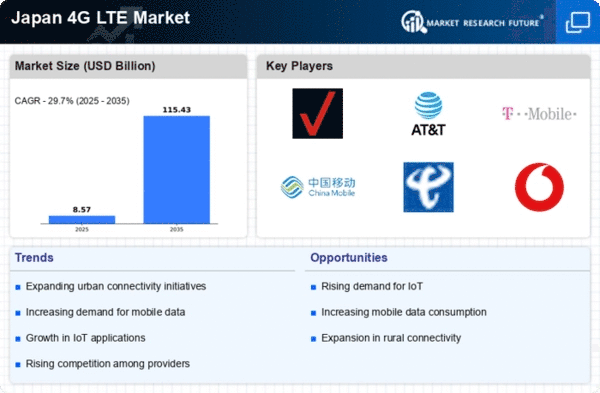
As per Market Research Future analysis, the Japan 4G Lte Market size was estimated at 6.61 USD Billion in 2024. The 4G Lte market is projected to grow from 8.57 USD Billion in 2025 to 115.43 USD Billion by 2035, exhibiting a compound annual growth rate (CAGR) of 29% during the forecast period 2025 - 2035

Key Market Trends & Highlights

The Japan 4G LTE market is experiencing robust growth driven by technological advancements and increasing mobile data consumption.

  • Mobile data consumption in Japan is witnessing a substantial increase, reflecting a shift towards data-intensive applications.
  • The expansion of IoT applications is becoming a prominent trend, indicating a growing interconnectivity among devices.
  • Regulatory support for innovation is fostering a competitive landscape among service providers, enhancing service offerings.
  • Rising demand for high-speed connectivity and the growth of mobile-first businesses are key drivers propelling market expansion.

Market Size & Forecast

2024 Market Size 6.61 (USD Billion)
2035 Market Size 115.43 (USD Billion)
CAGR (2025 - 2035) 29.7%

Major Players

Verizon (US), AT&T (US), T-Mobile (US), China Mobile (CN), China Telecom (CN), Vodafone (GB), Orange (FR), Deutsche Telekom (DE), NTT Docomo (JP)

Our Impact
Enabled $4.3B Revenue Impact for Fortune 500 and Leading Multinationals
Partnering with 2000+ Global Organizations Each Year
30K+ Citations by Top-Tier Firms in the Industry

Japan 4G Lte Market Trends

The Japan 4G Lte Market in Japan is characterized by a robust infrastructure and a high level of consumer adoption. As of November 2025, the country boasts one of the most advanced telecommunications networks in the world, with extensive coverage and high-speed connectivity. This has been facilitated by significant investments from major telecom operators, who have focused on enhancing service quality and expanding network reach. The competitive landscape is marked by several key players, each striving to innovate and offer superior services to attract and retain customers. Furthermore, the increasing demand for mobile data and the proliferation of smart devices have further propelled the growth of this market. In addition to consumer demand, regulatory support has played a crucial role in shaping the 4g lte market. The Japanese government has implemented policies aimed at promoting technological advancements and ensuring fair competition among service providers. This regulatory environment encourages investment in infrastructure and fosters innovation, which is essential for meeting the evolving needs of consumers. As the market continues to mature, trends such as the integration of IoT technologies and the transition towards 5G networks are likely to influence future developments, indicating a dynamic and rapidly evolving landscape.

Increased Mobile Data Consumption

The demand for mobile data continues to rise, driven by the growing use of streaming services, social media, and online gaming. This trend is pushing telecom operators to enhance their network capabilities to accommodate higher data traffic.

Expansion of IoT Applications

The integration of Internet of Things (IoT) technologies is becoming more prevalent, with various sectors adopting connected devices. This shift is expected to create new opportunities within the 4g lte market, as businesses seek reliable connectivity for their IoT solutions.

Regulatory Support for Innovation

Government policies are increasingly focused on fostering innovation within the telecommunications sector. This support is likely to encourage further investment in infrastructure and the development of new services, enhancing the overall competitiveness of the market.

Japan 4G Lte Market Drivers

Growth of Mobile-First Businesses

The emergence of mobile-first businesses significantly influences the 4g lte market in Japan. Companies that prioritize mobile platforms for their operations are increasingly reliant on robust mobile connectivity to deliver services and engage customers effectively. This shift is evident in sectors such as e-commerce, where businesses leverage mobile applications to enhance user experience and streamline transactions. As of 2025, it is estimated that mobile commerce will account for over 50% of total e-commerce sales in Japan, underscoring the critical role of mobile connectivity. Consequently, the demand for reliable 4g lte services is expected to rise, prompting telecommunications providers to enhance their offerings to cater to this growing segment.

Increased Adoption of Smart Devices

The proliferation of smart devices in Japan is a key driver of the 4g lte market. With the increasing penetration of smartphones, tablets, and wearables, consumers are demanding seamless connectivity to support their digital lifestyles. As of November 2025, it is estimated that over 80% of the population owns a smartphone, leading to a corresponding rise in mobile data usage. This trend is further amplified by the integration of smart devices into everyday life, such as smart home technologies and health monitoring applications. As users seek to connect multiple devices simultaneously, the demand for robust 4g lte services is likely to escalate, prompting network operators to invest in expanding their infrastructure to accommodate this growing need.

Rising Demand for High-Speed Connectivity

The 4g lte market in Japan experiences a notable surge in demand for high-speed connectivity, driven by the increasing reliance on mobile internet for various applications. As consumers and businesses alike seek faster data transfer rates, the market is projected to grow significantly. According to recent data, mobile data traffic in Japan is expected to increase by approximately 30% annually, indicating a robust appetite for enhanced connectivity solutions. This trend is further fueled by the proliferation of streaming services, online gaming, and remote work, all of which require reliable and swift internet access. Consequently, telecommunications providers are compelled to invest in infrastructure upgrades to meet this escalating demand, thereby propelling the growth of the 4g lte market.

Competitive Landscape Among Service Providers

The competitive landscape among service providers significantly impacts the 4g lte market in Japan. With multiple operators vying for market share, there is a continuous push for innovation and improved service offerings. This competition often leads to attractive pricing strategies, promotional packages, and enhanced customer service, benefiting consumers. As of November 2025, the market is characterized by a diverse range of plans and services tailored to meet varying consumer needs. Additionally, operators are increasingly focusing on customer retention strategies, such as loyalty programs and value-added services, to differentiate themselves in a crowded marketplace. This competitive dynamic is likely to drive further investments in network enhancements, ultimately benefiting the overall growth of the 4g lte market.

Technological Advancements in Network Infrastructure

Technological advancements play a pivotal role in shaping the 4g lte market in Japan. The ongoing evolution of network infrastructure, including the deployment of advanced antennas and improved signal processing technologies, enhances the overall performance of 4g lte networks. These innovations not only increase data speeds but also improve network reliability and coverage. For instance, the introduction of Massive MIMO technology has been shown to boost capacity and efficiency, allowing operators to serve more users simultaneously. As a result, the market is likely to witness a significant uptick in user satisfaction and retention, further driving the adoption of 4g lte services across various demographics.


Market Segment Insights

By Device Type: Smartphone (Largest) vs. Tablets (Fastest-Growing)

In the Japan 4g lte market, smartphones hold a significant market share due to their widespread adoption and versatility. They are the primary device for accessing mobile data, driving the demand for high-speed connectivity. Laptops and tablets, while also important, command a smaller share of the market, highlighting the dominance of smartphones in everyday usage. Looking ahead, the growth trend in the Japan 4g lte market indicates that tablets are becoming the fastest-growing device type. Factors contributing to this growth include an increase in remote work, online education, and the portability of tablets. As users seek more mobile solutions, tablets are expected to capture a larger portion of the market, complementing the established smartphone segment.

Smartphones (Dominant) vs. Tablets (Emerging)

Smartphones represent the dominant device type in the Japan 4g lte market, characterized by their multifunctionality and user-friendly design. They serve as essential tools for communication, social media, and gaming, making them integral to daily life. On the other hand, tablets are emerging as a sought-after alternative, particularly in educational and professional settings. Their larger screens and portability appeal to users requiring enhanced functionality without sacrificing mobility. As more applications are developed specifically for tablets, they are poised to challenge the dominance of smartphones in certain niches, thus reshaping user preferences in the market.

By Technology: LTE-Advance (Largest) vs. LTE-TDD (Fastest-Growing)

In the Japan 4g lte market, the distribution of market share among the various technology segments reveals a clear differentiation in performance and adoption. LTE-Advance stands out as the dominant technology, holding the largest share thanks to its enhancements that provide higher speeds and improved user experience. Following closely, LTE-FDD and LTE-TDD are also significant players, with LTE-TDD showing promising growth as it caters to specific market needs and enhances capacity in urban environments. The growth trends within the Japan 4g lte market are driven by the increasing demand for high-speed data services and the proliferation of smart devices. LTE-Advance will continue to thrive due to its established functionality and reliability, while LTE-TDD is gaining traction as network optimization becomes crucial for service providers. The increasing digitization of services in various sectors further propels the adoption of these technologies, making them essential for future communication enhancements.

Technology: LTE-Advance (Dominant) vs. LTE-TDD (Emerging)

LTE-Advance is recognized as the dominant technology in the Japan 4g lte market, characterized by its ability to deliver superior data speeds and efficiency, appealing to both consumers and service providers seeking high-quality transmission. It leverages advanced features such as carrier aggregation and MIMO to maximize capacity and user experience. Conversely, LTE-TDD is an emerging technology that focuses on best serving urban areas by allowing dynamic allocation of bandwidth, thus improving response times and handling high user density. Its flexibility and ability to adapt to varying traffic conditions make it a compelling option as the demand for bandwidth continues to rise. As both technologies evolve, they will play pivotal roles in shaping the landscape of mobile connectivity.

By Organization Size: Large Enterprises (Largest) vs. SME (Fastest-Growing)

In the Japan 4g lte market, Large Enterprises dominate the organization size segment, accounting for a significant portion of market share. This segment has benefited from the increasing demand for robust connectivity solutions, allowing large-scale operations to maintain efficient communication and operational effectiveness. The presence of established brands further bolsters the market position of large enterprises, making them an essential component of the technological landscape. Conversely, SMEs are emerging as the fastest-growing segment within the market. The rise of digital transformation initiatives and government support for small and medium-sized enterprises boosts their adoption of 4g lte technology. SMEs are increasingly investing in advanced connectivity solutions to enhance their business capabilities, leading to their rapid growth and a shift in market dynamics that favors more agile and flexible service offerings.

Large Enterprises: (Dominant) vs. SME (Emerging)

Large Enterprises in the Japan 4g lte market are characterized by their need for comprehensive and high-capacity communication solutions, which are essential for their extensive operations. These organizations typically require advanced network capabilities to manage large amounts of data traffic effectively. On the other hand, SMEs are characterized as an emerging segment capitalizing on the growing demand for agile and cost-effective connectivity solutions. They are increasingly adopting 4g lte technologies to enhance business communication, expand their customer reach, and improve overall efficiency. This dynamic creates a competitive landscape where Large Enterprises maintain dominance, while SMEs capitalize on innovative solutions to swiftly adapt to evolving market conditions.

By Connection Plan: Post-paid (Largest) vs. Pre-paid (Fastest-Growing)

The Japan 4g lte market sees a significant market share distribution between Post-paid and Pre-paid connection plans. Post-paid plans have traditionally dominated the market, appealing to consumers who prefer stable billing and enhanced services. These plans often capture loyal customers from premium smartphone segments, thus maintaining a stronghold in the market. In contrast, Pre-paid plans, while currently holding a smaller share, are gaining traction as they offer flexibility and cost-effectiveness, especially appealing to younger demographics and those seeking short-term solutions. As consumer preferences shift towards mobile flexibility and budget-conscious options, the Pre-paid segment is emerging as the fastest-growing segment in the market. The rise of digital services and mobile internet reliance has fueled the demand for prepaid options, as users favor plans that allow them to manage their expenditures efficiently. Furthermore, the increasing integration of mobile payment options with Pre-paid plans is anticipated to enhance its attractiveness and growth trajectory in the forthcoming years.

Connection Plans: Post-paid (Dominant) vs. Pre-paid (Emerging)

The Post-paid connection plan in the Japan 4g lte market is recognized for its stability and comprehensive service offerings, making it a dominant choice among consumers seeking reliable connectivity. Post-paid plans typically come with various perks, such as unlimited data options and high-speed access, catering to users with higher data consumption needs. They often appeal to business clients and technology enthusiasts who prioritize quality and service continuity. In contrast, the Pre-paid plan represents an emerging trend, characterized by its flexibility and affordability. Ideal for budget-conscious consumers, these plans allow users to avoid long-term contracts and offer a range of customizable options. The surge in popularity of these plans is bolstered by a younger user base that values control over their usage and spending, indicating a significant shift in market demand.

Get more detailed insights about Japan 4G Lte Market

Key Players and Competitive Insights

The competitive dynamics within the 4G LTE market in Japan are characterized by a blend of innovation, strategic partnerships, and regional expansion. Key players such as NTT Docomo (Japan), Verizon (US), and China Mobile (CN) are actively shaping the landscape. NTT Docomo (Japan) focuses on enhancing its network infrastructure and customer experience through advanced technologies, while Verizon (US) emphasizes strategic partnerships to bolster its service offerings. China Mobile (CN) appears to be leveraging its vast customer base to expand its market presence, indicating a competitive environment that thrives on technological advancements and customer-centric strategies.
The market structure is moderately fragmented, with several players vying for market share. Key tactics employed by these companies include localizing manufacturing and optimizing supply chains to enhance operational efficiency. This collective approach not only strengthens their market positions but also fosters a competitive atmosphere where innovation and service quality are paramount.
In October 2025, NTT Docomo (Japan) announced a significant investment in 5G infrastructure, aiming to enhance its 4G LTE services. This strategic move is likely to improve network reliability and speed, positioning the company favorably against competitors. The investment reflects a broader trend of integrating next-generation technologies to meet evolving consumer demands.
In September 2025, Verizon (US) launched a new partnership with a leading tech firm to develop AI-driven solutions for network management. This initiative is expected to streamline operations and enhance customer service, showcasing Verizon's commitment to leveraging technology for competitive advantage. Such partnerships may redefine service delivery standards in the market.
In August 2025, China Mobile (CN) expanded its collaboration with local Japanese firms to enhance its service offerings. This strategic alliance is indicative of a growing trend where companies seek to localize their operations to better cater to regional preferences. By aligning with local entities, China Mobile (CN) is likely to strengthen its market foothold and improve customer engagement.
As of November 2025, the competitive landscape is increasingly influenced by trends such as digitalization, sustainability, and AI integration. Strategic alliances are becoming pivotal in shaping service delivery and operational efficiency. The shift from price-based competition to a focus on innovation and technology is evident, suggesting that companies will need to prioritize supply chain reliability and technological advancements to maintain a competitive edge in the evolving market.

Key Companies in the Japan 4G Lte Market include

Industry Developments

In recent months, the Japan 4G LTE Market has seen significant developments, particularly within major telecom companies. Rakuten Mobile has continued to expand its network infrastructure to enhance service coverage and competition, while NTT Communications focuses on improving its data services amid increasing user demand. KDDI has also introduced innovative mobile plans to attract customers and retain market share. Additionally, SoftBank is investing heavily in upgrading its network, aiming to provide better reliability and speed to users.

In September 2023, NTT Docomo announced a partnership with Toyota Tsusho to jointly explore opportunities in advanced connectivity services, indicating a trend towards collaboration among companies. Furthermore, SoftBank's recent acquisition of Fusion Communications aims to strengthen its position in the broadband market. The Japan 4G LTE Market is projected to experience growth due to increased smartphone penetration and the rising need for data services, with companies like IIJ and SBI Holdings also contributing to this market dynamic.

Historical developments, such as the launch of 5G trials by NTT Docomo in July 2022, continue to influence the trajectory of the 4G LTE space as firms prepare for advanced networks in future iterations.

Future Outlook

Japan 4G Lte Market Future Outlook

The 4G LTE market in Japan is projected to grow at a 29.7% CAGR from 2025 to 2035, driven by increased mobile data consumption and technological advancements.

New opportunities lie in:

  • Expansion of IoT connectivity solutions for smart cities
  • Development of tailored enterprise mobile data plans
  • Investment in 4G LTE infrastructure upgrades for rural areas

By 2035, the market is expected to be robust, driven by innovation and increased demand.

Market Segmentation

Japan 4G Lte Market Technology Outlook

  • LTE-advance
  • LTE-TDD
  • LTE-FDD
  • WiMax
  • HSPA+

Japan 4G Lte Market Device Type Outlook

  • Smartphone
  • Laptop
  • Tablets

Japan 4G Lte Market Connection Plan Outlook

  • Post-paid
  • Pre-paid

Japan 4G Lte Market Organization Size Outlook

  • SME
  • Large Enterprises

Report Scope

MARKET SIZE 2024 6.61(USD Billion)
MARKET SIZE 2025 8.57(USD Billion)
MARKET SIZE 2035 115.43(USD Billion)
COMPOUND ANNUAL GROWTH RATE (CAGR) 29.7% (2025 - 2035)
REPORT COVERAGE Revenue Forecast, Competitive Landscape, Growth Factors, and Trends
BASE YEAR 2024
Market Forecast Period 2025 - 2035
Historical Data 2019 - 2024
Market Forecast Units USD Billion
Key Companies Profiled Verizon (US), AT&T (US), T-Mobile (US), China Mobile (CN), China Telecom (CN), Vodafone (GB), Orange (FR), Deutsche Telekom (DE), NTT Docomo (JP)
Segments Covered Device Type, Technology, Organization Size, Connection Plan
Key Market Opportunities Expansion of Internet of Things applications driving demand in the 4g lte market.
Key Market Dynamics Intensifying competition among providers drives innovation and service enhancements in the 4G LTE market.
Countries Covered Japan
Leave a Comment

FAQs

What is the expected market size of the Japan 4G LTE Market in 2024?

The Japan 4G LTE Market is expected to be valued at 7.34 USD Billion in 2024.

What will be the market value of the Japan 4G LTE Market by 2035?

By 2035, the Japan 4G LTE Market is anticipated to reach a market value of 113.4 USD Billion.

What is the expected compound annual growth rate (CAGR) for the Japan 4G LTE Market from 2025 to 2035?

The expected CAGR for the Japan 4G LTE Market from 2025 to 2035 is 28.258 percent.

Which are the key players in the Japan 4G LTE Market?

Major players in the Japan 4G LTE Market include NTT Docomo, SoftBank, KDDI, and Rakuten Mobile.

What is the projected market share of smartphones in the Japan 4G LTE Market by 2035?

Smartphones are projected to hold a market share valued at 65.0 USD Billion in the Japan 4G LTE Market by 2035.

What will be the market value for laptops in the Japan 4G LTE Market in 2035?

The market value for laptops in the Japan 4G LTE Market is expected to reach 30.0 USD Billion by 2035.

How much is the tablets segment of the Japan 4G LTE Market expected to be worth by 2035?

The tablets segment of the Japan 4G LTE Market is anticipated to be worth 18.4 USD Billion by 2035.

What are the growth drivers for the Japan 4G LTE Market?

Growth drivers for the Japan 4G LTE Market include increasing smartphone penetration and demand for mobile data.

What challenges does the Japan 4G LTE Market face?

Challenges in the Japan 4G LTE Market include competition from emerging technologies and network congestion issues.

How is the current market trend expected to evolve in the Japan 4G LTE sector?

The current market trend indicates significant growth opportunities fueled by advancements in mobile technology and increased data consumption.

Download Free Sample

Kindly complete the form below to receive a free sample of this Report

Compare Licence

×
Features License Type
Single User Multiuser License Enterprise User
Price $4,950 $5,950 $7,250
Maximum User Access Limit 1 User Upto 10 Users Unrestricted Access Throughout the Organization
Free Customization
Direct Access to Analyst
Deliverable Format
Platform Access
Discount on Next Purchase 10% 15% 15%
Printable Versions