×
Request Free Sample ×

Kindly complete the form below to receive a free sample of this Report

* Please use a valid business email

Leading companies partner with us for data-driven Insights

clients tt-cursor
Hero Background

Italy Veterinary Laboratory Testing Market

ID: MRFR/MED/48693-HCR
200 Pages
Rahul Gotadki
February 2026

Italy Veterinary Laboratory Testing Market Research Report: Size, Share, Trend Analysis By Animal Type (Companion, Livestock Animals), By Technology (Clinical Biochemistry, Molecular Diagnostics, Others) and By Product (Consumables, Instruments) - Growth Outlook & Industry Forecast 2025 To 2035

Share:
Download PDF ×

We do not share your information with anyone. However, we may send you emails based on your report interest from time to time. You may contact us at any time to opt-out.

Italy Veterinary Laboratory Testing Market Infographic
Purchase Options

Italy Veterinary Laboratory Testing Market Summary

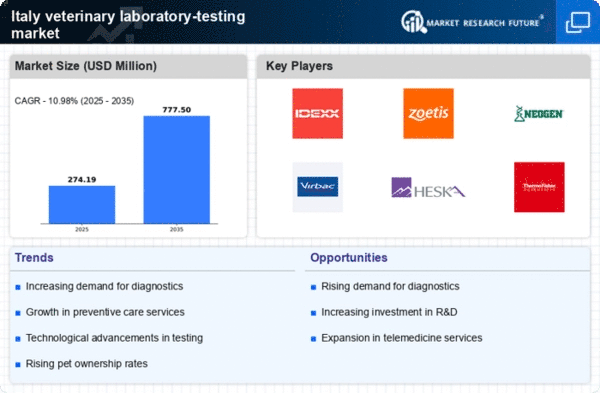
As per Market Research Future analysis, the Italy Veterinary Laboratory Testing Market size was estimated at 247.06 USD Million in 2024. The Veterinary Laboratory-testing market is projected to grow from 274.19 USD Million in 2025 to 777.5 USD Million by 2035, exhibiting a compound annual growth rate (CAGR) of 10.9% during the forecast period 2025 - 2035

Key Market Trends & Highlights

The Italy veterinary laboratory-testing market is experiencing robust growth driven by technological advancements and a focus on preventive healthcare.

  • Technological advancements in diagnostics are reshaping the veterinary laboratory-testing landscape.
  • The preventive healthcare focus among pet owners is driving demand for routine testing services.
  • Regulatory changes are influencing laboratory practices and compliance standards in the veterinary sector.
  • Rising pet ownership and increased awareness of animal health are key drivers propelling market growth.

Market Size & Forecast

2024 Market Size 247.06 (USD Million)
2035 Market Size 777.5 (USD Million)
CAGR (2025 - 2035) 10.98%

Major Players

Idexx Laboratories (US), Zoetis (US), Neogen Corporation (US), Virbac (FR), Heska Corporation (US), Thermo Fisher Scientific (US), Randox Laboratories (GB), Boehringer Ingelheim (DE), MediVet Biologics (US)

Our Impact
Enabled $4.3B Revenue Impact for Fortune 500 and Leading Multinationals
Partnering with 2000+ Global Organizations Each Year
30K+ Citations by Top-Tier Firms in the Industry

Italy Veterinary Laboratory Testing Market Trends

The The There is a notable increase in awareness regarding animal health among pet owners in Italy. is currently experiencing notable growth, driven by increasing awareness of animal health and welfare. is currently experiencing notable growth, driven by increasing awareness of animal health and welfare. Pet ownership has surged, leading to a heightened demand for diagnostic services. This trend is further supported by advancements in technology, which enhance the accuracy and efficiency of laboratory tests. Moreover, regulatory frameworks are evolving, promoting better standards in veterinary care. As a result, veterinary practices are increasingly investing in laboratory capabilities to meet the rising expectations of pet owners and ensure compliance with health regulations. In addition, the market is witnessing a shift towards preventive care, with veterinarians emphasizing routine testing to detect diseases early. This proactive approach not only improves animal health outcomes but also reduces long-term treatment costs. The integration of telemedicine in veterinary practices is also noteworthy, as it allows for remote consultations and follow-ups, thereby expanding access to laboratory testing services. Overall, the Italy Veterinary Laboratory Testing Market is poised for continued expansion, reflecting broader trends in animal healthcare and the increasing importance of diagnostics in veterinary medicine.

Technological Advancements

The veterinary laboratory-testing market is benefiting from rapid technological innovations. New diagnostic tools and automated systems are enhancing testing accuracy and turnaround times. These advancements facilitate more efficient workflows in veterinary practices, allowing for quicker decision-making regarding animal health.

Preventive Healthcare Focus

There is a growing emphasis on preventive healthcare within the veterinary laboratory-testing market. Veterinarians are increasingly recommending routine tests to identify potential health issues before they escalate. This proactive strategy not only improves animal welfare but also reduces overall healthcare costs.

Regulatory Changes

Recent regulatory changes are shaping the veterinary laboratory-testing market. Stricter guidelines are being implemented to ensure higher standards of animal care and laboratory practices. These regulations encourage veterinary clinics to adopt better testing protocols, ultimately benefiting animal health.

Italy Veterinary Laboratory Testing Market Drivers

Rising Pet Ownership

The The market in Italy is experiencing growth due to the increasing number of pet owners. is experiencing growth due to the increasing number of pet owners. As more households adopt pets, the demand for veterinary services, including laboratory testing, rises. In 2025, it is estimated that approximately 50% of Italian households own a pet, leading to a heightened need for diagnostic services. This trend is further supported by the growing awareness of pet health and wellness, prompting owners to seek regular check-ups and preventive care. Consequently, veterinary laboratories are likely to see an uptick in testing services, which may include blood tests, urinalysis, and other diagnostic procedures. The rising pet ownership not only drives the demand for veterinary services but also encourages investment in advanced laboratory technologies, thereby enhancing the overall veterinary laboratory-testing market in Italy.

Regulatory Compliance and Standards

The The market in Italy is influenced by stringent regulatory requirements and standards that govern laboratory practices. is influenced by stringent regulatory requirements and standards that govern laboratory practices. Compliance with these regulations is essential for ensuring the accuracy and reliability of test results. In recent years, there has been a push for enhanced quality control measures and accreditation processes for veterinary laboratories. This focus on regulatory compliance is likely to drive investments in laboratory infrastructure and training, as veterinary practices strive to meet these standards. As a result, the market may witness an increase in the number of accredited laboratories, which could enhance consumer confidence in laboratory testing services. Furthermore, adherence to regulatory standards may lead to improved testing methodologies, ultimately benefiting the overall veterinary laboratory-testing market.

Increased Awareness of Animal Health

There is a notable increase in awareness regarding animal health among pet owners in Italy, which significantly impacts the veterinary laboratory-testing market. As pet owners become more informed about the importance of regular health check-ups and early disease detection, the demand for laboratory testing services is likely to rise. This trend is reflected in the growing expenditure on veterinary care, which has seen an increase of approximately 10% annually over the past few years. Owners are now more inclined to invest in preventive health measures, including routine blood tests and screenings, to ensure their pets' well-being. This heightened awareness not only drives the demand for laboratory services but also encourages veterinary professionals to adopt more comprehensive testing protocols, thereby enhancing the overall quality of care provided in the veterinary laboratory-testing market.

Growing Demand for Specialized Testing

The The market in Italy is witnessing a growing demand for specialized testing services. is witnessing a growing demand for specialized testing services. As veterinary medicine evolves, there is an increasing need for advanced diagnostic tests that cater to specific health issues in pets. This trend is particularly evident in the rise of tests for chronic diseases, genetic disorders, and infectious diseases. In 2025, it is anticipated that specialized testing could account for up to 30% of the total laboratory testing volume. This shift is driven by pet owners' desire for tailored healthcare solutions and the need for veterinarians to provide precise diagnoses. Consequently, veterinary laboratories are likely to expand their service offerings to include a wider range of specialized tests, thereby enhancing their competitiveness in the veterinary laboratory-testing market.

Technological Innovations in Diagnostics

Technological advancements in diagnostic tools and methodologies are playing a crucial role in shaping the Technological advancements in diagnostic tools and methodologies are playing a crucial role in shaping the market in Italy.. Innovations such as point-of-care testing devices and advanced imaging techniques are becoming increasingly prevalent, allowing for quicker and more accurate diagnoses. The integration of artificial intelligence and machine learning in laboratory processes is also enhancing the efficiency of testing services. As a result, veterinary laboratories are likely to experience improved turnaround times and increased testing capacity. In 2025, it is projected that the adoption of these technologies could lead to a 15% increase in the volume of tests conducted annually. This trend not only benefits veterinary practices by streamlining operations but also enhances the overall quality of care provided to animals, thereby driving growth in the veterinary laboratory-testing market.


Market Segment Insights

By Animal Type: Companion Animals (Largest) vs. Livestock Animals (Fastest-Growing)

The market share distribution in the Italy veterinary laboratory-testing market highlights Companion Animals as the largest segment, capturing a significant portion of the overall demand. Livestock Animals, while smaller in market share, are witnessing substantial growth due to increasing investments in agricultural health and biosecurity measures. This dynamic showcases the varying needs of veterinary testing across different animal types. Growth trends indicate that Companion Animals continue to dominate due to a rising pet ownership rate and enhanced awareness regarding animal health. Conversely, Livestock Animals are becoming the fastest-growing segment as farmers and producers focus on optimizing livestock health for better productivity. Factors such as advancements in diagnostic technologies and a shift towards preventive healthcare are driving this trend.

Companion Animals: Dominant vs. Livestock Animals: Emerging

Companion Animals represent a dominant force in the Italy veterinary laboratory-testing market, driven by strong emotional bonds between owners and their pets, leading to increased spending on veterinary care. This segment encompasses pets like dogs, cats, and small mammals, which enjoy regular health check-ups and diagnostic tests, thereby fueling demand. On the other hand, Livestock Animals are emerging rapidly as more stakeholders prioritize animal welfare and productivity. This segment includes farm animals such as cattle, pigs, and poultry, with market players responding to the growing need for health monitoring solutions in agriculture. The convergence of technology and agriculture is shaping the future growth of Livestock testing, signaling a shift towards more sustainable practices.

By Technology: Clinical Biochemistry (Largest) vs. Molecular Diagnostics (Fastest-Growing)

In the Italy veterinary laboratory-testing market, Clinical Biochemistry holds the largest share among technologies, widely utilized for routine testing and monitoring of various diseases in animals. Other segments such as Immunodiagnostics and Hematology follow closely, with noteworthy contributions to the overall market. Molecular Diagnostics is emerging as a significant player, indicating a shift towards more advanced testing methodologies. Growth in this segment can be attributed to increasing investments in veterinary healthcare and the rising prevalence of zoonotic diseases. Additionally, advancements in technology and a growing awareness of animal health are driving demand for innovative diagnostic solutions. The expanding pet population and more stringent regulations regarding animal health also contribute to the positive growth trajectory of these technologies.

Molecular Diagnostics (Dominant) vs. Hematology (Emerging)

Molecular Diagnostics is defining the landscape of the veterinary testing market due to its ability to offer precise and rapid results, particularly beneficial for diagnosing infectious diseases. This segment is characterized by cutting-edge techniques such as PCR and next-generation sequencing, making it indispensable in the modern veterinary diagnostic toolkit. On the other hand, Hematology is emerging as a crucial area, providing insights into blood disorders and general health status in animals. While it may not currently dominate the market share, increasing utilization of automated hematology analyzers is propelling its growth. Both segments are crucial for veterinarians, ensuring accurate diagnostic capabilities to enhance animal care.

By Product: Consumables (Largest) vs. Instruments (Fastest-Growing)

In the Italy veterinary laboratory-testing market, the product segment exhibits a clear distribution of market share. Consumables hold the largest share, driven by their essential role in routine testing and diagnostics. These include reagents, test kits, and other disposables that are vital for laboratories. Instruments, while holding a smaller share, are gaining significant traction as advancements in technology enhance their capabilities, making them an attractive segment for growth. The growth trends within this segment are primarily influenced by the increasing demand for accurate and rapid testing in veterinary diagnostics. Emerging technologies and innovations in instruments are making them faster and more efficient, thereby, becoming preferred choices among veterinary professionals. Furthermore, the rising awareness of animal health and welfare is contributing to the growth of both consumables and instruments, as more laboratories expand their testing capabilities to meet the demand.

Consumables: Dominant vs. Instruments: Emerging

Consumables represent the dominant segment in the Italy veterinary laboratory-testing market, characterized by a wide range of essential products that facilitate testing processes. This includes test kits, reagents, and other disposable items that are integral for diagnostics. Their regular use in testing protocols ensures a consistent demand. On the other hand, instruments are emerging as a significant segment, driven by technological advancements that enhance testing precision and efficiency. This category includes various devices such as automated analyzers and diagnostic instruments, which are increasingly adopted by laboratories seeking to improve operational workflows and diagnostic accuracy. While consumables continue to lead the market, the rapid evolution of instrument technology is positioning them as key players for the future.

By End User: Veterinary Hospitals & Clinics (Largest) vs. Research Institutes (Fastest-Growing)

In the Italy veterinary laboratory-testing market, the market share distribution indicates that Veterinary Hospitals & Clinics represent the largest segment, capturing a significant portion due to their widespread presence and essential role in animal health care. In-house Testing and Diagnostic Laboratories follow, contributing notably to the market with their specialized services. Research Institutes, while smaller, are rapidly gaining ground, reflecting a dynamic shift in demand for laboratory testing in advanced veterinary research applications. The growth trends in this segment are primarily driven by the increasing need for accurate and timely laboratory testing in veterinary medicine. Factors such as the rise in pet ownership, advancements in testing technologies, and heightened awareness of animal health are propelling the expansion of Veterinary Hospitals & Clinics. Furthermore, Research Institutes are becoming crucial in this landscape, as demands for innovation and research into animal diseases drive their growth, positioning them as the fastest-growing segment in the market.

Veterinary Hospitals & Clinics (Dominant) vs. Research Institutes (Emerging)

Veterinary Hospitals & Clinics characterize the dominant segment of the Italy veterinary laboratory-testing market, providing essential diagnostic services and treatments which cater to a broad spectrum of animal health needs. These establishments primarily focus on direct patient care, leading to a consistent demand for laboratory tests that facilitate accurate diagnosis. In contrast, Research Institutes represent an emerging segment known for their role in advancing veterinary science through innovative testing methods and research. Their focus on developing new diagnostic techniques positions them to meet evolving industry demands. As they receive increasing funding and collaboration opportunities, Research Institutes are set to enhance their impact in this market by fostering technological advancements and establishing new testing protocols that promise to improve animal health outcomes.

Get more detailed insights about Italy Veterinary Laboratory Testing Market

Key Players and Competitive Insights

The veterinary laboratory-testing market in Italy exhibits a dynamic competitive landscape characterized by innovation and strategic partnerships. Key players such as Idexx Laboratories (US), Zoetis (US), and Virbac (FR) are at the forefront, leveraging their technological advancements and extensive product portfolios to capture market share. Idexx Laboratories (US) focuses on enhancing diagnostic capabilities through continuous innovation, while Zoetis (US) emphasizes expanding its reach in the animal health sector via strategic acquisitions. Virbac (FR) appears to be concentrating on regional expansion, particularly in Southern Europe, to bolster its market presence. Collectively, these strategies contribute to a competitive environment that is increasingly driven by technological advancements and customer-centric solutions.
The market structure is moderately fragmented, with several players vying for dominance. Key business tactics include localizing manufacturing to reduce costs and optimize supply chains, which is particularly relevant in the context of rising operational expenses. The influence of major players is significant, as their strategic initiatives often set industry standards and drive innovation across the sector. This competitive structure fosters an environment where agility and responsiveness to market demands are crucial for success.
In October 2025, Idexx Laboratories (US) announced the launch of a new diagnostic platform aimed at enhancing the speed and accuracy of veterinary testing. This strategic move is likely to solidify Idexx's position as a leader in the market, as it addresses the growing demand for rapid and reliable diagnostic solutions. The introduction of this platform may also encourage other players to innovate, thereby intensifying competition.
In September 2025, Zoetis (US) completed the acquisition of a regional veterinary diagnostics company, which is expected to expand its product offerings and enhance its market penetration in Italy. This acquisition aligns with Zoetis's strategy to diversify its portfolio and strengthen its foothold in the veterinary laboratory-testing market. The integration of this new entity could lead to synergies that enhance operational efficiencies and broaden customer access to advanced diagnostic tools.
In August 2025, Virbac (FR) entered into a strategic partnership with a technology firm to develop AI-driven diagnostic solutions for veterinary practices. This collaboration is indicative of a broader trend towards digital transformation within the industry. By harnessing AI, Virbac aims to improve diagnostic accuracy and streamline workflows, which could significantly enhance the value proposition for veterinary practitioners.
As of November 2025, the competitive trends in the veterinary laboratory-testing market are increasingly defined by digitalization, sustainability, and the integration of AI technologies. Strategic alliances are becoming more prevalent, as companies recognize the need to collaborate to stay ahead in a rapidly evolving landscape. The shift from price-based competition to a focus on innovation and technology is evident, with companies prioritizing supply chain reliability and advanced solutions to differentiate themselves. Looking ahead, it is likely that competitive differentiation will continue to evolve, driven by the need for innovative approaches that meet the changing demands of the veterinary sector.

Key Companies in the Italy Veterinary Laboratory Testing Market include

Industry Developments

In the Italy Veterinary Laboratory Testing Market, recent developments include significant growth attributed to increasing pet ownership and a rising emphasis on animal health standards. Key players such as Mérieux NutriSciences, Eurofins Scientific, and IDEXX Laboratories are expanding their portfolios through innovative testing solutions and enhanced laboratory services. 

Notably, there have been reports of strategic collaborations aimed at improving diagnostic capabilities, although no major mergers or acquisitions involving these companies have been announced recently, keeping in line with the industry's stability. In terms of market valuation, the sector is expected to experience robust growth driven by advances in technology and increased public awareness of veterinary care quality.

A review of the market over the past 2-3 years indicates considerable investment in Research and Development from companies like Thermo Fisher Scientific and Biogénesis Bago, which have facilitated innovation in testing methodologies. Furthermore, Italy's regulatory framework is pushing for higher compliance in veterinary diagnostics, which is increasingly causing laboratories to adopt more sophisticated testing processes. Overall, the landscape in Italy's veterinary laboratory testing sector remains dynamic, adapting to both market demands and regulatory requirements.


Future Outlook

Italy Veterinary Laboratory Testing Market Future Outlook

The Veterinary Laboratory Testing Market veterinary laboratory-testing market in Italy is projected to grow at a 10.98% CAGR from 2025 to 2035, driven by technological advancements and increasing pet ownership.

New opportunities lie in:

  • Development of mobile diagnostic units for remote testing services.
  • Integration of AI-driven analytics for faster result interpretation.
  • Expansion of telemedicine platforms for veterinary consultations and diagnostics.

  • By 2035, the market is expected to be robust, reflecting substantial growth and innovation.

Market Segmentation

Italy Veterinary Laboratory Testing Market Product Outlook

  • Consumables
  • Instruments

Italy Veterinary Laboratory Testing Market End User Outlook

  • Veterinary Hospitals & Clinics
  • In-House Testing
  • Research Institutes
  • Diagnostic Laboratories

Italy Veterinary Laboratory Testing Market Technology Outlook

  • Clinical Biochemistry
  • Immunodiagnostics
  • Hematology
  • Molecular Diagnostics
  • Urinalysis

Italy Veterinary Laboratory Testing Market Animal Type Outlook

  • Companion Animals
  • Livestock Animals

Report Scope

MARKET SIZE 2024 247.06(USD Million)
MARKET SIZE 2025 274.19(USD Million)
MARKET SIZE 2035 777.5(USD Million)
COMPOUND ANNUAL GROWTH RATE (CAGR) 10.98% (2025 - 2035)
REPORT COVERAGE Revenue Forecast, Competitive Landscape, Growth Factors, and Trends
BASE YEAR 2024
Market Forecast Period 2025 - 2035
Historical Data 2019 - 2024
Market Forecast Units USD Million
Key Companies Profiled Idexx Laboratories (US), Zoetis (US), Neogen Corporation (US), Virbac (FR), Heska Corporation (US), Thermo Fisher Scientific (US), Randox Laboratories (GB), Boehringer Ingelheim (DE), MediVet Biologics (US)
Segments Covered Animal Type, Technology, Product, End User
Key Market Opportunities Integration of advanced diagnostic technologies enhances efficiency in the veterinary laboratory-testing market.
Key Market Dynamics Rising demand for advanced diagnostic tests drives innovation and competition in the veterinary laboratory-testing market.
Countries Covered Italy
Leave a Comment

FAQs

What is the projected value of the Italy Veterinary Laboratory Testing Market in 2024?

The Italy Veterinary Laboratory Testing Market is expected to be valued at 246.6 million USD in 2024.

What will the market value of the Italy Veterinary Laboratory Testing Market be in 2035?

In 2035, the Italy Veterinary Laboratory Testing Market is projected to reach a value of 745.8 million USD.

What is the expected CAGR for the Italy Veterinary Laboratory Testing Market from 2025 to 2035?

The market is expected to grow at a CAGR of 10.584% from 2025 to 2035.

Which segment of the market has the highest value in 2024?

In 2024, the Companion segment is valued at 147.0 million USD, making it the highest segment in the market.

What is the expected value of the Livestock Animals segment in 2035?

The Livestock Animals segment is expected to reach 299.8 million USD in 2035.

Who are the major players in the Italy Veterinary Laboratory Testing Market?

Major players include Mérieux NutriSciences, Eurofins Scientific, IDEXX Laboratories, and Labcorp among others.

What growth drivers are contributing to the Italy Veterinary Laboratory Testing Market?

The growth of the market is driven by increased pet ownership and the rising demand for livestock health management.

What trends are emerging in the Italy Veterinary Laboratory Testing Market?

Emerging trends include advancements in diagnostic technology and increasing investments in veterinary healthcare.

What impact does the current global scenario have on the Italy Veterinary Laboratory Testing Market?

The market continues to experience growth opportunities despite global economic challenges and changing regulations.

How does the market size of the Companion Animals segment compare to Livestock Animals in 2024?

In 2024, the Companion Animals segment's value of 147.0 million USD significantly surpasses the Livestock Animals segment's 99.6 million USD.

Download Free Sample

Kindly complete the form below to receive a free sample of this Report

Compare Licence

×
Features License Type
Single User Multiuser License Enterprise User
Price $4,950 $5,950 $7,250
Maximum User Access Limit 1 User Upto 10 Users Unrestricted Access Throughout the Organization
Free Customization
Direct Access to Analyst
Deliverable Format
Platform Access
Discount on Next Purchase 10% 15% 15%
Printable Versions