×
Request Free Sample ×

Kindly complete the form below to receive a free sample of this Report

* Please use a valid business email

Leading companies partner with us for data-driven Insights

clients tt-cursor
Hero Background

Italy TMJ Implants Market

ID: MRFR/MED/47655-HCR
200 Pages
Rahul Gotadki
February 2026

Italy TMJ Implants Market Research Report: Size, Share, Trend Analysis By Component (Mandibular Components, Fossa Prostheses, Screws), By Material (Cobalt-Chromium-Molybdenum, Titanium Alloy, Ultra-High Molecular Weight Polyethylene (UHMWPE), Aluminum, Silicon, Others), By Indication (Arthritic Conditions, Ankylosis, Others) and By End Users (Hospitals, Dental Clinics, Others) - Growth Outlook & Industry Forecast 2025 To 2035

Share:
Download PDF ×

We do not share your information with anyone. However, we may send you emails based on your report interest from time to time. You may contact us at any time to opt-out.

Italy TMJ Implants Market Infographic
Purchase Options

Italy TMJ Implants Market Summary

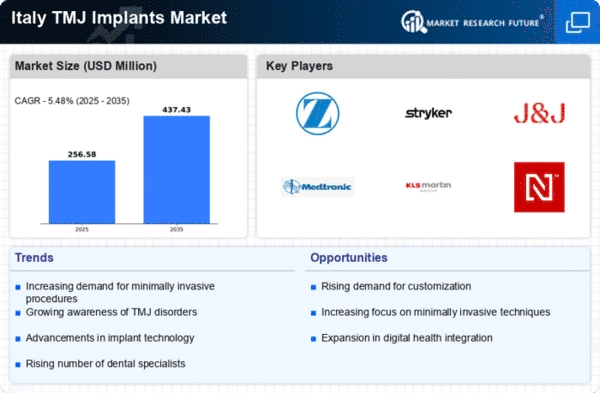
As per Market Research Future analysis, the Italy TMJ Implants Market size was estimated at 243.25 USD Million in 2024. The Tmj Implants market is projected to grow from 256.58 USD Million in 2025 to 437.43 USD Million by 2035, exhibiting a compound annual growth rate (CAGR) of 5.4% during the forecast period 2025 - 2035

Key Market Trends & Highlights

The Italy TMJ implants market is experiencing a positive trajectory driven by technological advancements and increasing patient awareness.

  • Technological advancements are enhancing the efficacy and safety of TMJ implants, leading to improved patient outcomes.
  • The largest segment in the Italy TMJ implants market is the surgical implants segment, while the fastest-growing segment is the aesthetic implants segment.
  • Regulatory support is fostering innovation and encouraging new product development in the TMJ implants market.
  • The rising incidence of TMJ disorders and advancements in implant technology are key drivers propelling market growth.

Market Size & Forecast

2024 Market Size 243.25 (USD Million)
2035 Market Size 437.43 (USD Million)
CAGR (2025 - 2035) 5.48%

Major Players

Zimmer Biomet (US), Stryker (US), DePuy Synthes (US), Medtronic (US), KLS Martin (DE), Nobel Biocare (CH), Straumann (CH), B. Braun (DE)

Our Impact
Enabled $4.3B Revenue Impact for Fortune 500 and Leading Multinationals
Partnering with 2000+ Global Organizations Each Year
30K+ Citations by Top-Tier Firms in the Industry

Italy TMJ Implants Market Trends

The Italy TMJ Implants Market is currently experiencing notable growth., driven by advancements in medical technology and an increasing awareness of temporomandibular joint disorders. In Italy, the demand for innovative treatment options is rising, as patients seek effective solutions for pain relief and improved quality of life. The healthcare system is adapting to these needs, with a focus on integrating cutting-edge materials and techniques into surgical practices. Furthermore, the collaboration between dental professionals and orthopedic specialists is fostering a more comprehensive approach to treatment, enhancing patient outcomes. Moreover, regulatory frameworks in Italy are evolving to support the introduction of new products in the tmj implants market. This shift is likely to encourage research and development initiatives, leading to the emergence of novel implant designs that cater to specific patient requirements. As the population ages, the prevalence of joint disorders is expected to increase, further propelling the market forward. Overall, The TMJ implants market is poised for sustained growth., reflecting a commitment to improving patient care and outcomes in Italy.

Technological Advancements

Recent innovations in materials and design are transforming the tmj implants market. Enhanced biocompatibility and durability of implants are leading to better patient experiences and outcomes. These advancements are likely to attract more patients seeking effective solutions.

Regulatory Support

The evolving regulatory landscape in Italy is facilitating the introduction of new products in the tmj implants market. Streamlined approval processes may encourage manufacturers to invest in research and development, resulting in a wider array of treatment options.

Increased Patient Awareness

Growing awareness of temporomandibular joint disorders is driving demand for tmj implants. Patients are becoming more informed about their treatment options, leading to higher consultation rates and a greater willingness to explore surgical solutions.

Italy TMJ Implants Market Drivers

Rising Incidence of TMJ Disorders

The increasing prevalence of temporomandibular joint (TMJ) disorders in Italy is a notable driver for the tmj implants market. Recent studies indicate that approximately 10-15% of the population experiences TMJ-related issues, leading to a heightened demand for effective treatment options. As awareness of these disorders grows, patients are more likely to seek surgical interventions, including implants. This trend is further supported by the aging population, which is more susceptible to joint-related ailments. Consequently, the tmj implants market is expected to expand as healthcare providers respond to this rising demand, offering innovative solutions to alleviate pain and restore function.

Advancements in Implant Technology

Technological innovations in implant design and materials are significantly influencing the tmj implants market. Recent developments have led to the creation of more biocompatible materials, enhancing the longevity and effectiveness of implants. For instance, the introduction of 3D printing technology allows for customized implants tailored to individual patient anatomy, improving surgical outcomes. Furthermore, minimally invasive techniques are gaining traction, reducing recovery times and enhancing patient satisfaction. As these advancements continue to evolve, they are likely to attract more patients seeking surgical options, thereby driving growth in the tmj implants market in Italy.

Growing Demand for Aesthetic Solutions

The rising interest in aesthetic dentistry is influencing the tmj implants market in Italy. Patients are increasingly seeking treatments that not only address functional issues but also enhance their appearance. TMJ disorders can lead to facial asymmetry and discomfort, prompting individuals to consider surgical options that provide both relief and aesthetic improvement. This trend is particularly evident among younger demographics who prioritize facial aesthetics. As the demand for aesthetic solutions continues to rise, the tmj implants market is likely to benefit from an influx of patients seeking comprehensive treatment options.

Enhanced Training for Dental Professionals

The ongoing education and training programs for dental professionals in Italy are positively impacting the tmj implants market. As more dentists and oral surgeons receive specialized training in TMJ disorders and implantology, the quality of care provided to patients improves. This enhanced expertise leads to increased confidence among practitioners in recommending surgical interventions for TMJ issues. Furthermore, collaborative efforts between dental schools and healthcare institutions are fostering a culture of continuous learning, ensuring that professionals stay updated on the latest techniques and technologies. Consequently, this trend is expected to drive growth in the tmj implants market as more patients receive informed and effective treatment.

Increased Investment in Healthcare Infrastructure

Italy's commitment to enhancing its healthcare infrastructure is a crucial factor propelling the tmj implants market. The government has allocated substantial funding towards modernizing healthcare facilities and improving access to specialized treatments. This investment is expected to facilitate the adoption of advanced surgical techniques and technologies, making TMJ surgeries more accessible to patients. Additionally, the establishment of specialized clinics focusing on TMJ disorders is likely to increase patient referrals for surgical interventions. As a result, the tmj implants market is poised for growth, driven by improved healthcare access and quality.


Market Segment Insights

By Component: Mandibular Components (Largest) vs. Fossa Prostheses (Fastest-Growing)

In the Italy tmj implants market, the distribution of market share among segment values reveals that mandibular components hold the largest share. This dominance is attributed to their critical role in providing stability and function in TMJ disorders. Fossa prostheses, while smaller in share, show a significant trend in adoption due to their innovative design that accommodates a variety of clinical scenarios. Growth trends within this segment are primarily driven by increasing awareness of TMJ disorders and advancements in implant technologies. Mandibular components continue to be favored for their effectiveness, while fossa prostheses are rapidly gaining traction as an emerging alternative. The demand for specialized and customizable implants is promoting ongoing development in both areas, ensuring sustained market interest.

Mandibular Components (Dominant) vs. Fossa Prostheses (Emerging)

Mandibular components are recognized as the dominant segment in the Italy tmj implants market, owing to their established efficacy and reliability in clinical applications. They provide essential support and functionality, making them a preferred choice among healthcare professionals. In contrast, fossa prostheses are emerging as a significant alternative, appealing to practitioners seeking innovative solutions for complex TMJ cases. Their ability to be tailored to individual patient needs enhances their appeal. The screws segment, while crucial, serves primarily as supportive elements in implant systems, underlining the importance of both primary components and adjunctive solutions in comprehensive treatment plans.

By Material: Titanium Alloy (Largest) vs. Cobalt-Chromium-Molybdenum (Fastest-Growing)

In the Italy tmj implants market, the material segment showcases a competitive landscape with Titanium Alloy holding the largest share. This material is favored for its excellent biocompatibility and mechanical properties, making it a preferred choice among professionals. Cobalt-Chromium-Molybdenum follows closely, known for its strength and corrosion resistance, which adds to its increasing uptake in various implant applications. The growth trends indicate a rising preference for Titanium Alloy due to its long-term performance and effectiveness. However, Cobalt-Chromium-Molybdenum is recognized as the fastest-growing segment, driven by innovations in implant technology and increased demand for more durable solutions. The overall emphasis on patient outcomes and the longevity of implants is pushing these materials to the forefront.

Titanium Alloy (Dominant) vs. Cobalt-Chromium-Molybdenum (Emerging)

Titanium Alloy is currently the dominant material in the Italy tmj implants market, appreciated for its high strength-to-weight ratio, corrosion resistance, and biocompatibility. These properties make it ideal for long-term implant configurations. In contrast, Cobalt-Chromium-Molybdenum, while emerging, is rapidly gaining traction due to its superior mechanical strength and wear resistance, making it suitable for demanding applications. The growing healthcare innovations and the sustained focus on improving the durability of tmj implants are factors driving Cobalt-Chromium-Molybdenum's position in the market. Both materials represent crucial options for manufacturers and surgeons aiming to enhance patient health outcomes.

By Indication: Arthritic Conditions (Largest) vs. Ankylosis (Fastest-Growing)

In the Italy tmj implants market, the market share distribution reveals that arthritic conditions represent the largest segment. This dominance is a reflection of the high prevalence of arthritic cases among the population, driving significant demand for treatment solutions. In contrast, ankylosis, while smaller currently, is quickly capturing attention due to an increasing diagnosis rate and awareness among healthcare professionals. Growth trends for these segments indicate a robust potential for both arthritic conditions and ankylosis. The rising elderly population and lifestyle-related disorders contribute to the increasing adoption of implants for arthritic conditions. Additionally, advancements in surgical techniques and implant designs are propelling the ankylosis segment as it becomes the fastest-growing, motivating a shift towards more effective therapies and enhanced patient outcomes.

Arthritic Conditions (Dominant) vs. Ankylosis (Emerging)

Arthritic conditions are characterized by ongoing pain and inflammation, making them a dominant segment in the Italy tmj implants market. This group encompasses various disorders that lead to degeneration of joint functionality, prompting a continuous demand for advanced treatment solutions. Conversely, ankylosis is emerging as a significant segment characterized by abnormal stiffening and immobility of the joint. The increase in awareness and diagnosis of this condition is boosting its market presence. Enhanced surgical options and a focus on patient-specific solutions are further fueling the growth of ankylosis, indicating a notable shift toward innovative treatment pathways.

By End User: Hospitals (Largest) vs. Dental Clinics (Fastest-Growing)

In the Italy tmj implants market, Hospitals hold a significant share, serving as the largest end user segment. They are pivotal in the adoption of advanced surgical techniques and technologies, particularly for surgical implants. Dental Clinics, while slightly trailing in market share, are rapidly gaining traction with the increasing prevalence of dental disorders and rising patient awareness about treatment options. The growth of the end user segment is driven by various factors including the rising elderly population and the prevalence of TMJ disorders, leading to higher demand for surgical interventions. Furthermore, advancements in implant technologies and an increase in health insurance coverage are propelling the adoption of TMJ implants in both Hospitals and Dental Clinics, with Clinics emerging as the fastest-growing segment.

Hospitals (Dominant) vs. Dental Clinics (Emerging)

Hospitals serve as the dominant players in the Italy tmj implants market, offering comprehensive services and possessing sophisticated infrastructure for the treatment of TMJ disorders. Their ability to provide multidisciplinary care and manage complex cases enhances their appeal, making them a preferred choice for patients requiring surgical interventions. On the other hand, Dental Clinics are emerging as a vital segment, characterized by their focused approach to dental health and increasing patient access. The trend towards minimally invasive procedures and the rise of specialized TMJ treatments are further solidifying the role of Dental Clinics, making them a crucial aspect of the market dynamics.

Get more detailed insights about Italy TMJ Implants Market

Key Players and Competitive Insights

The tmj implants market in Italy is characterized by a competitive landscape that is increasingly shaped by innovation, strategic partnerships, and regional expansion. Key players such as Zimmer Biomet (US), Stryker (US), and KLS Martin (DE) are actively pursuing strategies that emphasize technological advancements and enhanced patient outcomes. For instance, Zimmer Biomet (US) has focused on integrating digital solutions into their product offerings, which appears to enhance surgical precision and patient satisfaction. Meanwhile, Stryker (US) has been expanding its portfolio through strategic acquisitions, thereby consolidating its market position and broadening its reach within the region. These collective strategies contribute to a dynamic competitive environment, where companies are not only vying for market share but also striving to lead in innovation and service delivery.In terms of business tactics, localizing manufacturing and optimizing supply chains are pivotal for companies operating in this market. The competitive structure is moderately fragmented, with several players holding significant market shares while others focus on niche segments. This fragmentation allows for diverse offerings, catering to varying patient needs and preferences. The influence of key players is substantial, as their operational strategies often set benchmarks for quality and innovation, thereby shaping market expectations.

In October KLS Martin (DE) announced the launch of a new line of tmj implants designed with advanced biomaterials aimed at improving integration with bone tissue. This strategic move is likely to enhance their competitive edge by addressing the growing demand for more biocompatible solutions in the market. The introduction of these implants could potentially lead to better patient outcomes and reduced recovery times, aligning with current trends towards personalized medicine.

In September Stryker (US) unveiled a partnership with a leading Italian research institution to develop AI-driven surgical planning tools specifically for tmj procedures. This collaboration underscores the importance of integrating cutting-edge technology into surgical practices, which may significantly improve surgical outcomes and operational efficiencies. By leveraging AI, Stryker (US) positions itself at the forefront of innovation, potentially reshaping the surgical landscape in the region.

In August Zimmer Biomet (US) expanded its distribution network in Italy by partnering with local healthcare providers to enhance accessibility to its tmj implant products. This strategic expansion not only increases market penetration but also fosters closer relationships with healthcare professionals, which could lead to improved product feedback and innovation. Such initiatives reflect a broader trend towards localized strategies that prioritize patient access and satisfaction.

As of November the competitive trends in the tmj implants market are increasingly defined by digitalization, sustainability, and the integration of AI technologies. Strategic alliances are becoming more prevalent, as companies recognize the value of collaboration in driving innovation and enhancing service delivery. Looking ahead, competitive differentiation is likely to evolve from traditional price-based competition to a focus on technological advancements, supply chain reliability, and the ability to deliver superior patient outcomes. This shift indicates a transformative phase in the market, where innovation and quality will be paramount.

Key Companies in the Italy TMJ Implants Market include

Industry Developments

Recent developments in the Italy TMJ Implants Market indicate a growing focus on innovation and advanced technology by companies like Smith and Nephew, Arthrex, and Medtronic. The market has experienced a notable increase in competition, with Exactech and Stryker enhancing their product offerings. In September 2023, KLS Martin announced plans to expand its product range in Italy, aligning with increasing demand for TMJ treatment solutions. Additionally, the sector has observed a merging trend; in July 2023, Conmed completed its acquisition of a small Italian biotech firm specializing in TMJ solutions, bringing new technologies into their portfolio. 

Companies such as Johnson and Johnson and Zimmer Biomet have also reported steady growth in market valuation, significantly impacting overall market dynamics. The Italian healthcare system continues to evolve, with regulatory frameworks supporting new implant technologies, reflecting a commitment to improving patient outcomes. Over the last two years, significant advancements were noted, particularly in March 2022 when the Italian Ministry of Health launched a national initiative aimed at enhancing TMJ treatment methodologies, resulting in increased collaboration among major players. This evolving landscape positions Italy as a key player in the global TMJ implants sector.

Future Outlook

Italy TMJ Implants Market Future Outlook

The TMJ Implants Market in Italy is projected to grow at a 5.48% CAGR from 2025 to 2035, driven by technological advancements, increasing patient awareness, and rising healthcare expenditure.

New opportunities lie in:

  • Development of customized tmj implants using 3D printing technology.
  • Expansion of telemedicine platforms for remote consultations and follow-ups.
  • Partnerships with dental clinics for integrated implant solutions.

By 2035, The TMJ implants market is expected to achieve substantial growth and innovation..

Market Segmentation

Italy TMJ Implants Market End User Outlook

  • Hospitals
  • Dental Clinics
  • Others

Italy TMJ Implants Market Material Outlook

  • Cobalt-Chromium-Molybdenum
  • Titanium Alloy
  • Ultra-high Molecular Weight Polyethylene (UHMWPE)
  • Aluminum
  • Silicone
  • Others

Italy TMJ Implants Market Component Outlook

  • Mandibular Components
  • Fossa Prostheses
  • Screws

Italy TMJ Implants Market Indication Outlook

  • Arthritic Conditions
  • Ankylosis
  • Others

Report Scope

MARKET SIZE 2024 243.25(USD Million)
MARKET SIZE 2025 256.58(USD Million)
MARKET SIZE 2035 437.43(USD Million)
COMPOUND ANNUAL GROWTH RATE (CAGR) 5.48% (2025 - 2035)
REPORT COVERAGE Revenue Forecast, Competitive Landscape, Growth Factors, and Trends
BASE YEAR 2024
Market Forecast Period 2025 - 2035
Historical Data 2019 - 2024
Market Forecast Units USD Million
Key Companies Profiled Zimmer Biomet (US), Stryker (US), DePuy Synthes (US), Medtronic (US), KLS Martin (DE), Nobel Biocare (CH), Straumann (CH), B. Braun (DE)
Segments Covered Component, Material, Indication, End User
Key Market Opportunities Advancements in minimally invasive techniques enhance patient outcomes in the tmj implants market.
Key Market Dynamics Rising demand for innovative TMJ implants driven by technological advancements and evolving patient preferences in Italy.
Countries Covered Italy
Leave a Comment

FAQs

What is the expected market size of the Italy TMJ Implants Market in 2024?

The Italy TMJ Implants Market is expected to be valued at 208.8 million USD in 2024.

What is the projected market size for the Italy TMJ Implants Market by 2035?

By 2035, the Italy TMJ Implants Market is anticipated to reach a value of 379.8 million USD.

What is the expected compound annual growth rate (CAGR) for the Italy TMJ Implants Market from 2025 to 2035?

The CAGR for the Italy TMJ Implants Market is expected to be 5.589% from 2025 to 2035.

Which component of the Italy TMJ Implants Market has the highest market value in 2024?

Mandibular Components hold the highest market value in the Italy TMJ Implants Market at 85.0 million USD in 2024.

How much is the market for Fossa Prostheses valued in 2035?

The market for Fossa Prostheses is projected to be valued at 126.0 million USD in 2035.

What are the key players in the Italy TMJ Implants Market?

Major players in the Italy TMJ Implants Market include Smith and Nephew, Arthrex, Exactech, and Medtronic.

What is the expected value of the Screws segment in the Italy TMJ Implants Market in 2035?

The Screws segment is expected to reach a value of 101.8 million USD by 2035.

What growth opportunities exist in the Italy TMJ Implants Market?

There are significant growth opportunities driven by advancements in technology and increased awareness of TMJ disorders.

What challenges does the Italy TMJ Implants Market currently face?

Challenges include regulatory hurdles and variations in healthcare infrastructure across regions.

What is the projected market size of the Mandibular Components segment in 2035?

The Mandibular Components segment is projected to grow to 152.0 million USD by 2035.

Download Free Sample

Kindly complete the form below to receive a free sample of this Report

Compare Licence

×
Features License Type
Single User Multiuser License Enterprise User
Price $4,950 $5,950 $7,250
Maximum User Access Limit 1 User Upto 10 Users Unrestricted Access Throughout the Organization
Free Customization
Direct Access to Analyst
Deliverable Format
Platform Access
Discount on Next Purchase 10% 15% 15%
Printable Versions