×
Request Free Sample ×

Kindly complete the form below to receive a free sample of this Report

* Please use a valid business email

Leading companies partner with us for data-driven Insights

clients tt-cursor
Hero Background

Italy Medical Alert Systems Market

ID: MRFR/MED/48437-HCR
200 Pages
Garvit Vyas
February 2026

Italy Medical Alert Systems Market Research Report: Size, Share, Trend Analysis By Types (Personal Emergency Response Systems (PERS), Nurse Call Systems (NCS), Ambulatory Auto Alert Systems, Automated Airborne Flight Alert System, Smart Belt), By Offering (Hardware, Software, Services), By Connection Type (Wired, Wireless), By Technology (Two-Way Voice Systems, Unmonitored Medical Alert Systems, Medical Alert Alarm (Button) System, IP-Based Systems) andBy Applications (Home-Based Users, Senior Living Facilities/Senior Care Centers, Assisted Living Facilities) - Growth Outlook & Industry Forecast 2025 To 2035

Share:
Download PDF ×

We do not share your information with anyone. However, we may send you emails based on your report interest from time to time. You may contact us at any time to opt-out.

Italy Medical Alert Systems Market Infographic
Purchase Options

Italy Medical Alert Systems Market Summary

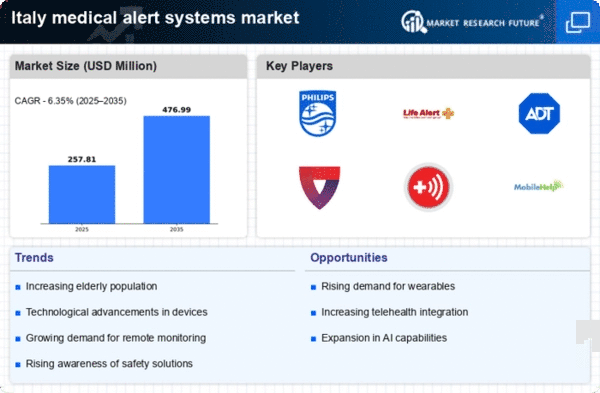
As per Market Research Future analysis, the Italy Medical Alert Systems Market size was estimated at 242.42 USD Million in 2024. The Medical Alert-systems market is projected to grow from 257.81 USD Million in 2025 to 476.99 USD Million by 2035, exhibiting a compound annual growth rate (CAGR) of 6.3% during the forecast period 2025 - 2035

Key Market Trends & Highlights

The Italy medical alert-systems market is experiencing robust growth driven by technological advancements and demographic shifts.

  • Technological advancements are enhancing the functionality and user-friendliness of medical alert systems.
  • Increased consumer awareness is driving demand for personalized and reliable healthcare solutions.
  • The aging population dynamics in Italy contribute to a growing need for effective medical alert systems.
  • Rising healthcare expenditure and a focus on home healthcare are key drivers propelling market growth.

Market Size & Forecast

2024 Market Size 242.42 (USD Million)
2035 Market Size 476.99 (USD Million)
CAGR (2025 - 2035) 6.35%

Major Players

Philips (NL), Life Alert (US), ADT (US), Medical Guardian (US), Bay Alarm Medical (US), MobileHelp (US), GreatCall (US), Lifeline (US)

Our Impact
Enabled $4.3B Revenue Impact for Fortune 500 and Leading Multinationals
Partnering with 2000+ Global Organizations Each Year
30K+ Citations by Top-Tier Firms in the Industry

Italy Medical Alert Systems Market Trends

The Italy Medical Alert Systems Market in Italy is currently experiencing a notable evolution, driven by an increasing aging population and a growing awareness of health and safety among individuals. As the demographic landscape shifts, there is a rising demand for solutions that enhance the independence and security of elderly citizens. This trend is further supported by advancements in technology, which have led to the development of more sophisticated and user-friendly alert systems. These systems not only provide immediate assistance in emergencies but also offer features such as fall detection and health monitoring, appealing to both users and caregivers alike. Moreover, the regulatory environment in Italy appears to be becoming more supportive of innovations in the medical alert-systems market. Government initiatives aimed at improving healthcare access and promoting the use of technology in health management are likely to foster growth in this sector. The integration of telehealth services with medical alert systems may also enhance their appeal, as it allows for real-time communication between users and healthcare providers. Overall, the medical alert-systems market is poised for growth, reflecting broader trends in healthcare and technology that prioritize safety and well-being for all individuals, particularly the elderly.

Technological Advancements

The medical alert-systems market is witnessing rapid technological advancements, with innovations such as wearable devices and mobile applications enhancing user experience. These developments enable users to receive alerts and communicate with emergency services more efficiently, thereby improving response times during critical situations.

Increased Consumer Awareness

There is a growing awareness among consumers regarding the importance of personal safety and health monitoring. This trend is likely to drive demand for medical alert systems, as individuals seek solutions that provide peace of mind for themselves and their loved ones.

Regulatory Support

The regulatory landscape in Italy is evolving to support the adoption of medical alert systems. Government initiatives aimed at promoting health technology and improving access to healthcare services may create a favorable environment for market growth.

Italy Medical Alert Systems Market Drivers

Aging Population Dynamics

The aging population in Italy is a crucial driver for the medical alert-systems market. As the demographic shifts towards an older age group, the demand for healthcare solutions that ensure safety and independence increases. In 2025, approximately 23% of the Italian population is projected to be over 65 years old, highlighting the necessity for systems that provide immediate assistance. This demographic trend suggests a growing market potential, as older adults often require support in daily activities and may face health emergencies. Consequently, families and caregivers are increasingly seeking reliable medical alert systems to enhance the safety of their loved ones. The medical alert-systems market is likely to experience substantial growth as it aligns with the needs of this aging demographic, which prioritizes autonomy and security.

Rising Healthcare Expenditure

In Italy, the rising healthcare expenditure is a significant driver for the medical alert-systems market. With healthcare spending projected to reach €200 billion by 2025, there is a growing emphasis on preventive care and safety solutions. This increase in expenditure allows for greater investment in medical alert systems, as both public and private sectors recognize the importance of ensuring the well-being of vulnerable populations. The medical alert-systems market stands to benefit from this trend, as more individuals and families allocate resources towards technologies that enhance safety and provide peace of mind. Furthermore, government initiatives aimed at improving healthcare access and quality may also contribute to the expansion of this market, as they encourage the adoption of innovative solutions.

Increased Focus on Home Healthcare

The shift towards home healthcare in Italy is reshaping the medical alert-systems market. As more individuals prefer to receive care in the comfort of their homes, the demand for medical alert systems that facilitate this trend is on the rise. This preference is driven by the desire for personalized care and the ability to maintain independence. In 2025, it is anticipated that over 50% of healthcare services will be delivered at home, creating a substantial market opportunity for medical alert systems. These systems not only provide immediate assistance but also enable remote monitoring by healthcare professionals, ensuring that patients receive timely interventions. The medical alert-systems market is likely to thrive as it aligns with the growing trend of home-based care, catering to the needs of patients and their families.

Technological Integration in Healthcare

The integration of advanced technologies into healthcare is significantly influencing the medical alert-systems market. Innovations such as wearable devices, mobile applications, and telehealth services are becoming more prevalent in Italy. These technologies not only enhance the functionality of medical alert systems but also improve user experience. For instance, the incorporation of GPS tracking and fall detection features allows for real-time monitoring and immediate response in emergencies. As of 2025, it is estimated that around 40% of medical alert systems in Italy will incorporate such advanced technologies, reflecting a shift towards more sophisticated solutions. This trend indicates that consumers are increasingly inclined to invest in systems that offer comprehensive features, thereby driving market growth and encouraging manufacturers to innovate further.

Consumer Demand for Enhanced Safety Features

Consumer demand for enhanced safety features is a pivotal driver in the medical alert-systems market. As awareness of health risks increases, individuals are seeking systems that offer more than basic functionalities. Features such as automatic fall detection, emergency response integration, and health monitoring capabilities are becoming essential. In Italy, surveys indicate that approximately 70% of potential users prioritize these advanced features when selecting a medical alert system. This trend suggests that manufacturers must innovate and adapt their offerings to meet consumer expectations. The medical alert-systems market is likely to expand as companies respond to this demand, developing products that not only ensure safety but also provide comprehensive health management solutions.


Market Segment Insights

By Type: PERS (Largest) vs. NCS (Fastest-Growing)

In the Italy medical alert-systems market, personal emergency response systems (PERS) hold the largest market share, reflecting their established adoption among users seeking reliable emergency response solutions. Nurse call systems (NCS) are rapidly rising in prominence, with increasing adoption in healthcare facilities, showcasing how users are prioritizing effective communication systems for patient safety and timely assistance. Growth trends in this market segment are being driven by technological advancements, including enhanced connectivity and improved user interfaces. Additionally, the aging population in Italy and the rising demand for remote healthcare services fuel the adoption of both PERS and NCS, making them critical components in the healthcare landscape. Consumer preference towards convenience and efficiency further solidifies their growth potential, as they adapt to meet modern needs.

PERS (Dominant) vs. NCS (Emerging)

Personal emergency response systems (PERS) are characterized by their user-friendly design and reliability, serving as the backbone of emergency alert solutions for seniors and individuals with health concerns. Their widespread acceptance results from a legacy of proven effectiveness in providing prompt response during emergencies. Conversely, nurse call systems (NCS) are emerging rapidly in popularity as they pivot towards more integrated healthcare solutions. NCS improve communication between patients and medical staff, allowing seamless healthcare interaction. This emerging segment is becoming crucial in hospitals and care facilities, where timely assistance is vital. The divergence between these segments illustrates a dynamic market where traditional reliability is balanced with innovative healthcare advancements.

By Offering: Hardware (Largest) vs. Services (Fastest-Growing)

In the Italy medical alert-systems market, hardware remains the dominant segment, capturing a significant market share due to its established presence and reliability. Hardware offerings such as wearable devices and alert buttons are essential for users seeking immediate assistance. Services, while smaller in market share, show promising growth as they encompass monitoring and response services that provide peace of mind, especially for elderly users who require constant supervision. The growth trends in this segment are largely driven by advancements in technology and an increasing awareness of personal safety among the aging population. Innovations in software applications that enhance the functionality of hardware devices are propelling the services segment forward. Additionally, the increasing adoption of telehealth services, combined with a rise in health and fitness awareness, is leading to a surge in demand for comprehensive medical alert systems that combine hardware, software, and services efficiently.

Hardware (Dominant) vs. Services (Emerging)

The hardware segment of the Italy medical alert-systems market includes essential devices such as medical alert pendants and wristbands that provide users with instant access to help in emergencies. This segment is characterized by robust product development, ensuring high durability and ease of use. In contrast, the services segment is emerging with a focus on personalized monitoring and support, appealing to a growing demographic that seeks not just equipment but also reassurance and assistance. As more individuals recognize the importance of proactive health management, the demand for integrated services that can monitor health and safety from a distance is increasing, making this segment crucial for future market dynamics.

By Connection Type: Wireless (Largest) vs. Wired (Fastest-Growing)

In the Italy medical alert-systems market, the share distribution between wired and wireless connection types shows wireless systems as the predominant choice among consumers. The convenience and ease of use associated with wireless connections contribute to their widespread acceptance, attributing to a significant proportion of the market share. On the other hand, wired systems, while less popular, still hold a vital place, particularly in settings requiring constant connectivity and reliability. Growth trends indicate that while wireless systems continue to lead the pack, wired systems are witnessing a surge in demand as technological advancements make them more appealing than before. The increasing focus on creating reliable communication channels drives the rapid expansion of wired systems, particularly in emergency scenarios where connection stability is crucial. This duality in consumer preference underscores a complex and evolving market landscape.

Wireless (Dominant) vs. Wired (Emerging)

Wireless medical alert systems dominate the market due to their user-friendly features and flexibility, allowing users to move freely without being tethered to a location. These systems typically incorporate advanced technologies such as cellular and Wi-Fi connectivity, which enhance tracking and emergency communication capabilities. On the other hand, wired systems, while emerging, are gaining traction due to their reliability and lower risk of signal interference, making them ideal for environments where consistent connectivity is essential. As both technologies continue to evolve, they cater to different segments of the market, ensuring that consumer needs for portability against reliability are met effectively.

By Technology: Two-Way Voice Systems (Largest) vs. IP-Based Systems (Fastest-Growing)

In the Italy medical alert-systems market, Two-Way Voice Systems hold a significant market share, appealing to users who desire direct communication in emergencies. Unmonitored Medical Alert Systems follow, offering cost-effective solutions but lacking immediate assistance, while Medical Alert Alarm (Button) Systems stand out for their reliability and ease of use. Finally, IP-Based Systems have emerged recently, gaining traction with the integration of advanced technology features. The growth trends in this segment are driven by an aging population increasingly aware of health and safety. Two-Way Voice Systems remain a trusted choice for families, while IP-Based Systems are rising rapidly due to their innovative features, such as smartphone connectivity and remote monitoring. The desire for more sophisticated health monitoring solutions continues to fuel the demand for IP-Based Systems as they offer greater flexibility and user engagement.

Technology: Two-Way Voice Systems (Dominant) vs. IP-Based Systems (Emerging)

Two-Way Voice Systems are a dominant force in the Italy medical alert-systems market, primarily due to their ability to provide immediate communication with emergency services. Users appreciate the reliability and reassurance these systems bring, especially in critical situations. In contrast, IP-Based Systems represent an emerging segment, characterized by the integration of digital technology that enables enhanced functionality, such as real-time data tracking and remote monitoring via mobile devices. These systems are quickly gaining popularity among tech-savvy consumers and younger caregivers who prioritize flexibility in accessing health information, leading to a potential shift in market dynamics as they enter the mainstream.

By Application: Home-Based Users (Largest) vs. Senior Living Facilities/Senior Care Centers (Fastest-Growing)

The application segment of the Italy medical alert-systems market showcases a diverse distribution, with home-based users commanding the largest share. This segment benefits from the growing trend of aging at home, allowing seniors to maintain their independence while ensuring safety. Meanwhile, senior living facilities and senior care centers are witnessing remarkable growth driven by the increasing population of elderly residents seeking communal living with enhanced healthcare support. Growth trends in this segment are propelled by rising awareness about the importance of safety among senior populations and their families. Innovations in technology, such as mobile alert systems and integration with smart home devices, are making medical alert systems more appealing. Additionally, government initiatives promoting healthcare accessibility are further boosting adoption rates in both home-based settings and care facilities.

Home-Based Users (Dominant) vs. Assisted Living Facilities (Emerging)

Home-based users represent the dominant segment in the Italy medical alert-systems market, primarily appealing to ageing individuals who prefer to live independently while having access to emergency support. This segment is characterized by the adoption of user-friendly devices that can easily be worn or carried around the home, providing peace of mind to users and their families. In contrast, assisted living facilities are an emerging segment, integrating advanced medical alert technology into their services. These facilities focus on creating a safe environment for residents while enhancing their living experience with proactive health monitoring solutions. The interplay between these two segments reflects a market dynamic that emphasizes both independence and communal safety.

Get more detailed insights about Italy Medical Alert Systems Market

Key Players and Competitive Insights

The medical alert-systems market in Italy is characterized by a competitive landscape that is increasingly shaped by technological advancements and evolving consumer preferences. Key growth drivers include an aging population, rising health awareness, and the integration of smart technologies into healthcare solutions. Major players such as Philips (NL), Life Alert (US), and ADT (US) are strategically positioned to leverage these trends. Philips (NL) focuses on innovation in health technology, emphasizing connected health solutions that enhance user experience. Life Alert (US) maintains a strong brand presence through its direct-to-consumer marketing strategy, while ADT (US) is expanding its service offerings through partnerships with healthcare providers, thereby enhancing its operational focus on integrated health solutions.The market structure appears moderately fragmented, with several players competing for market share. Key business tactics include localizing manufacturing to reduce costs and optimize supply chains, which is particularly relevant in the context of rising global logistics costs. The collective influence of these key players shapes a competitive environment where differentiation is increasingly based on service quality and technological innovation rather than solely on price.

In October Philips (NL) announced the launch of a new line of wearable medical alert devices that integrate AI-driven health monitoring features. This strategic move is significant as it positions Philips at the forefront of the digital health revolution, potentially enhancing user engagement and satisfaction through personalized health insights. The introduction of such advanced technology may also attract a younger demographic, thereby expanding the customer base.

In September Life Alert (US) expanded its service offerings by introducing a new mobile app that allows users to connect with emergency services directly. This development is crucial as it enhances the immediacy of response in emergencies, thereby reinforcing Life Alert's commitment to user safety and satisfaction. The app's user-friendly interface is likely to appeal to tech-savvy consumers, further solidifying the company's market position.

In August ADT (US) entered into a strategic partnership with a leading telehealth provider to offer integrated health monitoring services. This collaboration is indicative of a broader trend towards holistic health solutions, where companies are increasingly recognizing the value of combining security and health services. Such partnerships may enhance customer loyalty and create new revenue streams, positioning ADT as a comprehensive service provider in the medical alert-systems market.

As of November current competitive trends are heavily influenced by digitalization, sustainability, and the integration of AI technologies. Strategic alliances are becoming more prevalent, as companies seek to enhance their service offerings and operational efficiencies. The competitive differentiation is likely to evolve from traditional price-based competition to a focus on innovation, technology, and supply chain reliability. This shift suggests that companies that prioritize technological advancements and strategic partnerships will be better positioned to thrive in the future.

Key Companies in the Italy Medical Alert Systems Market include

Industry Developments

The Italy Medical Alert Systems Market has experienced notable developments recently, particularly with an emphasis on increasing technological advancements and growth in consumer demand for remote monitoring solutions. Companies such as Lifeline, MobileHelp, and Bay Alarm Medical have been focusing on expanding their product lines to include more reliable and user-friendly devices tailored for the aging population in Italy. In April 2023, it was reported that Guardian Alert announced a partnership aimed at enhancing the integration of Artificial Intelligence in their alert systems to improve responsiveness and user satisfaction.

Furthermore, the market has been witnessing a steady increase in overall market valuation, largely driven by demographic shifts and government initiatives targeting senior care. Over the past two to three years, Tunstall and Alert1 have made strides in local collaborations to promote health technology solutions. Notably, no major mergers or acquisitions have been announced among the primary players in Italy, reflecting a focus on organic growth and technology updates instead. As the market matures, regulatory standards are expected to evolve, influencing manufacturing parameters and service delivery in the sector, thus contributing positively to collaborative healthcare outcomes in Italy.

Future Outlook

Italy Medical Alert Systems Market Future Outlook

The Medical Alert Systems Market in Italy is projected to grow at a 6.35% CAGR from 2025 to 2035, driven by technological advancements and an aging population.

New opportunities lie in:

  • Integration of AI for predictive health monitoring solutions.
  • Expansion of mobile app platforms for real-time alerts.
  • Development of customizable wearable devices for diverse user needs.

By 2035, the market is expected to achieve substantial growth, reflecting evolving consumer demands.

Market Segmentation

Italy Medical Alert Systems Market Type Outlook

  • Personal Emergency Response Systems (PERS)
  • Nurse Call Systems (NCS)
  • Ambulatory Auto Alert Systems
  • Automated Airborne Flight Alert System
  • Smart Belt

Italy Medical Alert Systems Market Offering Outlook

  • Hardware
  • Software
  • Services

Italy Medical Alert Systems Market Technology Outlook

  • Two-Way Voice Systems
  • Unmonitored Medical Alert Systems
  • Medical Alert Alarm (Button) System
  • IP-Based Systems

Italy Medical Alert Systems Market Application Outlook

  • Home-Based Users
  • Senior Living Facilities/Senior Care Centers
  • Assisted Living Facilities

Italy Medical Alert Systems Market Connection Type Outlook

  • Wired
  • Wireless

Report Scope

MARKET SIZE 2024 242.42(USD Million)
MARKET SIZE 2025 257.81(USD Million)
MARKET SIZE 2035 476.99(USD Million)
COMPOUND ANNUAL GROWTH RATE (CAGR) 6.35% (2025 - 2035)
REPORT COVERAGE Revenue Forecast, Competitive Landscape, Growth Factors, and Trends
BASE YEAR 2024
Market Forecast Period 2025 - 2035
Historical Data 2019 - 2024
Market Forecast Units USD Million
Key Companies Profiled Philips (NL), Life Alert (US), ADT (US), Medical Guardian (US), Bay Alarm Medical (US), MobileHelp (US), GreatCall (US), Lifeline (US)
Segments Covered Type, Offering, Connection Type, Technology, Application
Key Market Opportunities Integration of advanced telehealth features into medical alert-systems enhances user engagement and care coordination.
Key Market Dynamics Rising demand for advanced medical alert systems driven by aging population and technological innovations in Italy.
Countries Covered Italy
Leave a Comment

FAQs

What is the expected market size of the Italy Medical Alert Systems Market in 2024?

In 2024, the Italy Medical Alert Systems Market is anticipated to be valued at 242.4 million USD.

How much is the Italy Medical Alert Systems Market projected to be worth by 2035?

The market is expected to reach approximately 575.2 million USD by the year 2035.

What is the expected compound annual growth rate (CAGR) for the Italy Medical Alert Systems Market from 2025 to 2035?

The projected CAGR for the market from 2025 to 2035 is 8.173%.

Who are the major players in the Italy Medical Alert Systems Market?

Key players include Lifeline, Guardian Alert, GreatCall, EZ Talk, MobileHelp, Bay Alarm Medical, Philips, ConnectAmerica, Tunstall, Axxon, Alert1, Medical Guardian, Vigilant, Life Alert, and SafeWise.

What is the value of Personal Emergency Response Systems (PERS) in the market for 2024?

In 2024, the Personal Emergency Response Systems segment is valued at 107.4 million USD.

How much is the Nurse Call Systems (NCS) segment expected to be worth in 2035?

By 2035, the Nurse Call Systems segment is projected to be valued at 149.5 million USD.

What is the projected market size for Ambulatory Auto Alert Systems by 2035?

The Ambulatory Auto Alert Systems segment is expected to reach around 115.3 million USD by 2035.

What challenges might impact the growth of the Italy Medical Alert Systems Market?

Challenges that may affect growth include regulatory changes and competition among key market players.

Are there any emerging trends in the Italy Medical Alert Systems Market?

Emerging trends include the adoption of smart technology and integration of medical alert systems with telehealth services.

What market segment has the largest share in 2024?

The Personal Emergency Response Systems segment holds the largest market share with a value of 107.4 million USD in 2024.

Download Free Sample

Kindly complete the form below to receive a free sample of this Report

Compare Licence

×
Features License Type
Single User Multiuser License Enterprise User
Price $4,950 $5,950 $7,250
Maximum User Access Limit 1 User Upto 10 Users Unrestricted Access Throughout the Organization
Free Customization
Direct Access to Analyst
Deliverable Format
Platform Access
Discount on Next Purchase 10% 15% 15%
Printable Versions