×
Request Free Sample ×

Kindly complete the form below to receive a free sample of this Report

* Please use a valid business email

Leading companies partner with us for data-driven Insights

clients tt-cursor
Hero Background

Italy Hematopoietic Stem Cell Transplantation Market

ID: MRFR/LS/48282-HCR
200 Pages
Rahul Gotadki
February 2026

Italy Hematopoietic Stem Cell Transplantation Market Research Report: Size, Share, Trend Analysis By Transplant Type (Allogeneic, Autologous), By Indication (Acute Myeloid Leukemia, Acute Lymphoblastic Leukemia, Hodgkin Lymphoma, Non-Hodgkin Lymphoma, Multiple Myeloma, Other Non-Malignant Disorders) and By Applications (Bone Marrow Transplant, Peripheral Blood Stem Cells Transplant, Cord Blood Transplant) - Growth Outlook & Industry Forecast 2025 To 2035

Share:
Download PDF ×

We do not share your information with anyone. However, we may send you emails based on your report interest from time to time. You may contact us at any time to opt-out.

Italy Hematopoietic Stem Cell Transplantation Market Infographic
Purchase Options

Italy Hematopoietic Stem Cell Transplantation Market Summary

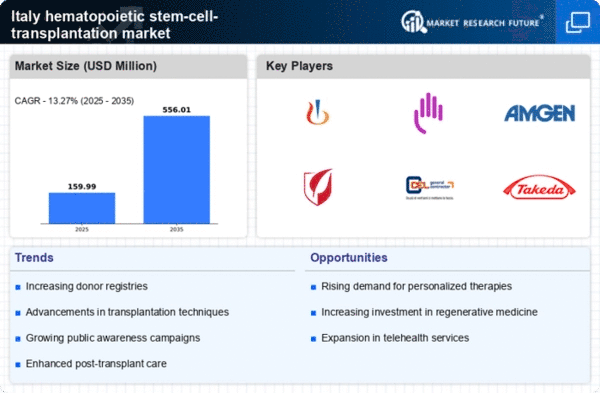
As per Market Research Future analysis, the Italy Hematopoietic Stem Cell Transplantation Market size was estimated at 141.25 USD Million in 2024. The Hematopoietic Stem-cell-transplantation market is projected to grow from 159.99 USD Million in 2025 to 556.01 USD Million by 2035, exhibiting a compound annual growth rate (CAGR) of 13.2% during the forecast period 2025 - 2035

Key Market Trends & Highlights

The Italy hematopoietic stem-cell-transplantation market is experiencing robust growth driven by technological advancements and increasing healthcare investments.

  • The market shows an increased adoption of stem-cell therapies, particularly in the treatment of hematological disorders.
  • Regulatory support for innovative treatments is fostering a conducive environment for market expansion.
  • Collaboration in research and development is enhancing the efficacy and accessibility of stem-cell transplantation.
  • Key drivers include the rising incidence of hematological disorders and technological advancements in transplantation techniques.

Market Size & Forecast

2024 Market Size 141.25 (USD Million)
2035 Market Size 556.01 (USD Million)
CAGR (2025 - 2035) 13.27%

Major Players

Novartis (CH), Bristol-Myers Squibb (US), Amgen (US), Gilead Sciences (US), Celgene (US), Takeda Pharmaceutical (JP), Roche (CH), Merck & Co. (US), AstraZeneca (GB)

Our Impact
Enabled $4.3B Revenue Impact for Fortune 500 and Leading Multinationals
Partnering with 2000+ Global Organizations Each Year
30K+ Citations by Top-Tier Firms in the Industry

Italy Hematopoietic Stem Cell Transplantation Market Trends

The Italy Hematopoietic Stem Cell Transplantation Market is currently experiencing notable advancements, driven by increasing awareness and acceptance of stem-cell therapies. In Italy, the healthcare system is progressively integrating these innovative treatments into standard care protocols, reflecting a shift towards personalized medicine. This evolution is supported by ongoing research and clinical trials, which aim to enhance the efficacy and safety of transplantation procedures. Furthermore, collaboration between academic institutions and healthcare providers is fostering a robust environment for innovation, potentially leading to improved patient outcomes. In addition, regulatory frameworks are adapting to accommodate the growing demand for hematopoietic stem-cell-transplantation. The Italian Medicines Agency is actively involved in streamlining approval processes for new therapies, which may encourage investment in research and development. As a result, the market is likely to witness an influx of novel treatments and technologies, enhancing the overall landscape of hematopoietic stem-cell-transplantation. This dynamic environment suggests a promising future for both patients and healthcare professionals, as advancements continue to unfold in this critical area of medicine.

Increased Adoption of Stem-Cell Therapies

There is a rising trend towards the adoption of stem-cell therapies within the healthcare system. This shift is largely attributed to growing public awareness and acceptance of the benefits associated with these treatments, leading to more patients seeking options for hematopoietic stem-cell-transplantation.

Regulatory Support for Innovative Treatments

Regulatory bodies are increasingly supportive of innovative treatments in the hematopoietic stem-cell-transplantation market. Streamlined approval processes are being implemented, which may facilitate quicker access to new therapies for patients, thereby enhancing treatment options.

Collaboration in Research and Development

Collaboration between academic institutions and healthcare providers is becoming more prevalent. This partnership is expected to drive research and development efforts, potentially leading to breakthroughs in transplantation techniques and improved patient care.

Italy Hematopoietic Stem Cell Transplantation Market Drivers

Rising Incidence of Hematological Disorders

The increasing prevalence of hematological disorders in Italy is a primary driver for the hematopoietic stem-cell-transplantation market. Conditions such as leukemia, lymphoma, and multiple myeloma are becoming more common, necessitating advanced treatment options. According to recent health statistics, the incidence of leukemia in Italy has risen by approximately 3% annually. This trend indicates a growing patient population that may require stem-cell transplantation as a therapeutic option. As healthcare providers seek effective treatments, the demand for hematopoietic stem-cell transplantation is likely to increase, thereby propelling market growth. Furthermore, advancements in transplantation techniques and post-transplant care are expected to improve patient outcomes, further driving the market as more patients are referred for these procedures.

Increased Investment in Healthcare Infrastructure

The Italian government's commitment to enhancing healthcare infrastructure is a significant driver for the hematopoietic stem-cell-transplantation market. Recent investments aimed at modernizing hospitals and expanding specialized treatment centers are expected to improve access to advanced therapies. For example, the Italian Ministry of Health has allocated approximately €500 million for the development of oncology units, which include facilities for stem-cell transplantation. This investment is likely to facilitate better patient care and increase the number of transplants performed annually. Furthermore, as healthcare facilities upgrade their capabilities, the hematopoietic stem-cell-transplantation market may experience accelerated growth, with an anticipated increase in the number of trained professionals and improved patient management systems.

Growing Awareness and Education on Stem-Cell Therapies

The rising awareness and education regarding stem-cell therapies among healthcare professionals and the general public are driving the hematopoietic stem-cell-transplantation market. Initiatives aimed at educating both patients and practitioners about the benefits and risks associated with stem-cell transplants are becoming more prevalent in Italy. This increased awareness is likely to lead to higher patient referrals for transplantation, as individuals become more informed about their treatment options. Additionally, healthcare providers are increasingly participating in training programs and workshops focused on stem-cell transplantation, which could enhance the quality of care provided. As a result, the market may see a notable uptick in demand, potentially increasing by 4% annually as more patients seek these innovative therapies.

Supportive Regulatory Environment for Stem-Cell Research

The supportive regulatory environment in Italy for stem-cell research and transplantation is a crucial driver for the hematopoietic stem-cell-transplantation market. The Italian government has established frameworks that encourage research and development in this field, facilitating clinical trials and the introduction of new therapies. Recent regulatory changes have streamlined the approval process for innovative treatments, which may lead to a surge in new stem-cell therapies entering the market. This regulatory support is likely to foster collaboration between academic institutions and healthcare providers, enhancing the overall landscape for stem-cell transplantation. As a result, the market could experience accelerated growth, with an expected increase in the number of approved therapies and clinical applications in the coming years.

Technological Advancements in Transplantation Techniques

Technological innovations in transplantation techniques are significantly influencing the hematopoietic stem-cell-transplantation market. The introduction of minimally invasive procedures and improved grafting techniques has enhanced the safety and efficacy of transplants. For instance, the use of robotic-assisted surgeries and advanced imaging technologies has reduced recovery times and complications. In Italy, hospitals are increasingly adopting these technologies, which could lead to a projected market growth of around 5% annually over the next few years. Additionally, the development of personalized medicine approaches, including tailored conditioning regimens, is likely to improve patient outcomes and expand the patient base eligible for transplantation. As these technologies continue to evolve, they are expected to play a crucial role in shaping the future of the hematopoietic stem-cell-transplantation market.


Market Segment Insights

By Transplant Type: Allogeneic (Largest) vs. Autologous (Fastest-Growing)

In the Italy hematopoietic stem-cell-transplantation market, the allogeneic transplant segment holds the largest share, primarily due to its extensive application in treating various blood disorders, including leukemia and lymphoma. This segment benefits from established protocols and a robust donor registry that enhances its accessibility. Conversely, the autologous transplant segment, while currently smaller in market size, is rapidly gaining traction due to advancements in technology and improved patient outcomes, making it a significant focus for future growth. Growth trends for the transplant types are influenced by several factors, including an aging population, increased incidence of hematological diseases, and technological innovations in transplant techniques. Autologous transplants, in particular, are seeing a surge in popularity due to their potential to minimize complications and optimize recovery times for patients. As awareness increases and more clinical data supports these methods, both segments are poised for expansion in the market landscape.

Transplant Type: Allogeneic (Dominant) vs. Autologous (Emerging)

The allogeneic transplant segment is characterized by its use of stem cells from a genetically matched donor, providing a broader range of treatment options for patients with severe blood disorders. This type remains dominant in the market due to its established efficacy and the support of medical institutions that focus on donor matching and collection. On the other hand, the autologous transplant segment is emerging as a competitive alternative, as it involves harvesting and reinfusing a patient's stem cells, leading to less risk of rejection and shorter recovery times. This segment is increasingly favored for patients presenting specific health criteria and is accelerating due to innovations in cryopreservation and mobilization techniques.

By Indication: Acute Myeloid Leukemia (Largest) vs. Acute Lymphoblastic Leukemia (Fastest-Growing)

In the Italy hematopoietic stem-cell-transplantation market, Acute Myeloid Leukemia (AML) represents the largest share among the indications due to its high incidence rate and established treatment protocols. Following AML, Non-Hodgkin Lymphoma and Multiple Myeloma are significant contributors, driven by increasing awareness and advancements in therapies. Other indications, such as Acute Lymphoblastic Leukemia, Hodgkin Lymphoma, and Other Non-Malignant Disorders, hold smaller shares but play critical roles in the treatment landscape. The growth trends in this segment are primarily influenced by the rising prevalence of hematological malignancies and ongoing research aimed at novel therapeutic approaches. Additionally, the increasing adoption of transplant procedures and supportive therapies promotes optimism in the segment. Acute Lymphoblastic Leukemia is gaining attention as the fastest-growing segment due to recent clinical advancements and an improved understanding of patient management, signaling robust future prospects for stakeholders in this area.

Acute Myeloid Leukemia (Dominant) vs. Acute Lymphoblastic Leukemia (Emerging)

Acute Myeloid Leukemia (AML) remains the dominant indication in the Italy hematopoietic stem-cell-transplantation market, characterized by a lengthy treatment history and comprehensive research backing conventional and innovative therapies. The established infrastructure for AML management and a high volume of clinical trials contribute to its stable position. In contrast, Acute Lymphoblastic Leukemia (ALL) is emerging rapidly, powered by improvements in diagnostic techniques and novel treatment protocols. With a focus on maximizing patient outcomes, advancements in ALL therapies are propelling this segment's growth, thereby shifting market dynamics as healthcare providers seek effective solutions for this challenging disease.

By Application: Bone Marrow Transplant (Largest) vs. Cord Blood Transplant (Fastest-Growing)

In the Italy hematopoietic stem-cell-transplantation market, the application segment showcases diverse modalities with Bone Marrow Transplant leading in market share, significantly influencing treatment protocols. Peripheral Blood Stem Cells Transplant and Cord Blood Transplant also contribute to the market but command smaller shares. This distribution indicates a robust preference for established methods while newer modalities gradually gain acceptance. Growth trends reveal that Cord Blood Transplant is becoming increasingly popular due to advancements in collection and storage techniques, coupled with rising awareness about the treatment benefits. Peripheral Blood Stem Cells Transplant is experiencing steady demand owing to its minimal invasiveness compared to traditional methods. Overall, innovation and patient outcomes are key drivers in enhancing market dynamics across these application categories.

Bone Marrow Transplant (Dominant) vs. Cord Blood Transplant (Emerging)

Bone Marrow Transplant remains the dominant application in the Italy hematopoietic stem-cell-transplantation market, characterized by its long-standing history and established protocols. It appeals to a wide range of patient demographics, providing effective treatment for various hematological disorders. In contrast, Cord Blood Transplant is emerging as a significant alternative, primarily due to its advantages such as lower risk of graft-versus-host disease and increased availability. As technology and regulatory frameworks improve, the adoption of Cord Blood Transplant is expected to rise, positioning it as a vital component for future treatment strategies in the market.

Get more detailed insights about Italy Hematopoietic Stem Cell Transplantation Market

Key Players and Competitive Insights

The hematopoietic stem-cell-transplantation market in Italy is characterized by a dynamic competitive landscape, driven by advancements in treatment methodologies and increasing patient demand. Key players such as Novartis (CH), Bristol-Myers Squibb (US), and Gilead Sciences (US) are at the forefront, each adopting distinct strategies to enhance their market presence. Novartis (CH) focuses on innovation through the development of novel therapies, while Bristol-Myers Squibb (US) emphasizes strategic partnerships to bolster its research capabilities. Gilead Sciences (US) appears to be concentrating on expanding its product portfolio, particularly in the realm of cell therapies, which could potentially reshape treatment paradigms. Collectively, these strategies contribute to a competitive environment that is increasingly oriented towards innovation and collaboration.In terms of business tactics, companies are localizing manufacturing and optimizing supply chains to enhance operational efficiency. The market structure is moderately fragmented, with several players vying for market share. This fragmentation allows for a diverse range of treatment options, yet the influence of major companies remains substantial, as they leverage their resources to drive advancements in stem-cell therapies.

In October Novartis (CH) announced a collaboration with a leading Italian research institution to develop next-generation CAR-T cell therapies. This strategic move is likely to enhance Novartis's capabilities in personalized medicine, positioning the company to better meet the specific needs of Italian patients. The partnership underscores the importance of local expertise in driving innovation and could lead to significant advancements in treatment outcomes.

In September Bristol-Myers Squibb (US) expanded its clinical trial program in Italy, focusing on the efficacy of its latest immunotherapy in combination with stem-cell transplantation. This initiative not only demonstrates the company's commitment to advancing treatment options but also highlights the potential for synergistic effects that could improve patient outcomes. By investing in local clinical research, Bristol-Myers Squibb (US) is likely to strengthen its foothold in the market and enhance its reputation among healthcare professionals.

In August Gilead Sciences (US) launched a new initiative aimed at increasing access to its stem-cell transplantation therapies across Italy, particularly in underserved regions. This initiative reflects a growing trend towards addressing healthcare disparities and ensuring that innovative treatments are accessible to all patients. By prioritizing access, Gilead Sciences (US) may enhance its market position while contributing to improved health equity in the region.

As of November the competitive trends in the hematopoietic stem-cell-transplantation market are increasingly defined by digitalization, sustainability, and the integration of artificial intelligence (AI) in treatment protocols. Strategic alliances are becoming more prevalent, as companies recognize the value of collaboration in driving innovation. Looking ahead, competitive differentiation is likely to evolve, with a shift from price-based competition to a focus on technological advancements, innovative therapies, and reliable supply chains. This transition may ultimately lead to improved patient outcomes and a more sustainable healthcare ecosystem.

Key Companies in the Italy Hematopoietic Stem Cell Transplantation Market include

Industry Developments

Recent developments in the Italy Hematopoietic Stem Cell Transplantation Market reflect significant advancements and increased investments by major companies. Bristol Myers Squibb and Novartis continue to push forward with innovative therapies, enhancing treatment options for patients with blood disorders. The market has seen an overall growth in valuation.

This is largely driven by ongoing clinical trials and the development of personalized medicine approaches. In terms of mergers and acquisitions, Takeda has shown interest in strengthening its portfolio through strategic partnerships, while Merck continues to explore options to expand its capabilities in advanced therapies.

Notably, the Italian government has implemented new regulatory frameworks aimed at accelerating the approval process for stem cell-related therapies. This is likely to attract further investments from companies like Celgene and Kite Pharma. Over the last two years, there have been increasing collaborations among organizations.

These include research initiatives with Gilead Sciences and Amgen, fostering a vibrant ecosystem. Additionally, Roche's recent move to enhance its Research and Development facilities in Italy hints at a growing commitment to the region. This is as the country aims to be a pivotal hub for biotech advancements in hematopoietic stem cell transplantation.

Future Outlook

Italy Hematopoietic Stem Cell Transplantation Market Future Outlook

The Hematopoietic Stem Cell Transplantation Market is projected to grow at a 13.27% CAGR from 2025 to 2035, driven by advancements in technology, increasing patient demand, and improved healthcare infrastructure.

New opportunities lie in:

  • Development of personalized stem cell therapies for niche markets.
  • Expansion of telemedicine platforms for remote patient monitoring.
  • Investment in automated cell processing technologies to enhance efficiency.

By 2035, the market is expected to achieve substantial growth, driven by innovation and strategic investments.

Market Segmentation

Italy Hematopoietic Stem Cell Transplantation Market Indication Outlook

  • Acute Myeloid Leukemia
  • Acute Lymphoblastic Leukemia
  • Hodgkin Lymphoma
  • Non-Hodgkin Lymphoma
  • Multiple Myeloma
  • Other Non-Malignant Disorders

Italy Hematopoietic Stem Cell Transplantation Market Application Outlook

  • Bone Marrow Transplant
  • Peripheral Blood Stem Cells Transplant
  • Cord Blood Transplant

Italy Hematopoietic Stem Cell Transplantation Market Transplant Type Outlook

  • Allogeneic
  • Autologous

Report Scope

MARKET SIZE 2024 141.25(USD Million)
MARKET SIZE 2025 159.99(USD Million)
MARKET SIZE 2035 556.01(USD Million)
COMPOUND ANNUAL GROWTH RATE (CAGR) 13.27% (2025 - 2035)
REPORT COVERAGE Revenue Forecast, Competitive Landscape, Growth Factors, and Trends
BASE YEAR 2024
Market Forecast Period 2025 - 2035
Historical Data 2019 - 2024
Market Forecast Units USD Million
Key Companies Profiled Novartis (CH), Bristol-Myers Squibb (US), Amgen (US), Gilead Sciences (US), Celgene (US), Takeda Pharmaceutical (JP), Roche (CH), Merck & Co. (US), AstraZeneca (GB)
Segments Covered Transplant Type, Indication, Application
Key Market Opportunities Advancements in personalized medicine enhance treatment efficacy in the hematopoietic stem-cell-transplantation market.
Key Market Dynamics Rising demand for hematopoietic stem-cell-transplantation driven by advancements in treatment protocols and regulatory support.
Countries Covered Italy
Leave a Comment

FAQs

What is the expected market size of the Italy Hematopoietic Stem Cell Transplantation Market in 2024?

The Italy Hematopoietic Stem Cell Transplantation Market is expected to be valued at 117.6 million USD in 2024.

What will be the market value of the Italy Hematopoietic Stem Cell Transplantation Market by 2035?

By 2035, the market is anticipated to reach a value of 401.86 million USD.

What is the compound annual growth rate (CAGR) for the Italy Hematopoietic Stem Cell Transplantation Market from 2025 to 2035?

The expected CAGR for the market from 2025 to 2035 is 11.819%.

What are the two main types of transplants in the Italy Hematopoietic Stem Cell Transplantation Market?

The market is divided into two main transplant types: Allogeneic and Autologous.

What is the market value for Allogeneic transplants in 2024?

Allogeneic transplants are valued at 79.5 million USD in 2024.

What is the projected market value for Autologous transplants by 2035?

The market for Autologous transplants is expected to reach 127.32 million USD by 2035.

Who are the major players in the Italy Hematopoietic Stem Cell Transplantation Market?

Key players in the market include Bristol Myers Squibb, Novartis, Takeda, Merck, and Gilead Sciences, among others.

What growth drivers are influencing the Italy Hematopoietic Stem Cell Transplantation Market?

The market growth is driven by advancements in transplant technologies and increasing treatment applications for hematological disorders.

What are the challenges faced by the Italy Hematopoietic Stem Cell Transplantation Market?

Challenges include stringent regulatory requirements and the high cost of transplantation procedures.

What trends are emerging in the Italy Hematopoietic Stem Cell Transplantation Market?

Emerging trends include personalized medicine approaches and increasing research in stem cell therapies.

Download Free Sample

Kindly complete the form below to receive a free sample of this Report

Compare Licence

×
Features License Type
Single User Multiuser License Enterprise User
Price $4,950 $5,950 $7,250
Maximum User Access Limit 1 User Upto 10 Users Unrestricted Access Throughout the Organization
Free Customization
Direct Access to Analyst
Deliverable Format
Platform Access
Discount on Next Purchase 10% 15% 15%
Printable Versions