×
Request Free Sample ×

Kindly complete the form below to receive a free sample of this Report

* Please use a valid business email

Leading companies partner with us for data-driven Insights

clients tt-cursor
Hero Background

Italy Healthcare RFID Market

ID: MRFR/HC/48792-HCR
200 Pages
Garvit Vyas
February 2026

Italy Healthcare RFID Market Research Report By Product Type (Equipment Tracking, Medicine Tracking, Others), By Component (Tags, Readers, Middleware, Printers), andBy End User (Pharmaceutical and Biotechnology Companies, Hospitals) - Growth & Industry Forecast 2025 To 2035

Share:
Download PDF ×

We do not share your information with anyone. However, we may send you emails based on your report interest from time to time. You may contact us at any time to opt-out.

Italy Healthcare RFID Market Infographic
Purchase Options

Italy Healthcare RFID Market Summary

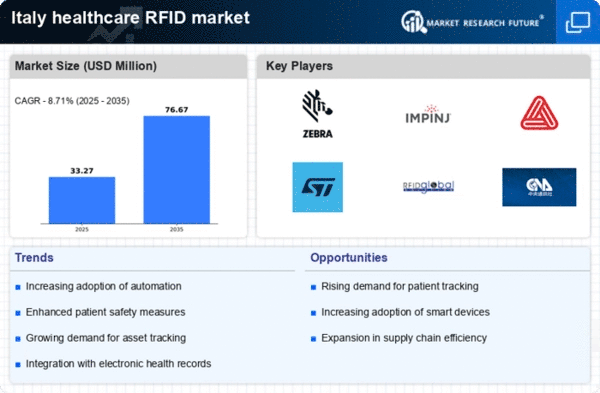
As per Market Research Future analysis, the Italy healthcare RFID market size was estimated at 30.6 USD Million in 2024. The Italy healthcare rfid market is projected to grow from 33.27 USD Million in 2025 to 76.67 USD Million by 2035, exhibiting a compound annual growth rate (CAGR) of 8.7% during the forecast period 2025 - 2035

Key Market Trends & Highlights

The Italy healthcare RFID market is experiencing robust growth driven by technological advancements and a focus on patient-centric solutions.

  • The largest segment in the Italy healthcare RFID market is asset tracking, which is witnessing increased adoption across healthcare facilities.
  • Integration with IoT and data analytics is emerging as a key trend, enhancing operational efficiencies and decision-making processes.
  • The fastest-growing segment is patient safety solutions, reflecting a heightened focus on compliance and quality of care.
  • Major market drivers include enhanced inventory management and growing demand for patient-centric solutions, which are shaping the market landscape.

Market Size & Forecast

2024 Market Size 30.6 (USD Million)
2035 Market Size 76.67 (USD Million)
CAGR (2025 - 2035) 8.71%

Major Players

Zebra Technologies (US), Impinj (US), Avery Dennison (US), STMicroelectronics (FR), RFID Global Solution (US), CenTrak (US), MediTags (AU), TagMaster (SE), Sato Holdings (JP)

Our Impact
Enabled $4.3B Revenue Impact for Fortune 500 and Leading Multinationals
Partnering with 2000+ Global Organizations Each Year
30K+ Citations by Top-Tier Firms in the Industry

Italy Healthcare RFID Market Trends

The healthcare RFID market in Italy is currently experiencing a notable transformation, driven by advancements in technology and increasing demand for efficient patient management systems. The integration of RFID technology into healthcare facilities enhances inventory management, reduces errors in medication administration, and improves overall operational efficiency. Hospitals and clinics are increasingly adopting RFID solutions to track medical equipment, manage supplies, and ensure patient safety. This trend appears to be fueled by the need for real-time data and improved workflow processes, which are essential in modern healthcare environments. Moreover, the regulatory landscape in Italy supports the adoption of innovative technologies in healthcare. Government initiatives aimed at digitizing healthcare services and improving patient care are likely to further propel the growth of the healthcare rfid market. As healthcare providers seek to optimize their operations and enhance patient experiences, the demand for RFID solutions is expected to rise. This shift not only reflects a commitment to technological advancement but also indicates a broader trend towards data-driven decision-making in healthcare settings. The future of the healthcare rfid market in Italy seems promising, with potential for continued growth and innovation in the coming years.

Increased Adoption of RFID for Asset Tracking

Healthcare facilities are increasingly utilizing RFID technology for tracking assets such as medical equipment and supplies. This trend enhances inventory management, reduces loss, and ensures that critical resources are readily available when needed.

Integration with IoT and Data Analytics

The convergence of RFID technology with Internet of Things (IoT) devices and data analytics is becoming more prevalent. This integration allows for real-time monitoring and analysis of healthcare operations, leading to improved decision-making and operational efficiency.

Focus on Patient Safety and Compliance

There is a growing emphasis on using RFID solutions to enhance patient safety and ensure compliance with healthcare regulations. By accurately tracking medications and patient information, healthcare providers can minimize errors and improve overall care quality.

Italy Healthcare RFID Market Drivers

Enhanced Inventory Management

The healthcare RFID market in Italy is experiencing a notable shift towards enhanced inventory management solutions. Hospitals and clinics are increasingly adopting RFID technology to streamline their supply chain processes. This technology allows for real-time tracking of medical supplies, reducing waste and ensuring that critical items are always available. According to recent data, the implementation of RFID systems can lead to a reduction in inventory costs by up to 30%. This efficiency not only improves operational workflows but also contributes to better patient care by ensuring that necessary equipment is readily accessible. As healthcare facilities continue to prioritize cost-effectiveness, the demand for RFID solutions is likely to grow, further driving the healthcare rfid market in Italy.

Regulatory Compliance and Standards

Regulatory compliance is a significant driver for the healthcare rfid market in Italy. The Italian government has established stringent regulations regarding the tracking and management of medical devices and pharmaceuticals. RFID technology facilitates adherence to these regulations by providing accurate and real-time data on inventory and usage. This capability is crucial for ensuring patient safety and minimizing errors in medication administration. Furthermore, compliance with these regulations can lead to financial incentives for healthcare providers, thereby encouraging the adoption of RFID systems. As the regulatory landscape continues to evolve, the healthcare rfid market is expected to expand in response to these compliance requirements.

Cost Reduction and Operational Efficiency

Cost reduction and operational efficiency are critical drivers for the healthcare rfid market in Italy. Healthcare organizations are under constant pressure to reduce operational costs while maintaining high-quality care. RFID technology offers a solution by automating various processes, such as inventory management and patient tracking, which can lead to significant labor savings. Studies indicate that implementing RFID can reduce labor costs by approximately 20%. Additionally, the reduction in errors associated with manual tracking can lead to fewer adverse events, further enhancing operational efficiency. As healthcare providers seek to optimize their operations, the demand for RFID solutions is expected to rise, positively impacting the healthcare rfid market.

Technological Advancements in RFID Systems

Technological advancements are playing a pivotal role in shaping the healthcare rfid market in Italy. Innovations such as miniaturized RFID tags, improved read ranges, and enhanced data analytics capabilities are making RFID systems more effective and accessible. These advancements allow for greater accuracy in tracking assets and patients, which is essential for modern healthcare environments. Moreover, the integration of RFID with other technologies, such as artificial intelligence and machine learning, is expected to further enhance the capabilities of RFID systems. As these technologies continue to evolve, they are likely to attract more investments in the healthcare rfid market, driving growth and adoption across various healthcare settings.

Growing Demand for Patient-Centric Solutions

The healthcare rfid market in Italy is increasingly driven by the growing demand for patient-centric solutions. Healthcare providers are recognizing the importance of enhancing patient experiences and outcomes through innovative technologies. RFID systems enable better tracking of patient movements, ensuring timely care and reducing wait times. Additionally, these systems can be integrated with electronic health records to provide comprehensive patient data at the point of care. This integration not only improves operational efficiency but also enhances the overall quality of care. As patient expectations continue to rise, the healthcare rfid market is likely to see increased investment in technologies that prioritize patient needs.


Market Segment Insights

By Application: Inventory Management (Largest) vs. Patient Tracking (Fastest-Growing)

In the Italy healthcare rfid market, the application segment is primarily dominated by Inventory Management, which captures the largest share due to its critical importance in maintaining accurate stock levels and reducing wastage. Patient Tracking follows closely as a significant contributor, with a growing presence that reflects the increasing need for secure and efficient patient management processes. Other applications like Medication Management and Asset Management also play pivotal roles, but their shares are comparatively smaller. The growth trends in the application segment are driven by technological advancements and the rising adoption of RFID systems in healthcare settings. The emphasis on effective inventory oversight, coupled with the surge in demand for patient safety measures, has accelerated the integration of RFID solutions. Furthermore, regulatory pushes for improved healthcare services and operational efficiencies are expected to bolster the growth of these applications, particularly in Patient Tracking, which is gaining traction as the fastest-growing segment.

Inventory Management (Dominant) vs. Medication Management (Emerging)

Inventory Management stands out as the dominant application within the segment, characterized by its robust functionality in tracking and managing healthcare supplies efficiently. This application ensures that essential items are always available, thereby enhancing operational efficiencies and reducing costs. In contrast, Medication Management is emerging as a critical focus area, driven by the need for accurate tracking of pharmaceutical products to minimize errors and enhance patient safety. Both segments are increasingly relying on advanced technologies to streamline processes, but Inventory Management remains the backbone of RFID deployment, while Medication Management is poised for significant growth as healthcare providers prioritize patient care and safety.

By End-Use: Hospitals (Largest) vs. Clinics (Fastest-Growing)

In the Italy healthcare rfid market, hospitals hold the largest share, representing a significant portion of the market due to their extensive usage of RFID technology for inventory management, patient tracking, and asset management. Clinics follow, showing promising growth as they increasingly adopt RFID solutions to enhance patient care and streamline operations, which addresses their unique needs for efficiency and accuracy. Growth trends in this segment are largely driven by the increasing need for improved operational efficiency and cost reduction in healthcare facilities. Hospitals are adopting more advanced RFID systems to manage complex workflows, while clinics are emerging as the fastest-growing segment by leveraging RFID technology to enhance patient interactions and data management. The demand for real-time tracking solutions is also accelerating the growth of pharmacies and laboratories, contributing significantly to the overall dynamism of the sector.

Hospitals: Dominant vs. Clinics: Emerging

Hospitals represent the dominant force in the Italy healthcare rfid market, utilizing RFID technology to significantly enhance operational efficiency, improve patient safety, and reduce costs associated with asset management and tracking. Their investments in sophisticated RFID systems reflect a commitment to maintaining high standards of care and operational excellence. On the other hand, clinics are emerging as a crucial segment, increasingly adopting RFID solutions to optimize their processes. While historically smaller, clinics are rapidly recognizing the value of RFID for tasks such as patient identification, inventory management, and workflow efficiency. This duality highlights a shifting landscape where hospitals lead in market share but clinics are capturing attention with their rapid integration of innovative technologies.

By Product Type: Tags (Largest) vs. Readers (Fastest-Growing)

The Italy healthcare rfid market shows a significant distribution in its product type segment, where Tags emerge as the largest contributing component. The widespread adoption of RFID Tags in various healthcare applications, including patient tracking and inventory management, underscores their importance. Readers also play a pivotal role, witnessing increased deployment rates as healthcare facilities seek to enhance operational efficiencies through real-time data capture. Rapid advancements in RFID technology are driving growth within this segment. The proliferation of IoT devices and the rising need for automated inventory management are particularly enhancing the relevance of Readers. Meanwhile, Tags are benefitting from innovations such as miniaturization and improved functionality, making them essential tools for modern healthcare practices, thus solidifying their market presence alongside the burgeoning opportunities for Readers.

Tags (Dominant) vs. Readers (Emerging)

Tags represent the dominant force within the Italy healthcare rfid market due to their essential applications in asset tracking, medication management, and patient identification. Their durability and reliability make them an integral part of healthcare operations. Conversely, Readers are emerging as key players, driven by the demand for enhanced data accuracy and efficiency in patient care. Newer Reader technologies are being integrated into existing systems, facilitating seamless data flow and real-time monitoring. As healthcare facilities strive to optimize their processes, the synergy between Tags and Readers is vital, with each contributing distinct advantages that cater to different operational needs.

By Technology: Active RFID (Largest) vs. Passive RFID (Fastest-Growing)

In the Italy healthcare rfid market, the distribution of market share among the technology segments shows Active RFID as the leading segment, dominating the landscape with its superior features of real-time tracking and reliability. Conversely, Passive RFID is rapidly gaining ground and has emerged as the fastest-growing segment, driven by its cost-effectiveness and simplicity in implementation for various healthcare applications. The growth trends in the technology segment highlight an increasing adoption of RFID solutions in healthcare for asset tracking, patient management, and inventory control. Factors such as technological advancements, rising demand for efficient healthcare management, and enhanced operational efficiency are propelling the growth of these RFID technologies. This trend is expected to continue as more healthcare facilities recognize the value of integrating RFID systems into their operations.

Technology: Active RFID (Dominant) vs. Passive RFID (Emerging)

Active RFID technology stands out as a dominant force in the Italy healthcare rfid market due to its ability to provide continuous, real-time monitoring and tracking capabilities, which are essential for critical healthcare operations. Its robust battery-powered tags facilitate constant communication, making it ideal for asset tracking and ensuring the safety of high-value medical equipment. On the other hand, Passive RFID is positioned as an emerging player in the market, appealing to healthcare facilities looking for more affordable and simpler solutions. While it may lack the continuous range of Active RFID, Passive RFID is gaining traction for its effectiveness in managing items like pharmaceuticals and supplies, thereby enhancing inventory accuracy and reducing costs.

Get more detailed insights about Italy Healthcare RFID Market

Key Players and Competitive Insights

The healthcare RFID market in Italy is characterized by a dynamic competitive landscape, driven by technological advancements and increasing demand for efficient patient management systems. Key players such as Zebra Technologies (US), Impinj (US), and Avery Dennison (US) are at the forefront, each adopting distinct strategies to enhance their market presence. Zebra Technologies (US) focuses on innovation through the development of advanced RFID solutions that integrate seamlessly with existing healthcare systems, thereby improving operational efficiency. Impinj (US) emphasizes partnerships with healthcare providers to expand its reach and enhance its product offerings, while Avery Dennison (US) is investing in sustainable RFID technologies, aligning with the growing emphasis on environmental responsibility in healthcare.The market structure appears moderately fragmented, with several players vying for market share. Key business tactics include localizing manufacturing to reduce costs and optimize supply chains, which is particularly relevant in the context of Italy's unique regulatory environment. The collective influence of these companies shapes a competitive environment where innovation and operational efficiency are paramount, allowing them to respond effectively to the evolving needs of healthcare providers.

In October Zebra Technologies (US) announced a strategic partnership with a leading Italian hospital network to implement a comprehensive RFID tracking system aimed at enhancing patient safety and inventory management. This move is significant as it not only reinforces Zebra's commitment to innovation but also positions the company as a key player in the Italian healthcare sector, potentially leading to increased market share and customer loyalty.

In September Impinj (US) launched a new line of RFID tags specifically designed for medical devices, which are expected to improve tracking accuracy and reduce errors in patient care. This strategic initiative highlights Impinj's focus on product development tailored to the healthcare sector, suggesting a proactive approach to addressing the challenges faced by healthcare providers in managing medical assets.

In August Avery Dennison (US) unveiled a new sustainable RFID inlay that reduces environmental impact while maintaining high performance. This initiative not only aligns with global sustainability trends but also positions Avery Dennison as a leader in eco-friendly technology, potentially attracting environmentally conscious healthcare organizations looking to enhance their sustainability practices.

As of November current trends in the healthcare RFID market include a strong emphasis on digitalization, AI integration, and sustainability. Strategic alliances among key players are increasingly shaping the competitive landscape, fostering innovation and collaboration. The shift from price-based competition to a focus on technological advancement and supply chain reliability is evident, suggesting that future competitive differentiation will hinge on the ability to innovate and adapt to the rapidly changing healthcare environment.

Key Companies in the Italy Healthcare RFID Market include

Industry Developments

In Italy, the Healthcare RFID Market has recently experienced significant advancements, particularly in the adoption of RFID technology for inventory management and patient safety. Companies like NXP Semiconductors and Zebra Technologies are making strides in developing innovative RFID solutions tailored for hospitals and healthcare providers. Throughout 2023, there has been a heightened focus on improving operational efficiency within Italian healthcare facilities, leading to increased investments in RFID technology.

In terms of mergers and acquisitions, Zebra Technologies acquired a logistics firm specializing in RFID solutions in March 2023, signaling a robust trend toward consolidation in the market. The growth in this sector is also reflected in the expanding market valuation of Impinj, which reported a revenue increase of approximately 15% year-on-year due to the rising demand for RFID-enabled healthcare applications. Notably, the Italian Ministry of Health has been supportive of technological integrations that enhance patient care, resulting in a favorable environment for players like Avery Dennison and Invengo.

Over the past two years, major developments have included the rollout of RFID systems in several major hospitals, further emphasizing a shift towards digitization within the healthcare sector in Italy.

Future Outlook

Italy Healthcare RFID Market Future Outlook

The Healthcare RFID Market in Italy is projected to grow at an 8.71% CAGR from 2025 to 2035, driven by technological advancements, increased demand for patient safety, and inventory management efficiency.

New opportunities lie in:

  • Integration of RFID with IoT for real-time asset tracking solutions.
  • Development of RFID-enabled medication management systems to reduce errors.
  • Expansion of RFID applications in telehealth services for remote patient monitoring.

By 2035, the healthcare RFID market is expected to achieve substantial growth, enhancing operational efficiencies and patient care.

Market Segmentation

Italy Healthcare RFID Market End-Use Outlook

  • Hospitals
  • Clinics
  • Pharmaceutical Companies
  • Laboratories

Italy Healthcare RFID Market Technology Outlook

  • Active RFID
  • Passive RFID
  • Semi-Passive RFID

Italy Healthcare RFID Market Application Outlook

  • Inventory Management
  • Patient Tracking
  • Medication Management
  • Asset Management

Italy Healthcare RFID Market Product Type Outlook

  • Tags
  • Readers
  • Software
  • Services

Report Scope

MARKET SIZE 2024 30.6(USD Million)
MARKET SIZE 2025 33.27(USD Million)
MARKET SIZE 2035 76.67(USD Million)
COMPOUND ANNUAL GROWTH RATE (CAGR) 8.71% (2025 - 2035)
REPORT COVERAGE Revenue Forecast, Competitive Landscape, Growth Factors, and Trends
BASE YEAR 2024
Market Forecast Period 2025 - 2035
Historical Data 2019 - 2024
Market Forecast Units USD Million
Key Companies Profiled Zebra Technologies (US), Impinj (US), Avery Dennison (US), STMicroelectronics (FR), RFID Global Solution (US), CenTrak (US), MediTags (AU), TagMaster (SE), Sato Holdings (JP)
Segments Covered Application, End-Use, Product Type, Technology
Key Market Opportunities Integration of advanced tracking solutions enhances patient safety and operational efficiency in the healthcare rfid market.
Key Market Dynamics Rising adoption of healthcare RFID technology enhances asset tracking and patient safety in Italy's healthcare sector.
Countries Covered Italy
Leave a Comment

FAQs

What is the expected market size of the Italy Healthcare RFID Market in 2024?

The market is expected to be valued at 29.26 million USD in 2024.

What is the projected market size for the Italy Healthcare RFID Market by 2035?

By 2035, the market is anticipated to reach a valuation of 78.11 million USD.

What is the expected compound annual growth rate (CAGR) for the Italy Healthcare RFID Market from 2025 to 2035?

The expected CAGR for the market during this period is 9.338 percent.

What segment of the Italy Healthcare RFID Market is projected to have the highest value in 2035?

The Medicine Tracking segment is expected to reach a value of 31.5 million USD by 2035.

Which key player is projected to significantly influence the Italy Healthcare RFID Market?

Major players such as NXP Semiconductors and Zebra Technologies are expected to have a significant influence in the market.

What is the value of the Equipment Tracking segment in the Italy Healthcare RFID Market in 2024?

The Equipment Tracking segment is valued at 10.0 million USD in 2024.

How much is the Others segment in the Italy Healthcare RFID Market expected to grow by 2035?

The Others segment is projected to grow to 20.61 million USD by 2035.

What are the growth drivers for the Italy Healthcare RFID Market from 2025 to 2035?

The market is driven by advancements in technology and increased demand for efficient healthcare management.

What challenges might the Italy Healthcare RFID Market face in the coming years?

Potential challenges include high implementation costs and the need for interoperability among systems.

What are the applications driving growth in the Italy Healthcare RFID Market?

Applications such as equipment tracking, medicine tracking, and patient safety are key growth drivers in the market.

Download Free Sample

Kindly complete the form below to receive a free sample of this Report

Compare Licence

×
Features License Type
Single User Multiuser License Enterprise User
Price $4,950 $5,950 $7,250
Maximum User Access Limit 1 User Upto 10 Users Unrestricted Access Throughout the Organization
Free Customization
Direct Access to Analyst
Deliverable Format
Platform Access
Discount on Next Purchase 10% 15% 15%
Printable Versions