×
Request Free Sample ×

Kindly complete the form below to receive a free sample of this Report

* Please use a valid business email

Leading companies partner with us for data-driven Insights

clients tt-cursor
Hero Background

Italy Healthcare Quality Management Market

ID: MRFR/MED/51063-HCR
200 Pages
Rahul Gotadki
February 2026

Italy Healthcare Quality Management Market Research Report: Size, Share, Trend Analysis By Quality Management System Type (Total Quality Management, Continuous Quality Improvement, Performance Improvement), By Deployment Mode (On-Premises, Cloud-Based, Hybrid), By End Users (Hospitals, Clinics, Nursing Homes, Pharmacies) and By Component (Software, Services) - Growth Outlook & Industry Forecast 2025 To 2035

Share:
Download PDF ×

We do not share your information with anyone. However, we may send you emails based on your report interest from time to time. You may contact us at any time to opt-out.

Italy Healthcare Quality Management Market Infographic
Purchase Options

Italy Healthcare Quality Management Market Summary

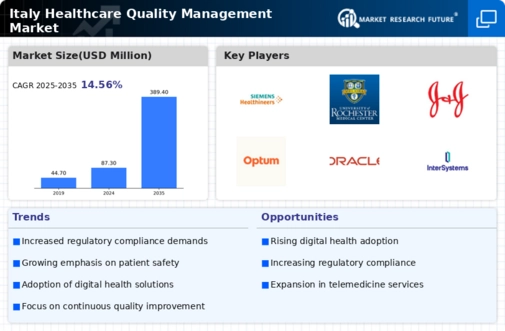
As per Market Research Future analysis, the Italy healthcare quality management market size was estimated at 87.31 USD Million in 2024. The Italy healthcare quality-management market is projected to grow from 97.68 USD Million in 2025 to 300.0 USD Million by 2035, exhibiting a compound annual growth rate (CAGR) of 11.8% during the forecast period 2025 - 2035

Key Market Trends & Highlights

The Italy healthcare quality-management market is experiencing a transformative shift towards enhanced regulatory frameworks and technological integration.

  • Regulatory enhancements are driving compliance and improving healthcare standards across the sector.
  • Technological integration is facilitating data-driven decision making, thereby optimizing quality management processes.
  • Patient-centric approaches are becoming increasingly prevalent, focusing on individual needs and outcomes.
  • Rising demand for quality care and government initiatives are key drivers propelling market growth.

Market Size & Forecast

2024 Market Size 87.31 (USD Million)
2035 Market Size 300.0 (USD Million)
CAGR (2025 - 2035) 11.88%

Major Players

McKesson Corporation (US), Cerner Corporation (US), Optum (US), Allscripts Healthcare Solutions (US), Epic Systems Corporation (US), Siemens Healthineers (DE), Philips Healthcare (NL), Medtronic (US), GE Healthcare (US)

Our Impact
Enabled $4.3B Revenue Impact for Fortune 500 and Leading Multinationals
Partnering with 2000+ Global Organizations Each Year
30K+ Citations by Top-Tier Firms in the Industry

Italy Healthcare Quality Management Market Trends

The healthcare quality-management market in Italy is currently experiencing a transformative phase, driven by a growing emphasis on patient safety and the need for improved healthcare outcomes. Regulatory frameworks are evolving, with the Italian government implementing stricter guidelines to ensure that healthcare providers adhere to high standards of quality. This shift is likely to enhance accountability and transparency within the sector, fostering a culture of continuous improvement. Furthermore, the integration of advanced technologies, such as electronic health records and data analytics, is becoming increasingly prevalent, enabling healthcare organizations to monitor performance metrics more effectively. In addition, the focus on patient-centered care is reshaping the landscape of the healthcare quality-management market. Stakeholders are recognizing the importance of engaging patients in their own care processes, which may lead to better health outcomes and increased satisfaction. As healthcare providers adapt to these changes, they are likely to invest in training and development programs aimed at equipping staff with the necessary skills to meet evolving quality standards. Overall, the current trends suggest a robust commitment to enhancing the quality of healthcare services in Italy, with a clear trajectory towards more efficient and effective management practices.

Regulatory Enhancements

Recent regulatory changes in Italy are pushing healthcare providers to adopt more rigorous quality-management practices. These enhancements aim to ensure compliance with national and European standards, thereby improving patient safety and care outcomes.

Technological Integration

The adoption of advanced technologies is becoming a hallmark of the healthcare quality-management market. Tools such as data analytics and electronic health records are facilitating better monitoring and evaluation of healthcare services, leading to improved quality.

Patient-Centric Approaches

There is a noticeable shift towards patient-centered care within the healthcare quality-management market. Engaging patients in their treatment processes is seen as a way to enhance satisfaction and health outcomes, prompting providers to rethink their quality strategies.

Italy Healthcare Quality Management Market Drivers

Rising Demand for Quality Care

The increasing demand for high-quality healthcare services in Italy is a primary driver of the healthcare quality-management market. Patients are becoming more informed and are actively seeking providers that demonstrate superior quality metrics. This trend is reflected in the growing emphasis on patient satisfaction scores and clinical outcomes. According to recent data, approximately 75% of patients consider quality indicators when choosing healthcare providers. Consequently, healthcare organizations are compelled to adopt robust quality-management systems to meet these expectations. The healthcare quality-management market is thus experiencing a surge as institutions invest in technologies and processes that enhance care quality, ensuring compliance with both national and EU regulations.

Integration of Quality Standards

The integration of international quality standards into Italian healthcare practices is a crucial driver of the healthcare quality-management market. Organizations are increasingly adopting frameworks such as ISO 9001 and the EFQM Excellence Model to enhance their quality management systems. This integration not only helps in standardizing processes but also improves overall service delivery. Recent surveys indicate that about 50% of healthcare facilities in Italy have implemented these standards, leading to better patient outcomes and increased operational efficiency. As more institutions recognize the benefits of adhering to established quality standards, the healthcare quality-management market is expected to expand further.

Emphasis on Continuous Improvement

The emphasis on continuous improvement within healthcare organizations is a vital driver of the healthcare quality-management market. Italian healthcare providers are increasingly adopting methodologies such as Lean and Six Sigma to enhance their quality management processes. These approaches focus on eliminating waste and improving efficiency, which are essential for delivering high-quality care. Recent studies suggest that organizations implementing these methodologies have seen a reduction in operational costs by up to 20%. This commitment to continuous improvement not only enhances patient satisfaction but also positions healthcare providers competitively in the market, thereby fostering growth in the healthcare quality-management market.

Government Initiatives and Funding

Government initiatives aimed at improving healthcare quality in Italy significantly influence the healthcare quality-management market. The Italian government has allocated substantial funding to enhance healthcare infrastructure and quality standards. For instance, recent budgets indicate an increase of over €1 billion dedicated to quality improvement programs. These initiatives often include the implementation of quality-management frameworks that align with national health objectives. As a result, healthcare providers are incentivized to adopt quality-management practices that not only comply with regulations but also improve patient outcomes. This influx of government support is likely to propel the growth of the healthcare quality-management market in the coming years.

Focus on Data-Driven Decision Making

The shift towards data-driven decision making in healthcare is reshaping the landscape of the healthcare quality-management market. Italian healthcare providers are increasingly utilizing data analytics to monitor performance metrics and identify areas for improvement. This trend is supported by advancements in health information technology, which facilitate the collection and analysis of vast amounts of data. Approximately 60% of healthcare organizations in Italy are now employing data analytics tools to enhance their quality-management processes. By leveraging data, providers can make informed decisions that lead to improved patient care and operational efficiency, thereby driving the growth of the healthcare quality-management market.


Market Segment Insights

By Type: Total Quality Management (Largest) vs. Continuous Quality Improvement (Fastest-Growing)

In the Italy healthcare quality-management market, Total Quality Management exhibits the largest share, establishing itself as the primary approach used by healthcare organizations. Continuous Quality Improvement follows closely as a rapidly gaining methodology, highlighting the sector's shift towards more dynamic and iterative improvement processes. Performance Improvement also plays a crucial role, but its market presence is overshadowed by the more established methodologies. The growth trends in the segment are largely driven by increasing regulatory requirements and an emphasis on patient safety and satisfaction. Organizations are adopting Continuous Quality Improvement practices to enhance operational efficiency and patient care quality, reflecting a broader commitment to excellence. Performance Improvement is gaining traction as healthcare providers seek measurable outcomes and enhanced performance metrics, further shaping the competitive landscape.

Total Quality Management: Dominant vs. Continuous Quality Improvement: Emerging

Total Quality Management is regarded as the dominant approach within this segment, providing a comprehensive framework for strategic quality initiatives that ensure high standards in healthcare delivery. It involves systematic efforts to improve processes and outcomes across various departments. On the other hand, Continuous Quality Improvement is an emerging practice that focuses on incremental improvements and real-time feedback, fostering a culture of ongoing enhancement. While Total Quality Management emphasizes structured methodologies, Continuous Quality Improvement leverages agility and adaptability, making it particularly appealing in today’s fast-paced healthcare environment. Both approaches are vital, yet they serve distinct purposes within the quality-management spectrum.

By Deployment Mode: Cloud-Based (Largest) vs. On-Premises (Fastest-Growing)

In the Italy healthcare quality-management market, the deployment mode segment exhibits a dynamic distribution among On-Premises, Cloud-Based, and Hybrid solutions. Currently, Cloud-Based solutions dominate, capturing the largest share of the market due to their scalability, flexibility, and reduced infrastructure costs, appealing to many healthcare providers. On-Premises solutions, although traditionally preferred for control and security, are increasingly challenged by Cloud-Based deployments. Growth trends indicate a significant shift towards Cloud-Based solutions driven by the increasing demand for remote accessibility, data management efficiencies, and integration capabilities with emerging technologies like AI and analytics. Hybrid solutions are also gaining traction, blending on-premises and cloud features, providing a balanced approach for facilities looking to optimize their operations while addressing compliance and security concerns. This shift is reshaping competitive dynamics in the sector.

Cloud-Based (Dominant) vs. On-Premises (Emerging)

Cloud-Based solutions represent the dominant deployment mode in the market, primarily due to their ability to offer cost-effective, scalable, and flexible options that align well with the evolving needs of healthcare facilities. This mode enables institutions to enhance their operational efficiency and data management while reducing IT overhead. In contrast, On-Premises solutions are becoming increasingly recognized as an emerging alternative, particularly among institutions prioritizing data control and regulatory compliance. These solutions allow for tailored setups but can incur higher maintenance costs and require significant upfront investment. The market is now witnessing a crucial dialogue between scalability and control, with many organizations opting for hybrid approaches that leverage the strengths of both deployment modes.

By End User: Hospitals (Largest) vs. Clinics (Fastest-Growing)

In the Italy healthcare quality-management market, hospitals hold the largest market share, significantly outpacing other end users like clinics, nursing homes, and pharmacies. This dominance is driven by their extensive operational scale and ongoing investments in quality management systems to enhance patient care. Clinics, while smaller in market share, are quickly closing the gap due to a rising trend towards outpatient services and preventive care, making them a key player in the healthcare landscape. Looking ahead, the growth trends within this segment indicate a focused shift towards technology-driven solutions, particularly in hospitals and clinics. Factors such as increased regulations, the demand for improved patient outcomes, and the adoption of digital health solutions are propelling this market forward. The pandemic has also accelerated the need for efficient quality management systems, especially in clinics that have become essential for healthcare delivery in less critical settings.

Hospitals: Dominant vs. Clinics: Emerging

In the Italy healthcare quality-management market, hospitals represent the dominant force due to their large-scale operations, comprehensive service offerings, and substantial resources allocated to quality management. These institutions are committed to enhancing patient safety and care quality, leading to significant investments in advanced quality management systems and technologies. On the other hand, clinics are emerging as a crucial segment, experiencing rapid growth driven by shifts towards outpatient care and the integration of telehealth services. Though smaller in overall market influence, clinics are becoming increasingly pivotal, particularly as patients seek more personalized and accessible healthcare solutions. This dual dynamic fosters a competitive environment where hospitals focus on maintaining their leadership while clinics innovate to capture greater market share.

By Component: Software (Largest) vs. Services (Fastest-Growing)

In the Italy healthcare quality-management market, the Software segment is the largest, dominating the market share due to its critical role in enhancing operational efficiency and compliance. This segment benefits from the increasing demand for integrated solutions that streamline workflows and improve patient outcomes. Meanwhile, the Services segment is experiencing rapid growth, driven by the need for expert consulting, implementation, and support to navigate complex quality management processes. Growth trends in this segment are influenced by several factors, including the shift towards digital transformation in healthcare and increasing regulatory requirements. The expanding focus on patient safety and quality improvement initiatives has further propelled the demand for both Software and Services. As healthcare providers seek to optimize performance and meet compliance standards, investments in technology and supportive services are expected to escalate during the forecast period.

Software: Software (Dominant) vs. Services (Emerging)

The Software segment in the Italy healthcare quality-management market stands out as the dominant player, offering comprehensive solutions that address the multifaceted needs of healthcare providers. Its advantages include automation capabilities, improved data management, and enhanced reporting functionalities. As organizations strive to improve operational efficiency and meet stringent regulatory standards, the reliance on sophisticated software solutions continues to grow. In contrast, the Services segment emerges as a vital support mechanism, assisting healthcare organizations in effectively implementing these software solutions. This segment encompasses consulting, training, and maintenance services that ensure successful adaption and maximize the benefits of software investments. As both segments evolve, the interplay between software innovation and supportive services will be crucial for overall market growth.

Get more detailed insights about Italy Healthcare Quality Management Market

Key Players and Competitive Insights

The healthcare quality-management market in Italy is characterized by a dynamic competitive landscape, driven by the increasing demand for improved patient outcomes and operational efficiencies. Key players such as McKesson Corporation (US), Cerner Corporation (US), and Siemens Healthineers (DE) are actively shaping the market through strategic initiatives focused on innovation and digital transformation. McKesson Corporation (US) emphasizes enhancing its supply chain solutions, while Cerner Corporation (US) is investing heavily in data analytics to optimize healthcare delivery. Siemens Healthineers (DE) is leveraging its technological expertise to integrate advanced imaging solutions with quality management systems, thereby enhancing diagnostic accuracy and patient care. Collectively, these strategies indicate a trend towards a more integrated and technology-driven approach to healthcare quality management.In terms of business tactics, companies are increasingly localizing their operations to better serve the Italian market, which appears to be a response to the unique regulatory and operational challenges present in the region. The market structure is moderately fragmented, with several players vying for market share, yet the influence of major corporations remains substantial. This competitive environment fosters innovation, as companies strive to differentiate themselves through advanced technologies and tailored solutions.

In October McKesson Corporation (US) announced a partnership with a leading Italian healthcare provider to implement a new supply chain management system aimed at reducing costs and improving service delivery. This strategic move is likely to enhance McKesson's presence in the Italian market, allowing it to leverage local expertise while optimizing its operational efficiencies. Such partnerships may also facilitate the adoption of best practices in quality management across the healthcare sector.

In September Cerner Corporation (US) launched a new analytics platform designed specifically for Italian healthcare providers, focusing on real-time data integration and patient management. This initiative underscores Cerner's commitment to enhancing healthcare quality through data-driven insights, which could significantly improve patient outcomes and operational efficiencies. The introduction of such technology may position Cerner as a leader in the Italian market, particularly as healthcare providers increasingly seek to harness data for quality improvement.

In August Siemens Healthineers (DE) unveiled a new suite of imaging solutions that integrate seamlessly with existing quality management systems in Italian hospitals. This development is indicative of Siemens' strategy to enhance diagnostic capabilities while ensuring compliance with local regulations. By providing advanced imaging technologies that align with quality management objectives, Siemens Healthineers is likely to strengthen its competitive position in the market.

As of November the healthcare quality-management market is witnessing a pronounced shift towards digitalization, sustainability, and the integration of artificial intelligence (AI) into operational frameworks. Strategic alliances among key players are increasingly shaping the competitive landscape, fostering innovation and collaboration. The focus appears to be shifting from price-based competition to a more nuanced approach that prioritizes technological advancement, quality of care, and supply chain reliability. This evolution suggests that companies will need to continuously adapt their strategies to maintain a competitive edge in an ever-changing market.

Key Companies in the Italy Healthcare Quality Management Market include

Industry Developments

Recent developments in the Italy Healthcare Quality Management Market have showcased significant advancements and investments. In July 2023, Siemens Healthineers announced an expansion of its healthcare solutions tailored to improve patient outcomes, emphasizing proactive quality management in hospitals.

IBM Watson Health continues to adapt its analytics tools to meet regulatory standards, reflecting an increasing demand for data-driven decision-making in Italian healthcare. In August 2023, Roche implemented new quality management frameworks focusing on diagnostics to enhance efficiency. Notably, in September 2022, GE Healthcare launched an integrated platform for monitoring healthcare quality metrics across various facilities in Italy, optimizing resources and improving patient care.

In the mergers and acquisitions arena, Medtronic acquired Mazor Robotics in June 2023, reinforcing its commitment to elevating surgical quality management. The market valuation for companies like Johnson and Johnson and Cerner has shown a steady increase, driven by the emphasis on data standardization and patient safety protocols in compliance with government regulations.

Regulatory bodies are focusing on digital transformation within healthcare systems, aiming to enhance overall quality standards in Italy's diverse healthcare landscape, impacting both service delivery and technological advancements crucial for future growth.

Future Outlook

Italy Healthcare Quality Management Market Future Outlook

The Healthcare Quality Management Market in Italy is projected to grow at 11.88% CAGR from 2025 to 2035, driven by technological advancements, regulatory changes, and increasing patient expectations.

New opportunities lie in:

  • Integration of AI-driven analytics for real-time quality monitoring.
  • Development of telehealth quality assessment tools for remote care.
  • Implementation of patient feedback systems to enhance service delivery.

By 2035, the market is expected to be robust, driven by innovation and enhanced quality standards.

Market Segmentation

Italy Healthcare Quality Management Market Type Outlook

  • Total Quality Management
  • Continuous Quality Improvement
  • Performance Improvement

Italy Healthcare Quality Management Market End User Outlook

  • Hospitals
  • Clinics
  • Nursing Homes
  • Pharmacies

Italy Healthcare Quality Management Market Component Outlook

  • Software
  • Services

Italy Healthcare Quality Management Market Deployment Mode Outlook

  • On-Premises
  • Cloud-Based
  • Hybrid

Report Scope

MARKET SIZE 2024 87.31(USD Million)
MARKET SIZE 2025 97.68(USD Million)
MARKET SIZE 2035 300.0(USD Million)
COMPOUND ANNUAL GROWTH RATE (CAGR) 11.88% (2025 - 2035)
REPORT COVERAGE Revenue Forecast, Competitive Landscape, Growth Factors, and Trends
BASE YEAR 2024
Market Forecast Period 2025 - 2035
Historical Data 2019 - 2024
Market Forecast Units USD Million
Key Companies Profiled McKesson Corporation (US), Cerner Corporation (US), Optum (US), Allscripts Healthcare Solutions (US), Epic Systems Corporation (US), Siemens Healthineers (DE), Philips Healthcare (NL), Medtronic (US), GE Healthcare (US)
Segments Covered Type, Deployment Mode, End User, Component
Key Market Opportunities Integration of advanced analytics and artificial intelligence in healthcare quality-management systems.
Key Market Dynamics Rising regulatory scrutiny drives innovation and competitive differentiation in the healthcare quality-management market.
Countries Covered Italy
Leave a Comment

FAQs

What is the projected market size of the Italy Healthcare Quality Management Market in 2024?

The projected market size of the Italy Healthcare Quality Management Market in 2024 is 87.3 million USD.

What is the expected market value of the Italy Healthcare Quality Management Market by 2035?

By 2035, the market is expected to be valued at 389.39 million USD.

What is the expected CAGR for the Italy Healthcare Quality Management Market from 2025 to 2035?

The expected CAGR for the Italy Healthcare Quality Management Market from 2025 to 2035 is 14.56 percent.

Which segment holds the largest market share in the Italy Healthcare Quality Management Market?

The Total Quality Management segment is anticipated to hold the largest market share with a projected value of 36.5 million USD in 2024.

What are the projected values for Continuous Quality Improvement in 2024 and 2035?

The Continuous Quality Improvement segment is valued at 25.3 million USD in 2024 and expected to grow to 111.13 million USD by 2035.

What is the market size for Performance Improvement by the year 2035?

The Performance Improvement segment is projected to reach 115.63 million USD by the year 2035.

Who are the major players in the Italy Healthcare Quality Management Market?

Key players in the market include Siemens Healthineers, IBM Watson Health, Roche, and GE Healthcare among others.

What are some key trends shaping the Italy Healthcare Quality Management Market?

Key trends include increasing adoption of quality management systems and a focus on improving healthcare delivery.

What growth opportunities exist in the Italy Healthcare Quality Management Market?

Opportunities for growth lie in advancing technology integration and enhancing patient care quality across healthcare facilities.

What challenges does the Italy Healthcare Quality Management Market face?

Challenges include regulatory complexities and the need for comprehensive training in quality management practices.

Download Free Sample

Kindly complete the form below to receive a free sample of this Report

Compare Licence

×
Features License Type
Single User Multiuser License Enterprise User
Price $4,950 $5,950 $7,250
Maximum User Access Limit 1 User Upto 10 Users Unrestricted Access Throughout the Organization
Free Customization
Direct Access to Analyst
Deliverable Format
Platform Access
Discount on Next Purchase 10% 15% 15%
Printable Versions