×
Request Free Sample ×

Kindly complete the form below to receive a free sample of this Report

* Please use a valid business email

Leading companies partner with us for data-driven Insights

clients tt-cursor
Hero Background

Italy Electronic Skin Patches Market

ID: MRFR/HC/48904-HCR
200 Pages
Garvit Vyas
February 2026

Italy Electronic Skin Patches Market Research Report: Size, Share, Trend Analysis By Component (Stretchable Circuits, Stretchable Conductors, Electro-active Polymers, Photovoltaics, Others), By Applications (Diabetes Management, Cardiovascular, Patient Monitoring, Others), andBy End-User (Pharmacies, Online Channel, Others) - Growth Outlook & Industry Forecast 2025 To 2035

Share:
Download PDF ×

We do not share your information with anyone. However, we may send you emails based on your report interest from time to time. You may contact us at any time to opt-out.

Italy Electronic Skin Patches Market Infographic
Purchase Options

Italy Electronic Skin Patches Market Summary

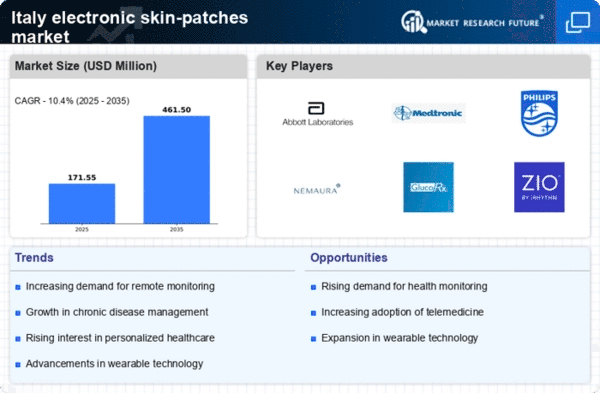
As per Market Research Future analysis, the Italy Electronic Skin Patches Market size was estimated at 155.39 USD Million in 2024. The Electronic Skin-patches market is projected to grow from 171.55 USD Million in 2025 to 461.5 USD Million by 2035, exhibiting a compound annual growth rate (CAGR) of 10% during the forecast period 2025 - 2035

Key Market Trends & Highlights

The Italy electronic skin-patches market is poised for growth driven by technological advancements and increasing consumer demand.

  • Technological advancements are enhancing the functionality and efficiency of electronic skin-patches in Italy.
  • The largest segment in the market is anticipated to be the healthcare sector, while the fastest-growing segment is likely to be the wellness and fitness sector.
  • Regulatory support is fostering innovation and adoption of electronic skin-patches across various applications.
  • Rising healthcare expenditure and an aging population are key drivers propelling the growth of the electronic skin-patches market in Italy.

Market Size & Forecast

2024 Market Size 155.39 (USD Million)
2035 Market Size 461.5 (USD Million)
CAGR (2025 - 2035) 10.4%

Major Players

Abbott (US), Medtronic (US), Philips (NL), Nemaura Medical (US), GlucoRx (GB), iRhythm Technologies (US), VitalConnect (US), Biotricity (US)

Our Impact
Enabled $4.3B Revenue Impact for Fortune 500 and Leading Multinationals
Partnering with 2000+ Global Organizations Each Year
30K+ Citations by Top-Tier Firms in the Industry

Italy Electronic Skin Patches Market Trends

The Italy Electronic Skin Patches Market is experiencing notable growth, driven by advancements in technology and increasing demand for wearable health monitoring devices. In Italy, the integration of these patches into healthcare systems appears to enhance patient monitoring and management. This trend is likely influenced by the rising prevalence of chronic diseases, which necessitates continuous health tracking. Furthermore, the Italian government has been supportive of innovations in healthcare technology, potentially fostering an environment conducive to the development and adoption of electronic skin-patches. Moreover, the market is characterized by a growing interest in personalized medicine. Consumers in Italy seem to favor solutions that cater to their specific health needs, which electronic skin-patches can provide. These devices offer real-time data collection and analysis, allowing for tailored health interventions. As the healthcare landscape evolves, the electronic skin-patches market may continue to expand, reflecting broader trends in digital health and patient-centric care. The future of this market appears promising, with ongoing research and development likely to yield even more sophisticated products that meet the demands of both healthcare providers and patients.

Technological Advancements

Recent innovations in materials and sensor technology are enhancing the functionality of electronic skin-patches. These advancements allow for improved accuracy in health monitoring, which is crucial for effective patient care. In Italy, research institutions are collaborating with industry players to develop next-generation patches that can monitor various health parameters seamlessly.

Regulatory Support

The Italian government is actively promoting the integration of digital health solutions within the healthcare system. This regulatory support is likely to facilitate the approval and adoption of electronic skin-patches, making them more accessible to healthcare providers and patients alike. Such initiatives may encourage investment in this sector.

Consumer Demand for Personalization

There is a growing trend among consumers in Italy for personalized healthcare solutions. Electronic skin-patches can provide tailored health insights, which align with the increasing preference for individualized treatment plans. This demand for customization is expected to drive further innovation and expansion within the electronic skin-patches market.

Italy Electronic Skin Patches Market Drivers

Aging Population

Italy's demographic shift towards an aging population significantly influences the electronic skin-patches market. With approximately 23% of the population aged 65 and older, there is a growing need for healthcare solutions that cater to chronic conditions prevalent in older adults. Electronic skin patches offer a non-invasive method for monitoring vital signs and managing health conditions, which is particularly appealing to this demographic. The demand for remote patient monitoring solutions is likely to increase, as elderly patients prefer to manage their health from home. This trend suggests that the electronic skin-patches market will expand as healthcare providers and patients alike recognize the benefits of these innovative technologies in improving quality of life and ensuring timely medical interventions.

Rising Healthcare Expenditure

The increasing healthcare expenditure in Italy is a pivotal driver for the electronic skin-patches market. As the Italian government allocates more funds towards healthcare innovation, the demand for advanced medical technologies, including electronic skin patches, is likely to rise. In 2025, healthcare spending in Italy is projected to reach approximately €200 billion, reflecting a growth of around 4% from previous years. This financial commitment to healthcare not only enhances the availability of innovative solutions but also encourages research and development in wearable health technologies. Consequently, the electronic skin-patches market is expected to benefit from this trend, as healthcare providers seek efficient and cost-effective monitoring solutions for patients, thereby driving market growth.

Growing Interest in Health and Wellness

The rising interest in health and wellness among the Italian population is a significant driver for the electronic skin-patches market. As consumers become more health-conscious, there is an increasing demand for wearable technologies that provide insights into personal health metrics. The trend towards fitness and wellness is evident, with a reported 40% of Italians actively seeking solutions to monitor their health. Electronic skin patches offer a convenient and user-friendly way to track vital signs, physical activity, and other health indicators. This growing consumer interest is likely to stimulate market growth, as manufacturers respond to the demand for innovative and personalized health monitoring solutions.

Technological Integration in Healthcare

The integration of advanced technologies in healthcare systems is a crucial driver for the electronic skin-patches market. In Italy, the adoption of digital health solutions, including telemedicine and wearable devices, is on the rise. The Italian Ministry of Health has been promoting initiatives to enhance digital health infrastructure, which facilitates the incorporation of electronic skin patches into routine healthcare practices. As of 2025, it is estimated that around 30% of healthcare providers in Italy will utilize wearable technologies for patient monitoring. This trend indicates a growing acceptance of electronic skin patches as essential tools for real-time health tracking, thereby propelling market growth and encouraging further innovation in the sector.

Increased Focus on Preventive Healthcare

The shift towards preventive healthcare in Italy is driving the electronic skin-patches market. As healthcare providers and patients increasingly prioritize prevention over treatment, the demand for continuous health monitoring solutions is likely to grow. Electronic skin patches enable users to track various health metrics, facilitating early detection of potential health issues. This proactive approach aligns with Italy's national health strategy, which emphasizes the importance of preventive measures. By 2025, it is anticipated that the preventive healthcare market in Italy will expand by approximately 5%, further boosting the adoption of electronic skin patches. This trend suggests that the market will continue to thrive as consumers seek innovative ways to maintain their health and well-being.


Market Segment Insights

By Application: Chronic Disease Management (Largest) vs. Health Monitoring (Fastest-Growing)

The Italy electronic skin-patches market displays a diverse application landscape where Chronic Disease Management holds a significant share, catering primarily to patients with various chronic conditions. Health Monitoring is catching up quickly, becoming increasingly popular among consumers looking to track their health metrics daily. This distribution reflects the changing focus towards preventive healthcare and personalized medicine, with both segments expected to play crucial roles in the market's future. Growth trends indicate that Health Monitoring is the fastest-growing segment, driven by advancements in technology and increasing consumer health awareness. The rising prevalence of lifestyle-related diseases and the demand for real-time health data are pushing innovation in this area. Chronic Disease Management remains dominant due to a critical need for ongoing care, enhanced by supportive government policies and reimbursement frameworks, but Health Monitoring is projected to see significant growth as wearable technology becomes more mainstream.

Chronic Disease Management (Dominant) vs. Health Monitoring (Emerging)

Chronic Disease Management is characterized by its robust presence in the Italy electronic skin-patches market, focusing on providing continuous care solutions for patients with persistent health conditions. These patches facilitate medication adherence and health monitoring, enhancing patient outcomes. The segment benefits from established healthcare practices and supportive infrastructure. In contrast, Health Monitoring represents an emerging trend where consumers increasingly rely on technology to track fitness and wellness metrics. This segment is attracting attention due to the growing interest in personal health management and the ability to access real-time data conveniently. As technology evolves, this segment is expected to experience rapid growth, driven by consumer demand and innovation in wearable devices.

By Technology: Flexible Sensors (Largest) vs. Wireless Communication (Fastest-Growing)

In the Italy electronic skin-patches market, Flexible Sensors hold the largest share, characterized by their adaptability and integration with various skin types. This segment has established itself as a cornerstone for monitoring physiological parameters, showing substantial uptake in healthcare applications. Meanwhile, Wireless Communication is emerging rapidly, tapping into the increasing demand for real-time data transmission, which is vital for telehealth solutions. This segment's growth is fueled by technological advancements in connectivity and the consumer shift towards remote monitoring systems. Looking at growth trends, the push for more convenient and efficient health monitoring solutions continues to drive the demand for these technologies. As the population ages and healthcare needs evolve, both segments are poised for expansion. Flexible Sensors are being enhanced with new materials to improve flexibility and comfort, while Wireless Communication is benefiting from innovations in low-power communication technologies, paving the way for smarter and more integrated skin-patch solutions.

Technology: Flexible Sensors (Dominant) vs. Wireless Communication (Emerging)

Flexible Sensors are a dominant force in the Italy electronic skin-patches market due to their versatility and ability to conform to the skin's surface, making them ideal for various applications such as health monitoring and diagnostics. These sensors are increasingly incorporated with advanced materials that enhance user comfort and accuracy in data collection. In contrast, Wireless Communication is an emerging segment, focusing on the capabilities of transmitting data seamlessly to external devices. This technology is key to enabling remote health monitoring, a growing trend fueled by technological advancements. Both segments are critical to the future of electronic skin-patches, with Flexible Sensors leading in market strength while Wireless Communication rapidly adapts to meet modern healthcare demands.

By End Use: Healthcare (Largest) vs. Sports (Fastest-Growing)

In the Italy electronic skin-patches market, the distribution of market share reveals that the healthcare segment holds the largest portion, driven by increasing adoption of remote patient monitoring and chronic disease management. Following closely, the sports segment is gaining traction, attributed to rising health consciousness and the integration of technology in athletic performance tracking. Both segments showcase unique characteristics that cater to distinct consumer needs. Growth trends in this sector are primarily influenced by advancements in technology and the growing demand for personalized health solutions. The healthcare segment benefits from regulatory support and a more established infrastructure, while the sports segment sees rapid growth due to increasing participation in fitness activities and advancements in wearable technology. This dual growth highlights the dynamic nature of end-use applications in the electronic skin-patches market.

Healthcare (Dominant) vs. Sports (Emerging)

The healthcare segment is characterized by its robust infrastructure and regulatory support, focusing on applications such as chronic disease management and continuous monitoring, making it the dominant player in the market. As consumers prioritize convenience and health tracking, this segment continuously innovates with solutions that provide real-time data and enhance patient outcomes. In contrast, the sports segment is an emerging player, drawing attention from fitness enthusiasts and athletes alike. With the increasing popularity of health and wellness activities, this segment focuses on developing patches that monitor vital signs and performance metrics in real-time, positioning itself as a crucial player as more individuals embrace an active lifestyle. Together, these segments reflect the diverse applications of electronic skin-patches, catering to a range of consumer needs.

By Sensor Type: Temperature Sensors (Largest) vs. Electrochemical Sensors (Fastest-Growing)

In the Italy electronic skin-patches market, the distribution among sensor types reveals that temperature sensors currently hold the largest market share, primarily due to their wide application in health monitoring and diagnostic processes. Electrochemical sensors, while smaller in share, are rapidly gaining traction as they cater to specialized needs in biochemical analysis and patient care, representing a significant shift in consumer preference towards more advanced technologies. Growth trends in this segment indicate a robust increase in the adoption of electrochemical sensors driven by innovations in wearable technology and the rising demand for real-time health monitoring solutions. Additionally, the aging population and a growing health-conscious consumer base in Italy are propelling both temperature and electrochemical sensors forward, with manufacturers focusing on enhanced accuracy and multifunctional capabilities to meet evolving market demands.

Temperature Sensors (Dominant) vs. Pressure Sensors (Emerging)

Temperature sensors have established themselves as a dominant force in the Italy electronic skin-patches market due to their reliability and ease of integration into various applications, such as fever detection and chronic disease management. These sensors are favored for their accuracy and continuous monitoring capabilities. On the other hand, pressure sensors are emerging in the market as they find applications in monitoring physiological parameters related to cardiovascular health and rehabilitation. While they currently represent a smaller segment, advancements in sensor technology and the integration of pressure sensors with other wearable devices are expected to enhance their market position, presenting new opportunities for growth and innovation.

Get more detailed insights about Italy Electronic Skin Patches Market

Key Players and Competitive Insights

The electronic skin-patches market in Italy is characterized by a dynamic competitive landscape, driven by technological advancements and increasing demand for remote health monitoring solutions. Key players such as Abbott (US), Medtronic (US), and Philips (NL) are at the forefront, each adopting distinct strategies to enhance their market presence. Abbott (US) focuses on innovation, particularly in glucose monitoring technologies, while Medtronic (US) emphasizes strategic partnerships to expand its product offerings. Philips (NL) is leveraging its expertise in digital health to integrate advanced analytics into its skin-patch solutions, thereby enhancing user experience and health outcomes. Collectively, these strategies contribute to a competitive environment that is increasingly centered around technological innovation and patient-centric solutions.
In terms of business tactics, companies are localizing manufacturing and optimizing supply chains to enhance efficiency and reduce costs. The market structure appears moderately fragmented, with several players vying for market share. However, the influence of major companies is significant, as they set industry standards and drive technological advancements. This competitive structure fosters an environment where smaller firms can innovate, but also face challenges in scaling their operations to compete effectively.
In October 2025, Abbott (US) announced the launch of a new continuous glucose monitoring system that integrates seamlessly with its existing skin-patch technology. This strategic move is likely to enhance patient adherence and provide real-time data to healthcare providers, thereby improving diabetes management. The introduction of this product underscores Abbott's commitment to innovation and its focus on addressing the needs of patients and healthcare professionals alike.
In September 2025, Medtronic (US) entered into a partnership with a leading telehealth provider to enhance its remote monitoring capabilities. This collaboration aims to integrate Medtronic's skin-patch technology with telehealth services, allowing for more comprehensive patient monitoring. The strategic importance of this partnership lies in its potential to expand Medtronic's market reach and improve patient outcomes through enhanced data sharing and real-time health insights.
In August 2025, Philips (NL) unveiled a new line of smart skin patches designed for chronic disease management, which utilize AI algorithms to analyze patient data. This development is indicative of Philips' strategy to incorporate advanced technology into its products, thereby positioning itself as a leader in the digital health space. The integration of AI not only enhances the functionality of the patches but also aligns with the growing trend towards personalized healthcare solutions.
As of November 2025, current trends in the electronic skin-patches market include a strong emphasis on digitalization, sustainability, and the integration of AI technologies. Strategic alliances are increasingly shaping the competitive landscape, enabling companies to pool resources and expertise to drive innovation. Looking ahead, it appears that competitive differentiation will evolve from traditional price-based competition to a focus on technological innovation, reliability of supply chains, and the ability to deliver personalized healthcare solutions. This shift suggests that companies that prioritize R&D and strategic partnerships will likely emerge as leaders in the market.

Key Companies in the Italy Electronic Skin Patches Market include

Industry Developments

The Italy Electronic Skin Patches Market has witnessed significant developments in 2023, driven by the increasing adoption of wearable health technologies. Notable companies like Xsensio, VitalConnect, and Abbott Laboratories are actively involved in advancing the functionality of electronic skin patches for health monitoring.

Reports suggest that there has been robust market growth, with investments in Research and Development aimed at enhancing sensor accuracy and expanding application areas into chronic condition management, including diabetes and cardiovascular diseases.

Current trends show emerging partnerships and collaborations aimed at integrating advanced technologies, such as Artificial Intelligence, within these devices, promoting better healthcare delivery. In terms of mergers and acquisitions, the market noted the acquisition of LifeSignals by Philips in July 2023, a move aimed at strengthening its portfolio in the wearable health solutions sector.

In recent years, significant market events also include the entry of STMicroelectronics into partnerships focusing on the development of innovative electronic skin patches, with announcements made in March 2022. The ongoing evolution of regulatory frameworks in Italy is contributing to a favorable environment for innovation in electronic skin patches, further driving growth in this cutting-edge healthcare market.

Future Outlook

Italy Electronic Skin Patches Market Future Outlook

The Electronic Skin Patches Market is projected to grow at a 10.4% CAGR from 2025 to 2035, driven by technological advancements, increasing healthcare demands, and rising consumer awareness.

New opportunities lie in:

  • Development of personalized health monitoring solutions for chronic disease management.
  • Integration of AI analytics for real-time health data interpretation.
  • Expansion into wearable fitness technology for enhanced user engagement.

By 2035, the market is expected to achieve substantial growth, positioning itself as a leader in innovative healthcare solutions.

Market Segmentation

Italy Electronic Skin Patches Market End Use Outlook

  • Healthcare
  • Sports
  • Wellness

Italy Electronic Skin Patches Market Technology Outlook

  • Flexible Sensors
  • Wireless Communication
  • Microelectronics

Italy Electronic Skin Patches Market Application Outlook

  • Chronic Disease Management
  • Health Monitoring
  • Fitness Tracking
  • Medication Delivery

Italy Electronic Skin Patches Market Sensor Type Outlook

  • Temperature Sensors
  • Electrochemical Sensors
  • Pressure Sensors

Report Scope

MARKET SIZE 2024 155.39(USD Million)
MARKET SIZE 2025 171.55(USD Million)
MARKET SIZE 2035 461.5(USD Million)
COMPOUND ANNUAL GROWTH RATE (CAGR) 10.4% (2025 - 2035)
REPORT COVERAGE Revenue Forecast, Competitive Landscape, Growth Factors, and Trends
BASE YEAR 2024
Market Forecast Period 2025 - 2035
Historical Data 2019 - 2024
Market Forecast Units USD Million
Key Companies Profiled Abbott (US), Medtronic (US), Philips (NL), Nemaura Medical (US), GlucoRx (GB), iRhythm Technologies (US), VitalConnect (US), Biotricity (US)
Segments Covered Application, Technology, End Use, Sensor Type
Key Market Opportunities Growing demand for remote health monitoring drives innovation in the electronic skin-patches market.
Key Market Dynamics Rising demand for wearable health monitoring drives innovation in electronic skin-patches within the Italian market.
Countries Covered Italy
Leave a Comment

FAQs

What is the expected market size of the Italy Electronic Skin Patches Market in 2024?

The Italy Electronic Skin Patches Market is expected to be valued at approximately 208.99 million USD in 2024.

What will be the projected market size of the Italy Electronic Skin Patches Market by 2035?

By 2035, the market is projected to reach a value of around 794.76 million USD.

What is the expected compound annual growth rate (CAGR) for the Italy Electronic Skin Patches Market from 2025 to 2035?

The market is expected to grow at a CAGR of 12.911% from 2025 to 2035.

Which segment of the market is expected to have the highest value in 2035?

The Stretchable Circuits segment is expected to reach a value of 200.0 million USD by 2035.

What are some of the key players in the Italy Electronic Skin Patches Market?

Major players in the market include Xsensio, Cardiomo, VitalConnect, Abbott Laboratories, and Medtronic, among others.

How much is the Stretchable Conductors segment valued at in 2024?

The Stretchable Conductors segment is valued at approximately 40.0 million USD in 2024.

What opportunities exist in the Italy Electronic Skin Patches Market?

The market shows potential growth opportunities due to increasing demand for wearable health technology and continuous monitoring solutions.

What challenges does the Italy Electronic Skin Patches Market face?

Challenges include technological advancements, regulatory compliance, and market competition among key players.

What is the revenue for the Electro-active Polymers segment in 2024?

The Electro-active Polymers segment is projected to generate around 45.0 million USD in revenue in 2024.

What is the anticipated market growth rate for the Italy Electronic Skin Patches Market?

The anticipated market growth rate from 2025 to 2035 is robust, reflecting the ongoing advancements in medical wearable technologies.

Download Free Sample

Kindly complete the form below to receive a free sample of this Report

Compare Licence

×
Features License Type
Single User Multiuser License Enterprise User
Price $4,950 $5,950 $7,250
Maximum User Access Limit 1 User Upto 10 Users Unrestricted Access Throughout the Organization
Free Customization
Direct Access to Analyst
Deliverable Format
Platform Access
Discount on Next Purchase 10% 15% 15%
Printable Versions